Dice games for 413 players sound impossible until you are the person holding the clipboard in a hall full of people with a crate of dice and an evening to fill. No single table seats 413 players, so stop thinking of one game and start thinking of one event built from many small games running at the same time. When every table plays the same game on the same clock, a crowd of 413 feels like a room full of small, noisy tables instead of one unmanageable mob.
The nine games below were picked for a crowd this size: each one can be taught in under a minute, each round lasts only a few minutes, and each result fits on one score sheet. Six of them turn familiar sports into dice games, so even players who have never touched a polyhedral die can follow along, while the last two use dice to pick what to act out or draw. Every game keeps its rules on a single printed card.
This guide gives you the table plan, dice counts, and round lengths you need to run the night, plus a comparison table, a setup checklist, and answers to the questions every host asks first. Read the scaling plan, pick three or four games, and let the tables rotate between them. With 413 players, the best plan is a simple one, repeated well.
Key takeaways
- Split 413 players into 59 tables of seven, and run the same game at every table on one shared clock.
- Choose games anyone can learn in under a minute, so the whole room starts together.
- Sports-themed dice games keep the room loud and competitive, while Dice Charades and Dice Pictionary give quieter tables a break.
- Bring one dice set per table, plus spare dice, score sheets, pens, and a rules card for every game.
- Keep rounds between ten and fifteen minutes, and move table winners to a new table after each round.

How Dice Games Scale to 413 Players
The first decision is the table plan, and 413 divides beautifully: 59 tables of seven covers every player. Seven is a good table size: everyone can see the dice, nobody waits long for a turn, and a single score sheet stays readable. If your venue has round tables that seat eight, use 51 tables of eight and one table of five, but seven keeps the games moving faster, so plan for seven wherever you can.
The second decision is the clock. Every table plays the same game at the same time, and the host calls each round over a microphone or loudspeaker. A round lasts ten to fifteen minutes, then the host calls time and tables record their scores. This shared clock turns 59 separate tables into one event. The same parallel-table idea powers the dice games for 411 players, where the room runs on one shared clock and a central scoreboard.
The third decision is the equipment: one dice set per table, plus a spare set for every ten tables, one score sheet and one pencil per table, a rules card for each game, and a visible leaderboard near the host table. Dice cups stop dice bouncing onto the floor, and a tray or shallow box on each table does the same job. Finally, appoint zone captains, one for every eight to ten tables, to answer rules questions, settle disputes, and report scores to the host.
Dice Games for 413 Players at a Glance
Use this table to pick your games at a glance. Every game below needs only standard dice, a score sheet, and a table, and every one works with groups of hundreds of people.
| Game | Dice needed | Players per table | Round length | Best for |
|---|---|---|---|---|
| Beat That! | 4 per table | 4 to 7 | 10 minutes | Big numbers, quick laughs |
| Dice Soccer | 2 per table | 6 to 7 | 15 minutes | Team rivalry |
| Dice Bowling | 2 per table | 2 to 7 | 15 minutes | Steady, relaxed play |
| Dice Golf | 1 per table | 2 to 7 | 10 minutes | Quiet, focused tables |
| Dice Darts | 2 per table | 2 to 7 | 15 minutes | Countdown tension |
| Dice Basketball | 1 per table | 6 to 7 | 10 minutes | Fast, loud rounds |
| Dice Tennis | 2 per table | 2 to 4 | 10 minutes | Pairs and duels |
| Dice Charades | 1 per table | 4 to 7 | 15 minutes | Acting and laughter |
| Dice Pictionary | 1 per table | 4 to 7 | 15 minutes | Drawing and guessing |
The 9 Best Dice Games for Huge Groups
Each game below includes the basic rules, the table size that works best, and one tip for running it with dozens of tables at once. Teach one game at a time, let every table play it, and only then move on.
1. Beat That!
Beat That! is the simplest number game on this list, and a perfect opener because the drama is instant. Each player rolls four dice, then arranges the four numbers to make the biggest number they can. A roll of 2, 6, 1 and 4 becomes 6,421, and the highest number at the table wins the round. If two players tie, they roll off with a single die until one of them wins.
For 413 players, Beat That! works because one set of four dice serves a whole table of seven, and a round takes about ten minutes. Players roll in turn while the rest of the table watches and calls out the best arrangement. Run it first, while late arrivals find their seats, and let each table winner move to a new table for the next game.
2. Dice Soccer
Dice Soccer turns a table into a football pitch. Draw a simple pitch on paper with five zones, and split the table into two teams of three, with the seventh player as referee. The team with the ball rolls two dice to move it forward, and rolling a double means a shot on goal. The defending team then rolls one die: five or six saves the shot, and anything lower means a goal.
For 413 players, Dice Soccer is the loudest game on this list, because every roll is a pass, a tackle, or a shot the whole table reacts to. A match lasts about fifteen minutes, first to three goals wins, and the referee keeps the score and settles arguments about which zone the ball is in.
3. Dice Bowling
Dice Bowling plays like ten-pin bowling without the heavy ball. Each player bowls ten frames, rolling two dice per frame and adding the total to knock down that many pins. Roll a ten on your first ball and it is a strike; clear all ten across two balls and it is a spare, with bonus points for the next ball. The score sheet looks exactly like a bowling scorecard, so anyone who has ever bowled will understand it at a glance.
For 413 players, Dice Bowling is the calm game in the middle of a loud evening: players take turns quietly while the rest of the table watches the score build. A full game takes about fifteen minutes at a table of seven, and one set of two dice is all it needs. Play it second or third, when the room needs a breather between noisier rounds.
4. Dice Golf
Dice Golf is a nine-hole round where the lowest score wins. Each hole is one roll of a single die, and the number showing is your strokes for that hole, with two twists: a one is a hole in one, and a six means your ball found the water, so you add two penalty strokes. Players write each hole on a small card, add up the nine holes, and the lowest total at the table wins. A round takes about ten minutes, and the whole game fits on a card the size of a postcard.
For 413 players, Dice Golf is the easiest game to run at scale: it needs one die per table and almost no supervision. Every player plays their own card at the same time, so nobody waits. Use it as a filler between bigger games, or as the quiet game for tables that want a rest from shouting.
5. Dice Darts
Dice Darts is a countdown game that builds tension with every roll. Each player starts at 301 points and takes turns rolling two dice, subtracting the total. The first player to reach exactly zero wins; a roll that would take you below zero is a bust, and your score stays where it was. A player sitting on twelve points needs a perfect roll, and the whole table watches the dice land.
For 413 players, Dice Darts works best in the second half of the evening, once tables have warmed up and the room is comfortable with quick maths. A round takes about fifteen minutes at a table of seven, and one scorekeeper per table keeps the countdown honest. Print 301 at the top of every score sheet, so nobody has to remember it.

6. Dice Basketball
Dice Basketball is a fast team game where every roll is a shot. Split the table into two teams of three, with the seventh player as referee. On each possession, the attacking team rolls one die: one or two is a missed shot, three or four is two points, five is a three-pointer, and six earns two free throws. For each free throw, roll again, and a four or higher scores. The first team to 21 points wins, and a game takes about ten minutes.
For 413 players, Dice Basketball is the best game for a short, high-energy round between longer games: the scoring is simple and the lead changes constantly. The referee calls each result out loud, so the whole table follows the score. Keep the games short and rotate the teams, so losing tables get fresh opponents.
7. Dice Tennis
Dice Tennis turns a table into a tennis court for two players, with the rest of the table watching and umpiring. One player serves by rolling two dice: seven or higher wins the point outright, four to six means the rally continues and the other player rolls, and three or lower is a double fault that hands the point away. Points follow real tennis scoring, and the first player to win two games takes the set.
For 413 players, Dice Tennis works as a pairs game inside a table of seven: two players play while the others umpire, keep score, and wait for their turn. A set takes about ten minutes, so a table can run two or three sets in one round. It is the best game here for players who enjoy a one-on-one duel, and it gives quieter guests a starring role.
8. Dice Charades
Dice Charades adds one small twist to the classic party game: the die picks the category. Split the table into two teams, and on your turn roll one die to choose what to act out. One means animals, two means movies, three means jobs, four means sports, five means food, and six is the acting player’s free choice. You have sixty seconds to mime the word while your team shouts guesses, and each correct guess earns a point. No talking, no pointing, and no spelling words in the air.
For 413 players, Dice Charades is the game that gets the whole room laughing, because the die keeps choosing categories nobody expected. A round takes about fifteen minutes at a table of seven, and one die is all a table needs. Give each team a stack of word cards per category, and keep the timer visible so all tables finish together.
9. Dice Pictionary
Dice Pictionary works exactly like Dice Charades, except the player draws instead of acting. Roll one die to pick the category, using the same six categories as charades, then draw the word while your team guesses against a sixty-second timer. Simple stick figures are fine, and the worse the drawing, the funnier the round. Letters and numbers are not allowed, and neither is pointing at anything in the room.
For 413 players, Dice Pictionary is the perfect closing game: creative and gentle, and easy to run while the host totals the scores. A round takes about fifteen minutes, and each table needs one die, a pad of paper, and a thick marker. Pin the best drawings to the leaderboard board at the end of the night, because the room will love seeing them.
Setting Up the Room for 413 Players
Arrive early and lay out the room before the players arrive. Place 59 tables of seven in rows with a clear aisle down the middle, so zone captains can reach every table quickly, and put the host table at the front with the leaderboard, timer, and spare dice. Test the microphone before the doors open: a host who cannot be heard cannot run a shared clock. If you want a wider mix for the night, the party games for 410 players pair well with this dice list and use the same table plan.
Hand each table a kit as players sit down: one dice set, a score sheet, a pen, a rules card, and a small tray for the dice. Brief the zone captains for five minutes before the doors open, and give each captain a printed schedule with the game order and round lengths. Start with Beat That! while late arrivals find their seats, move through the louder games, and finish with Dice Pictionary while you total the scores.
Your 413-Player Dice Night Checklist
- 59 tables seating seven, plus a host table at the front with a clear view of the room.
- One dice set per table, plus a spare set for every ten tables and extras at the host table.
- One score sheet and one pen per table, plus printed rules cards for every game.
- A large visible timer and a tested microphone or loudspeaker so every table hears the calls.
- A central leaderboard near the host table, updated after each round so the room can follow the leaders.
- One captain for every eight to ten tables, briefed before the doors open and carrying the schedule.
Frequently Asked Questions
Can 413 people really play dice games at the same time?
Yes, as long as you think of 59 small games running at the same time rather than one game. Every game here breaks cleanly into tables of seven, and when all 59 tables play the same game on one shared clock, the whole room starts and finishes together. The host runs the clock, the zone captains run their tables, and the players just play.
How many dice sets do we need for 413 players?
One dice set per table is enough for most games here: 59 sets, plus a spare set for every ten tables, about 65 sets in total. Most games need only one or two dice per table. Beat That! needs four dice per table, and Dice Soccer and Dice Tennis need two, but no game asks every player to hold their own set.
Which game should we start with?
Start with Beat That!, because it takes thirty seconds to explain and the whole table can see every number. It settles the room and gives late arrivals a game they can join without missing any rules. Save Dice Charades and Dice Pictionary for later, when the room is relaxed and ready to be silly. A trivia round also works as a breather, and the trivia games for 411 players show how to run one for a hall this size.
How long does a full evening take?
Plan for about two hours of play, plus time for arrivals and prize-giving. Three or four games at ten to fifteen minutes each, with a few minutes between rounds for scoring and rotating, fills an evening comfortably. Add thirty minutes at the start for seating and a welcome, and fifteen minutes at the end for final scores and prizes.
Do we need special dice for these games?
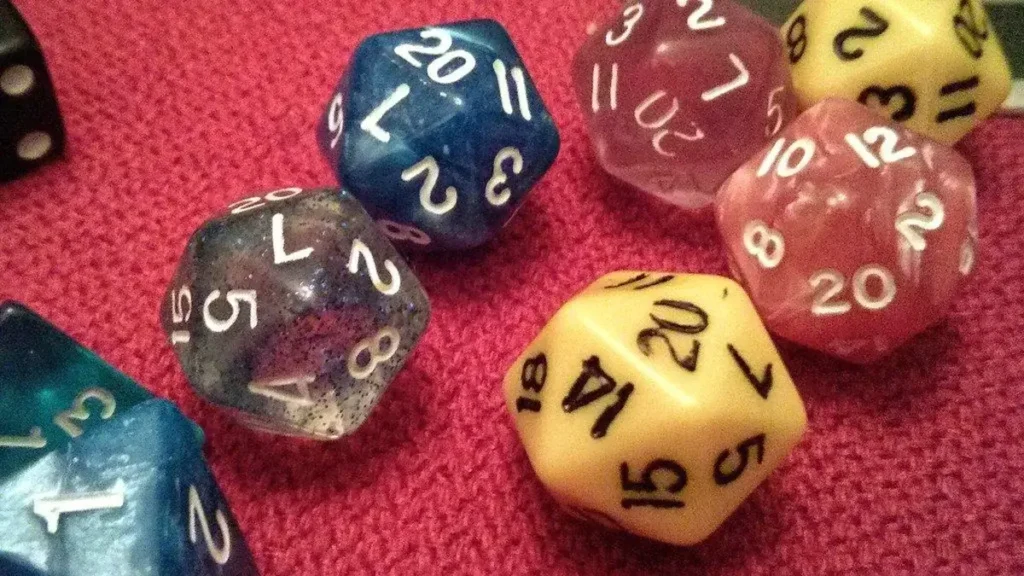
No, every game here uses ordinary six-sided dice, which are cheap in bulk and easy to replace. The featured photo shows twenty-sided dice from tabletop role-playing games, fun to have on the host table as decoration, but none of the nine games needs them. Buy standard dice in bulk bags, and keep spares at the host table for the ones that roll under furniture.
What if a table disagrees about a score?
The zone captain makes a quick call and play moves on: a five-minute argument ruins the round for the whole table. Print the scoring rules on the rules card, give one player at each table the job of scorekeeper, and ask the captain to settle anything the scorekeeper cannot. If a table is still unhappy, the host can award both sides the points.
The Bottom Line
Dice games for 413 players work when you keep the games simple, the rounds short, and the clock shared across all 59 tables. Pick three or four games from this list, print the rules cards, brief your captains, and let the room do the rest. The dice are cheap, the rules fit on one card, and the best moments will be the groans, the cheers, and the table that wins on the very last roll.