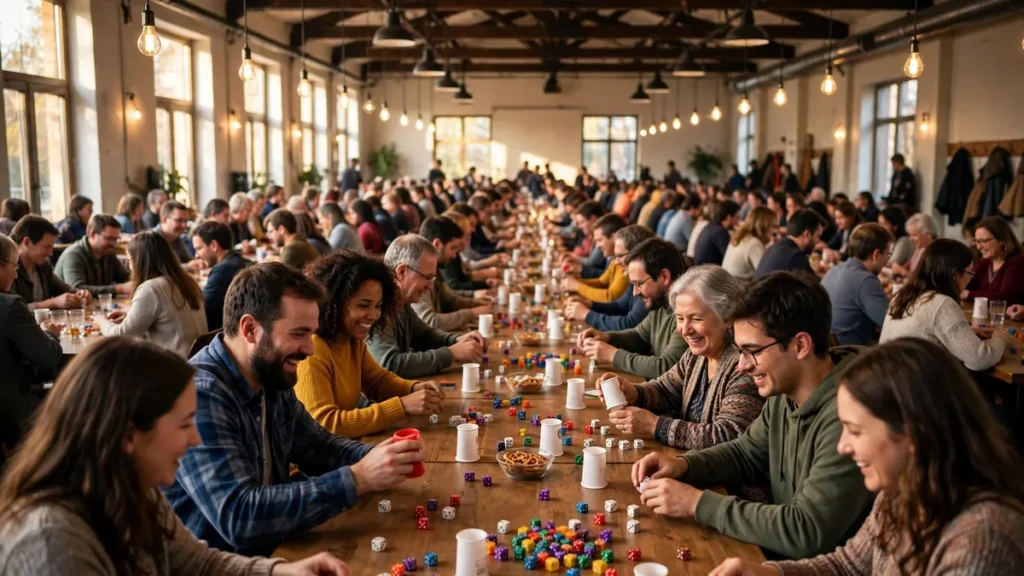
The best dice games for 324 players are the ones that keep hundreds of people rolling, laughing, and scoring at the same time, without long waits, complicated rules, or expensive equipment. A group this large is not a normal game night. It is a hall full of tables, a crowd that needs clear instructions, and an event where every player should feel involved from the first roll to the final score. Dice are perfect for that job because they are cheap, portable, easy to explain, and exciting to watch. One roll can change a table, and one table result can change the whole room.
Planning dice games for 324 players sounds difficult, but it becomes simple once you stop thinking of one giant game and start thinking of many small games running side by side. Split the room into tables of six, eight, or twelve players, give each table the same game and the same instructions, and let every table play at the same pace. A host calls the rounds, tables compare scores, and the best players move forward to a final. That structure works for school events, company parties, community nights, church gatherings, family reunions, and large celebrations where people of different ages and abilities all want to join in.
This guide brings together the strongest choices for a crowd of 324, with practical advice on dice, tables, scoring, timing, and prizes. You will find fast warm-up games, team games, quiet strategy games, and loud party games, plus a clear plan for running them all in one evening. Every game here can be played with ordinary six-sided dice, simple score sheets, and rules that can be explained in under two minutes. Pick two or three for your event, set up your tables, and let the dice do the work.
Key takeaways
- Split 324 players into tables of six to twelve so everyone rolls often and nobody waits long for a turn.
- Choose games with rules that can be explained in under two minutes and learned in one practice round.
- Use at least five dice per player, plus spare sets, score sheets, pencils, and a clear scoring chart at every table.
- Run the same game at every table at the same time, with a host calling rounds and collecting table winners.
- Mix one fast party game, one team game, and one calmer scoring game so every kind of player has a favourite.
Why Dice Games Work So Well for 324 Players
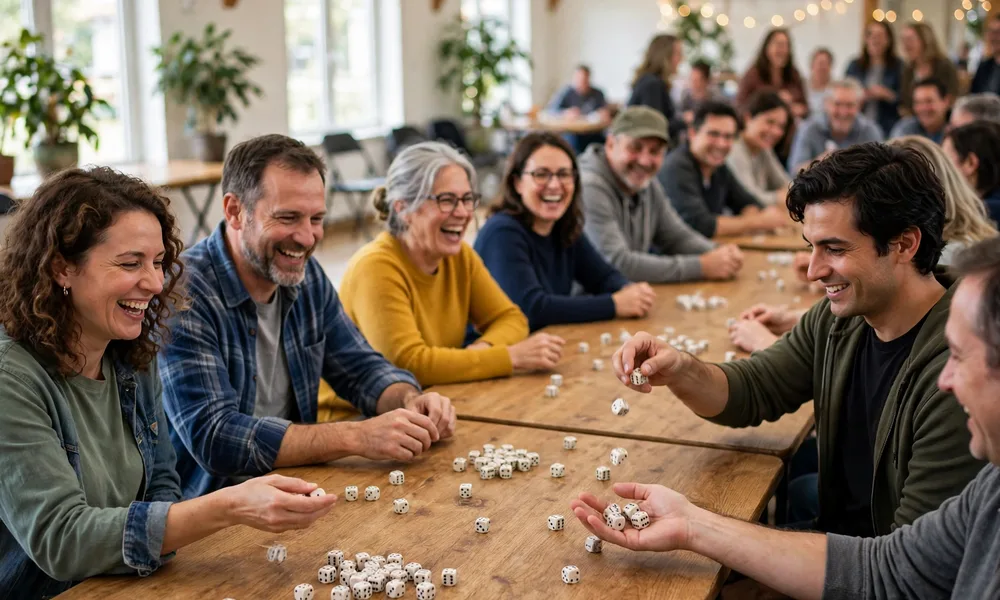
Dice games scale better than almost any other kind of party game. A board game needs one board per table and often takes an hour to finish. A card game needs a full deck per table and careful dealing. A dice game needs only a handful of dice, a pencil, and a score sheet, and a round can be finished in ten minutes. That speed matters when you have 324 people to entertain, because slow games create queues, boredom, and players who drift away from their tables.
Dice also level the playing field. A child can beat an adult on a lucky roll, a first-time player can beat a regular player, and a quiet player can win without speaking in front of the room. That fairness keeps large mixed groups happy. Nobody needs to know a long list of rules, remember cards, or study a strategy guide. They need to roll, add, and decide. The best dice games for 324 players use that simplicity on purpose, then add small choices that keep skilled players interested too.
How to Organise Dice Games for 324 Players
Good organisation turns a huge crowd into a smooth event. The most common mistake is letting each table play a different game at a different speed, which leaves some tables finished while others are still on round one. The fix is simple: one game at a time, one host, one clock. Every table starts together, plays the same number of rounds, and stops together. The host announces the round, gives a one-minute warning, and collects the table winners before the next game begins.
Set Up Tables of Six to Twelve Players
Tables of six to twelve players give the best balance of speed and social fun. Six players means fast turns and plenty of rolls each. Twelve players means a livelier table and more cheering, but turns take longer. For 324 players, tables of nine work neatly, giving you 36 tables. Tables of six give you 54 tables, which needs more space and more table hosts, but keeps the pace brisk. Choose the size that fits your hall, then keep every table the same size so no table feels short-changed.
Place a printed rule card, a score sheet for each player, pencils, and a dice tray or a shallow box at the centre of every table. A tray stops dice from rolling onto the floor and keeps the game moving. Assign one table host per table, or one host for every two tables if helpers are short. The table host reads the rules aloud, watches the scoring, and sends the table winner to the host desk at the end of the game.
Work Out How Many Dice You Need
Count dice before the event, not during it. Most games in this guide use five dice per player, so a table of nine needs 45 dice plus spares. Across 36 tables, that is more than 1,600 dice. That sounds like a lot, but bulk dice are sold in large bags, and you can also ask players to bring a set each. A safer plan is to run games that share dice: in many party dice games, players take turns with one shared set of five dice per table, so you need only five dice per table plus spares. Check the dice count for each game in the table below before you buy.
Buy dice in two colours per table if you can, so each player can spot their own dice quickly. Keep a spare bag at the host desk for lost or damaged dice. Count the dice back in at the end of each game, because dice walk away in pockets and bags. A quick count takes thirty seconds and saves you from starting the next game short.
Keep Scoring Simple and Visible
Scoring should be visible, simple, and hard to argue about. Use a large scoring chart on a wall or a printed chart at every table. Award points for each round, write the total clearly, and have the table host check the sheet before it goes to the host desk. For team games, give each team a coloured score card so the host can see the leaders at a glance. Avoid games that need a calculator or a long scoring table when you have 324 players, because scoring delays are the biggest cause of a slow evening.
Decide your prizes before the event. Small prizes for table winners and one larger prize for the overall winner work well. Certificates, fun titles, and small gift bags keep the mood friendly. Avoid one huge prize that makes the final feel tense. The best large-group events celebrate lots of small wins, so more people leave feeling like winners.
Best Dice Games for 324 Players at a Glance
The table below compares the strongest games for a crowd of this size. Use it to pick your line-up, then read the full game guides below for rules, timing, and tips.
| Game | Players per table | Dice per table | Time per game | Best for |
|---|---|---|---|---|
| Bunco | 12 | 9 | 30 minutes | Loud party nights |
| Farkle | 6 to 8 | 6 | 20 minutes | Risk and scoring |
| Yahtzee-style roll and score | 6 to 8 | 5 | 25 minutes | Classic scoring |
| Left Centre Right | 8 to 12 | 3 | 15 minutes | Fast warm-ups |
| Ten Thousand | 6 to 8 | 6 | 20 minutes | Push-your-luck play |
| Dice Bingo | 9 to 12 | 2 | 20 minutes | All ages together |
| Roll and Race | 6 to 9 | 2 | 15 minutes | Teams and relays |
| Highest Roll Knockout | 8 to 12 | 2 | 10 minutes | Quick finals |
The Best Dice Games for 324 Players
1. Bunco
Bunco is the classic large-group dice game, and it was made for crowds like this. Players sit in groups, roll three dice, and try to match the target number for the round. The head table rings a bell to start and stop each round, winners move up a table, and losers move down. That movement mixes the players, so everyone meets new people during the evening. With 324 players, Bunco feels like a party from the first roll, because the whole room is rolling at the same time.
2. Farkle
Farkle is a push-your-luck dice game that works beautifully at tables of six to eight. Each player rolls six dice, sets aside scoring dice, and decides whether to bank the points or roll again for more. Rolling with no scoring dice is a Farkle, and the player loses the points from that turn. That simple risk creates real tension, and tables get loud when a player is one roll away from a big score or a total loss.
3. Yahtzee-Style Roll and Score
A Yahtzee-style roll and score game gives your event a familiar classic that almost everyone already knows. Each player rolls five dice up to three times per turn, trying to fill a scorecard with categories like three of a kind, full house, small straight, large straight, and five of a kind. The categories reward planning, because a player must decide whether to chase a big category or take a safe score. If you are looking for a calmer game to balance a loud party game, this is the right pick, and the best dice games for 323 players guide uses the same style of scoring for a crowd just one player smaller.
Print a simple scorecard for every player, with the categories listed in order and space for the total. Play one full card per game, which takes about twenty-five minutes at a table of six to eight. The table host checks each card before it is handed in, because adding mistakes are the most common problem. Award a small prize for the highest card at each table, and keep the top cards for a final comparison if you want an overall winner.
4. Left Centre Right
Left Centre Right, often called LCR, is the fastest warm-up game in this guide. Each player starts with three chips or tokens. On a turn, a player rolls up to three dice marked with L, C, R, and dots. An L passes a chip left, an R passes a chip right, a C puts a chip in the centre pot, and a dot means the player keeps the chip. Players with no chips are out until someone passes them a chip. The last player holding chips wins the table.
LCR needs only three dice and a few chips per table, so it is cheap to run for 324 players. A game lasts about fifteen minutes, which makes it perfect as an opening game while latecomers arrive and find their tables. It also works as a quick tie-breaker between rounds. Use poker chips, coins, or wrapped sweets as tokens, and keep the centre pot visible so the table can see the prize growing.
5. Ten Thousand
Ten Thousand, also known as Zilch, is another push-your-luck game, but it plays faster than Farkle and uses simpler scoring. Players roll six dice, score ones, fives, and sets, and choose whether to keep rolling. The first player to 10,000 points wins, but in a large event it is better to play a fixed number of rounds and take the highest score. That keeps every table on the same clock and stops one slow table from holding up the room.
6. Dice Bingo
Dice Bingo brings the whole room together in a calm, inclusive game that suits all ages. Each player has a bingo card with numbers from two to twelve. The host rolls two large dice at the front of the room, calls the total, and every player marks that number if it appears on their card. The first player at each table to complete a line calls out, and the host checks the card. The game works just as well for children, older players, and anyone who prefers a quieter game, and a similar shared-roll format is described in the best dice games for 322 players guide.
7. Roll and Race
Roll and Race is a team dice game that adds movement and cheering to your evening. Split each table into two teams. Teams take turns rolling two dice and moving a marker along a track printed on a sheet, with special squares that send a team forward, back, or to a challenge. The first team to reach the finish wins the table. The track keeps the game visual, so even players waiting for their turn stay involved.
8. Highest Roll Knockout
Highest Roll Knockout is the perfect final game for 324 players. Every player rolls two dice at the same time. The lowest rollers at each table are knocked out, and the rest roll again. After several rounds, each table has one winner, and the table winners gather at the front for a grand final in front of the whole room. The crowd loves a final like this, because everyone can watch, cheer, and see the winner decided by a single roll.
Run the knockout in rounds of about two minutes each, with the host calling every roll. Keep the rules strict: dice must land in the tray, a die that falls off the table is re-rolled, and ties roll again. The grand final takes about ten minutes, including the presentation of the prize. It is a simple, dramatic way to end the evening, and the best dice games for 321 players guide uses the same knockout finish for a crowd of a similar size.
Checklist for Your 324-Player Dice Games Night
- Count and pack all dice, with at least ten percent spares, and sort them into labelled bags per table.
- Print rule cards, score sheets, bingo cards, and scoring charts, with extra copies for mistakes.
- Set tables of six to twelve players, with a dice tray, pencils, and a table number at each table.
- Brief table hosts on the rules, the scoring, and how to send winners to the host desk.
- Prepare prizes for table winners, an overall winner, and a few fun awards for the best team spirit.
- Test the microphone, the timer, and the bell or signal for starting and stopping rounds before players arrive.
Frequently Asked Questions
How many dice do I need for 324 players?
It depends on the game. Shared-dice games like Left Centre Right and Dice Bingo need only two or three dice per table, so about 100 dice cover the room. Games where every player rolls their own set, like Farkle, need five or six dice per player, which is more than 1,600 dice. For most events, choose shared-dice games for the main programme and keep individual-dice games for smaller tables.
What is the best first game for a crowd of 324?
Left Centre Right is the best first game. It takes one minute to explain, needs only three dice per table, and finishes in fifteen minutes. It warms up the room, teaches players to listen for the host, and gives latecomers time to find their tables without missing a long game.
Can children play these dice games?
Yes. Dice Bingo, Left Centre Right, and Roll and Race are all suitable for children, and Bunco works well for older children who can add small numbers. For mixed-age tables, choose games with simple adding and no complex scoring, and pair younger players with an adult at the same table.
How long should a dice games night for 324 players last?
About two hours works well. That gives you time for a welcome, four games, a short break, a knockout final, and prizes. Longer evenings tire players and make scoring mistakes more likely. If you want a longer event, add a social break with food rather than adding another long game.
Do I need a special venue for 324 players?
You need a hall with enough tables and chairs for 324 people, good lighting, and space between tables so hosts can walk around. A community hall, school hall, or large function room works well. Check the table layout the day before, and leave a clear space at the front for the host and the grand final.
What prizes work best for a large dice games night?
Small, fun prizes work best. Gift bags, vouchers, books, games, and certificates all suit a large group. Give a prize to every table winner, a larger prize to the overall winner, and a fun award for the loudest table or the best team spirit. Avoid one very large prize, because it can make the final feel too serious.
Bottom Line
The best dice games for 324 players are Bunco, Farkle, a Yahtzee-style roll and score game, Left Centre Right, Ten Thousand, Dice Bingo, Roll and Race, and Highest Roll Knockout. Together they cover fast warm-ups, team play, calm scoring, and a dramatic final, and they all run on ordinary dice, simple score sheets, and rules anyone can learn in minutes. Split the room into even tables, run one game at a time with a clear host, keep scoring simple, and finish with a knockout final in front of the whole room. Do that, and 324 players will leave with full score sheets, new friends at their table, and a night they want to repeat.