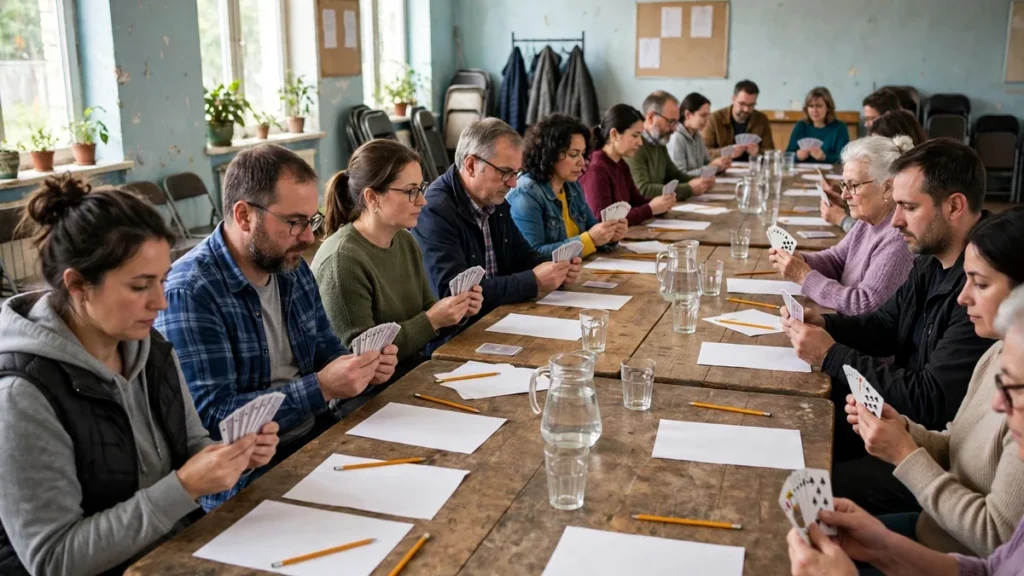
544 players sounds like a crowd that no card evening could fit. In practice it is a hall full of small tables, each one running its own short round, with a host who keeps every table moving on the same signal. Nobody waits long, nobody watches from the side, and every player gets a hand in every round. The size is the fun of it: the hall hums, the tables turn over, and the score sheets fill up fast.
The nine games below were picked because they travel well. Each one works at a small table, needs only plain packs and paper, and can be taught in about two minutes. Some are shedding games, some are trick-taking games, and two are one-player games run as parallel contests. Together they give a hall of 544 players a full day of play without a single table standing idle.
What follows is a plain plan: how the hall is arranged, the nine games in order, a table that sums up each game, and a short list of things to have ready before the doors open. Every game is scored with points only, explicitly not for money, and every round ends with a clear result that the host can read out.
Key takeaways
- 544 players fit into one hall as 68 tables of 8, with each table running short rounds on a shared signal.
- Nine games span shedding, trick-taking, melding, and one-player contests, so every table has a different feel.
- Plain packs, paper score sheets, and pencils are the whole kit list; no special equipment is needed.
- Tables rotate after each round, so players meet different opponents through the day.
- All scoring is points-only, with a single top scorer named at the end of the day.

How 544 players fit into one day
The arithmetic is simple. With 68 tables and 8 players at each table, the hall holds 544 players at once. Each table runs one game at a time, and the host gives a signal every 20 minutes. When the signal sounds, tables finish the hand in progress, write down the scores, and move to the next game on the list. Nobody needs to learn nine games at once: each table learns one game, plays it for two rounds, and then moves on.
Tables are numbered, and each table has a plain card with its number and the order of games for the day. A caller walks the hall with a raised hand and a short spoken count, so that every table hears the change at the same moment. The host keeps a master sheet with the score from each table, and the scores are added up at the end of the day. The whole day runs in about five hours, with a break in the middle for food and rest.
The nine games
The 540-player card games show how a long hall can fit dozens of tables at once, and the nine games below follow that pattern. Each game is described in two short parts: what the game asks players to do, and how it runs at a table of 544 players in one hall.
1. Daihinmin
Daihinmin is a Japanese shedding game in which the aim is to empty your hand before anyone else at the table. Players lay down single cards or matching groups in rising order, and anyone who cannot beat the card on the table passes until the round resets. A wild card sits above every other card, and a reversal turns the order upside down when a certain combination appears.
At a table of eight, Daihinmin moves fast and rewards a cool head. The host deals from two packs shuffled together, and each round takes about ten minutes. The first player to shed every card earns the most points, and the rest of the table earns points in the order they finish. Two rounds are enough for every player to learn the rhythm.
2. Dou Dizhu
Dou Dizhu is a Chinese game for three players, with one player taking the role of landlord against a duo of farmers. The landlord bids for the role, takes three extra cards, and then plays alone against the other two, who work together as a team. The landlord takes the round by shedding every card first; the farmers take it by stopping the landlord from doing so.
In a hall of 544, Dou Dizhu runs as a three-player game at tables of six, with two games side by side. Each table needs only one pack, and the bidding takes less than a minute once players know the pattern. The teamwork makes it a good early game: the duo must talk through each hand without showing their cards.
3. Sheng Ji
Sheng Ji is a Chinese trick-taking game in which duos work together to take tricks and climb a ladder of ranks. A strong suit is named at the start of each hand, and consecutive duos in that suit can beat single cards and smaller duos. The side that takes the most tricks moves up the ladder, and the side that falls behind stays where it is.
Sheng Ji suits a table of four, with two duos facing each other. In the hall it runs as 136 tables of four, which is the neatest fit for the game. Each hand takes about fifteen minutes, and the ladder gives every table a running story through the day. The host reads out the leading tables after each round.
4. Gong Zhu
Gong Zhu is a Chinese trick-taking game in which certain cards carry negative points, and the aim is to avoid taking them. Players follow suit when they can, and the table watches the dangerous cards move around the table. The player who takes the fewest negative points at the end of a hand earns the most points for that round.
At a table of four, Gong Zhu is quiet and tense, which makes it a good contrast after the noise of Daihinmin. The host deals one pack per table, and each hand takes about twelve minutes. Because the scoring is negative, the host explains the points before the first hand, so that nobody is surprised by the result.
5. Mariage
Mariage is a two-player melding game from Austria in which the two top face cards of one suit form a meld worth points. Players take turns laying down cards, and the melds are declared as they appear. The first side to reach the points target takes the round, and a fresh hand starts at once.
In the hall, Mariage runs as four two-player games at each table of eight, with the four games sharing one host. Each game takes about eight minutes, so the table can fit two rounds into one slot. It is the quickest game on the list, and it works well as a warm-up while the hall fills.

6. Baker’s Dozen
Baker’s Dozen is a one-player game in which thirteen columns of four cards are laid out face up, and the aim is to build each suit in order on four foundation piles. Cards move down in suit order, and the top face cards move into empty columns. It is a slow, thoughtful game that rewards patience and a clear eye.
As a hall game, Baker’s Dozen runs as a parallel contest: every player at a table lays out the same shuffled pack and plays alone, and the table compares results after ten minutes. The player with the most cards moved to the foundations earns the most points. It gives quiet players a moment of calm in a loud hall.
7. Fortress
Fortress is a one-player game in which ten columns of cards are arranged in a square, and the aim is to move every card to four foundation piles in suit order. Cards move up and down in suit order, and empty columns take only the highest cards. It is harder than it looks, and most hands end with a few cards still on the table.
In the hall, Fortress runs the same way as Baker’s Dozen: every player plays the same pack alone, and the table compares results after ten minutes. The shared pack keeps the contest fair, and the host can read out the best result in the hall. It is a good game for the middle of the day, when players want a change of pace.
8. Panguingue
Panguingue is a melding game from the American Southwest in which players form runs and groups from a hand of cards, using several packs shuffled together. A player draws a card, lays down a meld when possible, and discards one card to end the turn. The hand ends when one player lays down every card, and the rest of the table scores what is left in hand.
Panguingue needs more packs than any other game on the list, which is why it suits a big hall: the host can supply eight packs per table without running short. At a table of six, each hand takes about twenty minutes, so the host gives it a double slot. The many packs make the game feel generous and busy.
9. Gaps
Gaps is a one-player game in which four rows of thirteen cards are laid out, with the four lowest cards of each suit taken out to leave four empty spaces. A card moves into a space when it follows the card to its left in the same suit, and the aim is to arrange every row in order from lowest to highest. It is a puzzle as much as a card game, and it rewards careful planning.
In the hall, Gaps runs as a parallel contest like the other one-player games: every player gets the same pack, and the table compares rows after ten minutes. The player with the longest unbroken run in order earns the most points. It closes the day well, because it is calm, fair, and easy to score.
The nine games at a glance
| Game | Players at one table | Why it works for 544 |
|---|---|---|
| Daihinmin | 8 | Fast shedding rounds that fill a table exactly |
| Dou Dizhu | 6 | Two three-player games side by side at one table |
| Sheng Ji | 4 | Duos against duos, with a ladder that runs all day |
| Gong Zhu | 4 | Quiet tension that balances the louder games |
| Mariage | 8 | Four quick two-player games sharing one table |
| Baker’s Dozen | 8 | Parallel one-player contest with a shared pack |
| Fortress | 8 | Parallel one-player contest, fair and easy to score |
| Panguingue | 6 | Many packs per table, generous and busy |
| Gaps | 8 | Calm closing contest with a clear result |
Running the hall
The card games for 542 players use the same station rhythm, with tables turning over on a fixed signal, and that rhythm is the model here. The host opens the day by walking the hall, dealing a practice hand at each table, and answering questions before the first scored round. A practice hand takes five minutes and saves twenty minutes of confusion later.
Scoring stays simple through the day. Each table writes its scores on a plain sheet, and one player at each table reads the sheet aloud before handing it in. The host adds the sheets to a master list and reads out the leading tables after every other round. At the end of the day, the host names a single top scorer for the hall, and every table keeps its own sheets as a record of the day.
Checklist
- 68 tables, each with 8 chairs and a number card on the table.
- 140 packs of plain cards, with 20 extra packs held in reserve for worn packs.
- Plain paper score sheets and pencils, one sheet per table per round.
- A host and two helpers who walk the hall and answer questions.
- A rotation board at the front of the hall showing the order of games.
- Water and a break in the middle of the day, with food available nearby.
Frequently asked questions
How do 544 players fit in one hall?
They fit as 68 tables of 8 players, with each table running its own game on a shared signal. The 538-player card evening by a riverside boathouse ran the same way, with duos moving between tables after each round. The hall needs enough floor space for chairs to pull out, and a clear aisle down the middle for the host.
How many packs do we need?
About 140 packs, with 20 extra packs held in reserve. Most games need one pack per table, Daihinmin needs two, and Panguingue needs eight. The host counts the packs before the doors open and again at the break, so that no table runs short in the afternoon.
How long does the day run?
About five hours, with a break in the middle. Each round runs for about 20 minutes, and the nine games fill nine slots. The practice hand at the start takes five minutes, and the final scores take ten minutes to add up and read out.
What if a table finishes early?
The table plays another short hand of the same game while it waits for the signal. The extra hand is not scored, and the players use it to try a different approach. The host asks tables to stay seated until the signal, so that the hall moves together.
Can beginners join in?
Yes. Every game on the list can be taught in about two minutes, and each table has a plain card with the guidelines for the game in progress. The host deals a practice hand at the start of the day, and the helpers walk the hall to answer questions during the first two rounds.
How do we decide the top scorer?
Each table hands in a plain score sheet after every round, and the host adds the sheets to a master list. Points from all nine games count equally, and the player with the highest total at the end of the day is named the top scorer. Equal totals are broken by the best single-round score.
The Bottom Line
Card games for 544 players work when the hall is arranged as many small tables, the games are short and plain, and every table moves on the same signal. Daihinmin, Dou Dizhu, Sheng Ji, Gong Zhu, Mariage, Baker’s Dozen, Fortress, Panguingue, and Gaps give the day variety without confusion, and points-only scoring keeps the focus on play. Bring enough packs, keep the rounds short, and let the hall do the rest.