Finding the best card games for 46 players takes a different kind of planning than picking a game for a quiet evening with four friends. At this size, you are not really seating one group around one table. You are running a small event, and the games that work best are the ones that split naturally into tables, keep everyone involved at the same time, and let players rotate, compete, and cheer each other on without long waits between turns.
The good news is that card games are one of the easiest forms of entertainment to scale. A standard deck costs very little, the rules of the best large-group games can be explained in two minutes, and most of the games on this list work with two or more decks shuffled together. With six to eight tables of six to eight players each, a group of 46 can play the same game at the same time, compare scores between tables, and crown an overall winner at the end of the night.
This guide covers the card games that genuinely work for 46 players, the exact setup you need for each one, and a simple tournament format that keeps a huge group moving.
Key takeaways
- No single-table card game seats 46 people, so the best card games for 46 players use six to eight tables of six to eight players, with everyone playing the same game at the same time.
- Bluffing and shedding games such as Cheat, President, and Spoons scale best, because their rules stay simple even when the group is huge.
- Plan on at least six standard decks, and bring ten so you can run two games side by side or replace a worn deck without stopping play.
- A simple rotation or points tournament keeps all 46 players involved and produces a clear overall winner by the end of the night.
- Choose games that match your group, because fast party games suit mixed-age crowds while partnership games such as Canasta suit players who enjoy strategy.

How Card Games Work With 46 Players
A group of 46 players changes the shape of game night in three ways. First, nobody can see every card or hear every player, so the game must work in smaller units. Second, turns must move quickly, because a slow game with 46 people in a single circle would leave each player waiting several minutes between moves. Third, the social side matters as much as the game itself, because people at a 46-person event want to talk, laugh, and meet new people as well as play.
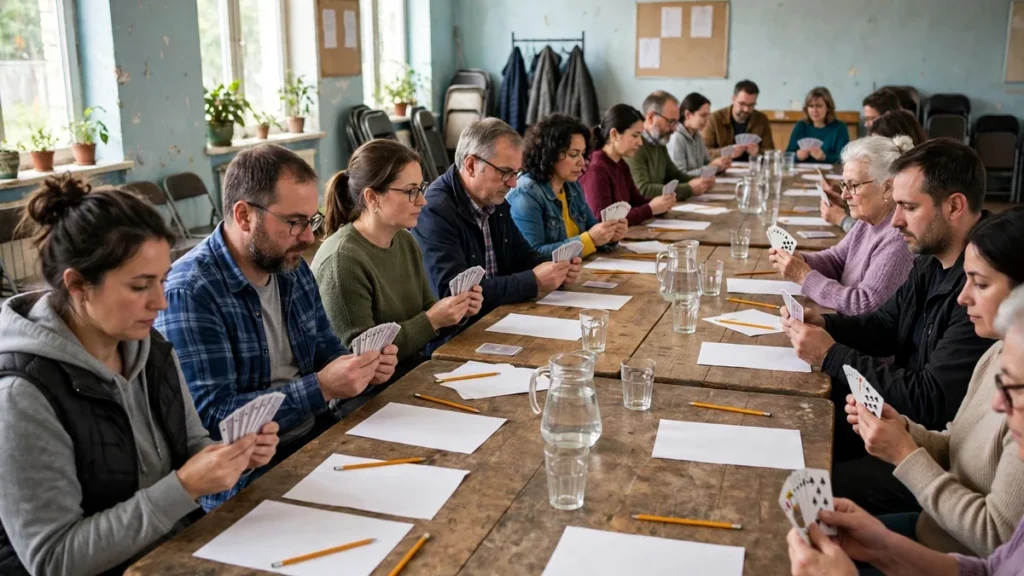
The solution used by schools, clubs, churches, and large family gatherings is the multi-table format. You divide 46 players into six tables of seven or eight, or seven tables of six or seven, and every table plays the same game with the same rules. A host keeps time, announces when a round ends, and records the winner from each table. After each round, winners can move to a new table, or tables can stay put while scores are added up. Either way, everyone plays at once and nobody sits out for long.
This format also makes it easy to adjust for your group. If your 46 players include children, choose a simple game such as Spoons or Uno and keep the rounds short. If the group is mostly experienced card players, a partnership game such as Canasta or a multi-deck Rummy tournament gives them something to think about. And if your group is one person short of a round number, the ideas in our guide to the best card games for 45 players show how the same games adapt when the headcount changes by one.
The Best Card Games for 46 Players
The games below are ranked by how well they handle a very large group, how easy they are to teach, and how much fun they create at a big table. Each one works in the multi-table format, and most of them need nothing more than standard decks of playing cards.
1. President
President, also known as Scum or Asshole, is one of the best card games for 46 players because it is built around shedding cards as fast as possible, and the ranking system gives every round a clear winner. Each table plays with two decks shuffled together, and the first player to empty their hand becomes the President, while the last player holding cards becomes the Scum. The rules take about two minutes to explain, and with seven or eight players per table, a round lasts about ten to fifteen minutes, which makes President ideal for a tournament where tables compare results.
2. Cheat
Cheat, also called I Doubt It or BS, is a bluffing game that gets better as the table gets bigger. Players take turns placing cards face down and announcing what they are, and anyone can challenge a claim they do not believe. A correct challenge forces the liar to pick up the pile, while a wrong challenge means the challenger takes the cards instead. For 46 players, run Cheat at tables of seven or eight with two decks shuffled together, and rounds will last about fifteen minutes.
3. Spoons
Spoons is the fastest game on this list, and it is perfect for opening a 46-player night with energy. Players pass cards around the table, trying to collect four of a kind, and when someone does, they quietly grab a spoon from the center. Everyone else must notice and grab a spoon too, and the player left without one is out. Each table needs one deck and one fewer spoon than the number of players, so a table of eight needs seven spoons.
4. Mao
Mao is a shedding game with a twist: the rules are secret, and new players must work them out by watching and by being penalized for breaking rules they do not know yet. The only rule the host explains at the start is that nobody may talk about the rules. Mao suits confident, good-humored groups, and it works well at tables of six to eight with one or two decks. A round lasts about twenty minutes, and the game is best played once or twice in an evening rather than all night.
5. Multi-Deck Rummy
Rummy is a classic for a reason, and with three or four decks shuffled together, it scales beautifully to tables of seven or eight players. Each player aims to form sets and runs, and the game rewards memory, planning, and a cool head. A round of multi-deck Rummy takes about twenty to thirty minutes, so it suits the middle of the evening, when the group has warmed up and is ready for something with more depth.
6. Canasta
Canasta is a partnership game, which makes it a natural fit for a 46-player event, because partners can cheer each other on and new friendships form across the table. Two teams of two play at each table with four decks shuffled together, and the goal is to build melds of seven cards, called canastas, before the other team. Canasta takes longer to teach than the other games here, so it works best when at least a few players at each table already know the rules.
7. Hearts Tournament
Hearts is usually played with four people, but a tournament version works wonderfully for 46 players. Each table of four plays a short round, scores are recorded, and winners move to new tables after each round. To run Hearts for 46 players, set up eleven tables of four with two tables holding five players, or run a rotation where one player sits out each round as the scorekeeper.
8. Uno With Multiple Decks
Uno is the most familiar game on this list, and familiarity is a real advantage when you have 46 players to teach. With three or four Uno decks mixed together at each table, the game handles seven or eight players easily, and the familiar colors, numbers, and action cards mean that nobody needs a rules lesson. A round of multi-deck Uno takes about fifteen to twenty minutes, which makes it easy to fit three or four rounds into an evening.
9. Party Prompt Card Games
Party prompt games, where one player reads a question or a sentence and everyone else answers with a card from their hand, are built for large groups. A judge picks the funniest answer, and the role of judge rotates each round, so everyone gets a turn in charge. For 46 players, run the game at tables of eight to ten, because more players mean funnier answers and a better range of choices. Rounds are quick, about ten minutes each, and the game works as a relaxed closer for the evening.
10. Egyptian Rat Screw
Egyptian Rat Screw, also known as Slapjack with rules, is a fast slapping game that brings real excitement to a big table. Players take turns flipping cards into a central pile, and when a pair, a sandwich, or a face card appears, everyone slaps the pile. The fastest hand wins the cards, and the first player to collect the whole deck wins the round. Each table plays with two decks, and rounds last about ten to fifteen minutes, which makes Egyptian Rat Screw a great second game of the night, after the group has warmed up with something calmer.
Best Card Games for 46 Players Compared
Use this table to pick the right game for your group at a glance. The best choice depends on how much time you have, how experienced your players are, and whether you want fast fun or deep strategy.
| Game | Players per table | Decks needed | Round length | Best for |
|---|---|---|---|---|
| President | 7 to 8 | 2 | 10 to 15 minutes | Tournaments and mixed groups |
| Cheat | 7 to 8 | 2 | 15 minutes | Bluffing and big laughs |
| Spoons | 6 to 8 | 1 | 10 minutes | Fast warm-up rounds |
| Mao | 6 to 8 | 1 to 2 | 20 minutes | Puzzle lovers and confident groups |
| Multi-deck Rummy | 7 to 8 | 3 to 4 | 20 to 30 minutes | Thoughtful, strategic play |
| Canasta | 4 in partnerships | 4 | 40 minutes or more | Strategy and conversation |
| Hearts tournament | 4 to 5 | 1 | 15 minutes | Experienced card players |
| Uno, multiple decks | 7 to 8 | 3 to 4 | 15 to 20 minutes | Families and mixed ages |
| Party prompt games | 8 to 10 | 1 party deck | 10 minutes | Relaxed laughter to close the night |
| Egyptian Rat Screw | 6 to 8 | 2 | 10 to 15 minutes | High energy and teenagers |
How to Set Up a 46-Player Card Game Night
Good setup is what turns a chaotic crowd into a great evening. The games matter, but the tables, the timing, and the way you explain the format matter just as much.
Arrange Six to Eight Tables
Count your chairs before you count your decks. Seven tables of six or seven players is the easiest layout for 46 people, because it keeps every table small enough for conversation while using the space well. Leave room behind each chair so players can stand, stretch, and move between tables, and place the tables far enough apart that one table’s laughter does not drown out another table’s game.
Bring Plenty of Decks
Bring at least ten standard decks, even if your chosen game only needs six. Decks wear out, cards go missing, and a spare deck saves the evening when a table needs a replacement. Use the same brand and design at every table if you can, so that cards cannot be told apart by their backs. For groups of a similar size, the setup notes in our guide to card games for 44 players cover the same table and deck math with a slightly smaller headcount.
Run a Simple Points Tournament
A points tournament is the easiest format for 46 players. Each table winner earns three points, second place earns two, and third place earns one. Play four or five rounds, add up the points, and the highest total wins. Announce the standings between rounds, because a visible leaderboard keeps the energy high and gives trailing players a reason to keep fighting. Keep the prizes simple, such as a small trophy, a box of chocolates, or the honor of choosing the game for the next event.
Keep Rounds Short and On Time
Set a timer for each round and stick to it. When the timer ends, the player with the fewest cards, the lowest score, or the most points, depending on the game, wins that table. A host who keeps time firmly is the difference between an evening that finishes on a high and one that drags on until half the group has gone home. Plan a ten-minute break in the middle for snacks and drinks, and use it to reshuffle, collect scores, and let players visit other tables.
Checklist for a 46-Player Card Game Night
Run through this checklist the day before your event, and you will avoid the small problems that slow down a big game night.
- Confirm the headcount and the number of tables, aiming for six to eight tables of six to eight players each.
- Buy or borrow at least ten standard decks, plus the party decks or Uno sets your chosen games need.
- Print simple rules sheets for each game and place one on every table before guests arrive.
- Prepare score sheets, pens, and a visible leaderboard so every table can record its winners.
- Set out snacks and drinks away from the playing tables so cards stay clean and dry.
- Appoint a host and a timekeeper, and agree on the round length and the tie-break rule before the first hand.
Frequently Asked Questions
Can 46 people really play one card game together?
Yes, but not around a single table. The best card games for 46 players use the multi-table format, where six to eight tables play the same game at the same time and compare results. Everyone plays at once, and a points system or a rotation between rounds produces an overall winner. This is how schools, clubs, and large family gatherings run card nights, and it works because the games are chosen to suit small tables while the event stays one shared experience.
How many decks do I need for 46 players?
Plan on at least six standard decks for a single game, and bring ten so you have spares and can run a second game. Most of the games in this guide need one or two decks per table, and a table of seven or eight players needs two decks shuffled together for games such as President, Cheat, and Egyptian Rat Screw. Partnership games need more: Canasta uses four decks per table.
What is the easiest card game for a group of 46?
Spoons is the easiest game to teach, because the goal is simply to collect four of a kind and grab a spoon. Uno with multiple decks is the easiest game that lasts a full evening, because almost everyone already knows the rules. If your group has never played together before, start with one of these two, and save games such as Canasta and Hearts for a second event. You can also compare nearby group sizes in our guide to card games for 43 players, which uses the same easy-to-teach games with a slightly different table layout.
How long does a 46-player card game night last?
Plan on two to three hours for a full evening. That gives you time for a short warm-up game, four or five tournament rounds of fifteen to twenty minutes each, a break in the middle, and a final round with a prize ceremony. Shorter evenings of ninety minutes work well if you pick one fast game and play three rounds. Whatever length you choose, set a firm finish time and announce it at the start, because a clear ending keeps the energy up until the last hand.
Can children play card games with 46 players?
Yes, and large card nights are often the most fun for children, because they meet new friends at every table. Choose Uno, Spoons, or Cheat for mixed-age groups, and avoid games with secret rules such as Mao or complex scoring such as Hearts until the children are older. Seat younger players with an adult at first, and keep the rounds short so nobody gets bored.
What if I have 46 players but only a small room?
Use the rotation format instead of the multi-table format. Set up three or four tables, and rotate groups through them in turns, with the waiting groups playing a standing game such as Cheat or a party prompt game that needs no table at all. A smaller room can still host 46 players comfortably if the host keeps the rounds moving.
The Bottom Line
The best card games for 46 players are the ones that turn a huge crowd into a room full of small, lively tables. President and Cheat lead the list for tournaments, Spoons and Uno are the easiest ways to get everyone playing, and Canasta and multi-deck Rummy reward groups that want real strategy. Set up six to eight tables, bring ten decks, keep the rounds short, and let a simple points system crown your winner. Do that, and 46 players will feel less like a crowd to manage and more like the best game night your group has ever had.