
Finding the best card games for 332 players sounds impossible at first. No single deck, table, or room can hold that many people in one game, and most card games are designed for four to eight players sitting close together. Yet huge gatherings happen all the time: school festivals, company offsites, community fundraisers, wedding weekends, and record-breaking game nights all bring hundreds of people together, and every one of those crowds wants something fun to play.
The trick is to stop thinking of 332 players as one giant game and start thinking of it as many small games running at the same time. When you split a crowd of 332 into tables of four, six, or eight, you get between forty and eighty simultaneous games, and suddenly the problem becomes a logistics puzzle rather than an impossible dream. The best card games for 332 players are the ones that are fast to learn, quick to finish, and simple enough for a volunteer to explain in under a minute.
This guide covers exactly that: a comparison table of the strongest options, a step-by-step plan for running a 332-player event, detailed notes on the games that work best at this scale, a supply checklist, and answers to the questions organisers ask most often.
Key takeaways
- Split 332 players into small tables of four to eight and run many games in parallel instead of one giant game.
- Choose games that take five to fifteen minutes per round so tables finish together and rotations stay smooth.
- Use simple scoring, such as points per round or wins counted on a score sheet, so volunteers can track results without confusion.
- Buy or borrow enough decks in advance, with at least one deck per table plus spares for damaged or lost cards.
- Rotate players between tables after every round so everyone meets new opponents and no one is stuck at a slow table.
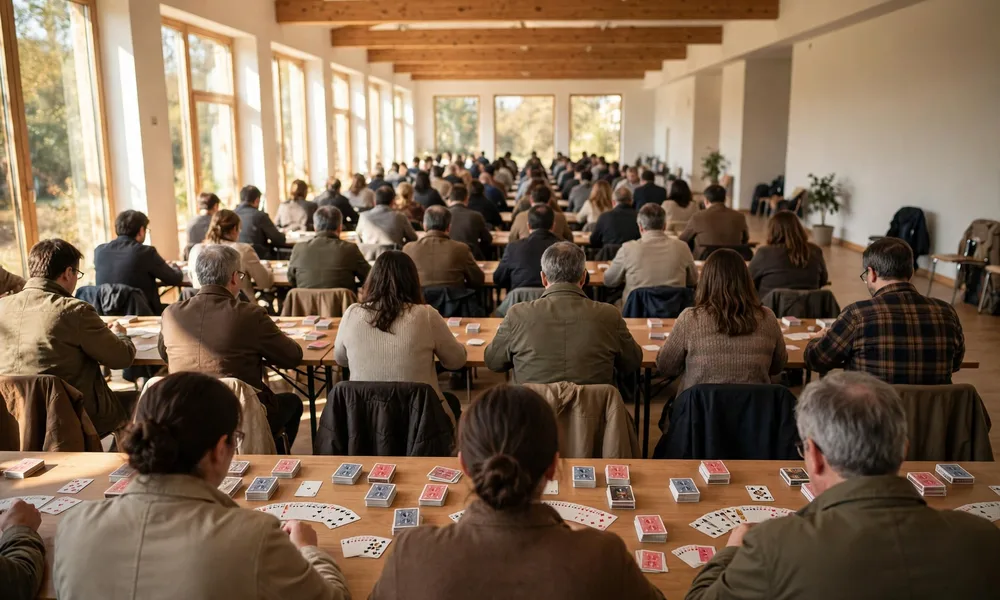
Why 332 Players Changes Everything About Card Games
A normal game night has one table, one deck, and a handful of friends. A 332-player event has dozens of tables, dozens of decks, and hundreds of people who all need to know what to do at the same time. A game that is brilliant for six people can be a disaster for 332 if it takes forty minutes to explain, needs a referee at every table, or leaves half the room waiting while one table finishes a long round.
Scale also changes the supply list. One deck is enough for a family evening, but a 332-player event needs forty to eighty decks, plus score sheets, pens, table numbers, and a public scoreboard. The games in this guide were chosen with all of that in mind: they use standard decks or cheap dedicated decks, need no special equipment, and can be taught by a volunteer who learned the rules ten minutes earlier.
How To Run Card Games for 332 Players
Running a 332-player card event is mostly about organisation, not about the cards themselves. The plan below works for schools, workplaces, clubs, and community halls, and it scales up or down if your final headcount changes slightly on the day.
Set Up the Room in Table Groups
Arrange tables in groups of four to eight seats, and give every table a clear number on a tent card. Leave wide aisles between table groups so players can move quickly during rotations and volunteers can reach every table. Put a deck, a score sheet, and a pen on each table before anyone arrives, and place the rules for the current game on a printed card at the centre of each table so players can check them without asking for help. Seat players as they arrive rather than waiting for everyone to show up, and start the first round once most tables are full.
Use a Simple Rotation System
The simplest rotation for a large group is the winner-moves-up system. After each round, the winner at each table moves to the next numbered table, while other players stay put or shift one seat along. This mixes the field gradually, rewards good play, and needs no computer or complicated draw. For a more social event, use random rotation instead: hand every player a new table number after each round, drawn from a hat or printed on a ticket. Keep rounds short and announce the time clearly, with five-minute and one-minute warnings before the host calls time.
Best Card Games for 332 Players Compared
The table below compares the strongest card games for a 332-player event. Every game listed here works with standard decks or inexpensive dedicated decks, finishes a round in fifteen minutes or less, and can be explained in under a minute. If your event is similar in size to the best card games for 330 players, the same planning and prize structure works well with only minor adjustments to the number of tables.
| Game | Players per table | Round length | Decks needed | Best for |
|---|---|---|---|---|
| Speed | 2 | 5 minutes | 1 per table | Fast head-to-head rounds |
| War | 2 | 10 minutes | 1 per table | Simple all-ages play |
| Rummy | 4 to 6 | 15 minutes | 2 per table | Classic skill play |
| Spades | 4 | 15 minutes | 1 per table | Team competition |
| Hearts | 4 | 15 minutes | 1 per table | Strategy fans |
| Uno | 4 to 8 | 10 minutes | 1 set per table | Families and mixed ages |
| Go Fish | 4 to 6 | 10 minutes | 1 per table | Young players |
| Blackjack | 4 to 7 | 10 minutes | 2 per table | Quick tournament rounds |
| Crazy Eights | 4 to 7 | 10 minutes | 1 per table | Easy learning curve |
| Spoons | 4 to 8 | 5 minutes | 1 per table | High-energy chaos |
The Best Card Games for 332 Players in Detail
Each game below has been judged on the same four tests: can a new player learn it in a minute, does a round finish in fifteen minutes or less, can forty or more tables play it at once, and does it stay fun after several rounds. Games that failed any of those tests did not make the list.
Speed
Speed is a two-player race to get rid of your cards first, and it is one of the fastest card games ever made. Each player holds five cards and flips from a central pile, matching cards by rank in either direction, with no turns, so both players act at the same time. A round usually ends within five minutes. For a 332-player event, Speed works best as a warm-up or tiebreaker game, because two-player tables mean you need 166 tables to seat everyone at once.
War
War is the simplest card game on this list, which is exactly why it works for huge groups. Two players split a deck evenly, flip their top cards at the same time, and the higher card wins both. Tied cards trigger a war, where each player lays down extra cards and flips again. Nobody needs to learn strategy or remember complex rules, so children, grandparents, and complete beginners can all play on equal terms. A round takes about ten minutes, and the only equipment is a standard deck per table.
Rummy
Rummy is the classic choice for a serious card tournament. Four to six players build sets and runs from the cards they are dealt, drawing and discarding until one player goes out. A round takes about fifteen minutes, which is the upper limit for a rotation event, but the depth of the game rewards that time. Use two decks per table for six-player games, and print a short rules card showing valid sets and runs so new players can check their hands without slowing the table down.
Spades
Spades is a four-player partnership game, and the partnership format makes it perfect for team events. Two pairs sit opposite each other, bid on how many tricks they think they can win, and then play their hands to hit the bid. The bidding adds a layer of drama that simple games lack, and partners can celebrate wins together, which builds a great atmosphere across a big room. A round takes about fifteen minutes, and the game needs only one deck per table.
Hearts
Hearts is a four-player trick-taking game where the goal is to avoid winning tricks that contain hearts or the queen of spades. That twist makes it very different from most card games, because players must think about which cards to lose rather than which cards to win. A round takes about fifteen minutes, and the game is easy to teach once players understand the one key rule: hearts cannot be led until they have been broken. Hearts suits strategy fans, so it works well as the second or third game of the night.
Uno
Uno is the most recognisable game on this list, and that familiarity is a huge advantage at a 332-player event. Almost everyone already knows the rules, which means volunteers spend no time teaching and every table can start immediately. Four to eight players take turns matching cards by colour or number, using action cards to skip, reverse, or force opponents to draw. A round takes about ten minutes, and the flexible player count absorbs uneven tables when attendance shifts.
Go Fish
Go Fish is the best card game on this list for younger players. Four to six players ask each other for cards by rank, collecting sets of four, and the player with the most sets at the end wins. The rules take thirty seconds to explain, the game is gentle and social, and it gives children a real chance to beat adults. A round takes about ten minutes with one standard deck per table. If your event includes families, run Go Fish at dedicated family tables so children play against other children.
Blackjack
Blackjack works surprisingly well as a tournament game when you remove the betting. One player deals, the rest play against the dealer, and everyone tries to reach twenty-one without going over. Rounds take about ten minutes, and the simple goal makes the game easy for newcomers while still giving experienced players decisions to make about hitting and standing. For a 332-player event, run Blackjack as a points tournament: players earn points for each hand they win against the dealer, and the highest totals advance to the final tables.
Crazy Eights
Crazy Eights is the game that Uno was based on, and it plays the same way with a standard deck, which saves you buying dedicated sets. Four to seven players match the top card by suit or rank, and eights are wild, so they can be played on anything. The game takes about ten minutes a round, needs only one deck per table, and is easy enough for children while still giving adults a fair contest. Crazy Eights is a smart backup choice: if you run short of Uno sets on the day, switch any Uno table to Crazy Eights and lose nothing.
Spoons
Spoons is the loudest and most energetic game on this list, and it is the perfect way to end a 332-player night. Four to eight players pass cards around the table, trying to collect four of a kind, and when one player succeeds, everyone grabs a spoon from the centre. The player left without a spoon is out, and the game continues until one winner remains. A round takes about five minutes, and the scramble for spoons creates noise and laughter. Keep spoons as the closing game, when the formal tournament is over and the crowd wants pure fun.
Planning a 332-Player Card Night Step by Step
Start with the guest list and the room. Count your tables and chairs first, because that number sets how many players can sit at once and how many decks you need. A hall with fifty tables of six seats holds 300 players, so a 332-player event needs roughly fifty-six tables of six, or a mix of table sizes that adds up to at least 332 seats plus a few spares for volunteers and latecomers.
Next, choose your game schedule. A good evening runs three game types across six to eight rounds: start with a simple game like War or Go Fish, move to a main tournament game like Rummy or Spades, and finish with a fast, loud game like Spoons or Uno. Announce the schedule on a poster at the entrance and on a handout at each table, so players know what comes next and volunteers know when to change the decks.
Recruit volunteers early and give each one a clear job. You need a host to announce rounds, table captains to collect score sheets, a scoreboard keeper to update the leaderboard, and a supplies runner to replace damaged decks and lost pens. One volunteer per ten tables is a good ratio, which means about six volunteers for a 332-player event. Offer a prize for the overall winner, prizes for the top table in each round, and fun awards such as best team name and loudest table, so players stay motivated through the later rounds.
Common Mistakes at Large Card Game Events
The most common mistake is choosing a game that is too complicated. A game with a ten-page rulebook might be wonderful for a home group of four, but it will stall a 332-player event while volunteers explain the rules table by table. Stick to games a volunteer can teach in under a minute, and save the complex games for smaller nights.
The third mistake is letting rounds run too long. When one table takes thirty minutes and the rest finish in ten, the whole rotation system breaks down. Use a timer, call time firmly, and score unfinished rounds by the points earned so far. Players will accept a firm time limit if it is announced in advance and applied fairly to every table. A similar lesson applies to the card games for 328 players format, where short rounds are what keep a huge field moving together.
Event Checklist for 332 Players
Use this checklist in the week before your event, and tick each item off as you complete it. Everything on the list is cheap or free, and missing any single item can slow the night down.
- Count tables and chairs to confirm at least 332 seats, plus spare seats for volunteers and late arrivals.
- Buy or borrow one deck per table, plus at least one spare deck for every five tables, and check every deck is complete.
- Print score sheets, table number cards, and a one-page rules card for each game on the schedule.
- Recruit and brief at least six volunteers, with clear jobs for hosting, scoring, and supplies.
- Test the microphone, timer, and scoreboard display in the room before the day of the event.
- Prepare prizes for the overall winner, round winners, and fun awards, and label them before the event starts.
Frequently Asked Questions About Card Games for 332 Players
Can 332 people really play card games at the same time?
Yes, if you split the crowd into small tables and run many games in parallel. With tables of four to eight players, a 332-player event needs roughly forty to eighty tables, and every table plays the same game at the same time. Rotation between rounds keeps the event social.
How many decks do I need for 332 players?
You need one deck per table, plus spares. For tables of six, that means about fifty-six decks, and for tables of four, about eighty-three decks. Add one spare deck for every five tables to cover damaged or lost cards.
What is the best card game for a group of 332?
Uno is the safest all-round choice because almost everyone knows it, it seats four to eight players, and a round takes ten minutes. For a more competitive event, Rummy or Spades work better, and for a family event, Go Fish is the friendliest option.
How long does a 332-player card event take?
Plan for two to three hours, including setup, six to eight rounds of play, and a prize ceremony. Each round takes five to fifteen minutes depending on the game, plus two or three minutes for rotation.
Do I need a referee at every table?
No. Choose games with simple rules, put a printed rules card on each table, and let players settle small disputes themselves. Have two or three roaming referees who can answer questions, and give the host the final say on any dispute that cannot be resolved quickly.
Can I mix card games with other games at a 332-player event?
Yes, and mixing games often improves the night. Many organisers run card games for the main tournament and add party games between rounds to keep the energy up. The party games for 330 players format shows how a large crowd can switch between game types, and the same approach works here: play cards for the scored rounds, then use a fast party game as a break before the final rounds.
The Bottom Line
The best card games for 332 players are the ones that are fast to learn, quick to play, and easy to run across dozens of tables at once. Speed, War, Rummy, Spades, Hearts, Uno, Go Fish, Blackjack, Crazy Eights, and Spoons all pass that test, and each one suits a different kind of crowd. Split your 332 players into small tables, rotate them between rounds, keep the scoring simple, and bring more decks than you think you need. Do that, and a crowd that looks impossible on paper becomes one of the best game nights your community, school, or workplace will ever run.


