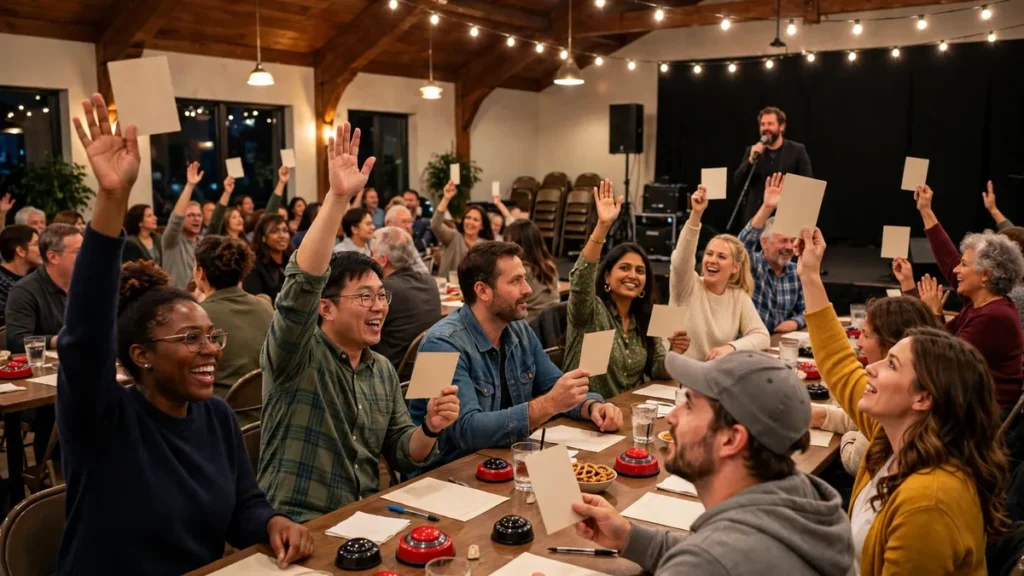
Finding the best card games for 336 players is a very different job from picking a game for a family evening. With 336 people in the room, a single deck of cards leaves most of the group with nothing to do, while a game that needs everyone to hear one quiet voice will fall apart fast. The card games for 336 players that actually work split a huge crowd into small, busy teams, give every team the same fair starting point, and keep the whole event moving through short, clear rounds that anyone can follow.
A group of 336 players usually means a school assembly, a company away day, a community festival, or a large family gathering with several generations mixed together. The organiser cannot assume that everyone knows each other or plays at the same level. Card games suit a crowd this size because they reward thinking, talking, and teamwork rather than speed alone, so players of every age can contribute something useful to their team.
This guide explains how to run card games for 336 players from start to finish. It covers the formats that scale best, the specific games that work with a crowd this size, how to set up teams and stations, and how to score fairly across dozens of teams. Every suggestion uses ordinary materials and keeps all 336 players involved rather than watching from the sidelines.
Key takeaways
- Split 336 players into teams of six for 56 teams, or teams of eight for 42 teams — both divide evenly and keep every table full.
- Use station rotation: each team plays a short card game at one table, then moves to the next, so nobody waits around.
- Pick games with simple rules that can be explained in two minutes, because you will be explaining them dozens of times.
- Score every team on the same simple scale, such as points per round, so a fair winner emerges across the whole hall.
- Bring at least one deck of cards per team, plus spares, and print the rules for each station in large, clear type.

Why 336 Players Changes the Game
Three hundred and thirty-six is a big number, but it is also a friendly one. It divides evenly by six, seven, eight, twelve, fourteen, sixteen, and twenty-one, which gives the organiser plenty of ways to split the crowd into equal teams. Teams of six give you 56 teams, and teams of eight give you 42. Equal teams are the foundation of fair play: nobody wants to lose a tournament before it starts because their team had two fewer players than everyone else.
The real challenge is not the number itself but the logistics around it. Three hundred and thirty-six people need a lot of space, a lot of cards, and a lot of patience from the organisers. A single game that seats everyone at once does not exist in the card world, so the event has to be built from many small games running at the same time. That is actually good news: small games are more fun, more social, and easier to learn, and a hall full of small games feels lively in a way that one giant game never could.
The Formats That Actually Scale to 336 Players
Before choosing individual games, choose a format. The format is the shape of the whole event, and it decides whether 336 people feel like one big party or one long queue. Three formats work well at this size, and each suits a different kind of occasion.
Station Rotation
Station rotation is the most reliable format for 336 players. Set up a row of tables, each running a different short card game. Teams of six or eight spend ten to fifteen minutes at each station, then move on when the bell rings. After five or six stations, every team has played every game, and the scores are added up. This format works because it spreads the crowd evenly, keeps every table busy, and gives players variety. A game one team dislikes is over in fifteen minutes, so nobody is stuck with it all afternoon.
Tournament Brackets
A tournament bracket suits a more competitive crowd. Teams play head-to-head matches at their tables, winners move up, and the field narrows until two teams meet in a final. With 56 teams of six, a single-elimination bracket needs six rounds to find a winner, which is too many for one afternoon unless the rounds are very short. A better option is a Swiss-style tournament, where every team plays the same number of rounds and is matched against teams with a similar record. Nobody is knocked out early, and the final standings still feel earned.
Simultaneous Team Play
In simultaneous team play, every team plays the same game at the same time, following the same central instructions. This works best for games with a caller or a host, such as a quiz-style card game or a bidding game where all teams submit answers at once. It creates a shared atmosphere that station rotation cannot match, because the whole hall reacts to the same moment together. The trade-off is that it needs a strong host and a sound system, and it only works with games designed for simultaneous play.
Best Card Games for 336 Players
The games below were chosen because they meet four tests: the rules can be taught in two minutes, the game works with a standard deck or a cheap commercial set, a round finishes in fifteen minutes or less, and the game stays fun when played by a team rather than an individual. Each one has been described in its team version, since that is how it will be played at this scale.
Team Rummy
Rummy is one of the best starting points for a crowd of 336. Each team of six plays its own game with two decks shuffled together, aiming to collect sets and runs and lay down a complete hand. Teammates can discuss strategy openly, which makes it a good icebreaker for groups who have just met. A round takes about fifteen minutes, and scoring is simple: the team with the fewest points left in hand wins. Print a one-page summary of the melding rules for each station.
Speed Sets
Speed Sets is a fast matching game that works brilliantly as a station because it needs almost no explanation. Each table gets a shuffled deck, and teams race to find sets of three cards that share a pattern, such as three cards of the same suit in sequence. The first team to call out a valid set scores a point, and the game runs for ten minutes. It is noisy, energetic, and a good contrast to the slower games on the other stations.
Team Blackjack Challenge
Blackjack adapts well to team play when the dealer is a volunteer rather than a player. Each team takes turns against the dealer, and the team decides together whether to hit or stand. This turns a game of individual nerve into a group discussion, which is far more entertaining for a crowd. Rounds are short, the rules are widely known, and the dealer role can rotate between team members. Use chips or tokens instead of money, and score teams by the number of winning hands across ten deals.
Memory Match Relay
Memory Match Relay is a card game that gets people moving, which matters when 336 people have been sitting down for an hour. Cards are laid face down in a grid on each table, and team members take turns flipping two cards to find a pair. Each correct pair scores a point, and the turn passes to the next teammate. The relay element means everyone plays, even the quietest member of the team, because the turn order guarantees it. It is also one of the easiest games to run, since the rules fit in a single sentence.
Trivia Card Showdown
Trivia Card Showdown pairs a deck of question cards with a deck of playing cards. Each team draws a question card, and a correct answer earns the right to draw a playing card. At the end of the round, the team holding the best poker hand from its drawn cards wins bonus points. This format rewards knowledge and luck in equal measure, which keeps weaker trivia teams in the contest. You can buy ready-made trivia card sets, or write your own questions to match the occasion.
Build the Bridge
Build the Bridge is a cooperative card game, and every large event needs at least one cooperative option. Each team works together to lay cards in sequence from ace to king, building a bridge across the table. Cards can only be placed by following the suit and rank rules, and the team must plan together because each player holds only part of the information. It is a calm, thoughtful game that suits players who prefer teamwork to competition, and it balances the louder stations nicely.
Card Games for 336 Players at a Glance
The table below compares the six games on the things that matter most to an organiser: how long a round takes, how many decks each table needs, and how much explaining the game requires. Use it to build a balanced set of stations, mixing fast and slow games, competitive and cooperative ones.
| Game | Round length | Decks per table | Teaching time | Best for |
|---|---|---|---|---|
| Team Rummy | 15 minutes | 2 | 2 minutes | Mixed-age groups |
| Speed Sets | 10 minutes | 1 | 1 minute | Energy and pace |
| Team Blackjack Challenge | 12 minutes | 2 | 2 minutes | Competitive teams |
| Memory Match Relay | 10 minutes | 1 | 1 minute | All ages, quiet players |
| Trivia Card Showdown | 15 minutes | 1 plus question cards | 2 minutes | Knowledge and luck |
| Build the Bridge | 15 minutes | 2 | 2 minutes | Cooperative players |
If you are building a station rotation, pick four or five games from the table rather than all six. Five stations of fifteen minutes fit neatly into a two-hour session with time for welcome, scoring, and a break. For ideas on mixing card stations with other tabletop options, our guide to the best board games for large groups covers games that seat big teams comfortably and pair well with a card rotation.
Setting Up the Room for 336 Players
Room setup decides whether the day feels organised or chaotic, and it deserves as much attention as the games themselves. Start with the tables. Teams of six need a table roughly 180 centimetres across, and teams of eight need more. Round tables work best for card games because everyone can reach the centre, but long rectangular tables are easier to arrange in rows. Whichever you choose, leave at least a metre between tables so players can pull out chairs and move between stations without squeezing past each other.
Next, plan the flow of movement. In a station rotation, teams move in one direction around the room, like a slow carousel. Number the stations clearly, put a large number card on each table, and mark the direction of travel with arrows on the wall. A simple bell, whistle, or chime signals the end of each round, and a five-minute warning lets teams finish their current hand gracefully. Test the bell from the far corner of the room before the event starts, because a signal nobody can hear is worse than no signal at all.
Materials are the third piece of the puzzle. Count decks carefully: 56 teams of six, with two decks per station, need well over a hundred decks across the whole event. Buy decks in bulk, check that every deck is complete before the day, and keep a box of spare decks at the organiser’s table. You will also need score sheets, pens, printed rules, and a central scoreboard, updated after each round to keep the competitive energy high.
Scoring Fairly Across Dozens of Teams
Fair scoring is what turns a pleasant afternoon into a proper event. The simplest system is points per round: each station awards points on the same scale, such as ten points for first place at the table, seven for second, five for third, and so on. Because every team visits every station, the totals are directly comparable, and the winner is simply the team with the most points. This system is easy to explain, easy to run, and hard to argue with.
For a tournament bracket, a Swiss-style system works better. Teams earn points for wins and draws, and each round pairs teams with similar records. After five or six rounds, the standings reflect real strength rather than a lucky draw. Keep the scoring visible: post the standings after every round so teams can see where they stand and what they need to do. Transparency prevents most disputes, and the few that remain can be settled by a quick look at the score sheet.
Tie-breaks deserve a decision before the event starts. The cleanest tie-break is a single sudden-death round of Speed Sets between the tied teams, because it is fast, visible, and exciting for the crowd to watch. Announce the tie-break rule at the start of the day so nobody feels it was invented to favour one team.
What to Prepare Before the Day
Use this checklist in the week before the event, and tick each item off as it is done. It covers the things organisers most often forget when the player count climbs into the hundreds.
- Confirm the team size and count: 56 teams of six, 42 teams of eight, or another split that divides 336 evenly.
- Buy and check every deck of cards, then add at least ten spare decks to the organiser’s box.
- Print the rules for each station in large type, one copy per table plus spares.
- Prepare score sheets, pens, and a central scoreboard, and decide the tie-break rule in advance.
- Test the round-change signal from every corner of the room, and brief the volunteers who will run each station.
- Plan the seating, the direction of travel between stations, and a clear arrival and registration area.
One more preparation step is worth the effort: a short practice run with a few volunteers. Even twenty minutes of rehearsal will reveal the problems that a checklist cannot, such as a station that takes too long to explain or a table that is too small for eight players. Fix those problems the day before, not on the day itself. A similar approach helps with smaller gatherings too, and our guide to card games for 334 players shows how the same format adapts when the group is two players smaller.
Frequently Asked Questions
How many teams do 336 players make?
It depends on the team size you choose. Teams of six give you 56 teams, teams of seven give you 48, teams of eight give you 42, teams of twelve give you 28, and teams of fourteen give you 24. Teams of six or eight are the most popular choices because they fit comfortably around a standard table and keep every player involved in each hand.
How many decks of cards do you need for 336 players?
Plan for at least one deck per team at each station, which means roughly 50 to 60 decks if you run one station at a time, and more if several stations run at once. A safe total for a five-station rotation is 120 decks, plus ten spares. Bulk packs of playing cards are inexpensive, and the spares will be needed: decks get dropped, bent, and mixed up at an event this size.
Can card games work for players who have never played before?
Yes, provided you choose games with rules that fit on one page. Memory Match Relay and Speed Sets can be taught in a minute, and most people already know the basics of rummy or blackjack. Put the printed rules on every table, station a volunteer at each game for the first round, and avoid any game that needs more than two minutes of explanation.
How long should a card game event for 336 players last?
Two to three hours is the sweet spot. A five-station rotation with fifteen-minute rounds takes about ninety minutes of play, plus time for welcome, breaks, and scoring. Shorter events feel rushed, and longer ones tire the players out. If the event must fill a whole day, add a lunch break and a lighter afternoon session rather than stretching the card games themselves.
What is the best age mix for a 336-player card event?
Card games suit mixed ages better than most activities, because they reward memory, patience, and teamwork rather than speed or strength. Mixing ages within each team works well: older players often know the classic games, while younger players bring energy and quick thinking. Keep at least one cooperative game on the rotation so teams with very young or very old players have a station where everyone can contribute equally.
Do you need a professional host for 336 players?
A professional host helps but is not essential. What matters is one clear voice giving instructions, a reliable signal for changing rounds, and enough volunteers to run the stations. One volunteer per station is enough for 336 players if the rules are printed and the format is station rotation. If you are also looking for quieter options to mix in between card rounds, our list of the best word games for adults offers games that work well as calm, seated breaks for older players.
Bottom Line
The best card games for 336 players are the ones that split a huge crowd into small, busy teams and keep every team playing at the same time. Choose a station rotation, pick four or five games with rules that can be taught in two minutes, and score every team on the same simple scale. With 56 teams of six or 42 teams of eight and a clear signal for each round, 336 players stop being a logistical problem and start being a very good afternoon.