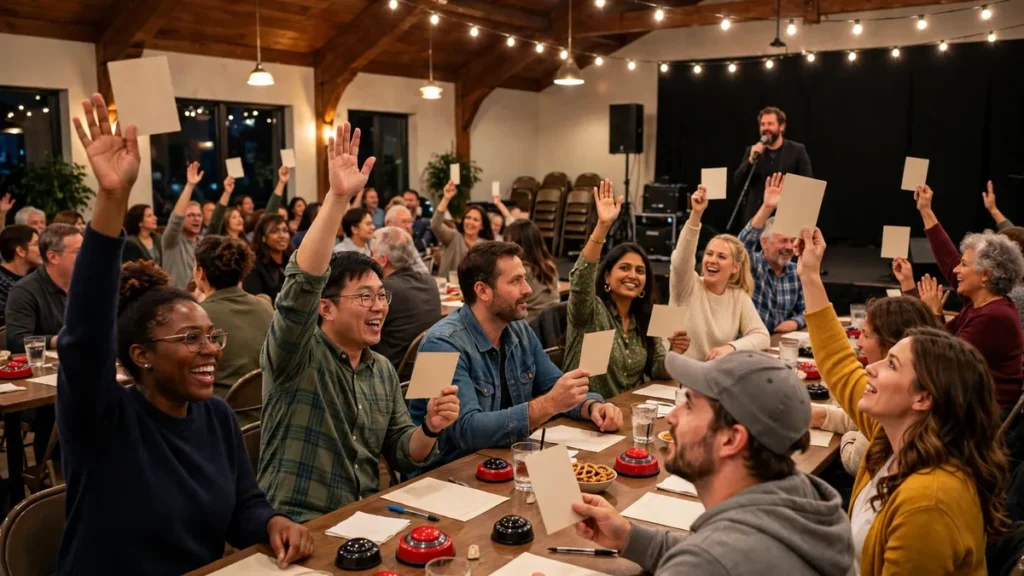
Finding the best dice games for 337 players sounds like a joke at first. Most dice games are built for two to six people sitting around a kitchen table, and 337 players is closer to a school assembly or a company-wide party than a game night. Yet the moment you start planning a giant gathering, a fundraiser, a reunion, or a community event, the question becomes very real: what can 337 people actually play together without chaos, long waits, or half the room checking their phones?
The answer is that dice games are one of the few formats that can scale to a crowd this size. Dice are cheap, the rules can be explained in under a minute, and the games on this list work in parallel tables, tournament brackets, or whole-room rounds where everyone rolls at once. The best dice games for 337 players are the ones with the simplest scoring, the fastest turns, and the easiest way to keep hundreds of people in the game at the same time.
This guide ranks the dice games that genuinely work for a group of 337, explains exactly how to set each one up at scale, and gives you a practical plan for running the night. Whether you are organising a school event, a corporate social, a wedding reception, or a charity game night, you will find a format here that fits your room, your budget, and your crowd.
Key takeaways
- Bunco is the best dice game for 337 players because it is designed for large groups and rotates players between tables every round.
- Whole-room games like Dice Bingo and Tenzi let all 337 players roll at the same time, so nobody waits for a turn.
- Tournament formats turn classic games like Yahtzee and Farkle into bracket competitions that work for any number of players.
- You need roughly 70 tables, 400 dice, and one scorekeeper per table to run a 337-player dice night smoothly.
- Keep rounds short, explain the rules in under a minute, and use a single visible scoreboard so the whole room stays engaged.
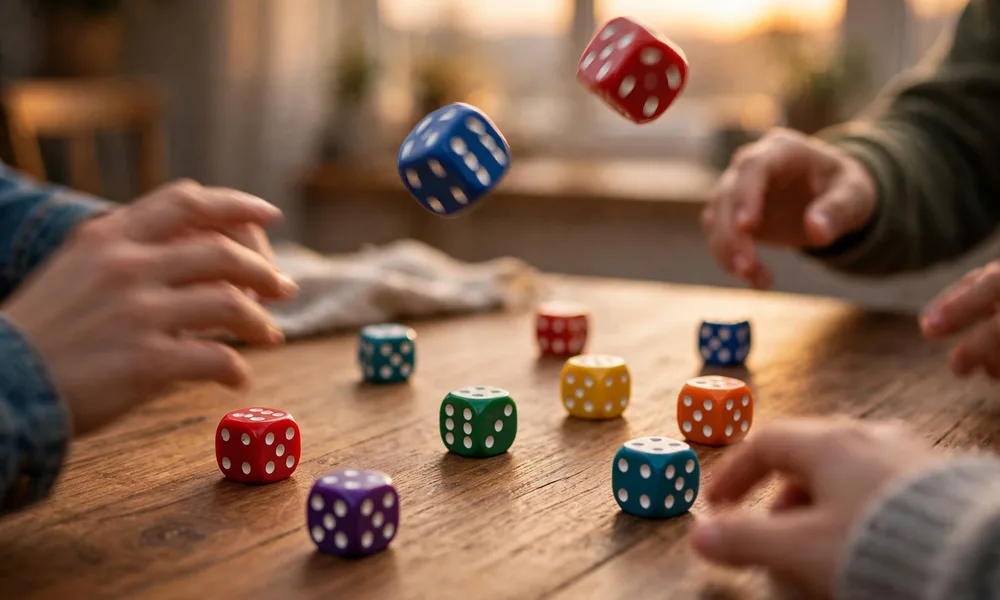
What Makes a Dice Game Work for 337 Players
Not every dice game survives contact with a crowd of 337. A game that is brilliant for four friends can fall apart completely when you multiply the player count by eighty. Before choosing, it helps to know what separates the games that scale from the ones that do not.
The first test is turn length. In a four-player game, waiting two minutes for your turn is fine. In a 337-player game, a two-minute turn means some players wait an hour. The best dice games for 337 players either give everyone a turn at the same time or keep individual turns under thirty seconds. Games like Bunco, Tenzi, and Dice Bingo pass this test easily. Games with long decision phases, trading, or negotiation do not.
The second test is rule simplicity. You cannot teach a complex rulebook to 337 people at once. The winning games can be explained in one minute, demonstrated in one round, and learned by watching. If a game needs a reference card, a scoring app, or a referee at every table, it will slow your event down. The games in this guide all have rules that fit on a single printed sheet.
Best Dice Games for 337 Players Compared
| Game | Players per Table | Dice Needed | Round Length | Best For |
|---|---|---|---|---|
| Bunco | 4 | 3 per table | 15 minutes | Large social events and fundraisers |
| Tenzi | 2 to 4 | 10 per player | 5 minutes | Fast, high-energy party rounds |
| Dice Bingo | Unlimited | 2 per room | 20 minutes | Whole-room play with no waiting |
| Yahtzee Tournament | 4 | 5 per table | 30 minutes | Competitive brackets and prizes |
| Farkle Tournament | 4 to 6 | 6 per table | 20 minutes | Risk-taking and crowd reactions |
| Left Center Right | 4 to 12 | 3 per table | 15 minutes | Casual play with simple rules |
| Liar’s Dice | 4 to 6 | 5 per player | 25 minutes | Bluffing and social deduction |
| Qwixx | 2 to 5 | 6 per table | 20 minutes | Quick roll-and-write scoring |
The Best Dice Games for 337 Players
1. Bunco
Bunco is the single best dice game for 337 players, and it is not close. It was designed for large groups, and it has been the backbone of church socials, charity nights, and ladies’ game nights for decades precisely because it handles crowds so well. Four players sit at each table, each table plays with three dice, and after every round the winners move to a new table while the losers stay put. That rotation is the secret. It means every player meets new people all night, nobody is stuck with the same table, and the whole room stays in motion.
2. Tenzi
Tenzi is the fastest dice game on this list and the best choice when you want pure energy. Every player gets ten dice and rolls them all at once, trying to get all ten to show the same number. Players keep the dice that match and re-roll the rest as fast as they can. The first player at a table to get all ten matching shouts Tenzi and wins the round. There are no turns, no waiting, and no downtime.
For a group of 337, Tenzi works best as a series of short heats. Set up tables of four, run a five-minute heat, and advance the winner of each table to the next round. After four or five heats, you have a final table of champions. The whole tournament can be finished in under an hour, which makes Tenzi a great opener or a warm-up game before a longer event like Bunco. The main cost is dice: each player needs ten, so a full room needs more than 3,300 dice. Buy them in bulk bags of a hundred, and count them back in at the end of each heat.
Tenzi is also the easiest game to explain. The rules take about twenty seconds, and anyone who has watched one round understands it completely. That makes it ideal for mixed groups with children, older players, and people who have never played a dice game before. If you are comparing party formats, the same fast, simultaneous style that makes Tenzi work is what makes the best party games for 334 players so popular at large gatherings.
3. Dice Bingo
Dice Bingo is the only game on this list where all 337 players can play in a single round at the same time, with no tables and no brackets at all. Every player gets a bingo-style card printed with numbers, and a caller rolls two large dice at the front of the room. Players mark the matching numbers on their cards, and the first person to complete a row, column, or full card wins. It is bingo with dice instead of a ball machine, and it scales to any number of players because the only limit is how many cards you can print.
4. Yahtzee Tournament
Yahtzee is one of the most famous dice games in the world, and its tournament format turns it into a serious competition for 337 players. Each table of four plays a standard game of Yahtzee with five dice and a scorecard, and the winner of each table advances to the next round. With 84 tables in round one, you have 84 winners for round two, then 21 tables, then a semi-final and a final. The full bracket takes about two and a half hours, so it suits an evening event with a prize for the champion.
For a group this large, print the scorecards in advance and use one standard set of five dice per table. Appoint a scorekeeper per table for the first round, then let tables self-score once the field narrows. If you want to warm the room up with a smaller version first, the classic format used in dice games for 335 players follows the same bracket structure and works just as well.
5. Farkle Tournament
Farkle is a push-your-luck dice game that produces the loudest reactions of any game on this list. Players roll six dice, set aside scoring combinations, and decide whether to bank their points or risk them all on another roll. Roll a Farkle, which means no scoring dice at all, and the turn scores zero. That single rule creates groans, cheers, and table-wide drama every few minutes, and in a room of 337 people the noise builds into something genuinely electric.
Farkle is the best pick when your crowd wants excitement rather than quiet concentration. It suits evening socials, team parties, and fundraisers where the atmosphere matters as much as the game. The only warning is volume. With dozens of tables cheering and groaning at once, Farkle nights get loud, so choose a venue that can handle the noise and keep the microphone for announcements only.
6. Left Center Right
Left Center Right, often called LCR, is the simplest game on this list and the best choice for a mixed-age crowd. Each player starts with three chips, rolls three dice marked L, C, R, and dots, and passes chips left, right, or to the centre pot according to the roll. The last player holding chips wins the pot. That is the entire game, and it takes about thirty seconds to teach.
LCR scales beautifully because it is fast and cheap. A table of four to twelve players can finish a game in fifteen minutes, and the only equipment is three special dice and a handful of chips per table. For 337 players, run LCR at tables of eight, which needs about 42 tables, and play three or four rounds with small prizes for each table winner. The chips can be poker chips, coins, or even wrapped sweets, which makes LCR a natural fit for holiday parties and charity nights where the pot itself is part of the fun.
The weakness of LCR is that it is almost entirely luck. There are no decisions to make, so experienced players will not find much depth. That is also its strength at a large event, because it puts a ten-year-old and a seventy-year-old on exactly equal footing. When you want a game that everyone can play without feeling outmatched, LCR is hard to beat.
7. Liar’s Dice
Liar’s Dice is the bluffing game of the group, and it is the best dice game for 337 players when your crowd wants social deduction rather than pure luck. Each player gets five dice and a cup, rolls them in secret, and bids on how many of a given number are showing across the whole table. Players can raise the bid or call the previous player a liar, and anyone caught lying loses a die. The last player with dice remaining wins the table.
8. Qwixx
Qwixx is a roll-and-write dice game that combines the simplicity of bingo with the strategy of a scorecard. Two white dice and four coloured dice are rolled at each table, every player uses the same roll to mark numbers on their personal score sheet, and the first player to lock enough rows wins. Because every player acts on every roll, there is no downtime, and a full game takes about twenty minutes.
The strategy in Qwixx comes from choosing which rows to fill and when to lock a row before your opponents. That decision-making keeps experienced players engaged, while the shared-roll mechanic keeps beginners in the game. If your event mixes dice games with other formats, Qwixx pairs well with the tabletop variety found in board games for 334 players, and the two formats share the same table setup and volunteer roles.
How to Run a 337-Player Dice Game Night
Running a dice night for 337 players is a logistics exercise as much as a game night, and the plan matters more than the game you choose. Start with the room. You need roughly 70 to 85 tables depending on the game, with space for players to move between tables during rotations. A school hall, a community centre, or a hotel ballroom works well. A living room does not. Visit the venue in advance, count the tables, and walk the rotation route yourself to make sure it flows.
Next, recruit volunteers. You need one scorekeeper per table for the first round, plus a head referee, a score desk team of three, and someone on the microphone. That is about 90 volunteers for a full Bunco or Yahtzee night, which sounds like a lot until you realise the scorekeepers are also players. Each table elects its own scorekeeper, so you only need to recruit the head referee, the score desk, and the announcer in advance. Train them the day before, and give each one a printed sheet with the rules, the rotation order, and the tie-breaker procedure.
Finally, plan the schedule and the prizes. A typical two-hour event runs like this: fifteen minutes for arrival and seating, ten minutes for the rules demonstration, six fifteen-minute rounds with a ten-minute break in the middle, and fifteen minutes for the final and the prize ceremony. Offer one main prize, a few table prizes, and a small prize for the most enthusiastic player. The prizes do not need to be expensive. A trophy, a gift card, and a box of chocolates will do. What matters is that the room has something to play for.
Checklist for a 337-Player Dice Game Night
- Book a venue with room for 70 to 85 tables and clear walkways between them for player rotation.
- Buy dice in bulk and pack them in labelled bags by table number, with at least 20 spare sets on hand.
- Print 337 score sheets, rotation cards, and rule sheets, plus a large leaderboard for the front of the room.
- Recruit a head referee, a three-person score desk, and an announcer, and train them the day before the event.
- Test the bell, whistle, microphone, and projector the day before, and bring backup batteries for all of them.
- Prepare prizes for the overall winner, table winners, and one fun award, and announce them at the start of the night.
Frequently Asked Questions
What is the best dice game for 337 players?
Bunco is the best dice game for 337 players because it was designed for large groups. Four players sit at each table, winners rotate to new tables after every round, and the simple scoring means a volunteer can run the whole event. Dice Bingo is the best alternative for a single whole-room game.
How many tables do I need for 337 players?
You need 84 tables of four for Bunco or Yahtzee, with one table of five for the extra player. Tenzi needs about 85 tables of four, LCR needs about 42 tables of eight, and Dice Bingo needs no tables at all.
How many dice do I need for 337 players?
A Bunco night needs 84 sets of three dice, or 252 dice plus spares. A Yahtzee tournament needs 84 sets of five dice, or 420 dice. Tenzi needs the most at ten dice per player, which is 3,370 dice for a full room. Always buy at least 20 spare sets.
Can 337 people play a dice game at the same time?
Yes. Dice Bingo lets all 337 players play in one round because one pair of dice is rolled at the front of the room and everyone marks their own card. Tenzi and Qwixx also let every player act at the same time, so nobody waits for a turn.
How long does a 337-player dice game night take?
Most formats fit into two to two and a half hours. A six-round Bunco night takes about two hours including a break, and a Yahtzee or Farkle tournament takes about two and a half hours. Tenzi heats can finish in under an hour, so Tenzi works well as a warm-up.
What prizes work best for a large dice game night?
Offer one main prize for the overall winner, small prizes for each table winner, and one fun prize for the most enthusiastic player. Gift cards, trophies, and hampers all work well. Keep the main prize visible at the front of the room.
Bottom Line
The best dice games for 337 players treat a huge crowd as an advantage rather than a problem. Bunco leads the list because its table rotation turns 337 strangers into a moving, social room. Dice Bingo and Tenzi win on speed and whole-room energy, while Yahtzee, Farkle, Liar’s Dice, and Qwixx turn the night into a real competition with brackets, strategy, and a champion at the end. Pick the format that matches your venue, your volunteers, and your crowd, print your score sheets the day before, and bring spare dice.