Finding the best card games for 143 players starts with an honest fact: no single card game seats 143 players at one table. A standard deck serves a handful of people, and even the largest party card games top out at around twenty players. That does not mean a 143-player card night is impossible. It means the game has to change shape, from one small contest into a team tournament, a multi-table event, or a whole-room game where every player still gets to play, laugh, and compete.
The best card games for 143 players are therefore the ones that scale gracefully. They have simple rules that a host can explain in two minutes, turns that move quickly, and scoring that stays fair when twenty or more teams are playing at once. A game that works beautifully for six friends can collapse completely in a hall of 143 people if the rules are fiddly, the turns are slow, or only a few players are involved at any moment.
This guide ranks the card games that genuinely work at this size and explains how to set up the room, the teams, and the scoring. Whether you are planning a company party, a school fundraiser, a community night, or a family reunion, the plan below turns an awkward headcount into the best part of the event.
Key takeaways
- No card game seats 143 players at once, so split the room into teams of four to seven and run a host-led tournament.
- Choose games with simple rules, fast turns, and one shared deck per table, because complex games collapse at this scale.
- Use a mix of team play, multi-table rounds, and whole-room rounds to keep every player involved from start to finish.
- Buy one copy of each game per table, plus spare decks, score sheets, and a clear scoring system before the night begins.
- Keep rounds short, rotate tables between rounds, and finish with a final round that brings the whole room together.

Why 143 Players Changes Everything
A card game for six people and a card game for 143 people are two different events that happen to use the same cards. With six people, everyone can see every card, hear every joke, and wait patiently for a turn. With 143 people, nobody can see the whole room, nobody can hear a quiet dealer, and a five-minute turn becomes an hour of waiting. The games that survive this jump are the ones built around speed, simplicity, and parallel play.
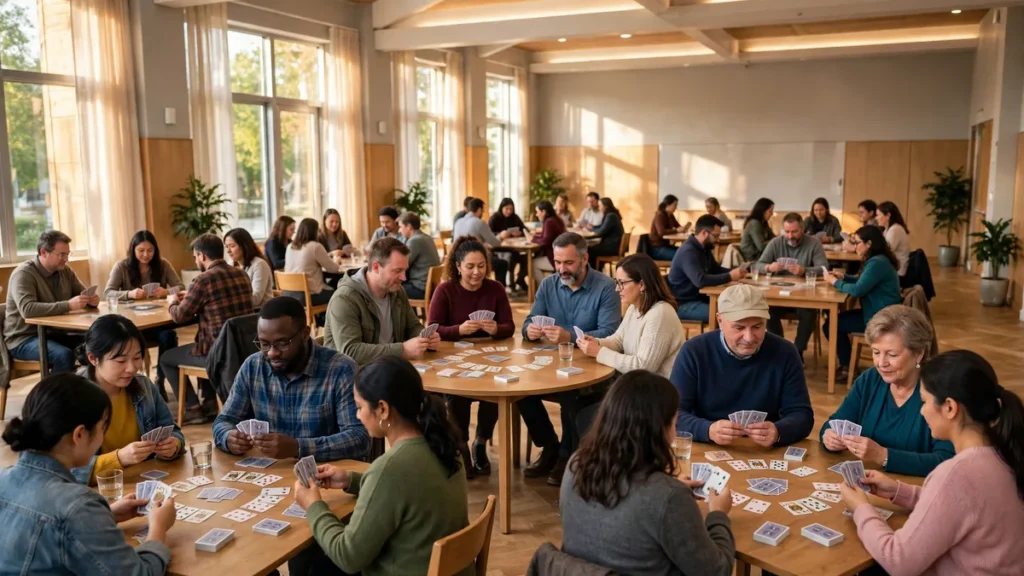
The first change is the table. A single table holds four to eight players comfortably. A hall of 143 players needs twenty to thirty tables, depending on team size, and each table needs its own deck, its own score sheet, and ideally its own table host. That sounds like a lot of organisation, and it is, but it is also the secret to a good night: when every table is playing at the same time, nobody is standing around waiting.
The second change is the rules. A host cannot walk around a hall explaining a complicated game to thirty tables one by one. The rules need to fit on a single printed card at each table, and the host needs to be able to demonstrate a full round on a stage or a screen in under three minutes. If a game needs ten minutes of explanation, it is the wrong game for 143 players, however good it is for a small group.
How to Run Card Games for 143 Players
The most reliable format for 143 players is the team tournament. Split the room into teams of five to seven players, which gives you roughly twenty to twenty-eight teams. Each team sits at its own table, and every table plays the same game at the same time. After each round, teams record their points, and the host announces the standings before the next round begins. This format works because it is simple to explain, easy to score, and keeps every player involved in every round.
A multi-table format works well when you want variety. Set up stations around the room, each with a different card game, and let teams rotate from station to station on a timer. A team might play Uno at one station, Skip-Bo at the next, and Sushi Go Party at the one after that. Rotation keeps the energy high, because a team that dislikes one game knows a new one is only fifteen minutes away. It also lets you use games that work best with smaller groups, because each station only needs to seat one team at a time.
Whole-room games are the fourth option, and they are the best way to open the night. In a whole-room game, the host reads a card aloud, every team answers at the same time on a whiteboard or a slip of paper, and the host reveals the answer to the whole hall. No table needs a dealer, nobody waits for a turn, and 143 people can play together in the truest sense. Whole-room rounds are ideal for warm-ups, tie-breakers, and the final question that decides the winner.
Most successful 143-player nights combine at least two of these formats. Open with a whole-room round to get everyone laughing, run two or three multi-table rounds in the middle, and finish with a relay or a final whole-room round. If you want to mix in other kinds of play between card rounds, the best word games for adults can add variety without breaking the flow of the evening.
The Best Card Games for 143 Players
The games below were chosen for the same three reasons: simple rules, fast turns, and a structure that works when twenty or more tables are playing at once. Each one can be bought in multiple copies, taught in minutes, and scored with a single number per round.
1. Uno
Uno is the most reliable card game for a very large group, because almost everyone already knows how to play it. The rules fit on a single card, turns take seconds, and a hand finishes in ten to fifteen minutes, which is exactly the length a tournament round should be. In a 143-player event, run Uno at every table at the same time, with each team playing as a partnership: teammates take turns playing from a shared hand, discuss each move quietly, and share the result.
The scoring is simple. The first team to empty its hand scores points equal to the cards left in the other teams hands, or you can award a fixed number of points per round to the winning team at each table. Uno works best as an opening round, because it warms the room up without asking anyone to learn anything new. Buy one deck per table, plus a few spares, and print the wild card rules on the table card, because the draw-four rule is the one argument that breaks out at every large Uno night.
2. Skip-Bo
Skip-Bo is a sequencing card game that suits a tournament format beautifully, because every table plays the same puzzle at the same time and the result is easy to compare. Each player, or each team, works through a stock pile by playing cards in number order, and the first to clear the pile wins the round. The rules are simple enough to teach in two minutes, but the game still rewards planning, which keeps experienced players interested.
3. Dutch Blitz
Dutch Blitz is a fast, frantic card game in which every player plays at the same time, racing to build piles in number order. There are no turns, which makes it one of the few card games that genuinely feels the same with four players as it does with forty tables playing at once. A round lasts three to five minutes, the table is loud, and the result is obvious the moment someone shouts that they are out of cards.
4. Exploding Kittens
Exploding Kittens is a quick, funny card game in which players draw cards, dodge exploding kittens, and use action cards to skip turns, attack other players, or peek at the deck. A hand takes ten to fifteen minutes, the rules take two minutes to explain, and the humour keeps the room laughing. That combination makes it an excellent middle round for a mixed group that includes teenagers and adults.
5. Sushi Go Party
Sushi Go Party is a card drafting game in which players pass hands of cards around the table, picking one card at a time to build the best menu of sushi dishes. The passing mechanic is the reason it works so well at scale: every player is involved in every turn, there is no waiting, and a round finishes in about twenty minutes. The party edition includes a large menu of cards, so you can change the selection between rounds and keep the game fresh all night.
6. Taco Cat Goat Cheese Pizza
Taco Cat Goat Cheese Pizza is a fast, silly card game in which players take turns flipping cards and slapping the pile when the spoken word matches the picture. It is the loudest and simplest game on this list, and it is the best choice for a final round, when the room is tired of thinking and ready to laugh. A round takes ten minutes, the rules take thirty seconds to explain, and the game works just as well for children as it does for adults.
Card Games for 143 Players Compared
The table below compares all six games on the four things that matter most at this size: how long a round takes, how easy the game is to teach, how many players it suits per table, and the format it suits best. Use it to build your running order, and remember that a good night mixes fast games with slow ones, quiet games with loud ones, and simple games with ones that reward a little thought.
| Game | Round length | Teach time | Players per table | Best format |
|---|---|---|---|---|
| Uno | 10 to 15 minutes | 1 minute | 4 to 7 | Team tournament |
| Skip-Bo | 20 minutes | 2 minutes | 4 to 7 | Team tournament |
| Dutch Blitz | 3 to 5 minutes | 2 minutes | 4 to 7 | Multi-table race |
| Exploding Kittens | 10 to 15 minutes | 2 minutes | 4 to 7 | Team tournament |
| Sushi Go Party | 20 minutes | 3 minutes | 5 to 7 | Multi-table rotation |
| Taco Cat Goat Cheese Pizza | 10 minutes | 30 seconds | 4 to 7 | Whole-room finale |
How to Score a 143-Player Tournament
Simple scoring beats clever scoring at this size. Award ten points to the winning team at each table, seven points to the second team, five to the third, and three to every team that finishes the round, so that nobody leaves a round with nothing. Add the points up after every round, write the top ten teams on a board or a screen, and read the full standings aloud at least twice during the night, so that teams at the bottom know they can still catch up.
Plan a tie-breaker before you need one. With twenty or more teams, ties are certain, so decide in advance how you will break them: a single whole-room question, a one-hand playoff between the tied teams, or the team with the most round wins across the night. Announce the tie-breaker at the start of the evening, so that nobody can complain about it at the end. If you want a quieter tie-breaker that still feels fair, the best puzzle apps for adults can provide a quick solo challenge while the scoring table checks the final numbers.
Event Checklist: Card Games for 143 Players
Use this checklist in the week before the event, and check every item off before the doors open. A missing deck or a missing score sheet is a small problem at a table of six and a serious problem in a hall of 143.
- Count the players, form teams of five to seven, and print a team list with a table number for every team.
- Buy one copy of each game per table, plus spare decks, and check that every box is complete before the night.
- Print a rules card, a score sheet, and a pen for every table, and place them on the tables before players arrive.
- Set out twenty to thirty tables with enough chairs, clear walkways, and a stage or screen the whole room can see.
- Brief the host and the table runners on the running order, the scoring, and the tie-breaker before the first round.
- Plan the prizes, the final round, and a short closing announcement, so the night ends on time and on a high note.
Common Mistakes to Avoid
The most common mistake is choosing a game that is too complicated. A game with a thick rulebook, a long setup, or a turn that takes five minutes will stall a hall of 143 players, however brilliant it is for a small group. Test every game with a real table before the night, time a full round, and drop any game that takes more than three minutes to teach or more than twenty minutes to play.
The third mistake is forgetting the room itself. A hall of 143 players needs clear sightlines, a sound system that reaches the back tables, and a host who can be heard without shouting. Test the microphone, put the leaderboard where everyone can see it, and walk the room before the doors open to check that every table has space to play. If you are planning a wider games night around the card tournament, the best escape room board games can inspire a second room or a side activity, but keep the card tournament itself in one hall, where the host can see every table.
The fourth mistake is letting the scoring drift. If score sheets are not collected after every round, if points are worked out differently at different tables, or if the leaderboard is not updated, teams lose trust in the contest and stop caring about the result. Keep the scoring simple, collect the sheets on time, and announce the standings often, so that every team knows where it stands and what it needs to do to win.
Frequently Asked Questions
Can 143 people really play card games together?
Yes, but not at one table. Split the room into teams of five to seven, give each team its own table and deck, and run the same game at every table at the same time. Add whole-room rounds at the start and the end, and all 143 players will be part of the same event, even though no single game seats them all.
How many tables do I need for 143 players?
You need twenty to thirty tables, depending on your team size. Teams of seven need twenty-one tables, teams of six need twenty-four tables, and teams of five need twenty-nine tables. Leave space between tables for runners, the host, and players moving between rounds, and check the hall capacity before you send invitations.
How many copies of each game should I buy?
Buy one copy per table for every game on your running order, plus at least two spare copies of each game. If you have twenty-four tables and four games, that is ninety-six copies plus spares, which sounds like a lot, but it is the only way to make sure every table is playing at the same time. Borrow copies from friends, a games cafe, or a library if buying them all is too expensive.
How long should a 143-player card night last?
Plan for two to three hours, including a welcome, four or five rounds of fifteen to twenty minutes each, short breaks between rounds, and a finale. A night shorter than two hours feels rushed, and a night longer than three hours loses the back tables. Publish the running order in advance, start on time, and keep the breaks short.
What is the best card game to start with?
Uno is the best game to start with, because almost everyone knows it, it takes a minute to teach, and it warms the room up without asking anyone to learn anything new. Follow it with a slower game such as Skip-Bo or Sushi Go Party, then finish with a loud, silly game such as Taco Cat Goat Cheese Pizza, so the night builds from familiar to fresh to fun.
How do I keep 143 players engaged all night?
Keep the rounds short, rotate the games, announce the standings often, and give every team something to do in every round. Teams stay engaged when they can see their score moving, when the next game is different from the last one, and when the host talks to the whole room rather than to one table. A whole-room round every hour is the simplest way to bring the energy back up.
The Bottom Line
The best card games for 143 players are the simple, fast, and sociable ones: Uno, Skip-Bo, Dutch Blitz, Exploding Kittens, Sushi Go Party, and Taco Cat Goat Cheese Pizza. None of them seats 143 players at one table, and none of them needs to. Split the room into teams, run the same game at every table, score simply, and finish with a whole-room round, and 143 players will have a card night that feels like one event, not thirty separate games.