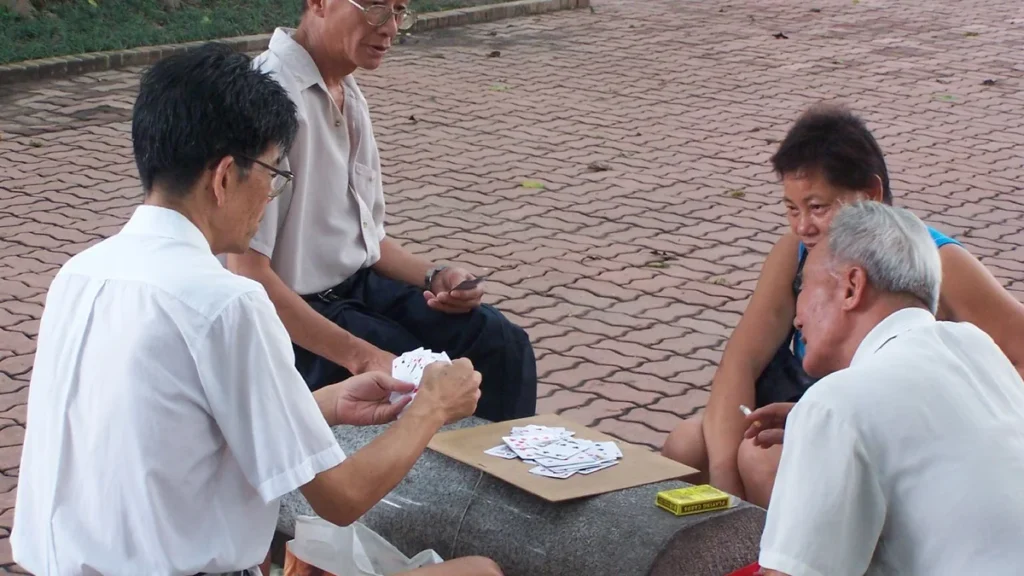
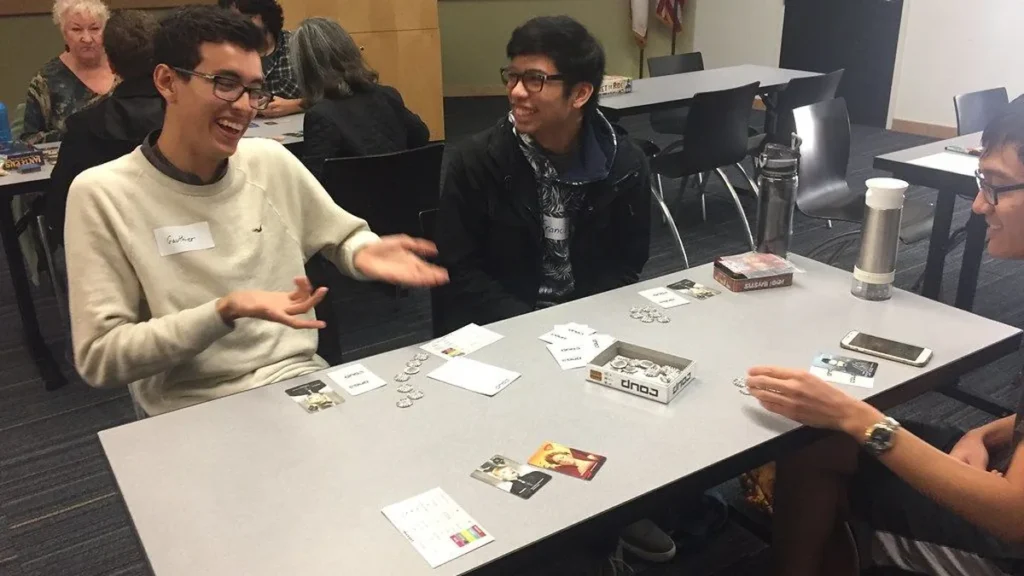
Planning a card game night for 109 players sounds impossible at first. Most card games are built for two to ten people, and even the biggest party games top out long before triple digits. Yet a group of 109 players is exactly the kind of crowd that shows up at school gatherings, company parties, family reunions, and community fundraisers — and with the right plan, every single person can play and have a genuinely good time.
The secret is that the best card games for 109 players are not played at one giant table. No single card game seats 109 players, and any plan that pretends otherwise will fall apart within minutes. Instead, the winning approach splits the crowd into small tables, runs the same game everywhere at once, and connects the tables with a shared scoreboard, a tournament bracket, or a whole-room team format.
This guide covers the card games that scale best to 109 players, the three formats that make a huge group work, a step-by-step setup plan, and a scoring system that keeps all 109 players engaged from the first shuffle to the final round. Whether you are organising a fundraiser, a team-building day, or a big family game night, you will find a format here that fits your room, your budget, and your players.
Key takeaways
- No single card game seats 109 players — plan for multiple tables, a tournament, or whole-room team play.
- Split 109 players into tables of 4 to 6, run the same game at every table, and connect them with one shared scoreboard.
- Uno, Spoons, Cheat, President, Rummy, and team card games scale best because their rules are quick to learn and rounds are short.
- Bring one deck per table plus spares, and appoint one table host at every table.
- Short rounds, visible scores, and small prizes keep 109 players engaged far better than one long game.
Why No Single Card Game Seats 109 Players
It helps to be honest about the maths before planning anything else. A standard deck has 52 cards, and most card games deal each player a hand of 5 to 13 cards. Even if every card went to a different player, a single deck could only serve about ten people, and the game itself would collapse long before that point. Turns would take forever, and most players would spend the evening waiting rather than playing.
Party card games are no different. Games built for big groups usually list a maximum of 10, 12, or 20 players, because the fun depends on everyone being able to see the cards, hear the calls, and take a turn in reasonable time. Stretch a game to 109 players at one table and a five-minute round takes an hour. People drift away, side conversations take over, and the game quietly dies.
That does not mean 109 players cannot enjoy card games together. It means the game has to change shape. The most successful large-group card nights treat the crowd as many small games happening at the same time, tied together by a shared structure. Think of it like a sports league: dozens of matches run at once, but everyone is part of the same competition. Once you accept that, choosing the best card games for 109 players becomes much easier.
The Three Formats That Actually Work for 109 Players
Every successful 109-player card night uses one of three formats, and many use a mix of all three across the evening. Pick the format first, then choose the games that fit it.
Multiple Tables, One Game
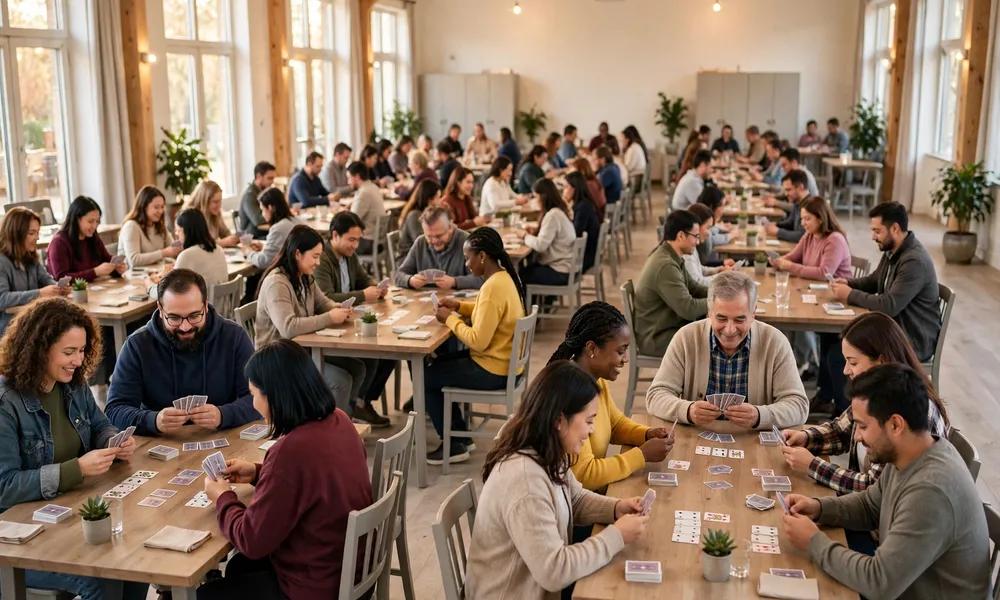
The simplest format is also the most reliable. Divide 109 players into tables of 4 to 6, set up 18 to 27 tables, and run the same game at every table at the same time. Each table plays its own short rounds, and after every round the winners earn points for a shared leaderboard. A host at the front calls the start and end of each round.
This format works because every player is always in a real game with a small group, exactly the way card games are meant to be played. The shared leaderboard adds the big-event feeling without slowing anything down. It suits Uno, Rummy, Cheat, and President especially well, since all four use short rounds and simple scoring.
Tournament and Relay Play
A tournament format adds drama. Players start at tables of 4 to 6, and after each round the winners move up to a higher table while others stay put or move down. After several rounds, the top tables hold the strongest players, and the final is played at one showcase table in front of the whole room. Spoons is the classic tournament card game for a crowd, because its elimination rounds are fast, noisy, and easy for spectators to follow.
Relay play is a useful variation when tables are scarce. Teams take turns at a smaller number of tables, with teammates swapping in between rounds. It keeps everyone involved even when there are not enough tables for 109 people at once, and the team element gives waiting players something to cheer about. Relay formats work best with quick games such as Spoons, Go Fish, or short rounds of Uno.
Whole-Room Team Games
The third format turns the entire room into the game. Players sit in teams of 8 to 12, and each team plays as one unit. In team versions of games like Cheat, teammates discuss their moves together and submit one team decision per turn. In social deduction card games, the whole room plays a single game with roles handed out on cards, and the drama comes from 109 people trying to work out who is bluffing.
Whole-room games are the best choice for the opening or closing of the evening, because they create shared moments that the whole crowd remembers. They need a confident host with a microphone and clear rules, since 109 people all listening at once is a challenge of its own.
Best Card Games for 109 Players Compared
The table below compares the six card games that scale best to a crowd of 109 players. All six are cheap to set up, quick to learn, and proven in large groups.
| Game | Best format | Players per table | Decks needed | Round length | Best for |
|---|---|---|---|---|---|
| Uno | Multiple tables | 4 to 6 | About 22 decks | 10 to 15 minutes | All ages |
| Spoons | Tournament | 4 to 6 | About 22 decks | 5 to 10 minutes | High energy |
| Cheat | Multiple tables | 4 to 6 | About 22 decks | 10 to 15 minutes | Bluffing fans |
| President | Multiple tables | 4 to 6 | About 22 decks | 10 minutes | Competitive groups |
| Rummy | Multiple tables | 4 to 6 | About 27 decks | 15 to 20 minutes | Classic players |
| Team deduction cards | Whole room | 8 to 12 per team | About 11 decks | 20 to 30 minutes | Big finales |
Uno
Uno is the safest pick for 109 players, and the easiest to explain to a mixed crowd. Almost everyone has played it, the rules fit on one page, and a round takes ten to fifteen minutes. Set up tables of 4 to 6 players, give each table one Uno deck, and run timed rounds of fifteen minutes. Players score points for the cards left in opponents’ hands, and the highest scorers move up the leaderboard.
For 109 players, buy or borrow about 22 Uno decks — one per table, plus a few spares. If that is too costly, standard playing cards can stand in for a simplified version. The main risk with Uno at scale is slow play, so appoint a table host at each table to keep the pace brisk and settle disputes quickly.
Spoons
Spoons is the loudest, fastest game on this list, and the best choice for a tournament. Each table plays with a deck of cards and one fewer spoon than players. Players pass cards around the table, and when someone collects four of a kind, they grab a spoon — and everyone else scrambles for the rest. The player left without a spoon is out, and play restarts until one winner remains at each table.
Because a round lasts only five to ten minutes, a Spoons tournament can run several heats in an hour. Table winners advance to new tables, and the final is played at a central table while the whole room watches. You will need about 22 decks and roughly 100 spoons, making Spoons one of the cheapest large-group games to set up. It is also the most physical game here, so keep tables spaced apart.
Cheat
Cheat, also known as I Doubt It, is a bluffing game that works beautifully with 109 players because the fun comes from the people, not the cards. Players take turns discarding cards face down and announcing what they played, and anyone can call out a suspected lie. Caught bluffers pick up the pile, and the first to empty their hand wins.
At each table of 4 to 6 players, a round of Cheat lasts ten to fifteen minutes, and the bluffing creates exactly the kind of laughter a big group night needs. Cheat uses a standard deck per table, so the equipment cost is minimal. Groups that enjoy Cheat often enjoy the lively, social energy of word games for adults at their next gathering. For shy players, Cheat is a gentle introduction to bluffing, since nobody has to perform.
President
President, sometimes called Scum, is built for competition, which makes it a natural fit for a leaderboard night. Players race to shed all their cards, and the finishing order decides their rank: the first player out becomes President, the last becomes Scum, and ranks carry small advantages into the next round. The ranking system gives every round a sense of progress, and players can see themselves climbing or falling.
President plays best at tables of 4 to 6 with a standard deck, and rounds last about ten minutes. The game is slightly more complex than Uno, so give each table a printed rules card and a host who has played before. It is worth the extra explanation, because President produces the most invested players on this list.
Rummy
Rummy is the classic choice for groups that include experienced card players and older guests. Players build sets and runs from their hands, and the game rewards memory and planning more than luck. For 109 players, use two decks per table of 4 to 6 — about 27 decks in total — and play timed rounds of fifteen to twenty minutes.
Rummy rounds run longer than the other games here, so it suits a relaxed evening rather than a high-energy tournament. It is also the best game on this list for mixed generations, since grandparents and teenagers can compete on equal terms. If your crowd includes many first-time players, pair Rummy tables with quicker games elsewhere in the room.
Team Deduction Card Games
For a finale, nothing beats a whole-room team deduction game. Divide 109 players into teams of 8 to 12, hand out role cards, and let the room play a single social deduction game together. One team tries to identify the hidden roles, the other tries to stay hidden, and every team discusses its moves before acting. The scale of it — a hundred people arguing, bluffing, and voting — is something a small group can never match.
Team deduction games need one deck per team, a host with a microphone, and a room where every team can hear the calls. Rounds last twenty to thirty minutes, so plan for one or two games at most. If your group enjoys this format, it is worth exploring board games built for 109 players as well, since many use the same team structure. Save it for the end of the evening, when the room is warmed up.
How to Set Up 109 Players in Under 30 Minutes
Setup is where large-group card nights succeed or fail, and the difference is preparation done before anyone arrives. Count your players in advance, plan 18 to 27 tables of 4 to 6 players, and label every table with a number and a game. Lay out one deck per table, a printed rules card, a score sheet, and a pen before the doors open. When players arrive, hand each person a wristband or name tag showing their starting table, and they will seat themselves without a queue forming at the door.
Recruit one table host per table from your most reliable players, and brief them the day before. A table host deals the first round, keeps the pace moving, records scores, and settles disputes. Without hosts, the first round can take twenty minutes to start; with them, it starts in five. Put a large leaderboard where everyone can see it — a whiteboard, a projector, or a printed sheet updated between rounds — because visible scores turn separate tables into one shared event.
Plan the timing in blocks. A typical evening runs as follows: fifteen minutes for arrival and seating, a five-minute welcome and rules briefing, four to six rounds of fifteen minutes each, a ten-minute break, and a twenty-minute final with prizes. That fills about two and a half hours and leaves room for delays. Keep spare decks, extra score sheets, pens, tape, and scissors at the host table, and you will handle most problems without leaving the room.
Scoring and Prizes That Keep 109 People Engaged
Scoring for 109 players has to be simple enough to update between rounds and fair enough that nobody feels cheated. The easiest system is points per round: the table winner earns 5 points, second place earns 3, third earns 2, and everyone else earns 1 for playing. After each round, table hosts hand their score sheets to the scorekeeper, who updates the leaderboard while the next round begins.
For a tournament, use advancement instead of points. Table winners move to a higher table, and after three or four rounds the top eight players meet in a final. This format is easy to follow from the audience side, and it gives the evening a clear climax. Announce the standings between rounds and celebrate small milestones — the highest score so far, the fastest round, the best bluff — so the room stays noisy and involved.
Prizes should be small, fun, and plentiful. With 109 players, one big prize leaves 108 people empty-handed, so spread the budget across many small prizes: a deck of cards, a box of sweets, a funny trophy, or a gift voucher. Award prizes for the overall winner, the best team, the best sport, the funniest bluff, and the most improved player. Small prizes cost little and give far more people a reason to keep playing hard in the final rounds. The same tables and scoring ideas also work for card games for 108 players.
Checklist: Your 109-Player Card Game Night
- Count your players and plan 18 to 27 tables of 4 to 6 players, with a game assigned to each table.
- Bring one deck per table plus spares — about 22 standard decks, or 27 for Rummy — and a printed rules card per game.
- Recruit and brief one table host per table, and give every player a wristband or tag showing their table.
- Set up a visible leaderboard and a simple scoring system before the first round.
- Plan short rounds of 10 to 20 minutes with a break in the middle, and a whole-room final to end it.
- Prepare many small prizes so winners, best teams, and funniest players all go home with something.
Frequently Asked Questions
Can 109 players really play card games together?
Yes, but not at one table. Split 109 players into tables of 4 to 6, run the same game at every table, and connect them with a shared leaderboard or tournament bracket. Everyone plays a real game while still being part of one big event.
What is the best card game for 109 players?
Uno is the best all-round choice because almost everyone knows it, rounds are short, and it suits all ages. Spoons is the best choice for a high-energy tournament, and team deduction card games are the best choice for a finale.
How many decks do I need for 109 players?
Plan for one deck per table, which means about 22 decks for 18 to 27 tables of 4 to 6 players. Rummy needs two decks per table, so about 27 decks. Always bring a few spares.
How long does a 109-player card game night take?
A full evening takes about two and a half hours: fifteen minutes for seating, a short briefing, four to six rounds of fifteen minutes, a ten-minute break, and a twenty-minute final.
What if I do not have enough tables for 109 players?
Use relay play, where teams take turns at fewer tables, or run a whole-room team game that needs no tables at all. You can also split the evening into two sessions, with half the group playing while the other half socialises, then swapping.
Are card games for 109 players suitable for children?
Yes, if you choose the right games. Uno, Go Fish, and Spoons all work well for mixed-age groups, and children can play at family tables with adults. Keep rounds short and explain the rules clearly.
The Bottom Line
The best card games for 109 players are not about finding one magical game that seats a hundred people. They are about choosing simple, fast, well-loved games — Uno, Spoons, Cheat, President, Rummy, and team deduction cards — and giving them a structure that fits the crowd: small tables, short rounds, a visible leaderboard, and a finale the whole room can share. Plan the tables, brief your hosts, bring enough decks, and keep the rounds moving.