Finding puzzle games for 14 players takes a different approach than picking a game for a quiet evening with four friends. Most puzzle games are designed for small groups, so a party of fourteen needs games that split neatly into teams, run in parallel, or turn the whole room into one big solving crew. The good news is that the best options are also the most fun: escape-room boxes, team word puzzles, and cooperative deduction games all get better when more brains are in the room.
The trick is structure. Fourteen players work best as two teams of seven, or as one large group with clear roles so nobody sits on the sidelines. The games on this list are chosen because they scale that way, whether through parallel copies, team play, or a shared puzzle that everyone can work on at once.
Whether you are planning a family reunion, a work social, a birthday party, or a game night with a big friend group, this guide covers the full range. You will find escape-room-style boxes, word puzzles, picture puzzles, and deduction games, plus a simple plan for running them so the evening flows and every player gets a real part to play.
Key takeaways
- Split fourteen players into two teams of seven for most puzzle games, and run the same game in parallel for a friendly race.
- Escape-room boxes such as EXIT and Unlock! work best for fourteen when each team gets its own copy and a shared timer.
- Team word and picture games like Codenames, Decrypto, and Dixit scale naturally to large groups without extra copies.
- Give every player a role, such as clue reader, note taker, or timekeeper, so nobody is left watching from the sidelines.
- Plan for ninety minutes to two hours of play, with a short break between rounds to keep energy high.
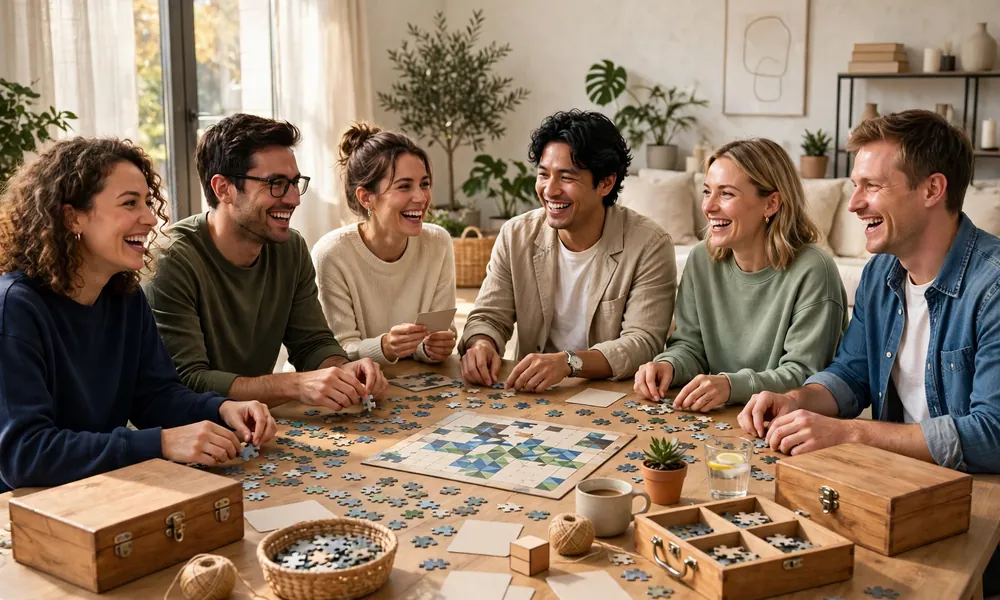
Why Puzzle Games Work So Well for 14 Players
Puzzle games suit large groups because the challenge is shared. Unlike a competitive board game where half the table waits for a turn, a good puzzle gives everyone something to examine, discuss, and solve at the same time. Fourteen minds bring fourteen different ways of seeing a clue, and that variety is exactly what makes a hard puzzle click.
Large groups also make puzzle games more social. Players talk, argue over theories, and celebrate together when a code finally cracks. The best nights feel less like a structured game session and more like a team adventure, with the puzzle as the excuse to work together.
The main risk with fourteen players is dead time. A single puzzle that only two people can touch at once will bore the other twelve. That is why the games in this guide either divide cleanly into teams or spread the solving across the whole table.
How to Run Puzzle Games for 14 Players
Start by dividing the group before the first game begins. Two teams of seven is the simplest split, and it works for almost every game on this list. Give each team a name, a table, and a captain who keeps the group focused and makes the final call when opinions split.
For escape-room boxes, buy two copies of the same game so both teams race the same puzzle. For word and picture games, one copy is usually enough because the whole group plays together in two large teams. Jigsaw races and puzzle hunts work the same way, with each team tackling an identical challenge side by side.
Set a clear timer and a visible scoreboard. A sixty-minute escape-room race, a best-of-three word game, or a timed jigsaw build all give the evening a shape. Keep rounds short, rotate roles between games, and let the winning team pick the next game. If you want ideas for a slightly smaller crowd first, the puzzle games for 13 players list uses the same team format and several of the same titles.
Team Setup That Keeps Everyone Involved
Assign roles inside each team of seven. One player reads clues aloud, one tracks the timer, one writes down codes and partial answers, and the rest work the puzzle itself. Rotate the reader and the note taker every fifteen minutes so the same people are not stuck in support roles all night.
Mix skill levels across the teams rather than stacking all the strongest puzzlers together. A balanced split keeps the race close, and a close race keeps both teams engaged until the final clue. If one team finishes early, let its players become hint givers for the other team rather than spectators.
Timing and Space for a Big Group
Plan for at least two tables, or one very large table with clear zones for each team. Escape-room boxes need space to spread cards and props, while jigsaw races need a full table each. A living room with two tables works well, and a dining room with a long table can host a whole-group word game with ease.
Allow ninety minutes to two hours for the main event, plus time for snacks and a warm-up round. A short, easy puzzle at the start settles nerves and teaches new players how the group works together. Save the hardest box for last, when the teams are warmed up and communicating well.
The 12 Best Puzzle Games for 14 Players
These twelve picks cover the full range of puzzle play, from escape-room boxes to word games, picture games, and deduction challenges.
1. EXIT: The Game – The Abandoned Cabin
EXIT is the classic escape-room-in-a-box series, and The Abandoned Cabin is one of the best starting points. A team decodes riddles, combines strange items, and works through a chain of puzzles to escape. It is designed for one to four players per box, which makes two copies the perfect setup for fourteen players split into two teams of seven.
Players: 1 to 4 per box, 14 with two copies and seven per team. Play time: 60 to 90 minutes per box. Why it fits: both teams race the identical puzzle, so the finish is a fair contest and the post-game comparison of solutions is half the fun.
2. Unlock! Escape Adventures
Unlock! pairs a deck of cards with a free companion app that handles timers, hints, and hidden codes. The cards are easy to pass around a big table, and the app keeps the game moving without a human game master. Run two copies in parallel and fourteen players become two racing teams of seven.
Players: 1 to 6 per box, 14 with two copies. Play time: 60 minutes per scenario. Why it fits: the app manages hints and the clock, so no player has to sit out to run the game, and the card-based puzzles are easy to share across a large team.
3. Escape Room in a Box: The Werewolf Experiment
This is a bigger, more physical escape-room box, with locks, props, and puzzles that fill a table. It supports up to eight players per box, so two copies comfortably cover fourteen. The werewolf theme adds a story hook that gets even quiet players talking and guessing.
Players: 2 to 8 per box, 14 with two copies. Play time: 60 to 90 minutes. Why it fits: the physical props give hands-on players something to do while the code breakers work, so a team of seven stays busy.
4. Codenames
Codenames is the large-group puzzle game. Two teams race to identify their secret words from a grid, guided by one-word clues from their spymaster. It officially supports up to eight or more players, and with fourteen you simply field two big teams and let everyone debate each clue. Few games scale this gracefully.
Players: 2 to 8 or more, easily 14 in two teams. Play time: 15 to 30 minutes per round. Why it fits: every player debates every clue, so nobody waits for a turn, and a best-of-three match fills an evening nicely. It also pairs well with other large-group picks, as the board games for 14 players guide shows.
5. Decrypto
Decrypto is a team word puzzle where each side tries to crack the other team’s secret four-digit code from cryptic word clues. It is a thinking game that rewards careful listening and lateral leaps, and it thrives on group debate. Fourteen players split into two teams of seven, with each team huddling over its secret words.
Players: 3 to 8 per game, 14 in two teams with one copy. Play time: 15 to 45 minutes. Why it fits: the whole team works on every clue together, so a big group makes the puzzle richer rather than slower.
6. Mysterium
Mysterium turns one player into a ghost who sends dream-like picture cards as clues, while the rest of the team interprets them to solve a murder. It is cooperative, atmospheric, and wonderfully talkative. With fourteen players, run two copies side by side, or let the whole group play one game with two ghosts and two sets of suspects.
Players: 2 to 7 per box, 14 with two copies. Play time: 45 to 60 minutes. Why it fits: the picture clues spark long, lively debates, and the cooperative format means the whole team wins or loses together.
7. Dixit
Dixit is a picture puzzle built on imagination. Each round, one player gives a clue for a beautiful illustrated card, and everyone else tries to match it. The scoring rewards clues that are clever but not obvious, which makes for brilliant group discussion. It plays up to twelve out of the box, and a fourteenth player can join as a second storyteller or scorekeeper.
Players: 3 to 12, 14 with a shared storyteller role. Play time: 30 to 45 minutes. Why it fits: the open-ended clues suit mixed-age and mixed-skill groups, and every round gives the whole table something to laugh about.
8. Wavelength
Wavelength asks teams to guess where a hidden target sits on a spectrum, from hot to cold, or from simple to complex. One player gives a clue, and the team debates the answer together. It is quick, funny, and almost impossible to play badly, which makes it a perfect warm-up or wind-down game for fourteen.
Players: 2 to 12, 14 in two teams. Play time: 20 to 40 minutes. Why it fits: the debate is the game, so a bigger team means better arguments and funnier clues, with no downtime at all.
9. Sherlock Holmes Consulting Detective
This is a pure deduction puzzle in a box. Teams read case books, study maps and newspapers, and follow leads around Victorian London to solve a mystery. It is designed for one to eight players, so two copies let fourteen players run two rival detective agencies in a race to the right answer.
Players: 1 to 8 per box, 14 with two copies. Play time: 60 to 120 minutes per case. Why it fits: the reading and discussion split naturally across a team of seven, with different players following different leads and reporting back.
10. Chronicles of Crime
Chronicles of Crime mixes physical cards with a phone app that shows crime scenes in virtual reality. Players scan locations, question suspects, and piece together evidence. The app-led format keeps the game moving, and the visual scenes give the whole team something to crowd around and examine.
Players: 1 to 4 per box, 14 with two or more copies. Play time: 60 to 90 minutes per case. Why it fits: the shared phone screen focuses the team, while the card evidence spreads across the table for everyone to study.
11. Hunt A Killer
Hunt A Killer is a subscription mystery box that arrives as a monthly episode of evidence: letters, photos, ciphers, and objects tied to one ongoing case. For a group of fourteen, work through a single episode as two teams racing to the same solution, or let the whole group tackle it together over a long evening. It is one of the most story-rich puzzle experiences available.
Players: 1 to 6 per box, 14 in two teams. Play time: 60 to 120 minutes per episode. Why it fits: the pile of physical evidence divides easily between players, and the ongoing story gives a big group a reason to meet again next month.
12. Team Jigsaw Puzzle Race
A jigsaw race is the simplest large-group puzzle of all. Give each team of seven an identical 1,000-piece puzzle, set a timer, and see who finishes first. Sorting edge pieces, hunting for colours, and building sections in parallel uses every player at once. It is quiet, absorbing, and surprisingly competitive.
Players: any number in teams, 14 as two teams of seven. Play time: 60 to 120 minutes for 1,000 pieces. Why it fits: a jigsaw has no turns and no waiting, so fourteen players are all solving from the first minute to the last piece.
Best Puzzle Games for 14 Players at a Glance
Use this table to compare the twelve picks quickly. Team size shows how fourteen players split, and the copies column tells you what to buy or borrow before the night.
| Game | Players per copy | Play time | Copies for 14 | Best for |
|---|---|---|---|---|
| EXIT: The Abandoned Cabin | 1 to 4 | 60 to 90 min | 2 | Escape-room race |
| Unlock! Escape Adventures | 1 to 6 | 60 min | 2 | App-led escape room |
| Escape Room in a Box | 2 to 8 | 60 to 90 min | 2 | Physical props |
| Codenames | 2 to 8 or more | 15 to 30 min | 1 | Word team play |
| Decrypto | 3 to 8 | 15 to 45 min | 1 | Code cracking |
| Mysterium | 2 to 7 | 45 to 60 min | 2 | Cooperative pictures |
| Dixit | 3 to 12 | 30 to 45 min | 1 | Creative clues |
| Wavelength | 2 to 12 | 20 to 40 min | 1 | Quick warm-up |
| Sherlock Holmes Consulting Detective | 1 to 8 | 60 to 120 min | 2 | Deep deduction |
| Chronicles of Crime | 1 to 4 | 60 to 90 min | 2 | App crime scenes |
| Hunt A Killer | 1 to 6 | 60 to 120 min | 1 to 2 | Story mystery |
| Team jigsaw race | Any team size | 60 to 120 min | 2 puzzles | Relaxed solving |
How to Choose the Right Puzzle Game for Your Group
Match the game to the mood of the night. A high-energy birthday crowd will love the race format of EXIT or a jigsaw build, while a quieter family gathering may prefer the gentle discussion of Dixit or Mysterium.
Consider age and experience as well. Word-heavy games such as Decrypto and Sherlock Holmes Consulting Detective suit confident readers, while picture games such as Dixit and Mysterium work across ages and language levels.
Think about the room, too. Escape-room boxes need table space and a little privacy between teams so nobody overhears the other side’s solution. Word and picture games need only one table and a clear view of the shared cards. If you are short on space, a single-copy game such as Codenames is the safest pick, and it sits naturally alongside other large-group favourites, including the party games for 14 players that many hosts run on the same night.
Checklist for a 14-Player Puzzle Night
Run through this checklist the day before so the evening itself is all play and no scrambling.
- Split the guest list into two teams of seven and share the team names in advance.
- Buy or borrow the second copy of any escape-room box so both teams race the same puzzle.
- Set up two tables with enough space for cards, props, and notebooks.
- Charge phones and tablets for app-led games, and test the companion app before guests arrive.
- Prepare a visible timer and a simple scoreboard for the night.
- Plan snacks, drinks, and a short break between games to keep energy up.
Frequently Asked Questions
What is the best puzzle game for 14 players?
Codenames is the easiest all-round pick, because it is built for two large teams and every player is involved in every clue. For a bigger event, pair it with two copies of EXIT or Unlock! so the night has both a quick word game and a full escape-room race.
Can fourteen players play an escape room game at home?
Yes, with two copies of the same box. Split into two teams of seven, start both teams at the same time, and compare finish times. The race format is fair, keeps both teams busy, and makes the post-game discussion much livelier.
How long should a puzzle night for 14 players last?
Plan for ninety minutes to two hours of play, plus arrival time and a break. One sixty-minute escape-room round plus two or three short word games fills an evening well without tiring the group.
Do puzzle games work for mixed ages?
Yes, especially picture-based games such as Dixit, Mysterium, and Wavelength, which rely on imagination rather than vocabulary. For mixed-age groups, seat younger players with an experienced teammate who can talk through the clues with them.
What if some players have never played a puzzle game?
Start with Wavelength or Codenames, which take about two minutes to explain. Once new players have had a quick win, they will be far more confident tackling a longer escape-room box or deduction case.
How do I stop one team from overhearing the other?
Seat the teams at separate tables, or in different corners of the same room, and ask teams to discuss clues quietly. For escape-room boxes, the identical puzzles mean overhearing a solution would spoil the race, so a little distance is worth arranging.
The Bottom Line
Puzzle games for 14 players work best when the group splits into two teams of seven and the game gives everyone a job. Codenames is the simplest large-group pick, EXIT and Unlock! deliver the best escape-room race with two copies, and a jigsaw race is the easiest way to keep all fourteen players solving at once. Pick one team game and one race game, set a timer, assign roles, and the group size stops being a problem and becomes the best part of the night.