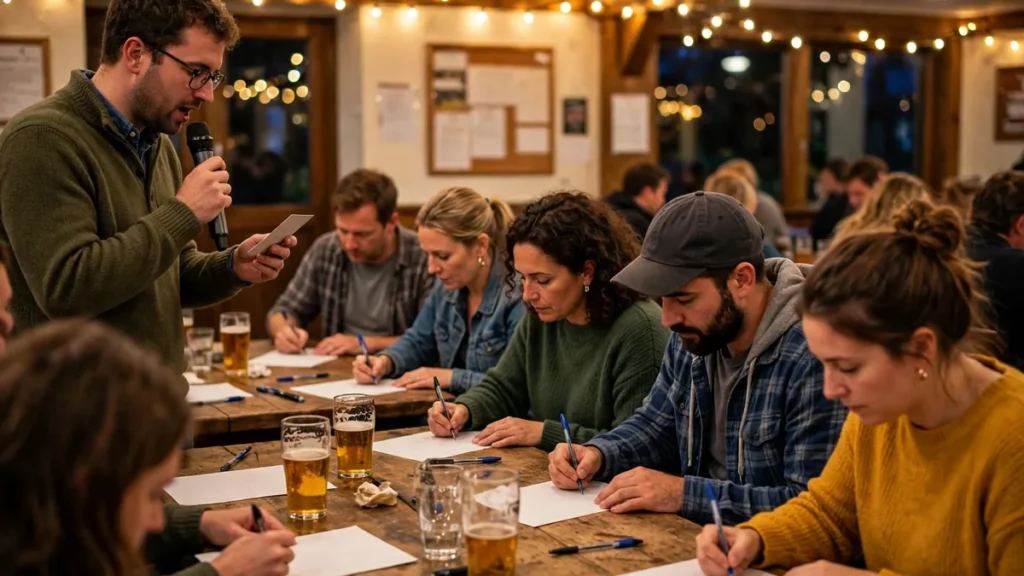
Four hundred and forty-eight players in one room sounds impossible for board games, and in a way it is. But a game night for 448 players is not one giant game. It is ninety tables playing at the same time, connected by one shared schedule, one scoring system, and one room full of energy that no small game night can match.
The trick is to stop thinking about one game and start thinking about one event. Each table of four or five players runs its own copy of a game, and the tables compare results at the end of each round. Nobody waits for 447 other people to take a turn. Everybody plays at once, everybody finishes at roughly the same time, and the room stays loud in the best possible way.
This guide shows you exactly how to do it. You will find nine games that work brilliantly at this scale, three formats that keep ninety tables moving together, a setup plan, a checklist,.
Key takeaways
- Split 448 players into about 90 tables of five, and run the same game on every table at the same time.
- Pick games that finish in under an hour and teach in under ten minutes, so every table stays in step.
- Use one shared scoring sheet so tables can be ranked against each other without slowing the night down.
- Appoint one helper for every ten tables to answer rules questions and keep rounds on schedule.
- Rotate games between rounds so players meet new opponents and nobody is stuck with one game all night.

How 448 Players Actually Play Together
The maths is simple, and it is the first thing to get right. Divide 448 players into tables of five and you need ninety tables, with two tables seating four. Tables of five are the sweet spot for most of the games in this guide: large enough to feel social, small enough that nobody waits long between turns.
Every table plays the same game in the same round. That shared game is what turns ninety separate tables into one event. When a table finishes, its players record their scores on a shared sheet or a simple form, and the best scores feed into a leaderboard. The leaderboard connects them.
Timing matters more than the choice of game. A round should last forty-five to sixty minutes, including teaching time. Games that run longer leave fast tables sitting idle and slow tables feeling rushed. Choose games that end on a fixed number of rounds or a clear trigger, so the whole room finishes within a few minutes of each other. A short break between rounds lets players stretch and swap tables.
The Team Format
In the team format, each table is a team, and the table’s combined score counts. This is the friendliest format for a mixed crowd, because a new player is never exposed on their own. Strong players lift their table, and beginners learn by watching the people sitting next to them. Teams keep the same name all night, which makes the leaderboard easy to follow and gives the room something to cheer for.
Team play also solves the teaching problem. You do not need to teach 448 people individually. You teach one captain per table, and the captain teaches the other four. A short captain briefing and a one-page rules summary per table are enough.
The Station Format
In the station format, the room is divided into zones, and each zone runs a different game. Tables rotate between stations each round, so every player tries several games over the night. This format suits a crowd that wants variety more than competition, and it is the best choice when your game library is wide but shallow, with only a few copies of each title.
Stations need clear signs and a simple rotation map. Number the stations, print the rotation on the back of every name badge, and announce each move with a bell. Stagger the move to avoid congestion: odd tables first, even tables thirty seconds later.
The Tournament Format
In the tournament format, tables are ranked after each round, and the top players move up to stronger tables while the rest stay put or move down. It is the most competitive of the three formats, and it works best when your crowd already knows the games. Winners feel the climb, and nobody is trapped at a table where they are out of their depth.
Tournament play needs a little more administration, so keep the movement simple. After each round, the winner of each table moves one table up and the lowest scorer moves one table down. If your crowd is mostly beginners, save this format for the final round, when everyone has had a practice game.
The 9 Best Board Games for 448 Players
The nine games below were chosen for a crowd of 448 for the same reasons: they teach fast, they finish in under an hour, they stay interesting when the whole room is playing them at once, and they work at tables of four or five. Each one brings something different to the night, from quiet route-building to loud party guessing.
| Game | Players per table | Playing time | Best for |
|---|---|---|---|
| Ticket to Ride | 2 to 5 | 30 to 60 minutes | First-time players |
| Carcassonne | 2 to 5 | 35 minutes | Quiet, thoughtful tables |
| Pandemic | 2 to 4 | 45 minutes | Teamwork |
| Forbidden Island | 2 to 4 | 30 minutes | Quick cooperative rounds |
| Dixit | 3 to 6 | 30 minutes | Creative, chatty groups |
| Splendor | 2 to 4 | 30 minutes | Fast, tense decisions |
| The Resistance | 5 to 10 | 15 to 30 minutes | Big, loud tables |
| Wavelength | 2 to 12 | 20 to 40 minutes | Party atmosphere |
| Telestrations | 4 to 8 | 30 minutes | Laughing together |
Before you read the list, it helps to know how the night fits together. The games in this list work well with the same approach used for board games for 446 players, where every table runs the same game in the same round and the room shares one leaderboard.
1. Ticket to Ride
Ticket to Ride is the safest opening game for a crowd of 448, because almost anyone can learn it in five minutes. Players collect coloured train cards and claim routes between cities on a map, trying to complete the destination tickets in their hand. The rules fit on a single page, the turns are quick, and there is very little a new player can do wrong. That matters when ninety tables are learning at the same time.
At a table of five, a game lasts about forty-five minutes, which fits the round length perfectly. Scoring is simple: points for each route claimed, points for completed tickets, and a bonus for the longest continuous route.
2. Carcassonne
Carcassonne is a tile-laying game where players build a shared map of cities, roads, fields, and monasteries, placing their followers to claim features as the landscape grows. It is quiet, thoughtful, and surprisingly tense, because every tile drawn can help you or help the player across the table. There is no direct conflict, which makes it a good choice for tables where people have only just met.
A five-player game finishes in about thirty-five minutes, leaving time for a rematch or a relaxed break. Keep a few spare copies on hand, because the tiles are small and a lost tile can stall a table.
3. Pandemic
Pandemic turns each table into a team fighting the same enemy: four diseases spreading across a world map. Players take different roles, such as the medic or the scientist, and work together to find cures before outbreaks overwhelm the board. Nobody wins alone, and nobody loses alone, which makes it the best cooperative game on this list for a huge group.
Cooperative games solve a real problem at a 448-player event. Competitive games can leave a table with one unhappy loser, but Pandemic leaves a table with a shared result to talk about. The difficulty can be tuned with epidemic cards, so early rounds can be gentle.
4. Forbidden Island
Forbidden Island is a smaller, faster cooperative game, and it is the best choice when a round needs to be short. Players are treasure hunters on a sinking island, collecting four treasures and escaping by helicopter before the island disappears under the water. The rules take five minutes to teach, and a game rarely lasts more than half an hour.
The sinking-island mechanism keeps every table on the same clock, because the island floods a little more on every turn. Tables cannot stall, and the game ends decisively, win or lose.
5. Dixit
Dixit is a game of pictures and imagination. One player gives a clue for a beautifully illustrated card, the other players choose cards from their own hands that match the clue, and everyone guesses which card was the storyteller’s. Points go to players who are clever but not too obvious, and the game rewards creativity over competition. It is the most social game on this list.
For a crowd of 448, Dixit is best in the middle of the night, when tables have relaxed and players are ready to talk. A game takes about thirty minutes, and the scoring is simple enough to record in seconds.

6. Splendor
Splendor is a game about gem trading in the Renaissance, and it is one of the fastest serious games you can put on ninety tables. Players collect gem tokens, buy development cards, and attract noble patrons, racing to fifteen points. There is no board to set up, no dice to roll, and almost no luck after the opening shuffle. Every turn takes seconds, and the whole game fits in half an hour.
That speed makes Splendor perfect for a tournament round, because tables finish close together and the results are easy to compare. The only warning is that the tokens are small and roll, so put a tray on each table to keep them contained.
7. The Resistance
The Resistance is a game of hidden roles and bluffing, and it is the loudest game on this list. Five to ten players sit around a table, most of them loyal members of a resistance group, but a few are secret spies trying to sabotage missions. Each round, players vote on a team, the team goes on a mission, and the spies decide in secret whether to help or to wreck it. Accusations fly, and the room gets very noisy.
That noise is exactly why it belongs in a 448-player night. After two quiet rounds, a game of The Resistance wakes the whole hall up. A full game takes twenty to thirty minutes, and it needs no board at all, just the cards.
8. Wavelength
Wavelength is a party game built around one simple idea: a target hidden somewhere on a spectrum between two opposite concepts, such as hot and cold, or boring and exciting. One player gives a clue to guide the group toward the target, and the rest of the table debates where it sits. The discussion is the game, and the best moments come when two players argue passionately about whether a sandwich is more hot than cold.
Wavelength works at tables of up to twelve, which makes it the most flexible game on this list for uneven numbers. When a few players are left over after seating, Wavelength absorbs them without a fuss.
9. Telestrations
Telestrations is a drawing game that plays like a game of telephone. Each player writes a secret word, passes it on, and the next player draws it. The drawing is passed on, the next player guesses what it shows, and the chain continues until the sketchbook returns to its owner. The results are almost always funny, and the worse the drawing, the better the game.
Telestrations needs no skill to enjoy, which makes it the most welcoming game on the list for people who have never played a modern board game. A full game takes about thirty minutes, and the sketchbooks and markers are cheap enough to buy in bulk for ninety tables.
Setting Up 90 Tables Without Chaos
The setup is where a 448-player night is won or lost, and it starts the day before, not the morning of the event. Lay out the tables in rows of ten, with a wide aisle down the middle for helpers to walk. Put a number card on every table, a rules summary for the first game, a scoresheet, and a pen.
Helpers are the second pillar of the setup. You need about nine helpers for ninety tables, one for every ten tables, plus two at a central desk for scoring and questions. Brief them the night before, give each one a coloured lanyard so players can spot them, and assign them a fixed zone so they learn their tables. Helpers need the rules summaries and a way to call the central desk.
The final pillar is the schedule on the wall. Print the night as a simple timetable: doors open, round one, break, round two, break, round three, results. Put it on the wall at the entrance and on every table, and stick to it. If a round overruns, cut the break short rather than the next game.
If you are planning a series of large game nights, the same structure scales down as well as up. The approach for board games for 444 players uses the same ninety-table layout and the same helper ratio, so a team that has run one of these nights can run the other with almost no changes.
Checklist: Your 448-Player Game Night
Use this checklist in the week before the night, and again on the morning of the event.
- Book the hall and the tables. Confirm ninety tables, 448 chairs, and enough floor space for a wide central aisle before you invite anyone.
- Count the game copies. You need one copy of each game per table, plus five spares for lost pieces and damaged boxes.
- Print the paperwork. Rules summaries, scoresheets, table numbers, and the night’s timetable, one set per table.
- Brief the helpers. Nine floor helpers and two at the scoring desk, each with a zone, a lanyard, and a copy of the schedule.
- Test the sound and the timer. A microphone that reaches the back row and a visible countdown timer are worth more than any game on the list.
- Plan the ending. Decide how winners are announced, what the prizes are, and how the room clears out, before the first round starts.
Frequently Asked Questions
Can 448 players really play board games together?
Yes, if you think of it as ninety tables playing at the same time rather than one giant game. Each table runs its own copy of the same game, and a shared leaderboard connects the tables. Nobody waits for 447 other people.
How many tables do 448 players need?
About ninety tables of five players, with two tables seating four. Tables of five are the best balance for the games in this guide: turns stay quick, everyone gets involved, and the room is easy to lay out in neat rows.
How many helpers do I really need?
Nine floor helpers, one for every ten tables, plus two at a central scoring desk. Helpers answer rules questions, keep rounds on time, and collect scoresheets. With fewer helpers, small problems pile up and rounds overrun.
Which game should I start with?
Start with Ticket to Ride. It teaches in five minutes, finishes in about forty-five minutes, and suits complete beginners. A calm first round lets the room settle, lets captains learn their job, and lets helpers find the tables that need attention.
What if some tables finish much faster than others?
Fast tables record their scores, then play a short filler game or simply chat until the next round. Keep a few quick games, such as Forbidden Island or Wavelength, on a spare table for early finishers. Never start the next round early for the whole room, because slow tables will feel punished for playing properly.
How long does a night for 448 players take?
Plan for about four hours: thirty minutes for arrival and seating, three rounds of about fifty minutes each, two ten-minute breaks, and fifteen minutes for results and prizes.
For organisers who want to compare notes with a slightly smaller event, the guide to board games for 442 players follows the same four-hour shape, so the timings transfer directly.
The Bottom Line
A board game night for 448 players works when you treat it as ninety small game nights happening at once, joined by one schedule and one leaderboard. Choose games that teach in minutes and finish in under an hour, give every table a captain and every ten tables a helper, and keep the rounds on time. Do that, and 448 strangers will spend an evening playing, laughing, and asking when the next one is.