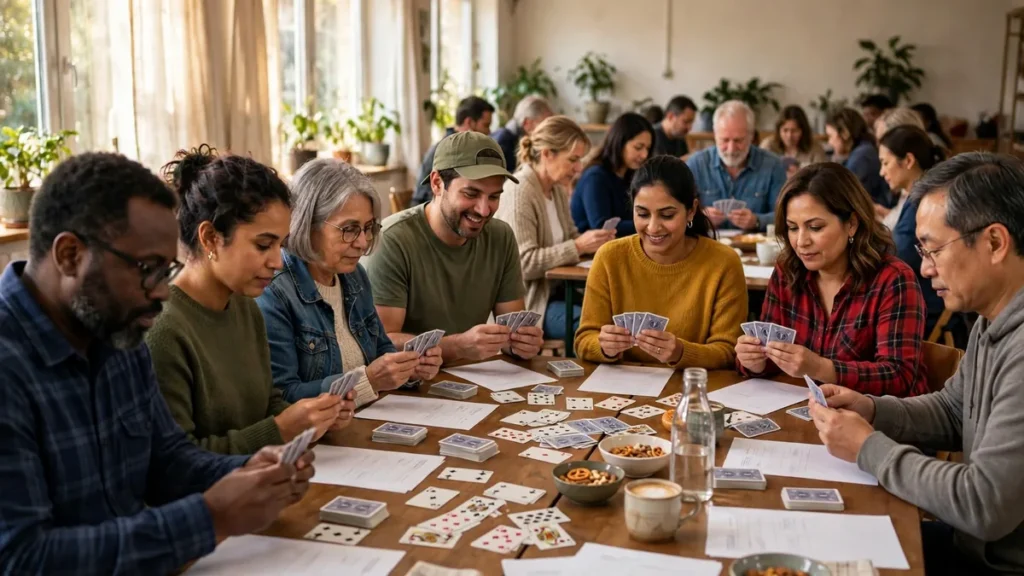
The best board games for 352 players are not games you buy in a single box and set up on one table. No ordinary board game seats 352 people, and no honest guide should pretend otherwise. The best board games for 352 players work because they scale: they run across many tables at once, split the crowd into teams, use simultaneous turns, and join every table into one shared scoreboard. When the format is right, 352 people stop feeling like a crowd and start feeling like one big game night.
Planning for a group this large changes every decision an organiser makes. A game that is brilliant for six friends can fall apart at this scale if it needs long individual turns, constant negotiation, or a single board that only a few people can reach. The games that succeed here are easy to explain in under five minutes, quick to reset between rounds, and fun even when each player controls only a small part of the result. They also give the host a clear way to keep score across dozens of tables, so the event still has a winner, a story, and a reason to keep playing.
This guide explains how to choose and run the best board games for 352 players, whether you are planning a school event, a company gathering, a community festival, a wedding weekend, or a large board game convention. You will find the formats that actually work at this size, the types of games to prioritise, a comparison table to help you decide, and a practical checklist for the day itself.
Key takeaways
- No single board game seats 352 players, so the best approach is parallel tables, team play, and one shared scoreboard.
- Choose games that can be explained in under five minutes and reset quickly between rounds.
- Split the crowd into teams of four to eight players, with each team playing the same game at the same time.
- Use simultaneous turns and short rounds so nobody waits long between moves.
- Keep score centrally and announce standings often to keep all 352 players invested in the result.

Why 352 Players Changes Everything
Most board games are designed for two to six players. The rules assume everyone can see the board, hear each other, and take turns in a reasonable amount of time. At 352 players, every one of those assumptions breaks. If each player took just thirty seconds per turn, a single round would take nearly three hours, and most of the room would be waiting rather than playing. That is why scale, not the game itself, is the first problem to solve.
The solution is to stop thinking of the event as one game and start thinking of it as many games played together. With 352 players, you might run forty-four tables of eight, or eighty-eight tables of four. Each table plays the same game, or a game from the same family, and every table reports its results to a central scoreboard. The room becomes a tournament, and the tournament becomes the game. This is the same approach used by large board game conventions, where hundreds of people play in parallel and the shared leaderboard keeps the energy high.
How to Run Board Games for 352 Players
Running a large board game event is a planning job before it is a games job. The best evenings follow a simple pattern: a short welcome, a clear explanation of the format, several short rounds, and a final round that brings the whole room together. Keep each round to twenty or thirty minutes so energy stays high and late arrivals can join the next round without disrupting the room.
Use Parallel Tables
Parallel tables are the foundation of any event for 352 players. Set up identical games at as many tables as you need, with one table host at each. Every table plays the same round at the same time, which means nobody is watching while others play. Table hosts explain the rules, keep the pace, and report scores. If you have forty-four tables, you need forty-four hosts or at least one host for every two tables, plus a small team of floaters who can answer questions and fix problems.
Identical setups also make the event fair. When every table plays the same game with the same rules, the scores mean something, and the best teams genuinely earn their place on the leaderboard. If you mix different games at different tables, you can still have a great evening, but compare scores loosely and celebrate table winners rather than crowning one overall champion. Both approaches work, and the right choice depends on whether your crowd cares more about competition or about trying something new.
Play in Teams
Teams turn a huge crowd into manageable groups. A team of four to eight players can discuss, decide, and play together without the chaos of a hundred people shouting at one board. Teams also solve the social problem of a large event: nobody has to find their own game or sit with strangers in silence, because the team gives everyone an instant group. Let people form their own teams where possible, and fill gaps with a friendly matching system at the door.
Keep One Shared Scoreboard
A shared scoreboard is what turns dozens of separate tables into one event. After each round, table hosts report their results to a central desk, and the standings go up on a screen or a large board where everyone can see them. Announce the top ten teams after every round, and save a small prize or a round of applause for the most improved team as well as the leaders. People play harder when they can see where they stand, and they stay longer when the result still feels open.
Keep the scoring simple. Award points for wins, bonus points for completing a challenge, and a small number of points for participation so that a team that loses early still has a reason to keep playing. Avoid scoring systems that need a calculator or a long explanation, because every minute spent on arithmetic is a minute not spent playing. A simple points table, updated after each round, is all you need.
The Best Board Games for 352 Players
The games below are not ranked by how good they are for a family of four. They are ranked by how well they scale to 352 players, how quickly they can be taught, and how much fun they create across a whole room. Each type works in the parallel-table, team-based format described above, and each one brings a different kind of energy to the event.
Quiz and Trivia Board Games
Quiz and trivia board games are the easiest large-group choice, and often the best place to start. The format is familiar to everyone, the rules need almost no explanation, and the game works just as well with eight players per table as with four. Teams answer the same questions at the same time, which keeps every table in step and makes scoring simple: one point per correct answer, with bonus points for the fastest correct team in each round.
Word and Party Board Games
Word and party board games bring noise, laughter, and energy to a large room, and they are ideal for the middle of the evening when the crowd has warmed up. These games ask teams to guess words, act out clues, draw pictures, or describe a word without saying it. The rules are simple, the turns are short, and the entertainment comes from the players themselves rather than from the board. That makes them perfect for mixed groups where some people have never played a board game before.
The best party games for a crowd this size are the ones where the whole team plays at once, rather than one player performing while the rest watch. Look for games with simultaneous guessing, team answers, and short rounds that reset quickly. If you want ideas for the livelier side of the evening, the best party games for 350 players use the same large-group format and pair naturally with a board game programme. Run a party game round between board game rounds to change the pace and give quieter players a different way to contribute.
Strategy Board Games in Teams
Strategy board games have a reputation for being slow and serious, but in teams they become social, fast, and surprisingly dramatic. When four to eight players share one set of decisions, the game becomes a debate, and the debate is the fun. Teams argue over whether to build, trade, attack, or defend, and the best move is often the one the whole team believes in. Choose strategy games with short turns, clear goals, and a fixed number of rounds, so that no single table runs long and holds up the room.
Keep the strategy rounds shorter than you would at home. A game that takes two hours for four players is too long for an event, but the same game played over six fixed rounds, with a timer on each turn, fits a thirty-minute slot. If your crowd includes experienced players who want a deeper challenge, the best strategy board games to sharpen your mind offer a good starting point for choosing titles that reward careful thinking without punishing new players. Offer one strategy table area for keen players and keep the rest of the room on quicker games.
Dice and Racing Board Games
Dice and racing board games are the simplest games on this list, and sometimes the most exciting. Players roll, move, and race to the finish, and the result can change on the last roll. That unpredictability is a gift at a large event, because it keeps every team in the running until the end and gives the final round genuine drama. These games also need almost no teaching: most people have played a racing game before, and the rules fit on a single card.
Cooperative Board Games
Cooperative board games ask every player at the table to work together against the game itself, rather than against each other. That makes them ideal for groups where competition could feel uncomfortable, such as a team-building day, a school event, or a family gathering with a wide age range. The table wins together or loses together, and the conversation is about solving a problem rather than beating a rival.
Comparison Table: Best Board Games for 352 Players
Use this table to match each game type to your crowd, your schedule, and the mood you want. The best events mix two or three types across the evening rather than running one type all night.
| Game type | Best for | Teach time | Round length | Energy level |
|---|---|---|---|---|
| Quiz and trivia board games | First round, mixed groups | 2 minutes | 20 minutes | Medium |
| Word and party board games | Mid-evening energy | 3 minutes | 20 minutes | High |
| Strategy board games in teams | Experienced players | 5 minutes | 30 minutes | Medium |
| Dice and racing board games | Openers and finales | 1 minute | 15 minutes | High |
| Cooperative board games | Team building, families | 4 minutes | 25 minutes | Medium |
What You Need to Set Up for 352 Players
Event Checklist
- Book a hall with enough tables and chairs for 352 players, plus clear walkways between tables for hosts and score runners.
- Buy or borrow enough copies of each chosen game so every table plays the same game at the same time.
- Recruit one table host per table, plus a central team to run the scoreboard, the timer, and announcements.
- Print a one-page rules summary for each game and place one on every table before players arrive.
- Set up a visible scoreboard and a sound system so standings and instructions reach every table.
- Prepare spare pieces, extra score sheets, pens, and a small prize for the winning team and the most improved team.
Common Mistakes to Avoid
The most common mistake is choosing games that are too long. A game that takes ninety minutes at home will take even longer in a hall full of people, and by the time it finishes, half the room will have lost interest. Short rounds are kinder to everyone, and they let you run more games in one evening, which means more variety and more chances for different teams to win.
The third mistake is forgetting the scoreboard. Without visible standings, the tables drift apart into separate games, and the event loses its sense of being one shared occasion. Announce the standings often, celebrate the leaders, and give the teams at the bottom a reason to keep playing, such as a comeback prize or a fun challenge in the final round. A good host can keep a room of 352 people engaged with nothing more than a clear voice, a visible scoreboard, and a sense of humour.
How Many Copies of Each Game Do You Need?
You can reduce the number of copies by running two or three different games at once, with each game at a third of the tables, and rotating teams between games after each round. Rotation adds variety and cuts the number of copies you need, but it also adds complexity, because teams need to move, hosts need to reset, and the scoreboard needs to compare results across different games. For a first event, identical games at every table are simpler and safer. For a returning event with experienced hosts, rotation is a good way to keep the programme fresh. A similar large-group setup is described in the best board games for 350 players guide, which uses the same parallel-table approach for a crowd of a similar size.
Frequently Asked Questions
Can one board game really seat 352 players?
No. No standard board game seats 352 people around one table. The best board games for 352 players work through parallel tables, team play, and a shared scoreboard, so that hundreds of people play the same game at the same time and the results are combined into one event.
How many tables do you need for 352 players?
It depends on team size. Teams of eight need forty-four tables, teams of six need about fifty-nine tables, and teams of four need eighty-eight tables. Teams of six to eight are usually the best balance, because they keep the number of tables manageable while giving every team enough players for a good discussion.
What is the best game type for a first large event?
Quiz and trivia board games are the safest first choice. They are familiar, quick to teach, easy to score, and fun for mixed groups. Add a party game round in the middle of the evening for energy, and finish with a dice or racing game so the final round is fast and dramatic.
How long should a board game event for 352 players last?
Two to three hours works well, including a welcome, three or four rounds of twenty to thirty minutes, and a short prize ceremony. Shorter events feel rushed, and longer events tire people out. Build in a break in the middle for food, drinks, and a chance to stretch.
Do you need experienced players to run the event?
No, but you do need organised hosts. Table hosts do not need to be expert players, but they do need to know the rules, keep the pace, and report scores accurately. Give every host a short briefing and a printed rules summary, and pair new hosts with experienced ones where possible.
What age groups can play board games at this scale?
Almost any age group, as long as you choose the right games. Dexterity, racing, and party games suit younger players and mixed-age families, while strategy and trivia games suit older players. For a mixed-age event, run different game types at different tables and let families choose the tables that suit them best.
Bottom Line
The best board games for 352 players are the ones that scale gracefully: simple to teach, quick to play, fun in teams, and easy to score across dozens of tables. Build your event around parallel tables, teams of four to eight, short rounds, and one shared scoreboard, and mix quiz, party, strategy, racing, cooperative, and dexterity games across the evening. Do that, and 352 players will feel less like a logistical problem and more like the best game night any of them has ever been part of.