
The best board games for 354 players are not games you buy in a single box and set up on one table. No ordinary board game seats 354 people, and no honest guide should pretend otherwise. The best board games for 354 players work because they scale: they run across many tables at once, split the crowd into teams, use simultaneous turns, and join every table into one shared scoreboard. When the format is right, 354 people stop feeling like a crowd and start feeling like one big game night.
Planning for a group this large changes every decision an organiser makes. A game that is brilliant for six friends can fall apart at this scale if it needs long individual turns, constant negotiation, or a single board that only a few people can reach. The games that succeed here are easy to explain in under five minutes, quick to reset between rounds, and fun even when each player controls only a small part of the result. They also give the host a clear way to keep score across dozens of tables, so the event still has a winner, a story, and a reason to keep playing.
This guide explains how to choose and run the best board games for 354 players, whether you are planning a school event, a company gathering, a community festival, a wedding weekend, or a large board game convention. You will find the formats that actually work at this size, the types of games to prioritise, a comparison table to help you decide, and a practical checklist for the day itself.
Key takeaways
- No single board game seats 354 players, so the best approach is parallel tables, team play, and one shared scoreboard.
- Choose games that can be explained in under five minutes and reset quickly between rounds.
- Split the crowd into teams of four to eight players, with each team playing the same game at the same time.
- Use simultaneous turns and short rounds so nobody waits long between moves.
- Keep score centrally and announce standings often to keep all 354 players invested in the result.
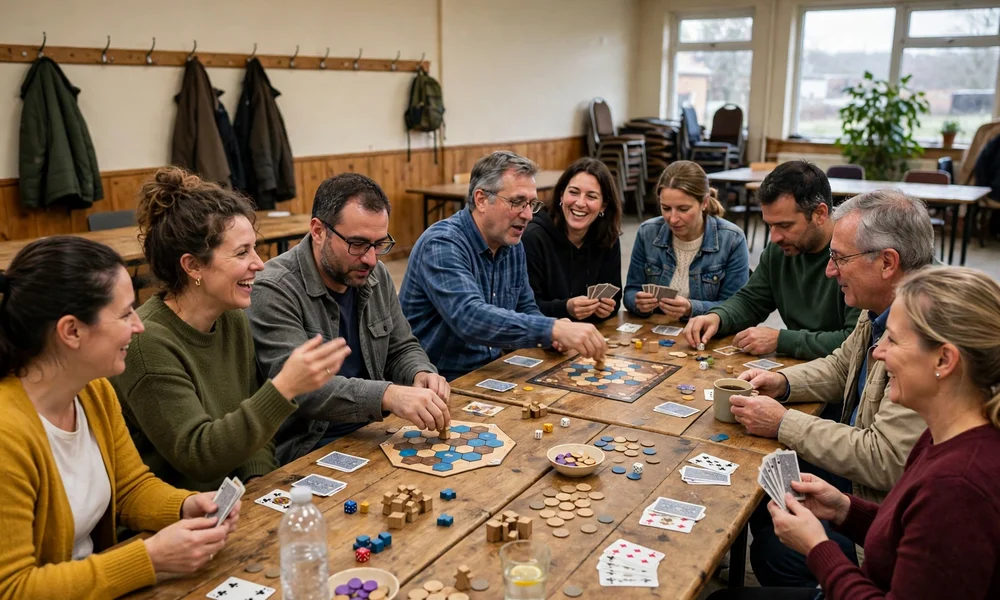
Why 354 Players Changes Everything
Most board games are designed for two to six players. The rules assume everyone can see the board, hear each other, and take turns in a reasonable amount of time. At 354 players, every one of those assumptions breaks. If each player took just thirty seconds per turn, a single round would take nearly three hours, and most of the room would be waiting rather than playing. That is why scale, not the game itself, is the first problem to solve.
The solution is to stop thinking of one game and start thinking of one event made of many identical games. Fifty or sixty tables each run the same game at the same time, and the results feed into a single leaderboard. A team that wins its table earns points for the overall standings, and the best table results decide the champions. This is how large board game conventions already work, and it is the only honest way to run a game night for hundreds of people.
Team size matters more than the choice of game. Teams of four to eight work best: small enough that everyone gets a say, large enough that no single player carries the whole result. With 354 players, that means roughly 45 to 88 teams depending on the size you choose. Smaller teams make the event feel more personal, while larger teams make the logistics simpler, because you need fewer tables, fewer copies of each game, and fewer volunteers to run them.
The venue matters too. You need a hall with enough tables, good lighting, and a sound system that reaches the back rows. If the room is too noisy for one voice, appoint a table captain at every table who has read the rules in advance and can answer questions on the spot.
The 10 Best Board Game Formats for 354 Players
The formats below are chosen because they scale. Each one works across dozens of tables at once, keeps rounds short, and produces a clear result that can be compared between tables. Pick two or three for your event rather than trying to run all ten.
1. Roll and Write Games
Roll and write games are the easiest format to scale to 354 players. One host rolls the dice at the front, calls out the result, and every player marks the same result on their own sheet at the same time. There is no waiting, no turn order, and no board to share. Buy one copy of the game per table plus a printed score sheet for every player, and the whole room plays together in perfect sync. Popular choices include games where players fill grids, draw routes, or build patterns from the dice.
2. Bingo Style Board Games
Bingo style games use the same idea: one caller, hundreds of players, simultaneous play. Modern board game versions add strategy, because players choose where to place each called number on their own board. The result is a game that feels like bingo but plays like a puzzle. It works well as an opening round because the rules take about two minutes to explain and everyone understands the goal immediately.
3. Team Trivia Boards
Trivia works brilliantly at this scale when it is run as a board game rather than a quiz show. Each team gets a board, a set of question cards, and a token to move. Teams answer together, move when they are right, and race around the board. Because every team answers at the same time, there is no dead time while one team thinks. The best trivia games for 353 players use the same simultaneous-answer structure, so they pair well with a board game round in a longer event.
4. Simultaneous Drafting Games
In a drafting game, every player picks a card from their hand at the same time and passes the rest on. The whole table acts together, so a round takes seconds rather than minutes. At 354 players, that speed is gold. Drafting games also scale naturally: the game does not care whether there are four tables or sixty, because each table is a closed system. Choose a light drafting game with colourful cards and simple scoring, and new players will understand it after a single practice round.
5. Cooperative Board Games
Cooperative games change the mood of a large event. Instead of teams fighting each other, every table works together against the game itself, and tables compare how far they got or how quickly they won. This format is ideal for school events and family gatherings, where you want the room to feel friendly rather than competitive.
6. Party Board Games with Team Play
Party board games are built for noise, laughter, and large groups. The best ones for 354 players use team play: one player draws, acts, or describes while the rest of the team guesses, and every team does it at the same time. The room gets loud, the energy stays high, and the game needs almost no equipment beyond the box itself. If you want the evening to feel like a celebration rather than a tournament, this is the format to build it around, and the best party games for 352 players show how the same team structure works at a similar scale.
7. Tile Laying Games
Tile laying games are quiet, thoughtful, and surprisingly good at scale. Each team builds a shared landscape, road network, or city from tiles drawn from a common pool. Turns are quick, the board grows visibly, and the final result is easy to score: count the completed features and compare across tables. Because the game is calm, it works well as a second or third round after a loud party game, giving the room a chance to breathe.
8. Card Driven Strategy Games
Light strategy card games give experienced players something to chew on while staying fast enough for a big room. The key is to choose games where a turn takes seconds: play a card, take an action, move on. Avoid games with long decision chains or heavy negotiation, because those slow down when a table has eight players. A good test is whether a full game finishes in under thirty minutes with new players. If it does, it will work at your event.
9. Dexterity Board Games
Dexterity games add physical fun to a board game night. Teams flick discs, stack blocks, or balance pieces, and the whole table can see the result instantly. These games are excellent as a warm up or as a break between longer rounds, because they take five minutes, need no explanation beyond a quick demonstration, and get people laughing. Run them as a relay: each team member takes one turn in sequence, so everyone plays and the team result depends on the whole group.
10. Legacy Style Tournament Games
A legacy style tournament runs the same game across several rounds, with results carrying over. Teams earn points in round one, the top teams move to harder tables in round two, and the final round decides the champions. This format gives a long event a story: teams can talk about their comeback, their rivals, and the table they need to beat. It needs more organisation than a single round, but it is the most memorable way to run a full day of board games for 354 players.
Comparison Table
| Format | Best For | Round Length | Setup Effort | Energy Level |
|---|---|---|---|---|
| Roll and write | Whole room playing together | 20 minutes | Low | Medium |
| Bingo style | Opening round | 15 minutes | Low | Medium |
| Team trivia boards | Mixed age groups | 30 minutes | Medium | High |
| Simultaneous drafting | Fast competitive play | 25 minutes | Low | Medium |
| Cooperative games | Schools and families | 30 minutes | Medium | Medium |
| Party board games | Celebrations | 20 minutes | Low | Very high |
| Tile laying | Calm middle round | 30 minutes | Medium | Low |
| Card strategy | Experienced players | 30 minutes | Medium | Medium |
| Dexterity games | Warm ups and breaks | 5 minutes | Low | High |
| Legacy tournament | Full day events | All day | High | High |
How to Split 354 Players into Teams
Start with the number of tables you can fit in the room, then work backwards. If you have 50 tables, you need teams of about seven players. If you have 60 tables, teams of six work neatly, with a few teams of five to absorb the remainder. Either way, keep team sizes within one player of each other, because a team of four competing against a team of eight is not a fair contest.
Mix experience levels inside each team rather than grouping all the keen players together. A table with two experienced players and five beginners is more fun than a table of eight experts and a table of eight first timers. The experts teach, the beginners contribute, and the game stays close. For school or company events, mix departments or classes too, so the event builds new connections instead of reinforcing old ones.
Give every team a name, a colour, and a table number before the event starts. Print team cards in advance and hand them out at the door, so players find their table in minutes instead of wandering the hall. Colour coding also helps the host: when you need the blue teams to stand up, or the red teams to swap tables, everyone knows where they belong.
Scoring That Keeps Every Table Invested
A single leaderboard is the heart of a large board game event. Without it, each table is playing its own private game and the room never feels connected. With it, every move matters, because a good round at table 47 can lift a team ten places in the standings. Update the leaderboard after every round and show it on a screen or a large board where everyone can see it.
Keep the scoring simple enough to explain in one sentence. Award points for a table win, bonus points for the margin of victory, and a small number of points for taking part, so a team that loses every round still has a reason to keep playing. Avoid scoring systems that need a calculator or a spreadsheet at the table, because they slow the game and create arguments. The host should be able to work out any team’s score by glancing at the result sheet.
Announce the standings often, but keep the announcements short. A thirty second update between rounds is enough: the top five teams, the biggest climber, and the next game. Longer announcements drain the energy you have just built. Save the full results and the stories behind them for the closing ceremony, when you have the whole room’s attention.
A Timetable That Actually Works
A three hour event for 354 players needs a timetable with generous buffers. Plan for thirty minutes of arrival and seating, three game rounds of thirty minutes each, two ten minute breaks, and fifteen minutes for the closing ceremony. That adds up to just under three hours, and the buffers absorb the delays that always happen when hundreds of people move between tables.
Start with the easiest game, not the best one. The first round is when players are still learning how the event works, finding their tables, and getting used to the noise. A simple roll and write or bingo style game lets everyone succeed quickly and builds confidence. Save the deeper strategy game for the second round, when the room is settled, and finish with the loudest party game, when the energy is highest and nobody minds the noise.
Build in a plan for the games that overrun. Some tables will finish early and some will run late, and that is normal. Have a short filler ready for early finishers, such as a quick dexterity challenge or a trivia question on the screen, so nobody sits idle. For late tables, the host should call time firmly and score the game as it stands, rather than letting one slow table hold up the whole room. The approach used for the best board games for 352 players follows the same principle, with short rounds and a firm call on time, and it works just as well at 354.
Event Day Checklist
- Count every copy of each game the night before, and pack two spares of the most popular title.
- Print a score sheet for every player plus a spare set for each table, and bring extra pens.
- Label every table with its number and team colour, and test the sound system from the back row.
- Brief every table captain on the rules and the scoring system at least thirty minutes before doors open.
- Set up the leaderboard where the whole room can see it, and assign one volunteer to update it after each round.
- Prepare a short filler game for tables that finish early, and agree the firm finish time for each round in advance.
Frequently Asked Questions
Can one board game really seat 354 players?
No single boxed game seats 354 people. The event works by running the same game on dozens of tables at once, with teams of four to eight players, and joining the results into one shared leaderboard. Every format in this guide is chosen because it works that way.
How many copies of each game do I need?
You need one copy per table. With 354 players in teams of six, that is about 59 tables, so you need roughly 59 copies of the game you run in each round. Borrow from friends, hire from a board game cafe, or choose a roll and write game, where one copy plus printed sheets per player is enough.
How long should a board game event for 354 players last?
Three hours is a good length for an evening event, with three rounds of about thirty minutes each plus arrival, breaks, and a closing ceremony. A full day event can run five or six rounds, but you should add longer breaks and a lunch stop so players stay fresh.
What is the best team size for 354 players?
Teams of six work best for most events, giving you about 59 teams. Teams of four feel more personal but need 88 tables and 88 copies of each game, while teams of eight are easier to organise but give each player less to do. Stay within four to eight players per team.
Do I need experienced players to run the event?
No, but you do need prepared table captains. Give each captain the rules in advance, run a short briefing before the doors open, and make sure they know the scoring system. The games themselves should be simple enough for a complete beginner to learn in five minutes.
How do I keep 354 players engaged between rounds?
Announce the standings, run a quick whole room challenge such as a dexterity relay or a one question trivia round, and keep breaks to ten minutes. The biggest cause of lost energy is dead time, so the host should always have the next thing ready before the current round ends.
Bottom Line
The best board games for 354 players are the ones that scale: simple rules, simultaneous turns, short rounds, and a shared scoreboard that ties dozens of tables into one event. Choose two or three formats from this guide, split the crowd into teams of four to eight, brief your table captains well, and keep the timetable firm. Do that, and 354 players will feel less like a logistical problem and more like the biggest, loudest, happiest game night you have ever run.


