
The best board games for 350 players are not single-box games with a player count printed on the lid. No ordinary board game seats 350 people around one table, and no honest list should pretend otherwise. Instead, the best options for a group this large are games that scale through parallel tables, team play, simultaneous turns, and shared scoring, so that hundreds of people can play at the same time without waiting hours for a turn. When the format is right, a crowd of 350 feels like one big event rather than 50 separate games happening in the same room.
Planning for 350 players changes every decision, from the number of tables to the length of each round. A game that works beautifully for six people can collapse at this scale if it needs constant discussion, long individual turns, or a single shared board that only a few players can reach. The games that succeed here are easy to explain in under five minutes, quick to reset between rounds, and fun even when a player only controls a small part of the result. They also give organisers a clear way to keep score across many tables, so the event still has a winner, a story, and a reason to keep playing.
This guide explains how to choose and run the best board games for 350 players, whether you are planning a school event, a company gathering, a community festival, a wedding weekend, or a large board game convention. You will find the formats that actually work at this size, the types of games to prioritise, a comparison table to help you shortlist, practical advice on tables, hosts, timing, and scoring, and answers to the questions organisers ask most often. The aim is simple: everyone plays, nobody waits too long, and the whole room stays involved from the first round to the last.
Key takeaways
- Choose games that run in parallel across many tables, not one game for 350 people at a single table.
- Pick games that can be explained in under five minutes and finished in 30 to 45 minutes per round.
- Use team play and shared scoring so small tables still feel part of one large event.
- Plan roughly one table for every four to eight players, plus extra tables for spare games and late arrivals.
- Test the full format with a smaller group first, then scale the number of tables rather than changing the rules.
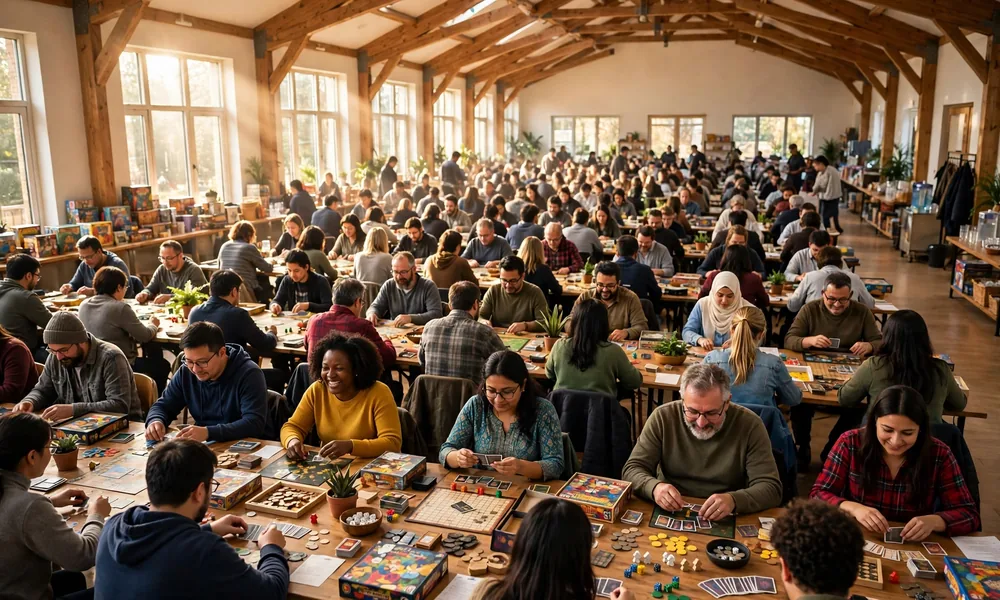
What 350 Players Really Means for a Board Game Event
A group of 350 players is a small festival, not a family game night. That fact shapes the whole event. You need enough space for dozens of tables, enough copies of each game, enough hosts to explain rules, and a schedule that keeps people moving. If you try to run the event like a normal game night, with one host and one game, most people will spend the evening watching rather than playing.
The first practical step is to stop thinking in terms of one game and start thinking in terms of stations. Each station is a table, or a cluster of tables, running the same game at the same time. Players rotate between stations, or stay at one station for a full round and then move on. Either way, the event works because many games are happening at once. A typical setup might use 50 to 70 tables, depending on the games chosen and the number of players per table.
Scoring also needs a different approach. In a normal game, the winner is the person with the most points at one table. With 350 players, you need a way to compare results across tables. The simplest method is to award points for finishing position at each table, then add those points to a team or individual total across several rounds. Another method is to use team colours, so every table contributes to a shared team score. Both methods work, and both keep the competition fair even though players never face everyone in the room.
Time is the other hidden constraint. If a round takes 90 minutes, you will only fit two or three rounds into an evening, and a slow start can ruin the schedule. Shorter rounds of 30 to 45 minutes give you more flexibility, more variety, and more chances for players to recover from a bad first game. They also make it easier to fit in breaks, food, and a final round where the best teams or players meet.
How to Choose Games That Scale to 350 Players
The best choices share a few clear qualities. They are quick to learn, quick to play, easy to reset, and enjoyable without deep strategy. They also work when players have different levels of experience, because a crowd of 350 will always include complete beginners, casual players, and keen hobbyists. A game that only rewards experienced players will frustrate most of the room.
Look for Simultaneous Play
Simultaneous play is the most important feature at this scale. In a simultaneous game, everyone acts at the same time, rather than waiting for a turn to come around the table. Dice games where everyone rolls at once, drawing games where everyone sketches at the same time, and word games where everyone writes an answer together all work well. They keep the pace fast, they remove downtime, and they make it easy to run the same game at 50 tables without the rounds drifting apart.
Games with long individual turns are the opposite. If each player needs two minutes to think and act, a table of eight players will take 16 minutes to complete one round of turns. Multiply that across several rounds and the game becomes slow and frustrating. At 350 players, speed matters more than complexity, and a simple game played quickly is usually more fun than a clever game played slowly.
Choose Simple Rules and Fast Resets
Rules should be explainable in under five minutes, ideally with a short demonstration rather than a long speech. If a host needs 15 minutes to explain a game, you will lose the attention of the room before play begins. Look for games with one main action, a clear goal, and a scoring system that fits on a single sheet of paper. Players should be able to start playing after one practice round.
Fast resets matter just as much. Between rounds, hosts need to collect cards, sort tokens, shuffle decks, and set up the next game. If that takes 10 minutes, you lose a large part of your evening to admin. Games with few components, simple layouts, and clear end conditions are much easier to reset. Keep spare copies, spare score sheets, and spare pens at every station so a missing piece does not stop a whole table.
Use Teams to Keep Everyone Connected
Teams solve one of the biggest problems at this scale: how to make 350 separate players feel like part of one event. When players are grouped into teams of 10, 20, or 50, their individual results contribute to a shared total. That gives every table a reason to care about the tables around it, and it gives the event a clear narrative as teams rise and fall in the standings.
Teams also help with logistics. You can assign each team a colour, a captain, and a starting station, then rotate teams through the stations in order. Captains can collect scores, answer simple questions, and keep their team moving on time. That takes pressure off the main hosts and makes the event feel organised rather than chaotic.
Comparison Table: Best Formats for 350 Players
Use this table to compare the main formats before you choose. Each format suits a different kind of event, and the right choice depends on your space, your players, and how competitive you want the day to feel.
| Format | Players per table | Round length | Best for | Main challenge |
|---|---|---|---|---|
| Parallel table tournament | 4 to 8 | 30 to 45 minutes | Competitive events with clear winners | Keeping scores consistent across tables |
| Team stations | 6 to 10 | 20 to 40 minutes | Company events and school groups | Moving large teams on time |
| Simultaneous party games | 8 to 12 | 15 to 30 minutes | Relaxed festivals and social nights | Noise and crowd control |
| Giant quiz and word rounds | Whole room | 20 to 30 minutes | Opening and closing sessions | Sound, screens, and visibility |
| Drop-in free play | 2 to 8 | Flexible | Conventions and open days | Uneven table use and queues |
The parallel table tournament is the most structured option and works best when you want a clear winner. Team stations are better when the social side matters more than the competition, because players spend more time with their own group. Simultaneous party games are ideal for the middle of an event, when energy is high and people want something light. Giant quiz and word rounds work well at the start or end, when the whole room is together. Drop-in free play suits open events where people arrive and leave at different times.
Best Types of Board Games for 350 Players
No single title fits every event, but certain types of games consistently work at this scale. The sections below describe the types to prioritise, what makes each one suitable, and where each one fits in a full schedule.
Party Games With Simultaneous Answers
Party games are the natural starting point for a crowd of 350. The best ones ask every player to write, draw, guess, or choose at the same time, then compare answers. That structure removes waiting, keeps the pace lively, and works just as well at a table of eight as at a table of 12. They are also easy to explain, which matters when you have dozens of tables starting at once.
Choose party games with short rounds and clear scoring. A game where each round takes two minutes and the whole game takes 20 minutes is ideal. Avoid party games that rely on one player performing for the whole table, because that creates downtime for everyone else. Instead, look for games where the fun comes from comparing answers, spotting the odd one out, or guessing what the group will choose. For a slightly smaller crowd, the ideas in our guide to the best board games for 348 players show how the same parallel-table approach works with almost the same number of players.
Word Games for Large Groups
Word games scale well because they need very little equipment. A pen, a score sheet, and a set of letter cards or prompt cards are often enough. Players can work alone, in pairs, or in small teams, and the game can be paused and restarted easily. Word games also suit mixed-age groups, and the best board games for adults show how grown-up titles can stay welcoming, because they reward vocabulary and quick thinking rather than fast reflexes or detailed rules.
For 350 players, choose word games that can be played in short bursts. A five-minute word challenge between longer games works well as a warm-up or a tie-breaker. You can also run a word game as a whole-room round, with answers collected on paper and scored by team captains. That format is simple, fair, and easy to run even when the room is noisy.
Dice Games With Everyone Rolling Together
Dice games are another strong choice, provided everyone rolls at the same time. When all players roll together, a table of eight finishes a round in seconds rather than minutes. Dice games also have a clear element of luck, which helps beginners compete with experienced players. That matters at a large event, where most players will not know the game in advance.
How to Run a 350-Player Board Game Event
A good event is planned in layers: space, tables, hosts, schedule, and scoring. Get those five layers right and the games themselves will do the rest. Get one of them wrong and even the best games will struggle.
Plan the Room and the Tables
Start with the room. You need enough floor space for 50 to 70 tables, with room for players to pull out chairs, move between tables, and reach the toilets and food without crossing the whole hall. Allow at least one metre of clear space around each table. If the room is too tight, players will feel crowded, games will be knocked over, and moving between rounds will take far longer than planned.
Label every table clearly with a number and a station name. Put the game, the rules sheet, the score sheet, and the pieces for that station on the table before players arrive. That saves time at the start and stops hosts from carrying boxes around the room while players wait. Keep a spare table near the entrance for late arrivals, spare games, and players who need a quieter spot.
Recruit and Brief Your Hosts
You will need far more hosts than a normal game night. A useful guide is one host for every four to six tables, plus a small team at the front to manage timing, scoring, and announcements. Hosts do not need to be experts in every game, but each host should know the one or two games at their tables well enough to explain them in a few minutes and answer common questions.
Brief hosts before the event, not during it. Give each host a one-page sheet for their game, with the goal, the main steps, the scoring, and the most common mistakes. The rotation used for the best party games for 348 players is a useful model for moving large groups between stations on time. Run a short practice round with the hosts so they can try the game themselves. That practice makes a real difference: a host who has played the game once will explain it far more clearly than a host who has only read the rules.
Checklist: Planning Your 350-Player Game Event
- Choose three to five games that can be explained in under five minutes and played in 30 to 45 minutes.
- Book a room with space for 50 to 70 tables, clear walkways, and a separate area for food and breaks.
- Buy, borrow, or hire enough complete copies of each game for every table running it.
- Recruit one host for every four to six tables and brief them with a one-page rules sheet each.
- Prepare simple score sheets, a visible leaderboard, and a clear rotation plan for every team.
- Run a timed practice round with hosts before the event and adjust the schedule if any game overruns.
Frequently Asked Questions
Can one board game really seat 350 players?
No, and any claim that it can should be treated with care. The best board games for 350 players work by running many copies of the same game at many tables at the same time, with shared teams and shared scoring. That is how a crowd of 350 can all play together, even though no single table seats more than about 12 people.
How many tables do I need for 350 players?
It depends on the games you choose, but a useful starting point is 50 to 70 tables. Games for four to six players need more tables, while games for eight to 12 players need fewer. Always add a few spare tables for late arrivals, broken games, and players who need a quieter space.
How long should each round last?
Most rounds should last 30 to 45 minutes, including setup and scoring. Shorter rounds of 15 to 30 minutes work well for party games and warm-ups. Avoid rounds longer than 60 minutes, because they reduce the number of games you can fit in and make the schedule harder to keep.
What is the best format for a first large event?
A parallel table tournament with team scoring is the safest first format. It is easy to explain, easy to run, and easy to keep fair across many tables. Start with three or four familiar game types, keep the rules simple, and add more variety only after you have run the format once and know how long each round really takes.
How do I keep scoring fair across 50 tables?
Use the same scoring sheet at every table, award points for finishing position rather than raw game points, and collect sheets after every round. A central scoring desk should check the sheets, update a visible leaderboard, and correct errors before the next round. That system is simple, transparent, and easy for hosts to follow.
What should I do if a game is too slow or too hard?
Have a backup game ready at every station. If a game is running slowly, shorten it by reducing the number of rounds, lowering the target score, or removing a complex rule. If a game is too hard, let the host explain a simpler version for the rest of the event. It is better to finish a simple game happily than to struggle through a complex game that nobody enjoys.
Bottom Line
The best board games for 350 players are the ones that let everyone play at once, without long waits, complex rules, or a single table that only a few people can reach. Choose simultaneous games, simple rules, and team scoring, plan for 50 to 70 tables with enough hosts and spare copies, and keep rounds to 30 to 45 minutes with a visible leaderboard. Do that, and a crowd of 350 will not feel like a logistical problem. It will feel like the best game night you have ever run, with hundreds of players sharing the same tables, the same laughter, and the same finish.


