Finding the best board games for 126 players starts with an honest fact: no single board game seats 126 people around one table. The largest party games top out at twenty or thirty players, and most classic board games are designed for two to six. That does not make a 126-player game night impossible. It means the night must be designed differently, with several tables running at once, teams sharing decisions, and a tournament or relay structure that keeps every person involved from the first roll to the final score.
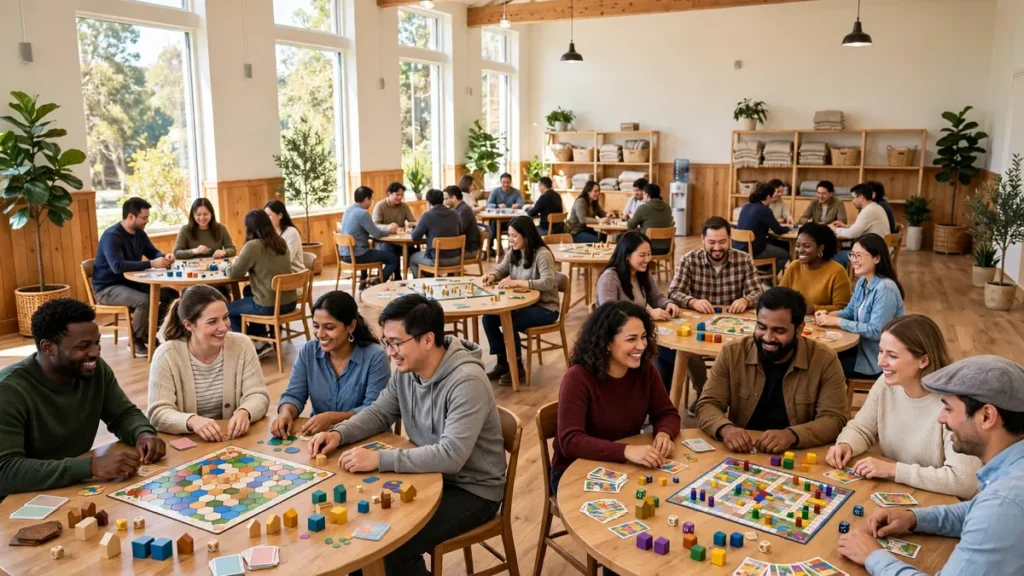
Board games for 126 players work best when you stop thinking of one game and start thinking of one event. A school hall, a company offsite, or a community fundraiser can host 126 players if the room is split into tables of four to eight, each table plays the same game or a different game, and results feed into a shared leaderboard. The games on this list were chosen because they are easy to teach in under five minutes, they play well in parallel copies, and they stay fun when dozens of tables play them at the same time.
This guide covers the formats that work at this scale, the specific games that suit them, and the practical details that decide whether the night feels organised or chaotic. You will find a comparison table to help you choose, a checklist for setting up the room, and answers to the questions every organiser asks first. Plan the structure before you buy the games, and 126 players can feel like one big shared game instead of twenty-one separate ones.
Key takeaways
- No single board game seats 126 players, so plan for multiple tables, team play, and a shared leaderboard.
- Split 126 players into tables of four to eight, which gives you between 16 and 32 tables depending on the game.
- Choose games that can be taught in under five minutes and played in parallel copies without a central referee.
- Run a tournament or relay format so every table contributes to one overall result.
- Buy or borrow enough copies of each game, and test the full setup with a small group before the big night.

Why 126 Players Changes Everything
A normal game night has one table, one game, and one conversation. A 126-player night has twenty or more tables, several games running at once, and a room full of people who may never meet each other. That scale changes every decision, from which games you pick to how you explain the rules. A game that is perfect for six friends can fail for 126 strangers if it takes twenty minutes to teach or needs constant supervision from one host.
The Honest Truth About One Table
Nobody should promise 126 people that they will all sit around one board. Even the biggest party games, which advertise twenty or more players, rely on teams shouting answers together, and the experience becomes thin past thirty players. At 126, the board becomes invisible to most of the room, turns take far too long, and most players spend the evening waiting rather than playing. The solution is not a bigger board. It is more boards, more tables, and a structure that links them together.
How 126 Breaks Down Into Playable Groups
Divide 126 by your table size to find how many tables and copies you need. Tables of six give you exactly 21 tables, a tidy number for a hall and easy to arrange in rows. Tables of seven give you 18 tables, which is workable but leaves some tables uneven. Tables of four give you 31 or 32 tables, which needs a much larger room and many more copies of each game. Most organisers settle on tables of six, because six is the sweet spot where games stay lively and the room stays manageable.
The Best Formats for 126 Players
Format matters more than the choice of game. A brilliant game in a bad format will still feel slow and confusing, while a simple game in a good format can carry the whole evening. The four formats below have proven themselves at very large gatherings, and each suits a different kind of group. Pick one before you pick your games, and let the format decide the shortlist.
Multi-Table Tournament
In a multi-table tournament, every table plays the same game at the same time, and the winners advance. With 126 players at tables of six, round one produces 21 table winners, who form new tables for round two, until a final table decides the overall champion. This format is exciting because every game matters, and it is easy to explain: win your table and you move on. It works best with games that have a clear winner and a fixed length, such as Ticket to Ride, Catan, or Azul.
Team Relay and Whole-Room Games
A team relay splits 126 players into large teams, often six teams of 21, and each team plays a series of short games at stations around the room. Teams rotate together, score points at each station, and the highest total wins. This format suits groups that already know each other, such as a company or a school year, because team identity creates noise, cheering, and a shared purpose. It also solves the copy problem, because each station needs only one or two copies of its game.
Whole-room games work differently: everyone plays at once, usually in teams, with a host calling out questions or challenges. Games such as Codenames and Wavelength can be adapted this way, with one team per table and a central host running the round. Keep these rounds short, no more than ten minutes each, and follow them with table games so players also get a quieter, more personal game. For more ideas on running a huge group, the guide to best trivia games for 124 players shows how quiz-style rounds can be structured for a crowd of almost the same size.
Festival and Free-Play Rotation
A festival format is the most relaxed option. Set up twenty or more tables, each with a different game, and let players wander freely, joining any table with an empty seat. A short game ends, players move on, and the room fills with a gentle hum of small conversations. This format needs the least organisation and the most variety, because players choose what interests them. It suits family gatherings and community events where the goal is enjoyment rather than competition.
Best Board Games for 126 Players
The games below were chosen for large-group play, not for a single table. Each one is easy to teach, plays well in parallel copies, and stays interesting when many tables play it at once. Some are classic strategy games, some are fast party games, and some are word and guessing games that thrive on team discussion. Together they cover every kind of player, from the serious strategist to the person who has never played a board game before.
Codenames
Codenames is one of the best large-group games ever made, and it adapts to 126 players better than almost any other title. Each table plays its own game with two teams, one spymaster per team, and a grid of twenty-five word cards. The spymaster gives a one-word clue, the team discusses, and the team guesses. A game takes about fifteen minutes, the rules take two minutes to explain, and the discussion at each table is the whole point. Run it as a tournament, with winners advancing, or simply record scores and crown the best team in the room.
Ticket to Ride
Ticket to Ride is a calm, beautiful route-building game that suits a tournament format perfectly. Players collect coloured train cards, claim railway routes across a map, and score points for completed destination tickets. A game takes thirty to forty-five minutes, which makes it a good main event rather than a quick filler. It is easy to teach: draw cards or claim a route, and the player with the most points wins. For 126 players you need a copy per table, and the standard game seats two to five, so tables of five work best.
Wavelength
Wavelength is a social guessing game built around a single target on a spectrum, such as hot versus cold. One player gives a clue, the team debates where the target sits, and the team scores points for accuracy. The game is designed for two to twelve players, but it adapts beautifully to team play, with each table forming two teams that debate every clue. At 126 players, Wavelength works as a whole-room game with one host and many tables, or as a tournament game with a copy per table.
Telestrations
Telestrations is a drawing and guessing game that produces laughter at every table, and it scales well because it needs no shared board and no central host. Each player gets a sketchbook and a marker, draws a word, passes the book on, and the next player guesses what the drawing shows. The results are usually wrong in the funniest possible way. A game takes about twenty minutes, seats four to eight players, and the rules take one minute to explain, which makes it ideal for tables of six at a 126-player event.
Just One
Just One is a cooperative word-guessing game that is almost perfectly designed for large groups. One player tries to guess a secret word while the other players each write a one-word clue, and any duplicate clues are cancelled before the guesser sees them. The game takes twenty minutes, seats three to seven players, and creates a lovely moment of teamwork every round. The cooperative nature matters at a large event, because a cooperative game gives new players a gentle introduction without the pressure of competition.
King of Tokyo
King of Tokyo is a fast, noisy dice game in which players take on the role of giant monsters fighting for control of Tokyo. Roll the dice, attack, heal, buy power cards, and be the last monster standing or the first to twenty victory points. A game takes thirty minutes, seats two to six players, and the rules take three minutes to explain. For 126 players it works well as a festival game, with several tables running at once and players joining when a seat frees up. Use the shorter variant so eliminated players can join a new table quickly.
Sushi Go Party
Sushi Go Party is a quick card-drafting game about collecting the best sushi dishes, and it is one of the easiest games to teach to a large group. Players pass hands of cards around the table, pick one card to keep, and score points for sets of sushi and pudding. A game takes twenty minutes, seats two to eight players, and the cute artwork makes it popular with every age group. At tables of eight, 126 players need only sixteen tables, which makes Sushi Go Party one of the most efficient choices on this list. If you want more card-based options for a crowd this size, the guide to best card games for 124 players covers titles that scale in a similar way.
How to Set Up a 126-Player Game Night
Good setup is the difference between a night that flows and a night that stalls. Start with the room: you need enough space for twenty-one tables of six, with room to walk between them, plus a central area for the host, the scoreboard, and the refreshments. A school hall or community centre works well, because the tables and chairs are already there. Visit the room in advance, count the tables, check the lighting, and test the sound system, because a host with a weak microphone will lose a room of 126 people in minutes.
Equipment, Copies, and Budget
Count your copies before you count your players. For a tournament with twenty-one tables, you need twenty-one copies of the main game, plus spares for damaged or lost pieces. For a festival with four games, you need five or six copies of each, which is a smaller total but a wider range. Borrow from friends, libraries, and board game cafes before you buy, and label every box with your name and a table number so copies do not wander off during the evening.
Keeping Every Player Involved
The biggest risk at a 126-player event is not a bad game. It is a bored player. Boredom happens when turns are long, when a player is eliminated early, or when a table finishes and has nothing to do. Prevent it by choosing games with short turns, by using formats that keep eliminated players in the action, and by having a filler game on every table for the gap between rounds. A deck of cards or a small party game on the side table gives waiting players something to do.
Comparison Table
| Game | Best Format for 126 | Players per Table | Playing Time | Why It Works at Scale |
|---|---|---|---|---|
| Codenames | Tournament or whole-room | 4 to 8 | 15 minutes | Fast to teach, team discussion, cheap in bulk |
| Ticket to Ride | Tournament | 2 to 5 | 30 to 45 minutes | Clear winner, satisfying main event |
| Wavelength | Whole-room or warm-up | 2 to 12 | 20 minutes | Every clue sparks a debate |
| Telestrations | Festival | 4 to 8 | 20 minutes | Instant laughter, one minute to teach |
| Just One | Tournament or festival | 3 to 7 | 20 minutes | Cooperative, gentle for new players |
| King of Tokyo | Festival | 2 to 6 | 30 minutes | Fast dice play, high energy |
| Sushi Go Party | Festival or closing game | 2 to 8 | 20 minutes | Seats eight, needs fewest tables |
Checklist for a 126-Player Game Night
- Confirm the room holds at least 21 tables of six with space to walk between them, and test the microphone and lighting in advance.
- Choose one format, tournament, relay, whole-room, or festival, and print the schedule on the wall at every entrance.
- Count your copies: one per table for the main game, plus spares, and label every box with your name and table number.
- Print a simple instruction card for every table with the game name, player count, playing time, and a three-sentence rules summary.
- Assign one volunteer per four tables to teach games, record scores, and keep rounds moving on time.
- Prepare score sheets, pens, a visible timer, a scoreboard, prizes, and refreshments away from the game tables.
Frequently Asked Questions
Can 126 people really play board games together?
Yes, but not around one board. Split the group into tables of four to eight, run the same game or several games in parallel, and link the tables with a shared leaderboard, a tournament bracket, or a team relay. Everyone plays a real game at their own table, and the whole room shares one event, one schedule, and one result.
How many tables do I need for 126 players?
It depends on the game. Tables of six give you exactly 21 tables, which is the most common setup. Tables of eight, for games such as Sushi Go Party or Telestrations, need only 16 tables. Tables of four need 32 tables, which requires a much larger room and many more copies, so most organisers avoid four-player games as the main event.
How many copies of each game should I buy?
One copy per table for the game in play. A tournament with 21 tables needs 21 copies of the main game, while a festival with four games and five tables each needs five or six copies of each title. Borrow from friends, libraries, and board game cafes first, and buy the rest, because the games will be useful long after the event.
What is the best game for players who have never played board games?
Codenames, Just One, and Telestrations are the safest choices for new players. Each one takes one or two minutes to explain, needs no prior knowledge, and is fun from the first turn. Avoid long strategy games for a first round, because new players will spend the evening learning rules instead of enjoying the game. Start simple, then offer deeper games later.
How long should a 126-player game night last?
Three hours is about right: thirty minutes for arrival and a warm-up game, two hours of main rounds, and thirty minutes for the final and prizes. Shorter evenings feel rushed, because setting up twenty tables takes time. Longer evenings lose energy, especially if players are sitting in a hall. Keep rounds timed and shorten a round rather than letting the night run late.
What if some players finish early or lose in the first round?
Plan for it in advance. Run a consolation bracket or a side festival so eliminated players keep playing for fun, and put a filler game on every table for the gap between rounds. Nobody should be left sitting with nothing to do while the rest of the room plays. A good event gives every player at least three games across the evening, win or lose.
The Bottom Line
The best board games for 126 players are not the biggest games, but the games that work best in parallel: Codenames for team discussion, Ticket to Ride for a satisfying tournament, Sushi Go Party for a fast closing round, and Just One for players who prefer cooperation to competition. Pick one format, split the room into tables of six, buy or borrow a copy per table, and keep the rounds timed and the rules short. Do that, and 126 players will not feel like a crowd. They will feel like one great game night, shared across twenty-one tables. For a closer look at how a similar crowd can be organised around a single classic format, the guide to best board games for 124 players offers a useful comparison for planning your own event.