My mother does her crossword at the kitchen table, always the same chair, always after breakfast, always with a pencil she has sharpened to a point that would make a schoolteacher proud. She is eighty-one. Some mornings the grid fills fast and she hums while she works. Other mornings she sits with one clue for ten minutes, pencil tapping, muttering the clue under her breath like a person arguing with an old friend. My father, who claims he does not do crosswords, leans over her shoulder and supplies answers he insists he only guessed. This has gone on for years, and it is the picture I carry whenever someone asks whether crosswords are genuinely good for older people or whether they are simply a polite way to pass the time.
It is a fair question, and it deserves a better answer than the one printed on the covers of puzzle books. Those covers promise sharper minds, stronger memories, and protection against decline, as if a grid of black and white squares were a vitamin. The real story is smaller, warmer, and more useful than that. Crosswords can be a genuinely good habit for seniors, but the reasons have less to do with brain training than the covers suggest, and the habit only works when the puzzle itself fits the person solving it: the print big enough to read without strain, the clues pitched at a level that rewards rather than humiliates, and the routine gentle enough to survive a bad day.
Key takeaways

What crosswords actually give an older solver
The first thing worth saying is that an older solver brings something to the grid that a younger one does not: decades of words. A person who has spent sixty years reading newspapers, cooking from recipes, following sport, watching films, and talking to neighbours carries an enormous store of ordinary language. Crosswords are one of the few pastimes that ask for that store directly. A clue about a 1960s film star, a gardening term, a seaside town, or an old song title is not a test of new learning. It is a chance to reach back and find something that is still there. That feeling — a word arriving after a pause, exactly when it is needed — is quietly satisfying in a way that is hard to explain to someone who has not felt it.
The third gift is attention with a shape to it. Much of later life is unstructured time, and unstructured time can drift. A crossword gives twenty minutes a beginning, a middle, and an end. There is a clear task, a visible measure of progress, and a finish line. For someone living alone, or for someone whose days have emptied out since retirement, that structure is worth more than any claim about brain exercise. It is a reason to sit down at a particular time, in a particular chair, and do one thing properly. If you want the fuller picture of what crosswords do for the brain, it is worth reading alongside this piece, because the evidence there is narrower and more interesting than the book covers admit.
The eyes get the first vote
Large-print crossword books exist precisely for this reason, and there is no shame in using them. The grids are roomier, the clues are set in type you can actually read, and there is space to write an answer without cramming letters into a box the size of a postage stamp. A book also lies flat, or can be propped on a cushion, where a newspaper folds and flaps and fights back. My mother’s rule is simple: if she has to fetch her strongest glasses and still lean in close, the puzzle is the wrong puzzle, and she sets it aside without a second thought.
Hands, pencils, and the pen question
Then there are the hands. Arthritis, stiffness, and a grip that is not what it was all change the physical act of solving. A thin pencil that has to be clutched hard is a bad tool for an older hand. A fat, soft pencil — the kind sold for young children, which many older solvers adopt with great satisfaction — needs less pressure and leaves a darker mark. A good eraser matters just as much. Writing an answer in pen, as the confident solvers in films always do, is a fine way to ruin a puzzle and a morning. Pencil and eraser say something kinder: a guess is allowed, a change of mind is allowed, and nothing is final until you decide it is.
The routine is worth more than the puzzle
That is why I would rather see an older person solve an easy crossword every morning than a hard one twice a week. The easy puzzle gets finished, and finishing feels good. The hard puzzle gets abandoned, and abandonment feels like a small failure, repeated. A routine that survives is worth far more than a routine that impresses. Twenty minutes a day, most days, in the same chair, with the same pencil, is the whole secret. There is no need to keep score, no need to time yourself, and certainly no need to compare your progress with anyone else’s.

Better with a second person at the table
The loveliest thing about crosswords in later life is that they are a sociable puzzle pretending to be a solitary one. Two people can share a grid without any of the awkwardness of a board game: one reads the clues aloud, the other stares at the ceiling, and the answer arrives from whichever mind it arrives from. Couples do this for decades. Friends do it over coffee. Grandchildren, drafted in to read clues while a grandparent solves, discover that they know more answers than they expected, and the grandparent discovers that the child is a better partner than the dictionary.
This shared solving does something that solitary solving cannot. It turns a quiet habit into a conversation. The clue about an old film becomes a story about seeing it at the cinema. The clue about a place name becomes a memory of a holiday. The puzzle stops being a test and becomes a prompt, and the afternoon gains a warmth that no amount of solitary word-chasing can provide. If the person you love is losing confidence with puzzles, do not buy them a harder book. Sit down and solve the easy one together, out loud, and let them have the answers they earn.
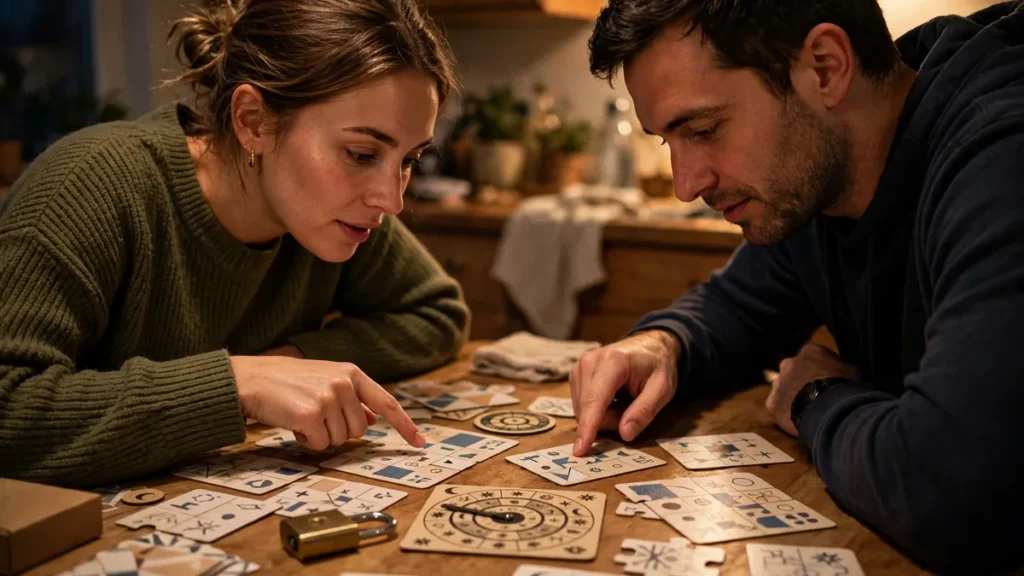
For families who want to make this a regular thing, a puzzle night built around seniors is a natural next step: the same pleasure, with more chairs pulled up to the table and more voices reading clues aloud.
Choosing the right difficulty
Difficulty is where most senior solvers go wrong, usually because someone else chose the puzzle for them. A well-meaning relative buys the hardest book on the shelf, reasoning that a challenge is good for the brain. A newspaper’s late-week puzzle, designed to defeat experienced solvers, is handed over as if difficulty were a compliment. It is not. A puzzle pitched above the solver is not a workout. It is a locked door, and a person who meets a locked door every morning will eventually stop knocking.
The right level is the one you finish most days with a few clues that made you think. If you finish everything in five minutes without a pause, the book is too easy and you will grow bored. If you finish half and abandon the rest, the book is too hard and you will grow discouraged. The sweet spot sits between the two, and it moves. Some weeks a solver is sharp and wants a sterner grid. Other weeks, after a poor night’s sleep or a cold, the easy book is the kind choice. There is no rule that says you must climb a ladder. Staying happily on the same rung for years is a perfectly good outcome.
Themed books help here. A solver who loves gardening will enjoy a garden-themed crossword far more than a general one, not because it is easier, but because the words are theirs. A solver who spent a career in teaching, or nursing, or the railways, will light up at clues drawn from that world. The best book for a senior is rarely the one labelled for seniors. It is the one whose clues meet the solver’s own life halfway. There are crossword books made with older solvers in mind that get the print and the pacing right, and they are a better starting point than whatever happens to be on the supermarket shelf.
The honest limits
Now the part that matters most, and the part the book covers leave out. Crosswords will not prevent dementia. They will not reverse memory loss, and they will not protect a brain against disease. The research that gets quoted on puzzle covers shows, at most, that people who do crosswords regularly tend to keep certain word skills in good shape, and that people who stay mentally active in many ways tend to fare better than people who do not. That is a long way from a promise, and anyone who sells a crossword book as medicine is being dishonest.
There are other limits worth naming plainly. A crossword can frustrate. A solver who gets stuck on the same square day after day can start to dread the puzzle, and dread is a poor companion for anything meant to be pleasurable. A puzzle that leans on modern slang, celebrity names, and internet culture can make an older solver feel like a stranger in their own pastime, and that feeling stings more than any blank square. And a long session hunched over a small grid can stiffen a neck and tire eyes that were fine when the puzzle began.
Questions people ask
Are crosswords good for seniors who have never done them before?
Yes, provided they start easy. A beginner in their seventies or eighties should start with a large-print easy book, not a newspaper grid, and should expect the first few puzzles to feel slow. Speed comes with familiarity, and familiarity comes with finishing. A grandchild reading the clues aloud makes a wonderful first week.
How long should an older person spend on a crossword each day?
About twenty minutes is plenty, and ten is fine. The value sits in the daily return, not in the length of any single session. If the eyes tire or the neck stiffens, stop. A puzzle can always wait until tomorrow, and tomorrow’s puzzle will be just as welcoming.
The bottom line
So, are crosswords good for seniors? My answer is yes, and I would defend it at any kitchen table in the country — with the conditions I have laid out. Give an older solver print they can read, a pencil they can hold, a puzzle they can finish, and a person to share it with, and you have given them something genuinely good: a daily moment of absorption, a small victory, and a thread back to a lifetime of words. That is not a miracle cure, and it was never going to be one. It is a modest, warm, reliable pleasure, and modest, warm, reliable pleasures are exactly what a good later life is made of.
Buy the large-print book. Sharpen the fat pencil. Put the lamp where the light falls on the page. Then sit down, read the first clue aloud, and let the words come. The grid will wait for you. It always does.