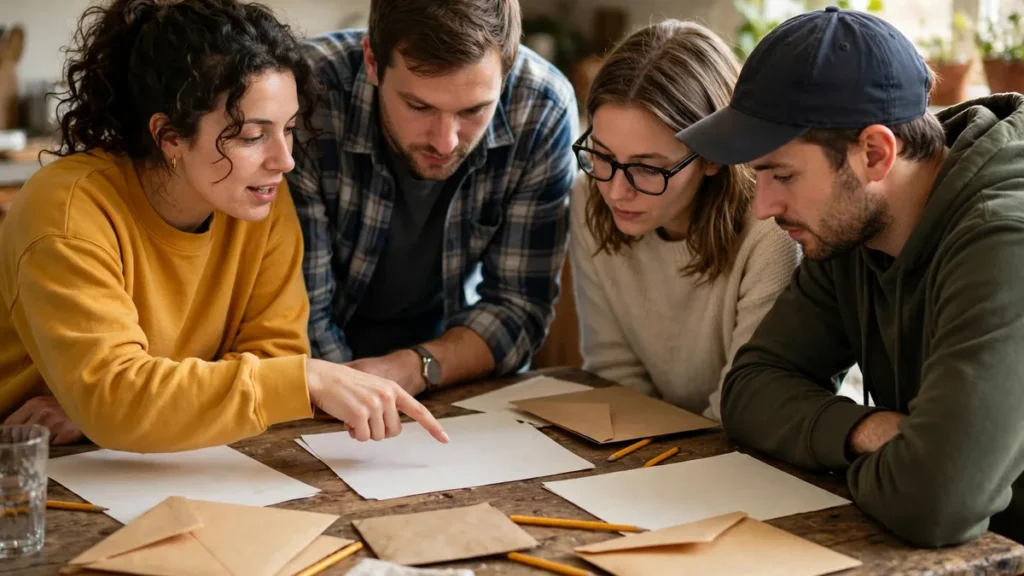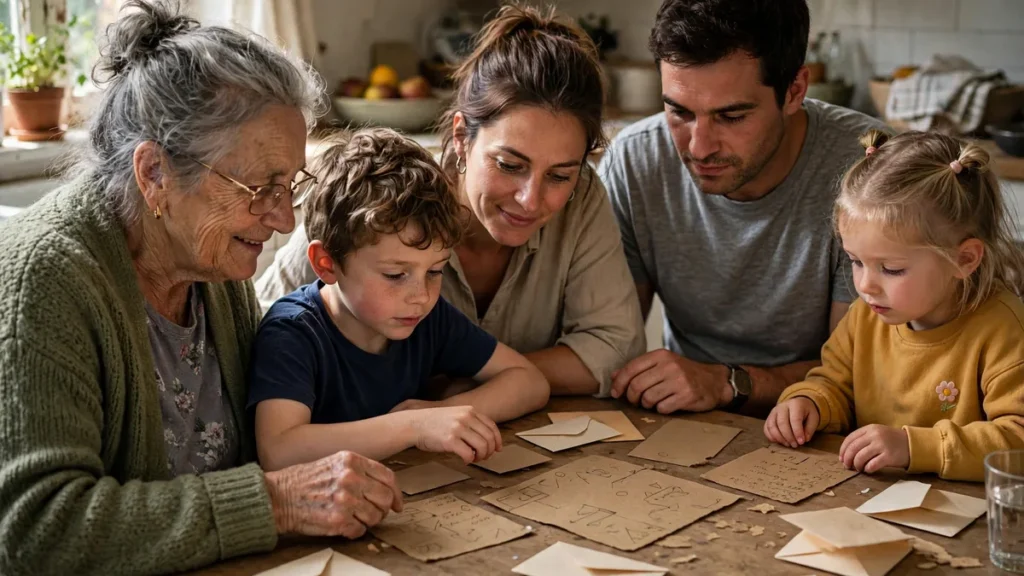
Rain was rattling the windows, the grandparents had come for lunch, and the house was full of people with nothing to do. Somebody produced a set of envelopes and a riddle about the fridge, and within minutes the living room had changed shape. The seven-year-old was under the stairs with a torch, the teenager was bent over a code sheet arguing with his grandmother, and the grandmother, who had claimed she would only watch, was the one keeping score. An hour later the whole household was in the garden, wet shoes and all, digging a tin out from behind the shed, and nobody was thinking about the rain. A puzzle hunt can be the best thing a family does together all month, or an hour of sulking while one adult does all the thinking. What follows is my judgement, not a manual. My answer is yes, for most families, on most occasions, as long as the hunt fits the family in the room.
What a puzzle hunt is, and what it is not
A puzzle hunt is a linked trail: solve one puzzle, and the answer tells you where the next one hides. A riddle points to a cupboard, the cupboard holds a code, the code names a room, and the final answer leads to the prize. That linked structure is what sets it apart from a scavenger hunt. A scavenger hunt gives players a list of things to find, and the finding is the game. Teams can tackle the list in whatever sequence they like, and a missed item costs only a point. A puzzle hunt gives players a problem, and the thinking is the game. Until the problem is cracked, there is nowhere to go, which is exactly why a hunt can thrill and exactly why it can stall. Families weighing the two should know the games reward different things, and scavenger hunts bring families together in a looser, more forgiving way. A scavenger hunt fits a large, restless group. A puzzle hunt fits a family willing to sit with a hard clue and debate it.
The mixed-age test
A puzzle hunt carries no age guardrail, and that is both its charm and its risk. A family is not a team of equals. It is a six-year-old who reads slowly, a ten-year-old who reads fast, a teenager who can crack a cryptic clue in seconds but may not want to be seen trying, two parents with tired brains after a working week, and a grandparent whose knowledge is vast and whose knees are not what they were. A hunt that treats them as different players with different jobs can be the rare activity where the age range is an asset rather than a problem. If the hunt mixes its clues, so a picture clue rewards sharp eyes, a word clue rewards vocabulary, a counting clue rewards patience, and a code rewards careful hands, then different people get their moment to shine. Everyone needs one moment to shine before the prize is found.
What the youngest players really do
The worry most parents carry is that a hunt will leave the smallest child behind, watching older siblings solve everything while they carry the envelopes. That worry is fair when every clue is written words and every hiding place is up high. It is avoidable, and the fix is not to make the whole hunt easier. The fix is to hand the youngest player a genuine job. A six-year-old can read each card out loud, which puts them at the centre of the group at every step. A five-year-old can be the runner, sprinting to the hiding place the moment the answer is agreed, a job no adult can do better. A child who cannot yet read can be the spotter, the one who looks for the envelope once the grown-ups have narrowed down the room, because small eyes at low height notice things adults walk straight past. A puzzle hunt for kids built on that principle is a different game from a hunt built for grown-ups with the hard bits left in, and families should look for the first kind.
Grandparents: the overlooked players
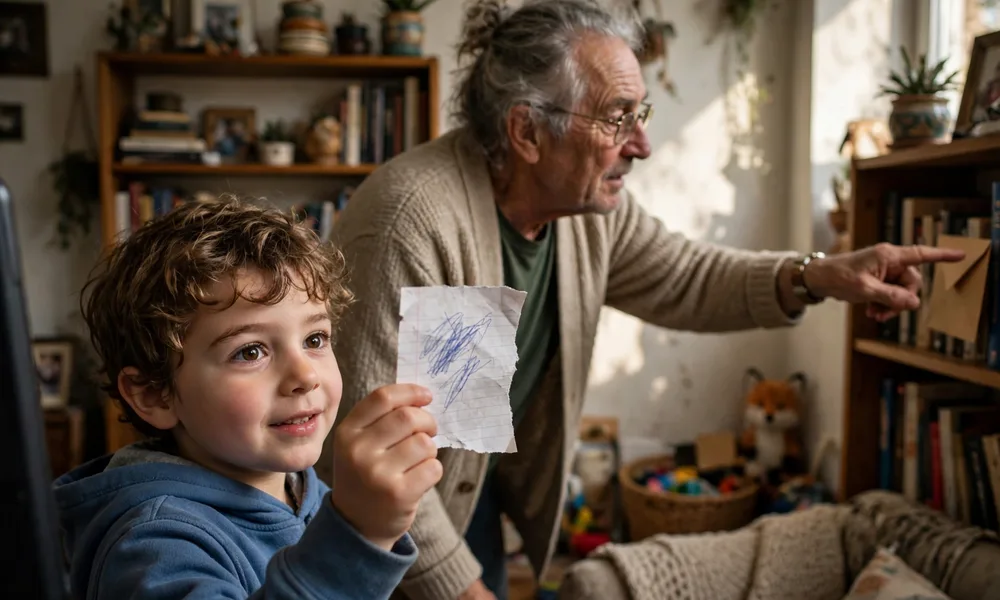
Grandparents are the most underrated players in a family hunt, and the most often forgotten when the hunt is put together. First, knowledge built over decades: the odd fact that turns out to be the key to a clue nobody else can crack. The second is patience. Grandparents are usually the players most willing to sit with a clue, read it twice, and talk it through slowly. The third is attention to detail: a lifetime of noticing small things. Against that, a family hunt has to respect real limits. A hunt that sends everyone running and climbing will quietly exclude the grandparent. Small print and dim corners are a needless barrier, and so is an hour of standing. A hunt that builds in sitting-down solving time, with the running done by the children, keeps everyone in the game. Give the grandparent a seated job that matters: keeper of the clue sheet or holder of the code key.
Teenagers hold the casting vote
Every family hunt has a swing voter, and it is usually the teenager. Small children will join in with almost anything when a prize is waiting. Teenagers bring a worry nobody else has: the dread of looking foolish in front of people whose opinion matters. A thirteen-year-old may solve riddles alone for fun, then refuse the same puzzles in front of relatives. A hunt lives or dies on whether the teenager takes it seriously in the first minute, and that call is made fast. Clues that talk down to them will be rejected in seconds. Fair difficulty earns respect; unfair clues earn contempt, and teenagers spot unfairness first. The other thing that matters is a real role. A teenager asked only to trail the younger children around will drift away, while one handed the map, the code sheet, or the job of photographing each solved clue has something to own. Our verdict on puzzle hunts for teenagers weighs the same gamble from the teenager’s side.
What it does to family conversation
The strongest case for puzzle hunts as a family activity is what they do to the way a family talks. In most family plans, one adult decides and the rest tag along. A puzzle hunt changes that shape, because the clue sets the agenda instead of any one person, and that small shift rearranges everything. Planning the household schedule gives nobody an edge on a picture clue or a counting code. Nobody moves on until the group settles on an answer, which means listening, arguing a case, and conceding when a guess turns out wrong. That matters in a household where the loudest voice usually wins the argument. Over an hour, the usual order turns upside down: the quiet child becomes the hero of one clue, the confident parent has to ask for help on a map, and the grandparent cracks the one clue nobody else can. The story gets retold at dinner for weeks.
Where family hunts fall flat
None of that guarantees a good afternoon, and the failure modes are common enough to describe plainly. The first is a difficulty mismatch. Clues pitched far below the group are finished in minutes and leave everyone wondering what the fuss was about. Clues pitched far above it bring the whole chain to a halt. The second failure is the solo solver. Every family has one, usually a parent, and when that person answers everything, the rest of the family becomes an audience. Spread the work around and mix the clue types so no single strength wins every round. The third failure is a disputed answer. A riddle that points equally well at two places in the house will split the family into camps, and family arguments have a way of outliving the game. The fourth failure is the clock. A strict time limit turns a family afternoon into a race, and races bring out the worst in people who love each other. Children cry, teenagers sulk, and parents snap. The fifth failure is the simplest: tired, hungry, or cold players. A hunt that runs through lunch will fail for reasons that have nothing to do with the puzzles.
Against the alternatives
It helps to set the puzzle hunt beside the other things a family might do with the same hour. A board game night is cheaper and calmer, but everyone sits still and quieter players fade. A film night asks nothing of anyone, but the family only sits facing the same way. A scavenger hunt is the closest rival, and the better choice on a busy day: faster to set up and forgiving when one item goes unfound. The puzzle hunt wins when the family wants a proper challenge and a shared story. It also loses with very large groups, and when the youngest player is under five. It is the best choice for a rested Saturday afternoon, and a poor one for a tired evening.
| Activity | Best for families when | Watch out for |
|---|---|---|
| Puzzle hunt | Everyone is rested and wants a real challenge together | One solver doing everything, unfair clues, a harsh clock |
| Scavenger hunt | Big groups, short windows, younger children | Finding is not the same as solving, so the thrill is smaller |
| Board game night | A calm evening indoors with no preparation | Hours sitting still, quieter players drift away |
| Film night | A tired family that needs to rest together | No teamwork, no conversation, no shared achievement |
Spotting a family-friendly hunt
If a family is choosing a hunt rather than building one, a few signs tell most of the story before anyone opens the first envelope. A good family hunt states its length, its walking distance, and its ideal group size up front. A good family hunt says plainly which clues suit younger children, which suit older ones, and whether the group can ask for help without shame. Without a way to ask for a hint, the slowest family spends an hour stuck. It ends with a definite finish and a shared prize. An indoor or garden hunt with a clear boundary suits small children and grandparents far better than one across unfamiliar streets. One hunt, on a free afternoon, with no guests and no pressure, will tell a family more than any review.
The verdict
So, are puzzle hunts good for families? Yes, with conditions that matter more than the yes itself. They are good for families because they do something almost no other activity does: they take a group of people of wildly different ages and abilities, give them a single problem that none of them can solve alone, and let them discover that they are better together than apart. They give every generation something real to do, and nobody is in charge. They build the kind of shared story a family retells for years, and they do it for the price of some envelopes and an hour of someone’s time. They suit a family badly when the clues are pitched at one age only, when one person is allowed to solve everything, when the clues are unfair, when the clock is too tight, or when the family is tired, hungry, or cold. Every one of those conditions is fixable in a single afternoon. It is one of the best family activities available, for the occasions that matter.
Frequently asked questions
From what age does a family puzzle hunt work? It works best when the youngest player is about five or six. Below five, children can still join as runners and spotters, but the chain itself will pass them by.
How long should a family puzzle hunt last? About an hour is right, with five or six clues. Longer than that and younger children tire and grandparents flag.
What if one person keeps solving everything? Give that person a job that is not solving: reading the clues aloud, keeping the score, or holding the map. Rotate the reader and mix the clue types.
Are puzzle hunts safe for families with small children? They are, as long as the hunt stays inside a clear boundary the children can see, such as a house, a garden, or a fenced park. Keep children off roads and out of unfamiliar areas.