Engaging with secret code puzzles is an exceptional way to sharpen your cognitive faculties, build advanced logical deduction strategies, and push your lateral thinking limits. Unlike traditional math problems that provide a direct equation, code breaking involves scanning text for hidden visual trends, identifying subtle linguistic cues, and systematically untangling complex linguistic traps.
At riddlepuzzle.com, we love diving deep into the history and mechanics of classic intelligence games. Below, we explore the inner workings of historical cryptograms, share a practical guide to decoding encrypted messages, and present four hands-on code breaking brain teasers complete with their dedicated password riddles to test your inner spymaster.
The Codebreaker’s Rule: In cryptography, the simplest solution is often the correct one. Before trying complex letter shifts, look closely for obvious spatial patterns, letter frequencies, or simple text reversals.
The Fascinating History Behind Cryptographic Puzzles
To master modern cipher puzzles, it helps to understand where these systems originated. Humans have been scrambling messages for thousands of years, and the basic principles of those early encryption methods still form the basis of the logic games we play today.
The Spartan Scytale (The First Physical Key)
One of the earliest recorded military encryption tools was the ancient Greek scytale, used heavily by the Spartan military. This system consisted of a wooden cylinder of a very specific diameter. The sender would wrap a long, thin strip of leather tightly around the cylinder and write their strategic message across the parchment.
When unrolled, the leather strip appeared to contain a completely random, meaningless string of disconnected letters. If enemy scouts intercepted the messenger, the text was useless to them. However, when the destination general wrapped that exact same leather strip around an identical wooden cylinder, the letters perfectly realigned to reveal the original military commands.
The Caesar Shift (The Foundation of Substitution)
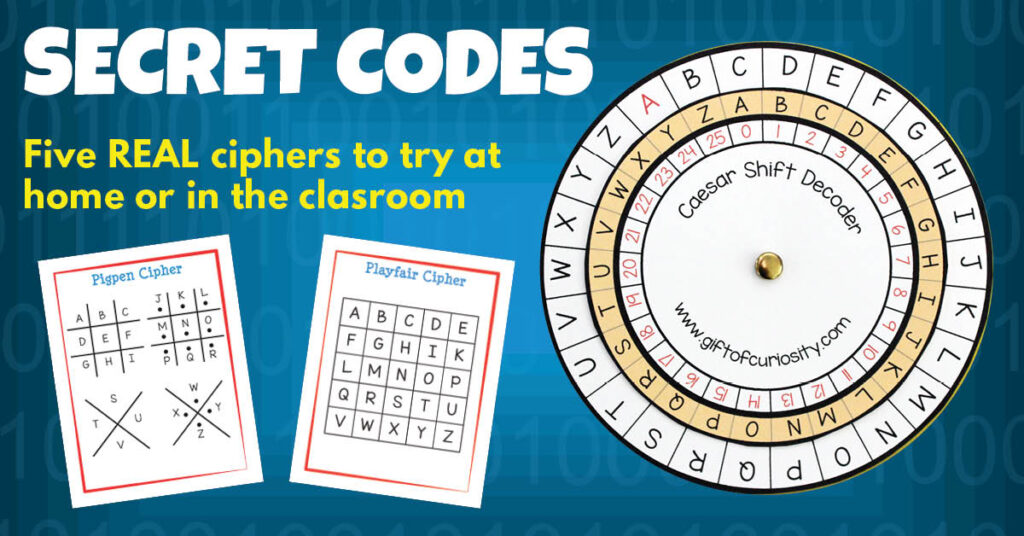
Perhaps the most famous historical encryption method is the Caesar Cipher, utilized by Julius Caesar to protect sensitive military correspondence. Caesar did not trust his messengers, so he developed a systematic method of shifting individual characters.
Every single letter in his original text was replaced by a letter sitting a fixed number of positions further down the Latin alphabet. For example, if Caesar chose a shift of 3, the letter ‘A’ became ‘D,’ ‘B’ became ‘E,’ and ‘C’ became ‘F.’ While this system appears laughably simple by modern security standards, it was highly effective in an era where most enemy soldiers were completely illiterate.
3 Foundational Cipher Types to Master
If you want to solve an escape room or dominate an online decryption game, you need to recognize the three core pillars of classic code design.
1. Monoalphabetic Substitution Ciphers
In a standard substitution puzzle, the overall structure of the word remains completely untouched, but every single letter is systematically swapped with an entirely different character. The matching key can be a different letter, a number, or an entirely unique symbol. The ultimate tool to conquer these puzzles is frequency analysis. In written English, certain letters (like E, T, A, and O) appear far more frequently than others (like Q, X, and Z). By counting the repeating symbols in a long puzzle, you can easily guess the vowels and dismantle the remaining text.
2. Transposition Puzzles
Transposition puzzles do not swap your letters out for different characters. Instead, they use the exact letters of your original message but scramble the overall order. A classic example is the Cipher puzzle , where letters are written diagonally across multiple imaginary horizontal rails and then read straight across line by line. To crack a transposition puzzle, look closely for unusual clusters of consonants or a strange distribution of vowels that hint at rearranged words.
3. Polyalphabetic Ciphers (The Vigenère Technique)
This is a significantly more advanced version of the Caesar Shift. Instead of using a single numeric shift for the entire message, a polyalphabetic cipher uses a repeating keyword to constantly change the shift amount for every single character. For centuries, this technique was known as le chiffre indéchiffrable (the indecipherable cipher) because it completely flattened traditional letter frequency analysis, making it a favorite blueprint for premium escape room creators.
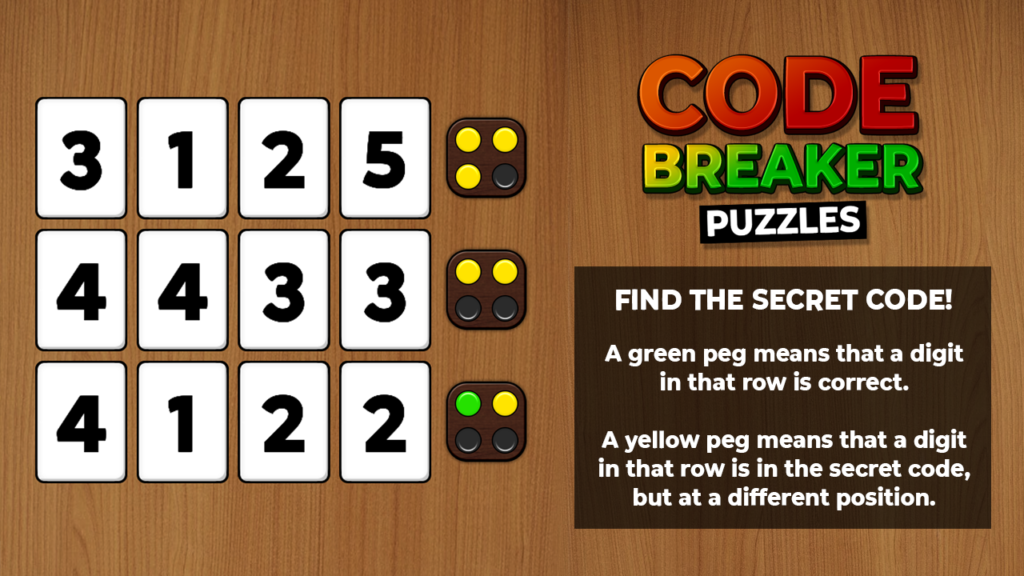
4 Hands-on Code Breaking Puzzles to Solve
Let’s put your investigative skills to the test. Below are four unique, self-contained puzzles of varying difficulty levels. Grab a scrap piece of paper, read the clues carefully, and see if you can break the codes.
Challenge 1: The Warehouse Digital Entry Pad
-
The Scenario: You stand before a reinforced vault door inside an abandoned industrial building. The digital keypad requires a numeric code to open, and a cryptic sticky note left behind by the manager reads: “The combination is hidden inside the absolute lengths of our core values.”
-
The Clue: The values listed on the wall are: TRUST, EFFICIENCY, INNOVATION, SAFETY.
-
The Password Riddle: Count the physical letters making up each individual value in the exact order they are listed to generate the unlock code.
-
The Solution: 510106 (TRUST = 5, EFFICIENCY = 10, INNOVATION = 10, SAFETY = 6).
Challenge 2: Julius Caesar’s Hidden Outpost
-
The Scenario: You discover an old military map containing a scrambled text string at the bottom. A note indicates that a standard Caesar Shift of three positions forward was used to secure the location name.
-
The Encrypted String: ORQGRQ
-
The Decoding Strategy: To decrypt this string, you must take each individual letter and count exactly three steps backward in the standard Latin alphabet sequence.
-
The Solution: LONDON (O shifts to L, R shifts to O, Q shifts to N, G shifts to D, O shifts to L, N shifts to O).
Challenge 3: The Backward Safe Room Code
-
The Scenario: You find a leather-bound diary belonging to an eccentric historical archivist. On the final page, a messy string of text is scrawled next to a drawing of a reinforced vault door. The archivist wrote: “True security requires you to look at your path completely in reverse.”
-
The Encrypted String: REBMYHCRA
-
The Decoding Strategy: Do not look for letter substitutions or alphabet shifts here. Read the entire string starting from the final letter on the right and move systematically backward to the left.
-
The Solution: ARCHYBERM (The word “ARCHYBERM” spelled completely backward).
Challenge 4: The Pigpen Masonic Cipher
-
The Scenario: You find an old stone tablet featuring strange geometric lines instead of traditional letters. Each symbol consists of an angular grid fragment containing a single dot.
Conclusion: Keep Testing Your Code Breaking Skills
Wrestling with secret code puzzles serves as a powerful reminder that information is rarely as chaotic as it appears at first glance. Training yourself to hunt for structural patterns, analyze linguistic frequencies, and question your baseline assumptions builds a highly resilient, analytical mindset that applies directly to programming, data science, and daily critical thinking.
Do you have a custom security layout that always stumps your friends, or an advanced historical cipher system we should break down next? Be sure to keep your browser tab permanently locked right here to riddlepuzzle for an endless supply of interactive logic games, password riddles, and creative challenges designed to keep your cognitive gears spinning.
Frequently Asked Questions (FAQ)
What is the structural difference between a code and a cipher?
While people often use these terms interchangeably, they have completely different definitions in technical cryptanalysis. A code replaces an entire entire word or complete phrase with a pre-determined secret word or numeric symbol (e.g., saying “The eagle has landed” to mean a mission is complete).
How does frequency analysis help you solve a substitution puzzle?
Frequency analysis takes advantage of the natural patterns embedded within human language. In standard English text, letters do not appear with equal regularity. The letter ‘E’ is consistently the most common character used, followed closely by ‘T,’ ‘A,’ and ‘O.’ By counting which unique symbol appears most often in an encrypted puzzle, you can safely assume it represents a common letter, giving you a foothold to decode the surrounding words.
What is a modern real-life example of a cipher wheel?
A classic historical example of a mechanical cipher wheel is the Jefferson Disk, invented by Thomas Jefferson in the late 18th century. It utilized a series of rotating wooden wheels mounted on a central axle, with each wheel containing a scrambled alphabet stamped along its outer edge.
Why are code breaking brain teasers used in job interviews?
Many modern technology companies, cybersecurity firms, and intelligence agencies integrate logical ciphers into their competitive hiring tracks. They do not expect you to be a professional cryptographer; instead, they use these puzzles to observe your structural problem-solving habits, your attention to small details, and how you behave when confronted with unfamiliar, chaotic data arrays.