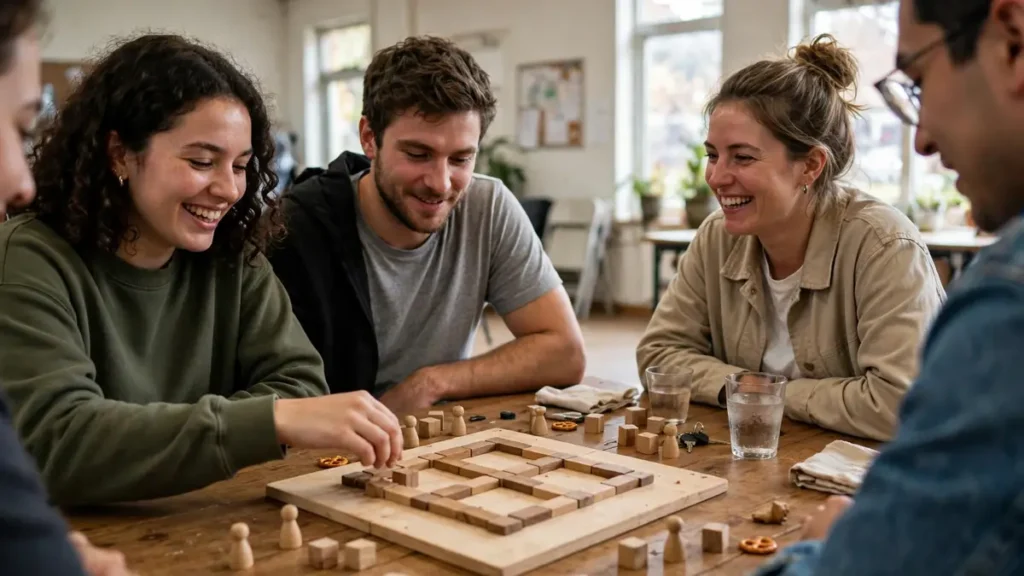
Running board games for 552 players sounds impossible until you break the crowd into small tables, give every table the same clear rhythm, and let a calm host keep the whole hall moving together. The keyword here is board games for 552 players, and the plan in this guide turns a huge crowd into dozens of lively tables that all finish, all share results, and all feel part of one big day. You do not need a stadium or a mountain of new boxes. You need enough tables, enough copies of a few friendly titles, and a timetable that everyone can follow without asking for help every few minutes.
A hall with 552 players works best when each table holds four to six people, when every table plays the same title at the same time, and when a host calls the start, the halfway mark, and the finish from the front of the room. That shared rhythm matters more than the choice of any single title. When tables drift apart, some finish early and grow bored while others still need twenty minutes, and the whole day starts to feel uneven. When tables move together, the breaks line up and the final tally feels shared.
This guide gives you nine fresh titles for a hall of this size, a simple rotation for the day, and practical advice on tables, copies, helpers, timing, and scoring. Each title below works with four to six players, teaches in a few minutes, and rewards thoughtful choices.
Key takeaways
- Split 552 players into tables of four to six, with every table playing the same title at the same time.
- Use a host with a clear voice and a visible clock so every table starts, pauses, and finishes together.
- Choose titles that teach in a few minutes and finish in under an hour at a full table.
- Keep spare copies, spare pieces, and a few helpers on the floor so no table waits long for help.
- Record results on one simple sheet per table, then gather the sheets at each break for a running tally.

How 552 Players Fit Into One Day
Start with the arithmetic, because the arithmetic decides the shape of the day. With six players at a table, 552 players need 92 tables. With four players at a table, the same crowd needs 138 tables. Most halls land in the middle, with a mix of four, five, and six at each table, so plan for about 110 tables and adjust the mix once you know how many people arrive in each group. Seat friends together, and keep one chair free at a few tables for late arrivals who need a home.
Each round needs three parts: a short teaching moment, a playing period, and a tidy finish with results recorded. Allow five minutes for teaching, forty-five minutes for play, and ten minutes for tidying and recording, which gives a comfortable hour per round. Four rounds fill a day with two breaks, a lunch pause, and a closing ceremony. If your hall has less time, run three rounds and use the extra hour for a relaxed final round where tables choose a favourite title from the day and play it again.
Helpers matter as much as tables. Aim for one helper for every ten tables, so about eleven helpers for a full hall, plus a host at the front and two people at the results desk. Helpers walk the floor, answer rules questions, and hand out spare pieces. Give every helper a printed rules summary for the current title and the time of the next break. Scoring should stay simple: three points for the top finisher at a table, two for the next, and one for everyone else who finishes.
The 9 Board Games for 552 Players
The nine titles below were chosen for a hall of this size. Each one plays well with four to six people, needs little table space, and gives every player a meaningful choice on most turns.
1. Ahoy
Ahoy is a bright, quick title about rival crews sailing the same waters, trading goods, and trying to outmanoeuvre each other without a long fight over the rules. Each player controls a small crew, moves a ship around a shared map, and picks up goods that earn points at the end of the round. The map stays small and the choices stay clear. The turn structure is simple: move, act, and pass the turn along. A newcomer learns the flow in one example turn, and the playing time stays near forty-five minutes with six players, which fits the hour-long round in this guide. Put the map in the middle where everyone can reach it.
2. Black Angel
Black Angel is a thoughtful title about a vast ship carrying people toward a new home, with players guiding the ship, managing resources, and sending crew members to work in different parts of the vessel. The theme sounds grand, but the play stays grounded: on your turn you place a crew member, take the benefit shown, and watch the ship move a little further along its journey. The board looks rich, yet the choices stay readable after two turns. Black Angel suits tables that enjoy a quieter, more careful style of play. Teach it with the ship in the middle, point to the three places where crew members can work, and let the table learn the rest by playing. Allow the full hour, and ask helpers to check in early.
3. Calimala
Calimala is a trading title based among cloth merchants, where players send workers to stalls, collect goods, and fill orders that earn points. The board shows a small network of stalls, and each worker placement opens a new option while closing another, so the table stays engaged even when it is not your turn. The pieces are easy to handle, and the scoring is visible on the board. Calimala shines as a second-round title, once tables have warmed up. The rules talk takes about five minutes, and the play takes about fifty minutes with six players. Keep the goods sorted in small bowls.
4. Coffee Traders
Coffee Traders is a warm, busy title about growing, buying, and selling coffee, with players building small trading firms and trying to meet demand from different buyers. Each turn offers a clear choice: plant, harvest, trade, or invest in a new part of the business. The pieces are pleasant to handle and the board stays uncluttered. This title suits a morning round, when players are fresh and happy to learn a slightly richer range of choices. Teach it by walking through one full turn with the whole table watching. The playing time is about an hour with a full table, so keep the teaching tight.
5. Corrosion
Corrosion is a clever title about old machines, rust, and clever workers who turn worn parts into useful tools. Players collect machine parts, combine them into working engines, and score points for the most useful combinations. The theme is unusual, but the play is straightforward: take a part, fit it into your engine, and watch your options grow. The table learns the flow quickly because every turn follows the same pattern. For a hall day, Corrosion works well as a third-round title, when tables want something fresh after two familiar styles of play. The pieces are chunky and easy to see across a table, the board stays compact, and the playing time fits inside the hour. Ask the host to warn tables that parts run out faster than they expect.
6. Crescent Moon
Crescent Moon is a thoughtful title about rival groups sharing one land, each with its own strengths, its own goals, and its own way of scoring. Players expand across the map, negotiate with neighbours, and choose when to cooperate and when to compete. The turn structure stays simple enough for a newcomer to follow after a single example round. In a hall of 552 players, Crescent Moon suits tables that enjoy talking, bargaining, and planning together. The host should allow the full hour and remind tables that this title rewards steady expansion more than a single bold move. Teach it by naming each group once and pointing to the one scoring idea that matters most for that group.
7. Cubitos
Cubitos is a lively, light-hearted title about a contest in which players roll dice, build a pool of dice, and test their luck a little further on each turn. The dice are colourful, the turns are quick, and the table laughs often, which makes it a fine choice for a hall that needs energy after lunch. The rules are among the shortest in this guide: roll, choose, move, and decide whether to stop or roll again. That short loop keeps every player involved. At a table of six, Cubitos finishes in about thirty-five minutes. Use it between two heavier titles, and let the host call out the leaders at the halfway mark. Keep spare dice in a small pouch at each table.
8. Endless Winter
Endless Winter is a rich title about a tribe surviving a long cold season, with players hunting, gathering, and building a camp that can last through the hardest months. The board shows a landscape of woods, streams, and hunting grounds, and each turn asks the player to choose where to send workers and which resources to gather. The scoring rewards a balanced camp rather than a single clever trick. This title suits a late-morning round, when tables have settled in and are ready for a deeper game. Teach it in five minutes by pointing to the three kinds of ground on the board and the camp area where resources are stored. The playing time is close to an hour with six players, so the host should call the halfway mark clearly.
9. Gentes
Gentes is a careful, elegant title about building a people through time, with players choosing actions that shape their community, train workers, and record achievements across the ages. Each turn offers a small number of clear actions, and the choices build on each other so that a thoughtful plan grows stronger as the round continues. The board is tidy and the scoring is open. For the final round, Gentes gives tables a calm, satisfying close. It plays in about fifty minutes with six players and teaches in five minutes. Teach it by showing the action track, the worker area, and the achievement row.
How the Day Flows
A clear timetable keeps 552 players happy. Open the doors thirty minutes before the first round, let tables find their places, and use that time for a short welcome from the host. The host names the first title, shows the teaching summary on a large screen, and starts the clock. Tables play, helpers walk the floor, and the results desk collects sheets at the end of the round. A ten-minute break follows, with water and a quick announcement of the leading tables. Repeat that pattern for the second and third rounds, with a longer lunch pause after the second round. After lunch, run the fourth round, collect the final sheets, and close with a short ceremony that names the leading tables and thanks the helpers.
At a Glance: The 9 Games
| Game | Players per table | Playing time | Best moment in the day |
|---|---|---|---|
| Ahoy | 4 to 6 | About 45 minutes | Opening round, quick and bright |
| Black Angel | 4 to 6 | About 60 minutes | Quiet, careful tables |
| Calimala | 4 to 6 | About 50 minutes | Second round, trading tables |
| Coffee Traders | 4 to 6 | About 60 minutes | Morning round, fresh players |
| Corrosion | 4 to 6 | About 50 minutes | Third round, something fresh |
| Crescent Moon | 4 to 6 | About 60 minutes | Talking and bargaining tables |
| Cubitos | 4 to 6 | About 35 minutes | After lunch, energy lift |
| Endless Winter | 4 to 6 | About 60 minutes | Late morning, deeper play |
| Gentes | 4 to 6 | About 50 minutes | Final round, calm close |
The table above is the quick reference to keep on the host desk. It shows the player count, the playing time, and the best moment for each title. Print it large and keep a copy at the results desk.

What to Prepare Before the Day
Preparation decides whether a hall of 552 players feels calm or chaotic. Count your copies first: you need one copy of the current title per table, so about 110 copies for a full hall, plus a few spares for tables that need a replacement. If you do not own that many copies, ask local groups, clubs, and shops to lend copies for the day, and label every box with the name of its owner and the table it belongs to. Prepare the hall the evening before: lay out the tables in straight rows with a clear aisle down the middle, put a chair at every place, and leave a gap at the end of each row for helpers. Put a results sheet, a pencil, and a printed rules summary on every table. Test the sound system from the back of the hall, and put water within easy reach of every row.
The nine titles in this guide sit beside earlier large-group guides on this site. The board games for 550 players in our guide to Arcs, Doggerland, Heredity, Tiletum, Civolution, Knarr, Men-Nefer, Sankoré: The Pride of Mansa Musa and Distilled show how a hall of almost the same size ran the day before, with a different nine titles and the same table rhythm. The board games for 548 players in our guide to Evacuation, Kutná Hora, Tindaya, Ancient Knowledge, At the Gates of Loyang, Rebirth, Frostpunk, Daitoshi and Ceres offer another nine titles that fit the same hour-long round and the same results sheet. The board games for 546 players in our guide to Black Forest, CloudAge, Kokopelli, Forum Trajanum, Carnegie, SETI: Search for Extraterrestrial Intelligence, Shackleton Base, Zoo Vadis and Galileo Galilei complete the recent run, with a calm, careful nine that suits tables who enjoy planning.
Checklist for the Morning
- Count the copies: one per table for the first title, plus at least five spare copies and spare pieces.
- Check every table: chairs in place, results sheet and pencil on the table, rules summary within reach.
- Test the sound system and the clock from the back of the hall before the doors open.
- Brief the helpers: rules summary, break times, results desk location, and the name of the host.
- Put water on every row, keep food away from the game tables, and mark a quiet corner for rest.
- Print the timetable large, put it at every entrance, and ask the host to repeat the next start time at each break.
Frequently Asked Questions
How many tables do 552 players need?
With six players at a table, 552 players need 92 tables. With four players at a table, the same crowd needs 138 tables. Most halls use a mix, so plan for about 110 tables, seat friends together, and keep a few chairs free at the ends of rows for late arrivals.
How long does each round take?
Allow an hour per round: five minutes for teaching, about forty-five minutes for play, and ten minutes for tidying and recording results. Four rounds fill a day with two breaks, a lunch pause, and a closing ceremony.
What if a table finishes early?
Ask early finishers to tidy the pieces, fill in the results sheet, and play a short filler from the spare copies while they wait. A quick dice title keeps the table busy without disturbing the tables still playing.
What if a table needs help with the rules?
Helpers walk the floor with a printed rules summary for the current title. A table should raise a hand, and a helper should answer in a few seconds rather than starting a long debate. If a rule is still unclear, the helper makes a fair call for that table, notes it on the results sheet, and moves on.
How do you keep scoring fair across so many tables?
Use one simple scale for every table: three points for the top finisher, two for the next, and one for everyone else who finishes the round. Add the points across the day at the results desk, announce the leading tables at each break, and keep the tone friendly.
Can newcomers join a hall of 552 players?
Yes, and they should be welcomed warmly. Seat newcomers with a friendly table, choose a quick title such as Ahoy or Cubitos for their first round, and ask a helper to stay nearby for the first ten minutes. Most newcomers learn the flow in one example turn.
The Bottom Line
Board games for 552 players work when the hall is organised around small tables, a shared clock, and a few friendly titles that everyone can learn quickly. Split the crowd into tables of four to six, run hour-long rounds with a clear start and finish, keep helpers on the floor, and record results on one simple sheet per table. The nine titles in this guide give you a full day: a bright opener, a careful middle, a lively lift after lunch, and a calm close.


