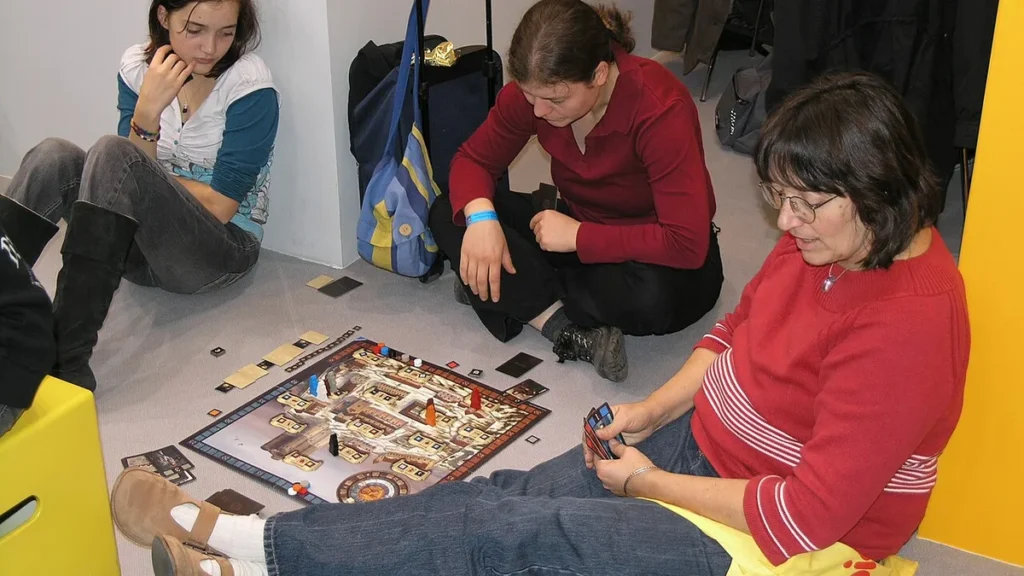
Five hundred and eight players in one hall sounds impossible until you break it into tables. One hundred and twenty-seven tables of four, a shared clock, and a team of helpers turn a crowd into a working game night. The trick is not finding one game that seats everyone at once. The trick is picking games that teach fast, finish on time, and run the same way at every table.
This guide gives you nine games that fit that brief. It builds on our guide to board games for 506 players, with nine fresh games for an even bigger hall. Each one teaches in under ten minutes, plays in under an hour, and works with simple supplies you can copy, print, or buy in bulk. You will also get a table of copies and timings, three formats for running the night, a six-point checklist, and answers to the six questions every organiser asks first.
The nine games below cover drawing, guessing, voting, bluffing, and word matching, so every table finds something it enjoys. Run them as stations, as a team contest, or as one big tournament, and the same 508 players who looked unmanageable at the door will be laughing, shouting, and asking when the next night happens.
Key takeaways
- 508 players means about 127 tables of four, so sort the room, the helpers, and the schedule before you pick the games.
- Choose games that teach in under ten minutes and finish inside one hour.
- Run every table on the same clock, with a helper watching each group of eight tables.
- Buy or print enough copies for every table, plus a few spares for late arrivals.
- End on a shared final round so all 508 players finish together.

The table below shows the nine games at a glance. Seats per copy is the number of players one copy serves, copies for 508 is how many you need for a full hall, and minutes is the length of one round. Keep a copy of this table on every helper’s clipboard.
| Game | Seats per copy | Copies for 508 | Minutes | Best for |
|---|---|---|---|---|
| Mafia | 20 | 26 | 30 | Late-night deduction rounds |
| Bingo | 100 | 6 | 45 | Whole-hall rounds |
| Fishbowl | 12 | 43 | 30 | Fast team laughs |
| Drawful | 8 + audience | 8 screens | 20 | Big-screen drawing rounds |
| Quiplash | 8 + audience | 8 screens | 20 | Quick-fire joke rounds |
| The Game of Things | 8 | 64 | 30 | Easy icebreakers |
| Funemployed | 8 | 64 | 30 | Job-interview laughs |
| The Voting Game | 10 | 51 | 25 | Getting to know the hall |
| Medium | 8 | 64 | 20 | Word-match warm-ups |
The Nine Games for 508 Players
Each game below teaches in minutes and plays the same way at every table. Pick the ones that fit your hall, your helpers, and your crowd, and run them on one shared clock.
Every game below lists the number of players one copy serves and the number of copies a full hall needs, so you can order and print with confidence. Helpers should read the two paragraphs for their game before the doors open, and keep the table of timings close at hand all evening.
1. Mafia
Mafia is a hidden-role party game for large groups. Each round, most players are innocent, a few take hidden roles as the mafia, and the whole group talks, votes, and narrows the suspects down one by one. Nobody needs a board, a deck, or any pieces at all, which makes Mafia the cheapest game on this list to run at scale.
For 508 players, run Mafia on parallel tables of twenty, with one host per table calling the day and night phases. Give every host the same script and the same timing, and run three rounds in a row so every table stays in step. Players who are out early join a fresh table instead of waiting around, and the last round of the night brings the best storytellers to the stage.
2. Bingo
Bingo needs no teaching at all, which is why it shines with a crowd this size. Hand every player a printed card, call the numbers from a stage, and the whole hall plays the same round together. Add a big display so players at the back can see the called numbers, and use a fresh card for every round so nobody plays from memory.
One caller can run Bingo for all 508 players at once, with helpers handing out cards and checking winners. Print six different card designs in rotation so neighbours cannot copy each other, and keep prizes modest so the focus stays on the fun. A round takes about fifteen minutes, which leaves room for several rounds in one evening.
3. Fishbowl
Fishbowl is a team guessing game played in three rounds with the same slips of paper. Players write a word or a name on each slip, drop the slips in a bowl, and then take turns drawing slips and getting their team to guess. Round one allows any words, round two allows one word only, and round three allows silent acting only.
Fishbowl scales beautifully because the slips come from the players themselves. Ask every table to write twenty slips before play starts, then run the same three rounds at all forty-three tables on one clock. A helper at each table keeps the scores and keeps the rounds moving, and the best team from each table meets in a final round on the stage.
4. Drawful
Drawful is a drawing game played on phones and shown on a big screen. One player gets a strange prompt, draws it with a finger, and the rest of the group invents fake titles for the drawing. Points reward the players who fool the most people and the players who spot the real title.
For 508 players, put Drawful on eight big screens around the hall, with eight players drawing on each screen and the rest of the audience voting from their phones. Rotate the drawing seats every round so fresh players get a turn, and show the funniest drawings on the main stage between rounds. One helper per screen keeps the voting moving and the crowd laughing.
5. Quiplash
Quiplash is a joke-writing contest played on phones and shown on a big screen. Every player answers the same funny prompt, the answers appear in pairs, and the audience votes for the answer that makes them laugh hardest. The best lines win points, and the worst lines often win the biggest laughs.
Quiplash works for 508 players the same way Drawful does: eight screens, eight writers per screen, and the whole audience voting. Keep the prompts clean and friendly so every age in the hall can join in, and read the top answers aloud from the stage at the end of each round. Two rounds per screen is plenty for one evening.

6. The Game of Things
The Game of Things is a simple writing game. One player reads a prompt aloud, such as “Things you should not say at a wedding”, and every other player writes an answer of their own. The reader reads the answers aloud, the group votes for its favourite, and the writer of the winning answer scores.
The Game of Things needs nothing but paper, pens, and a reader, so it is the easiest game on this list to run at scale. Print the prompts in advance, give each table the same prompt list, and run the rounds on one clock. Sixty-four tables of eight can play the same prompt at the same time, which makes the final vote a whole-hall moment.
7. Funemployed
Funemployed is a job-interview game in which players apply for silly jobs with strange qualifications. Each applicant draws four qualification cards and must explain why a trait like “can talk to animals” makes them perfect for a job like “astronaut”. The interviewer picks the applicant with the funniest pitch.
Funemployed runs best in modest groups, so give each table its own interviewer and its own deck. Run the same job cards at every table, rotate the interviewer every round, and bring the best applicant from each table to the stage for a final interview. The stage final is short, loud, and usually the funniest part of the night.
8. The Voting Game
The Voting Game is a get-to-know-you game built on funny questions. One player reads a question such as “Who is most likely to fall asleep at a party?”, every player votes at the same time by pointing, and the player with the most votes takes the card. The questions do the work, so nobody needs to be quick or witty.
The Voting Game is perfect for a crowd that is still getting to know each other. Run it early in the evening as an icebreaker, with ten players per table and one deck per table. Keep the questions friendly, skip any question that singles one player out, and let the laughter do the introductions for you.
9. Medium
Medium is a word-matching game for pairs. Two players each say a word at the same time, then try to land on the same word in the next round by finding the link between the two words they said. Pairs keep playing until they match, and the whole table can watch, groan, and cheer them on.
Medium is the quickest game on this list, so use it as a warm-up between longer games. Run it in pairs at every table, with a helper calling the start of each round, and award a point to every pair that matches inside three tries. It teaches in two minutes, which makes it ideal for the first ten minutes of the night.
Running the Night
Nine games are only half the job. The other half is the format that holds 508 players together. Pick one of the three formats below and build the whole evening around it. If you want a closer look at how a slightly smaller crowd runs, our guide to board games for 504 players uses the same three formats.
The Team Format
Split the hall into teams of eight, give each team a home table, and rotate the teams through the nine games on a fixed timetable. Every team plays every game once, and the team with the most points at the end takes the title. Keep the teams the same size all evening, and mix players of every age and experience level inside each team so no single team runs away with every game. This format suits a crowd that wants friendly rivalry and a clear winner.
The Station Format
Turn each game into a station and let players wander between stations as they please. Put a helper at each station to teach the game, keep the queue short, and hand out a stamp for every station a player finishes. Put the loudest games, like Bingo and Quiplash, at opposite ends of the hall so their noise never drowns out the quieter tables. This format suits a relaxed evening where players want to choose their own games.
The Tournament Format
Run one game at a time for the whole hall, with every table playing the same round on the same clock. After each round, the top teams move up a table and the rest stay put, so the strongest teams meet in the final. Post the standings where everyone can see them, and update the board after every round so the hall can follow the leaders. This format suits a crowd that loves a big shared finish.
Setup Checklist
Work through this list in order before the doors open. Our guide to board games for 502 players has a matching checklist you can borrow for a smaller hall.
- Book a hall with 127 tables, chairs for 508 players, and room for helpers to move between tables.
- Buy or print 508 name badges, one per player, with the table number on the back.
- Count every copy of every game, then add ten spares for damaged or missing pieces.
- Brief every helper on the rules, the clock, and the signal for starting and stopping rounds.
- Test every screen, speaker, and microphone the day before, with the same files you will use on the night.
- Print the table of games and timings for every helper, and pin one copy by the entrance.
Frequently Asked Questions
Can one board game really seat 508 players?
No single copy can, and no honest guide should claim otherwise. The 508 players sit at about 127 tables, and the games above run in parallel on the same clock. Bingo and the big-screen games are the only ones where the whole hall plays one round together.
How many tables do 508 players need?
About 127 tables of four, or fewer tables if you use bigger groups for games like Mafia and Bingo. Leave a spare table at each end of the hall for late arrivals and for players who need a quieter spot.
How many helpers do we really need?
Count on one helper per eight tables, which is about sixteen helpers for 508 players, plus two floaters who handle problems and cover breaks. Every helper needs the rules sheet, the timetable, and a way to reach the stage quickly.
Which game should we start with?
Start with Medium or The Voting Game. Both teach in minutes, both get strangers talking, and both leave the hall warm and ready for the longer games. Save Mafia for later in the evening, when the crowd knows each other and the bluffing lands better.
What if some tables finish much faster than others?
Give fast tables a short filler activity, such as a second round of Medium or an extra Bingo card, and hold the next round until the slowest table is ready. A shared clock and a clear signal keep the hall together.
How long does a night for 508 players last?
Allow three hours: thirty minutes for seating and teaching, two hours of play across three or four games, and thirty minutes for the final round and prizes. Add thirty minutes at each end for arrival and clearing away.
The Bottom Line
Five hundred and eight players is a big number, but it is only 127 tables, nine games, and one shared clock. Pick games that teach fast, give every table the same rules and the same timetable, and keep a helper close to every group of tables. Do that, and the night runs itself, the hall stays happy, and the only problem left is finding a date for the next one.


