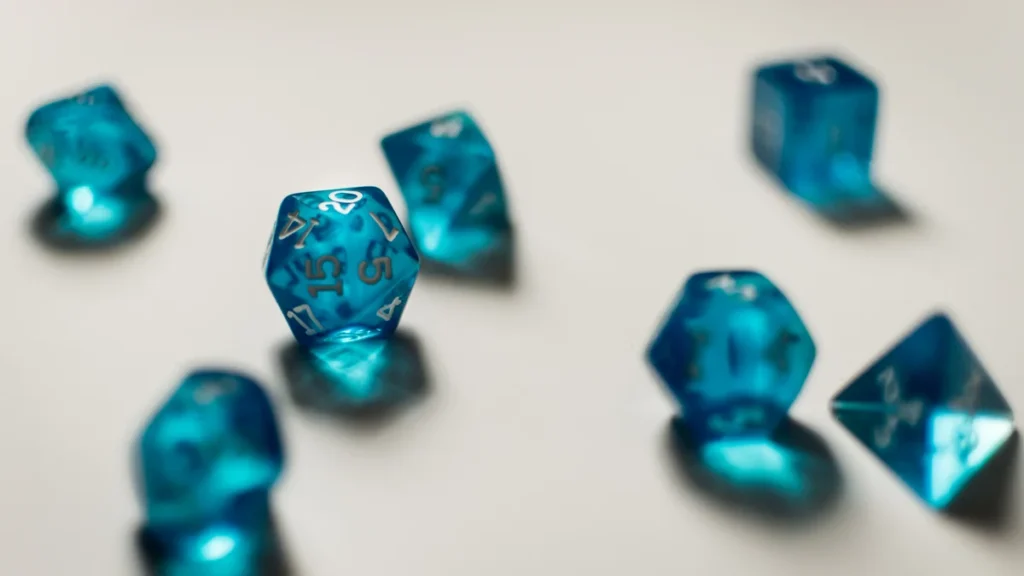
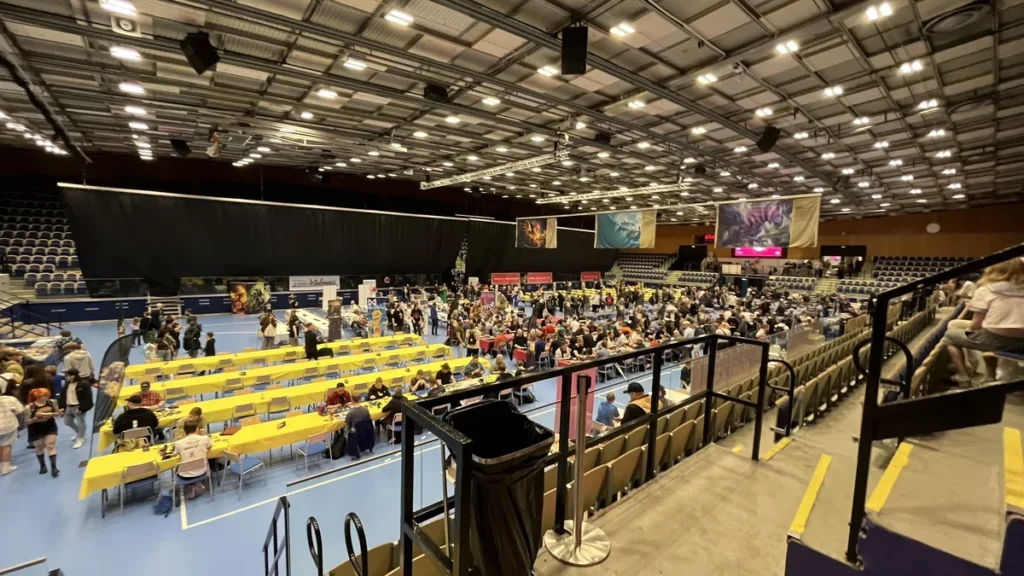
Dice games for 419 players sound impossible until you are the person holding the sign up sheet for a hall full of people and a crate of dice. No single table seats 419 players, and no single roll can include everyone at once, so the trick is to stop thinking of one game and start thinking of one event built from many small games running at the same time. Dice are cheap, the rules can be taught in under a minute, and the best games break cleanly into tables, teams, and short rounds, which is exactly what a crowd this size needs.
The nine games in this guide were picked for a crowd of 419: five of them are push your luck classics where every roll is a small gamble with the dice, while the last four add dice cups, pig dice, alien dice, and a climbing board to keep the room loud. Each game can be taught from a single printed card, each round lasts only a few minutes, and every result fits on one score sheet.
This guide gives you the table plan, dice counts, and round lengths you need to run the night, plus a comparison table, a setup checklist, and answers to the questions every host asks first. Read the scaling plan, pick three or four games, and let the tables rotate between them. With 419 players, the best plan is a simple one, repeated well.
Key takeaways
- Split 419 players into 69 tables of six plus one table of five, and run the same game at every table on one shared clock.
- Choose games anyone can learn in under a minute, so the whole room starts together.
- Push your luck games keep the room loud and tense, while Qwixx and Balut give quieter tables a calmer break.
- Bring one dice set per table, plus spare dice, score sheets, pens, and a rules card for every game.
- Keep rounds between ten and fifteen minutes, and move table winners to a new table after each round.

How Dice Games Scale to 419 Players
Scaling a dice game to 419 players is a maths problem before it is a games problem. Four hundred and nineteen divides into 69 tables of six, which covers 414 players, plus one table of five for the last five seats. Six is a good table size: everyone can see the dice, nobody waits long for a turn, and a single score sheet holds the whole table. Five works just as well for the last table, so nobody sits out.
Think of each table as a small adventuring party with its own game master. The game master reads the rules card aloud, keeps the score sheet, and calls the end of the round when the shared clock runs out. You need one confident reader, one pen, and one set of dice. If a table finishes early, the game master starts a fresh round or swaps in a second game from this guide.
The shared clock is the secret to the whole evening. When every table starts and stops together, the room feels like one event instead of 70 separate games. A whistle, a bell, or a phone timer on the speaker system does the job. Give each round ten to fifteen minutes, then sound the changeover, move the winners up a table, and start again.
Dice counts stay modest even at this scale. Most tables need only one set of dice, and a set costs less than a round of drinks at most venues. Buy one set per table, then add ten spare sets for lost dice and broken cups. Score sheets can be printed at home, and a single rules card per game per table is enough, since players share. The dice games for 417 players use the same table maths, so the plan here will feel familiar if you have run a big dice night before.
Dice Games for 419 Players at a Glance
Use this table to pick your games at a glance. Dice per table means the dice one table needs for one round, and round length is the time a typical table takes to finish one game.
| Game | Dice per table | Players per table | Round length | Best for |
|---|---|---|---|---|
| Farkle | 6 | 2 to 6 | 15 minutes | Push your luck tension |
| Pig | 1 | 2 to 6 | 10 minutes | Fast warm up rounds |
| Zombie Dice | 13 | 2 to 6 | 10 minutes | Themed party fun |
| Qwixx | 6 | 2 to 5 | 15 minutes | Quiet scoring tables |
| Pass the Pigs | 2 pig dice | 2 to 6 | 10 minutes | Laughs and surprises |
| Martian Dice | 13 | 2 to 6 | 10 minutes | Silly alien theme |
| Balut | 5 | 2 to 6 | 20 minutes | Longer thoughtful play |
| Can not Stop | 4 | 2 to 4 | 15 minutes | Climbing race drama |
| Drop Dead | 5 | 2 to 6 | 10 minutes | Quick knockout rounds |
The 9 Best Dice Games for 419 Players
Every game below works at a table of five or six, teaches in under a minute, and finishes inside fifteen minutes except Balut, which runs a little longer. Pick three or four for the night and let tables rotate between them.
1. Farkle
Farkle is the classic push your luck dice game, and it is the best opener for a huge group because the drama is instant. Each player rolls six dice and sets aside scoring dice: ones score 100, fives score 50, three of a kind scores from 300 up, and a straight scores 1500. After each roll you choose whether to bank your points or roll the remaining dice again for more. Roll with no scoring dice and you farkle, losing everything you scored that turn.
At a big event, Farkle shines because the whole table watches every roll. A player on 900 points with two dice left has the room holding its breath, and a farkle at the worst moment gets a cheer from the whole hall. Play to 10000 points, and let the table winner move up a table at the changeover. One set of six dice per table is all you need, plus a score sheet with the scoring table printed at the top.
2. Pig
Pig is the simplest game in this guide, and that is why it belongs at every big dice night. One player rolls a single die and adds the result to a running total, then chooses to hold and bank the points or roll again. Roll a one and the turn total is lost, so every roll is a small decision. The first player to 100 points wins the round, and a round rarely lasts more than ten minutes.
Pig works as a warm up game while latecomers find their tables, and it works as a tiebreaker when two tables finish early. For a crowd of 419, give each table one large die that everyone can see from across the table, and let the game master call the running total aloud so the whole table stays involved. Team Pig is a fun variation: split the table into two teams, and let each team decide together whether to hold or roll on.
3. Zombie Dice
Zombie Dice turns every player into a hungry zombie rolling for brains, and it is the funniest game on this list. Each turn you draw three dice from a cup of thirteen: green dice are easy victims, yellow dice are middling, and red dice are dangerous. Brains score a point, footprints let you reroll that die, and shotguns hurt. Collect three shotguns in one turn and you score nothing, so the question is always whether to push on or stop while you are ahead.
The first player to thirteen brains wins, and a full game takes about ten minutes. The theme does the teaching for you: everyone understands brains good, shotguns bad, and the green dice feel safe until they do not. Put Zombie Dice on the loudest tables near the front of the hall, because the groans and cheers carry across the room and pull people in.

4. Qwixx
Qwixx is the quiet game on this list, and every big night needs one. Each player has a score sheet with four coloured rows numbered 2 to 12, and the table shares six dice: two white dice and four coloured dice. On your turn you roll, and everyone at the table may cross off a number using the white dice, while only you may also cross off a number using one white die plus one coloured die. Numbers must be crossed off from left to right, and a row can be locked once enough numbers are crossed.
Qwixx suits mixed ages and mixed energy levels because there is no waiting: every roll matters to every player at the table. A game takes about fifteen minutes, and the score sheets are easy to print in bulk. Put Qwixx on the tables near the quieter corners of the hall, and let players who want a calmer game drift there between rounds.
5. Pass the Pigs
Pass the Pigs is the silliest game in this guide, and silliness is a strength when 419 people need to relax. Two small pig dice are rolled like ordinary dice, and the points depend on how the pigs land: both on their sides with matching dots, a trotter with a pig standing on all fours, a snouter with a pig on its nose, and the rare leaning jowler against the table edge. Roll a pig on its side and a pig on its back and you pig out, losing your turn total.
The first player to 100 points wins, and the game takes about ten minutes. Nobody needs to learn a scoring table in advance, because the pig positions are funny enough to remember after one round. For a huge group, Pass the Pigs is the best game for tables with children or first time players, since the pigs do the entertaining and the rules stay out of the way.
6. Martian Dice
Martian Dice is Zombie Dice with aliens, and it is perfect for tables that want a theme without a long rules talk. Each turn you roll thirteen dice showing earthlings, tanks, and death rays. Abduct humans, cows, and chickens for points, but watch the tanks: roll more tanks than death rays and your earthlings fight back, ending your turn with nothing. The first player to 25 points wins, and a game takes about ten minutes.
The joke lands fast with a big crowd, because everyone can picture a Martian invasion going wrong. Martian Dice teaches in under a minute, and the dice themselves carry the theme, so the game master only has to explain the tank rule once. The dice games for 416 players lean on team play and bluffing, while this list leans on push your luck, so the two guides pair well for a second night.
7. Balut
Balut is the longest and most thoughtful game on this list, and it suits tables that want a proper contest. Each player rolls five dice up to three times per turn, aiming to fill a score sheet of categories: pairs, straights, full houses, and the prized Balut, five of a kind, which scores 20 points on its own. Every category must be filled once, so the game rewards planning as much as luck, and a full game takes about twenty minutes.
For 419 players, Balut works best as a second round game, once the room has warmed up and players want something meatier. Print the score sheets in advance and give each table a worked example, since the categories look fussy until you have scored one line.
8. Can not Stop
Can not Stop is a climbing race played on a board of columns numbered 2 to 12, and it creates the loudest finishes of any game here. On your turn you roll four dice, pair them into two sums, and climb two columns with temporary markers. You may roll again to climb further, but if you cannot place a marker you lose all progress from that turn. Three columns climbed to the top wins the game, and most games finish in fifteen minutes.
The tension is perfect for a big hall, because every roll is a public decision and the whole table can see the markers creeping upward. Can not Stop suits tables of two to four best, so seat it at the smaller tables or let six player tables split into two games of three.
9. Drop Dead
Drop Dead is the fastest knockout game in this guide, and it is the best closer for the night. Each player rolls five dice, and any twos and fives are dead and set aside. Score the remaining dice, then roll what is left, losing more dice to twos and fives each time. When all five dice are dead, your turn ends, and the highest total wins the round. A round takes about ten minutes, and the game needs no board, no score sheet beyond a running total, and no teaching beyond one sentence.
Drop Dead is the game to run in the final round, when the hall is tired and wants one last quick contest before the prizes. It also works as a sudden death tiebreaker between table winners, since a single roll can settle a tied table in under a minute.
Running the Night: A Host Checklist
Run through this checklist the day before the event, and the night will look after itself.
- Count the players and set out 69 tables of six plus one table of five, with a chair, a pen, and a score sheet at every seat.
- Pack one dice set per table for each game on the night, plus ten spare sets, spare pens, and printed rules cards.
- Print the comparison table from this guide and pin it near the door, so players can choose their first game.
- Appoint one game master per table and give each of them a whistle or a phone timer for the shared clock.
- Plan three or four rounds of ten to fifteen minutes, with a five minute changeover between rounds for winners to move tables.
- Prepare a simple prize for the overall winner, such as a trophy, a gift voucher, or the honour of choosing the first game next time. The dice games for 415 players round out the series if your group wants a third night of games.
Frequently Asked Questions
Can 419 people really play dice games at the same time?
Yes, if you split the room into tables of five or six and run the same game at every table on one shared clock. Nobody plays all 419 opponents at once. Everyone plays the five people at their own table, and the winners move up a table after each round, so the event feels like one big game even though the dice stay small.
How many dice do we need for 419 players?
About 70 dice sets, one per table, plus ten spare sets. Most games in this guide need only one set per table: Farkle needs six dice, Zombie Dice and Martian Dice need thirteen dice each, and Pig needs a single die. Buy the sets in bulk and keep the spares in a labelled box at the host table.
What if some players have never played a dice game?
Start them on Pig, Drop Dead, or Pass the Pigs, which all teach in under a minute and need no scoring table to memorise. Seat one confident player at each table as game master, and give every table a printed rules card. New players learn fastest by watching one round, so let them sit in for a practice roll before the clock starts.
How long should the whole evening last?
Plan for about two hours: a fifteen minute welcome and seating, three or four rounds of ten to fifteen minutes, five minute changeovers between rounds, and a short prize giving at the end. Balut rounds run a little longer, so either give Balut tables twenty minutes or save Balut for the second round when the room is already moving well.
Do we need special dice or boards?
No. Ordinary six sided dice cover Farkle, Pig, Balut, Can not Stop, and Drop Dead, and the themed games come with their own dice in the box. Can not Stop needs a board, but a printed board with coins as markers works just as well. Qwixx needs printed score sheets, which you can print at home.
What is the best game to start with?
Farkle, because the whole table watches every roll and the room warms up fast. If your group is shy, start with Pass the Pigs instead, since the pig dice make people laugh before the competition starts. Either way, keep the first round short, about ten minutes, so nobody is stuck at a game they do not enjoy.
The Bottom Line
Dice games for 419 players work when you stop trying to seat everyone at one table and start running 70 small games on one shared clock. Farkle and Pig open the night, Zombie Dice and Martian Dice keep the room loud, Qwixx and Balut give thoughtful players a home, and Drop Dead closes the evening in ten minutes flat. Print the rules cards, pack the spare dice, and let the tables rotate. The dice will do the rest.