
The best party games for 330 players are not simply bigger versions of the games you play at home. When 330 people gather in one hall, a school gym, a company campus, or a wedding venue, the usual rules stop working. A game that keeps eight friends laughing for an hour can leave 300 people standing around, confused, bored, or waiting for a turn that never comes. The best party games for 330 players solve that problem by design: everyone plays at the same time, nobody waits long, and the whole room shares one clear goal, one clear signal, and one clear moment of fun.
Planning for 330 players means thinking like an event organiser rather than a party host. You need games that scale across teams, games that work with a microphone and a stage, games that use simple materials in bulk, and games that keep energy high even when the group is spread across a very large space. The games in this guide do exactly that. They have been chosen because they work with hundreds of players, they need little equipment, they are easy to explain in under two minutes, and they keep every single person involved from the first minute to the last.
This guide covers everything you need to run a successful event for 330 players. You will find team formats that split the crowd into manageable groups, whole-room games that need no teams at all, relay and challenge games that turn size into spectacle, and quieter table games for the moments when the room needs to settle. You will also find a planning table, a six-point checklist, and answers to the most common questions about timing, space, scoring, and prizes. Whether you are planning a corporate day, a school celebration, a community festival, or a very large family gathering, these games will help you turn 330 strangers or colleagues into one happy, noisy, connected crowd.
Key takeaways
- Choose games where everyone plays at once, so no one waits for a turn in a group of 330.
- Split the crowd into teams of 10 to 15 players to keep every game manageable and social.
- Use one microphone, one stage, and one visible scoreboard so the whole room can follow the game.
- Explain each game in under two minutes and demonstrate it once before the real round starts.
- Mix loud whole-room games with table games and relays to keep energy balanced across the event.
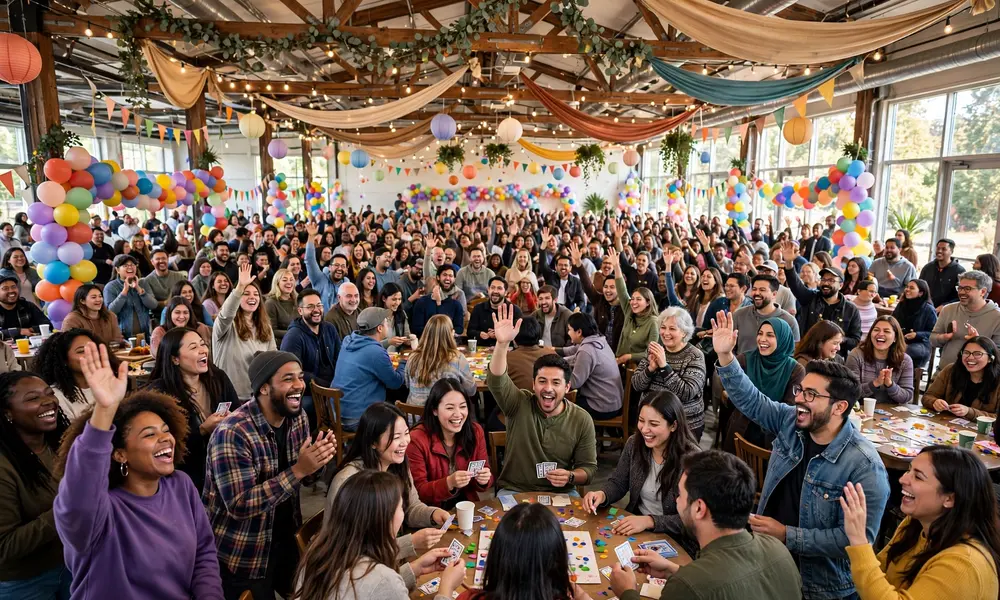
Why Party Games Change at 330 Players
Most party games are designed for a living room. They assume everyone can hear the host without a microphone, everyone can see the cards or the board, and everyone gets a turn within a few minutes. None of that is true with 330 players. Sound fades across a hall, sight lines disappear behind rows of tables, and a game with individual turns would take hours. The first job of the organiser is to accept that scale changes the game itself, not just the number of chairs.
The solution is to design for simultaneous play. In a simultaneous game, all 330 players act at the same time: they answer the same question, they complete the same challenge, or they compete in parallel heats. A quiz works because every table answers together. A scavenger hunt works because every team searches at the same time. A relay works because ten lanes run side by side. When everyone is busy, nobody is bored, and the room feels alive rather than restless.
Teams are the second key idea. A crowd of 330 is overwhelming, but a team of 11 is friendly. When you split the room into 30 teams of 11 players, each person has a small group to talk to, a team name to cheer for, and a clear role. Teams also make scoring simple: you track 30 scores instead of 330 individual results. Give each team a colour, a table, and a captain, and the whole event becomes far easier to manage.
How to Organise Games for 330 Players
Split the Crowd Into Teams
Divide 330 players into 30 teams of 11, or 33 teams of 10 if that fits your tables better. Mix people across teams rather than letting friends or departments sit together, because mixed teams spark new conversations and stop one strong team from dominating every game. Give each team a coloured wristband, a table number, and a printed team sheet with the schedule. Ask each team to choose a captain and a team name in the first ten minutes. That small act of choosing a name builds team spirit faster than any speech.
Plan the Schedule in Blocks
Do not try to run ten games back to back without breaks. Plan the event in blocks of 30 to 45 minutes, with a short break between blocks for drinks, snacks, and conversation. A typical three-hour event might include a welcome game, two quiz rounds, a relay block, a creative challenge, and a finale. Keep each game to 15 to 20 minutes of play, plus five minutes for explaining and scoring. Short, sharp games keep energy high, while long games drain it.
Score Simply and Visibly
Scoring must be simple enough for a volunteer to run without confusion. Use points per round, with 10 points for first place, 7 for second, 5 for third, and 3 for every team that finishes. Display the scores on a large screen or a whiteboard where everyone can see them. Update the board after each game, and announce the top five teams by name. Visible scoring creates friendly rivalry and gives every team a reason to keep trying, even if they are not winning overall.
The Best Party Games for 330 Players
The games below are grouped by style so you can build a balanced programme. Start with a whole-room warm-up, move into team quizzes and creative challenges, and finish with a big finale that brings everyone together. Every game here works for 330 players with the team structure described above, and every game can be explained in two minutes or less.
1. The Giant Quiz
The giant quiz is the most reliable game for a crowd of 330 because every team plays every question at the same time. Prepare 30 questions across six rounds of five, covering general knowledge, music, food, sport, films, and fun facts about your group or company. Each team writes its answers on one answer sheet, and a runner collects the sheets at the end of each round. Read each question twice, give teams 30 seconds to agree, and play a short music clip between rounds to keep the mood lively. The quiz works indoors or outdoors, needs almost no equipment, and gives every player a chance to contribute knowledge.
2. Music Bingo
Music bingo turns a quiet listening game into a room-wide celebration. Give every player a bingo card printed with song titles instead of numbers, then play short clips of popular songs over the speakers. When players hear a song on their card, they mark it off. The first team to complete a row shouts its team name, and the first team to complete a full card wins the round. Print different cards for each team so that no two teams have identical layouts, and choose songs that most of the room will recognise. Music bingo is ideal as a warm-up because it needs no talking, no movement, and no special skill, yet the whole room joins in at once.
3. Team Trivia Relay
Team trivia relay combines quick thinking with light movement. Set up a line of question stations across the front of the room. One player from each team runs to a station, reads a question, runs back, and whispers the answer to the team. The team discusses it, sends the next runner with the answer, and the cycle continues. Each correct answer earns a point, and the team with the most points after ten minutes wins. This game is fast, noisy, and very watchable, and it works well as a bridge between seated games and active games.
4. Human Bingo
Human bingo is a brilliant icebreaker for a crowd where many people do not know each other. Give every player a bingo grid filled with statements such as has visited three countries, can play a musical instrument, or has run a marathon. Players walk around the room, introduce themselves, and collect signatures from people who match each statement. The first player to complete a row wins a small prize, and the first team whose members complete the most grids wins team points. Human bingo turns 330 strangers into a room full of conversations within ten minutes.
5. Pictionary in Parallel
Pictionary scales beautifully when every team plays at the same time. Give each team a small whiteboard, a marker, and a stack of word cards. One player draws a word while the rest of the team guesses, and teams rotate the artist every minute. Award points for each correct guess, and add a bonus round where the whole room guesses a drawing shown on the big screen. Pictionary is funny, creative, and inclusive, because drawing skill matters far less than speed and teamwork. Keep the words simple and varied, mixing objects, actions, films, and everyday phrases.
6. Guess the Song
Guess the song is a fast whole-room game that needs only a speaker and a playlist. Play the first five seconds of a popular song, and teams race to write down the title and the artist. Award two points for both correct, one point for either, and a bonus point for the fastest correct team in each round. Play 20 songs across four rounds, mixing decades and styles so that every age group has a fair chance. Guess the song is perfect just before a break, because it leaves the room buzzing and talking about the songs they missed.
7. The Grand Finale: Team Showdown
Finish the event with a grand team showdown that brings all 330 players together. Choose a simple whole-room game, such as a giant version of musical statues, a mass dance challenge, or a final quiz round where the top five teams compete on stage while the rest of the room cheers. Announce the overall winners, award prizes, and take a group photograph. A strong finale matters because it is the last memory players take home. End on a high note, thank the teams by name, and invite everyone to stay for photos and conversation.
Choosing the Right Mix for Your Event
If you have run large party games before, you will recognise the pattern: the games that work best are the ones that are simple to explain and hard to get wrong. If you are new to events of this size, start with the giant quiz, music bingo, and human bingo. Those three games alone can fill the first hour with confidence, and they give you time to learn how the room responds before you try the more active games. For ideas on how the same formats work with slightly smaller crowds, see our guide to party games for 300 players, which uses the same team structure with a few different twists.
Planning Table: Games at a Glance
Use this table to plan your programme quickly. It shows the style, the time needed, and the equipment for each game, so you can balance your schedule and prepare your materials in advance.
| Game | Style | Time | Equipment needed |
|---|---|---|---|
| Giant Quiz | Seated, thinking | 30 minutes | Question sheets, pens, answer sheets |
| Music Bingo | Seated, listening | 20 minutes | Printed bingo cards, speaker, playlist |
| Team Trivia Relay | Active, thinking | 15 minutes | Question stations, timer |
| Human Bingo | Social, moving | 15 minutes | Printed bingo grids, pens |
| Pictionary in Parallel | Creative, seated | 20 minutes | Whiteboards, markers, word cards |
| Guess the Song | Seated, listening | 15 minutes | Speaker, playlist, answer sheets |
| Grand Finale Showdown | Whole room | 20 minutes | Microphone, prizes, camera |
Event Checklist for 330 Players
Use this checklist in the week before your event, and again on the morning of the event. It covers the essentials that make the difference between a smooth day and a stressful one.
- Confirm the venue, the layout, and the number of tables, chairs, and power points.
- Print team sheets, answer sheets, bingo cards, and word cards in bulk, with spares.
- Test the microphone, speakers, and screen from the farthest table in the room.
- Prepare balloons, paper, tape, markers, and all game materials in labelled boxes per game.
- Brief your volunteers and team captains on the schedule, the signals, and the scoring system.
- Prepare prizes, a visible scoreboard, and a camera for the group photograph at the end.
Large-group party planning follows the same principles whatever the exact headcount. If you want to compare formats for a smaller crowd before you commit to a 330-player plan, our guide to party games for 200 players shows how the team sizes, timings, and relay heats change when the room is a little smaller.
Frequently Asked Questions
How long should a party for 330 players last?
Three hours is a good length for a party of 330 players, including breaks. That gives you time for a welcome game, four or five main games, and a finale, without exhausting the group. A two-hour event can work if you choose four games and keep explanations very short. Avoid events longer than four hours unless you include a proper meal break and free time for conversation.
How much space do 330 players need?
You need a hall or venue that can seat 330 people at tables with space to move between them, plus an open floor area for relays and active games. As a rough guide, allow at least one square metre per seated player plus a central open area of about 100 square metres for active games. Visit the venue in advance and walk the layout to check sight lines and walkways.
What prizes work best for such a large group?
Choose prizes that can be shared by a whole team, such as a hamper, a voucher, or a fun trophy that the team keeps. Avoid individual prizes for every player, which are costly and hard to distribute fairly. Award a prize for the overall winning team, plus small fun prizes for categories such as best team name, funniest moment, and best dressed team.
Do I need volunteers to run games for 330 players?
Yes, volunteers make a huge difference. Aim for at least ten volunteers: one host, two scorers, two runners to collect answer sheets, two judges for creative games, and three helpers to set up materials between games. Brief them the day before, give each one a printed schedule, and make sure they know the signals for starting and stopping each game.
Can these games work outdoors?
Most of these games work outdoors, and some, such as the team trivia relay, work even better outside. You will need a sound system that carries across open space, shade or shelter in case of sun or rain, and a backup indoor plan if the weather changes. Quizzes and Pictionary work best under cover, where paper and whiteboards stay dry and readable.
What if some players do not want to join in?
Some players will prefer to watch rather than compete, and that is fine. Give them roles such as scorekeeper, photographer, or judge, so they stay part of the event without pressure to perform. Never force anyone onto a stage or into a relay. When reluctant players see others having fun, many of them will join in on their own by the second or third game.
Planning for a very large group gets easier with practice, and many organisers start with a smaller event before scaling up. If your next event is likely to be smaller, our guide to party games for 100 players explains how the same games adapt when you have fewer teams and a more intimate room.
Bottom Line
The best party games for 330 players are the ones where everyone plays at once, teams of 10 or 11 keep the crowd friendly and manageable, and a clear host, a microphone, and a visible scoreboard keep the whole room together. Start with a giant quiz or music bingo, mix in a team trivia relay for energy, and finish with a grand team showdown that everyone remembers. Prepare your materials in bulk, brief your volunteers, keep your explanations under two minutes, and let the size of the crowd become the spectacle rather than the problem. With the right games and a simple plan, 330 players is not a challenge to survive, it is a party to enjoy.


