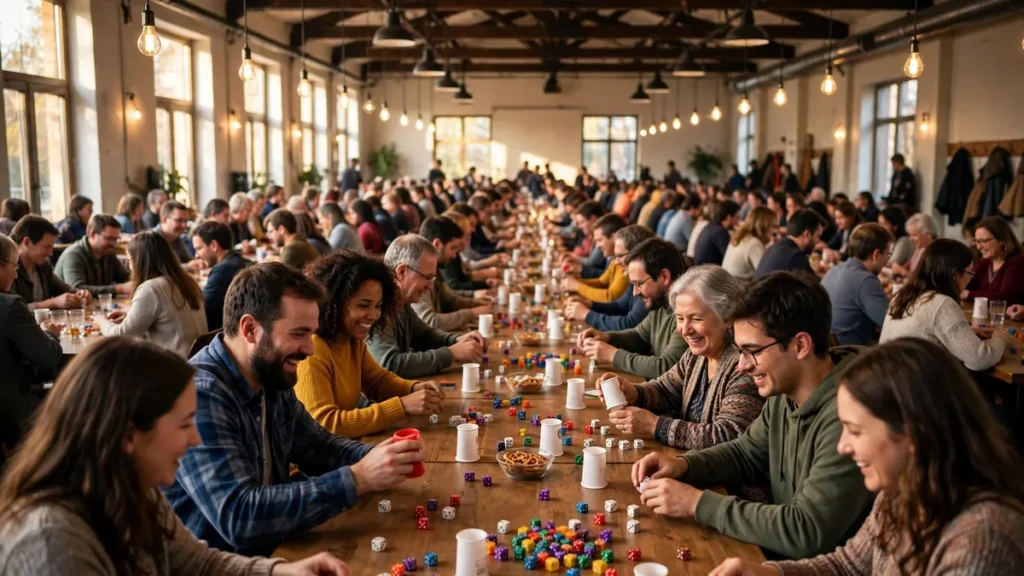
The best dice games for 320 players are the ones that turn a crowd that size into an advantage instead of a problem. When 320 people gather in one hall, a single table game will never work, but a well organised dice festival can keep every person rolling, laughing, and competing at the same time. The secret is not one magic game. It is choosing simple dice games, splitting the crowd into small teams, and running them in parallel so nobody waits long for a turn.
Most party games break down once the group passes twenty or thirty people. Dice games are different because the equipment is cheap, the rules can be learned in two minutes, and a single roll can involve a whole table. With enough dice, score sheets, and table hosts, a group of 320 can play together in one room, in one afternoon, without chaos. This guide shows you how to plan it, which games scale best, how many supplies you need, and how to keep the energy high from the first roll to the final score.
Whether you are planning a school celebration, a company social, a community festival, a reunion, or a large youth event, the ideas below will help you run a smooth and memorable day. Every game here uses ordinary dice, paper score sheets, and simple props you can buy or borrow in bulk. No game needs special skill, no game leaves players sitting out for long, and every game works for mixed ages and mixed abilities.
Key takeaways
- Split 320 players into 32 teams of 10, with one table host per team, so every player rolls often and nobody waits more than a minute or two.
- Choose games with rules that take under two minutes to explain, because long rules lose a large crowd before the first roll.
- Buy at least 160 sets of five dice, plus spare dice, score sheets, pencils, and dice trays, so every table can play without sharing.
- Run games in 15 to 20 minute rounds with a clear rotation, so teams try several games and the day keeps moving.
- Use a central scoreboard and a short closing ceremony, so the whole room shares one finish even though teams play separately.

Why Dice Games Work So Well for 320 Players
Dice games scale better than almost any other kind of party game. A board game needs one board per small group and often takes an hour. A quiz needs a host, a sound system, and a room that can hear every question. A dice game needs only a handful of dice and a flat surface, and a new round can start every minute. That simplicity is what makes dice the right choice when the player count reaches three figures.
How to Organise Dice Games for 320 Players
Split the Crowd Into Teams of Ten
Thirty-two teams of ten is the simplest split for 320 players, and it works well because ten people fit comfortably around two pushed-together tables or one long table. Give every team a name, a colour, and a table number. Print team lists in advance and hand them out at the door, so people find their table in minutes instead of wandering around the hall.
Run the Day in Short Rounds
Plan four game rounds of twenty minutes each, with five-minute changeovers between them. During a changeover, hosts collect score sheets, hand out the next rules card, and help players move if a game needs a different layout. A visible countdown timer helps everyone know how much time is left. Start with the simplest game first, save the most exciting game for the last round, and end with a ten-minute closing ceremony where you announce the top three teams and hand out small prizes.
The Best Dice Games for 320 Players
The games below were chosen because they meet four tests. They can be learned in two minutes, they keep every player involved, they need only dice and paper, and they work with five or ten players at a table. Each game includes the dice needed per table and the time per round. Mix fast games with slower games so the day has variety.
1. Team Yahtzee Relay
Team Yahtzee Relay is a natural opener. Each sub-group of five plays a simplified Yahtzee-style game, rolling five dice up to three times per turn to make combinations such as three of a kind, a full house, a small straight, a large straight, and five of a kind. Players write their score in the matching box, and the sub-group total counts toward the team score. A full game takes about twenty minutes. The rules are familiar to many people, the score sheet does the teaching, and the mix of luck and choice keeps players talking. For younger players, drop the hardest combinations and use a shorter sheet with six boxes instead of thirteen.
2. Bunco Style Rotation
Bunco is a classic social dice game made for large groups. Each table of four or five players rolls three dice, trying to roll the number that matches the current round. Every roll of the target number scores a point, and three of a kind scores a bonus. After six rounds, winners move up a table and other players stay or move down, so everyone meets new people during the day. The rotation suits reunions, company events, and community days where mixing matters. The rules take one minute to explain, the scoring is simple, and a bell signals the end of each round. Keep the rotation simple by numbering tables and telling winners to move one table forward.
3. Dice Bingo Roll and Cover
Dice Bingo Roll and Cover is the easiest game on this list to run for a huge group, and it is ideal as a calm round after a noisy one. Each player gets a printed card with numbers from two to twelve and counters to cover the numbers. A central caller rolls two large dice at the front of the room, calls out the total, and every player who has that number covers it. The first player to cover a full row, column, or pattern calls out and wins the round. Everyone plays at the same time from the same roll, which creates a shared moment across the whole hall. You need only one large pair of dice at the front and a printed card per player. Play three short games in one twenty-minute round, with a fresh card each time, and vary the winning pattern each game.
4. Ten Thousand Team Challenge
Ten Thousand, also known as Zilch or Farkle, is a press-your-luck dice game that creates real drama at every table. Players roll six dice, set aside scoring dice, and choose whether to bank their points or roll again for more. A roll with no scoring dice wipes out the points from that turn, so every decision feels risky. The scoring is easy to learn: ones are worth one hundred points, fives are worth fifty, three of a kind is worth one hundred times the face value, and three ones are worth one thousand. Print that scoring table on every score sheet. Keep the game moving by limiting each player to three rolls per turn, and set a team target of five thousand points instead of ten thousand if time is short.
5. Roll and Draw Story Dice
Roll and Draw Story Dice is the most creative game on this list, and it works wonderfully for mixed-age groups and school events. Each table gets ordinary dice with a printed picture key. Players roll three dice, look up the pictures, and draw or write a short story that includes all three pictures. The table votes for the funniest or cleverest story, and the winning story earns points for the team. This game needs no speed and no maths, which makes it a good change of pace after fast scoring games. Provide paper, pencils, and a picture key with twelve simple images, such as a key, a tree, a fish, a star, a house, a boat, a crown, a moon, a book, a cat, a mountain, and a cake. Run three story rounds of about six minutes each, and read two or three of the best stories aloud at the closing ceremony.
6. Dice Trivia Roll and Answer
Dice Trivia Roll and Answer combines the luck of dice with the fun of a quiz, without needing a quiz master for every table. Each table gets a pack of trivia question cards sorted into six categories, one for each face of a die. A player rolls one die, the host reads a question from the matching category, and the team discusses the answer for thirty seconds. A correct answer earns points equal to the number rolled multiplied by ten. Adapt the questions to your audience: general knowledge for a school event, fun workplace questions for a company event, and local history, food, music, and sport for a community event. Write at least sixty questions, ten per category, so no table runs out, and keep each question short with one clear answer.
7. Dice Relay Race
Dice Relay Race is the most active game on this list, and it is perfect for breaking up a long sitting session. Each team lines up at one end of the hall, and the first player walks or runs quickly to a table, rolls a die, and must roll a six before returning and tagging the next player. The team that gets all ten players through the relay first wins. Mark lanes with tape or cones, and have a volunteer at each relay table to watch the rolls and keep the order fair. Run the relay in heats of eight teams at a time, so the hall does not become crowded. This game works best outdoors or in a large hall with a clear floor, and a walking relay is just as fun as a running relay for mixed-age groups.
8. Roll for Points Target Game
Roll for Points Target Game is a simple scoring game that even the youngest players can enjoy. Each player rolls three dice and adds up the total. Rolling a double earns a bonus of ten points, and rolling a triple earns a bonus of fifty points. Players take it in turns for ten rounds, and the highest total wins the table. The game takes about fifteen minutes, which makes it a good filler round or warm-up game. There are no combinations to remember and no complicated scoring, which makes it ideal for children and for players who are new to dice games. To add variety, change the target each round: in round one the highest total wins, in round two the total closest to fifteen wins, and in round three the lowest total wins.
Comparison Table: Which Game Fits Your Event
Use this table to choose your four rounds quickly. Match the game to your audience, your venue, and the energy you want at each point in the day. A good day mixes one quiet game, one fast game, one thinking game, and one loud game, so every kind of player has a moment they enjoy.
| Game | Dice per table | Time per round | Best for | Energy level |
|---|---|---|---|---|
| Team Yahtzee Relay | 10 | 20 minutes | Families and mixed ages | Medium |
| Bunco Style Rotation | 6 | 20 minutes | Social mixing and reunions | High |
| Dice Bingo Roll and Cover | 2 large dice | 20 minutes | Large halls and all abilities | Low |
| Ten Thousand Team Challenge | 12 | 20 minutes | Players who like risk | High |
| Roll and Draw Story Dice | 6 | 20 minutes | Creative and school groups | Low |
| Dice Trivia Roll and Answer | 2 | 20 minutes | Quiz lovers and teams | Medium |
| Dice Relay Race | 8 | 20 minutes | Active and outdoor events | Very high |
| Roll for Points Target Game | 6 | 15 minutes | Young children and beginners | Low |
Supplies Checklist for 320 Players
- At least 800 dice in sets of five, plus 100 spare dice, stored in labelled bags of five so hosts can hand them out quickly.
- At least 32 dice trays or shallow boxes, one per table, plus a few spares for tables that lose theirs during the day.
- Four hundred printed score sheets, with a different sheet for each game, plus 400 pencils and 32 clipboards for hosts.
- Printed rules cards for every game, one per table, in large type, with the scoring table and a worked example on each card.
- A central scoreboard, a microphone or portable speaker, a bell or whistle, a countdown timer, and a prize table with small prizes for the top three teams.
- Team lists, table numbers, name badges or coloured wristbands, a help desk sign, and a first aid kit in case a player trips during the relay.
Tips for Hosts and Organisers
If you are planning a similar event with a slightly smaller crowd, the same structure works with fewer teams. The guide to dice games for 319 players shows how the same team format adapts when one team is smaller, and the ideas for seating, hosting, and rotation transfer directly. For a round-number milestone event, the guide to dice games for 300 players is a useful comparison, because it uses thirty teams of ten and the same supply list with fewer spares.
Frequently Asked Questions
How many dice do you need for 320 players?
You need at least 800 dice, in sets of five, plus about 100 spare dice. That gives every sub-group of five its own set, with spares for dice that roll away or go missing. Buy dice in bulk bags, count them into bags of five before the day, and keep the spares at a central help desk so hosts can replace lost dice quickly.
How long does a dice games event for 320 players take?
Plan for three hours, including four twenty-minute game rounds, five-minute changeovers, a twenty-minute break, and a fifteen-minute opening and closing ceremony. You can shorten the day to two hours by playing three games instead of four, or stretch it to four hours by adding a fifth game and a longer break. Do not try to fit five games into three hours, because the changeovers will feel rushed.
What is the best first game for a large group?
Team Yahtzee Relay is the best first game, because the rules are familiar, the score sheet explains itself, and the game is calm enough for players who are still finding their table. Dice Bingo Roll and Cover is another good opener if you want the whole room playing together from the same roll. Avoid starting with a bluffing game or a relay race, because both need confidence and energy that the room has not built up yet.
Can children and adults play together in the same teams?
Yes, dice games are ideal for mixed-age teams, because luck matters as much as skill. Pair younger children with an adult helper at the same table, use the simpler score sheets for the youngest players, and choose at least one quiet game and one creative game so children have rounds that suit them. Avoid Liar Dice for very young children, and keep the relay race to walking pace for mixed-age teams.
How do you keep score fairly with 32 teams?
Use the same printed score sheet at every table, collect sheets at the end of each round, and have two volunteers add up the scores independently. Post running totals on a central scoreboard after each round, and keep the completed sheets until the end of the day in case a team questions a total. Rotate the starting player each round, and make sure dice that land outside the tray are re-rolled.
What if you do not have enough tables for 32 teams?
Split the day into two sessions of 160 players, or use floor mats and picnic rugs for some teams. Dice games work on any flat surface, so a hall with twenty tables can still host 320 players if twelve teams play on mats in a second room or outside. Keep the timetable the same for both groups, use the same games, and bring everyone together for the closing ceremony and the group photo.
The Bottom Line
The best dice games for 320 players are simple, fast, fair, and social, and they work because they turn a huge crowd into thirty-two small teams that all play at once. Split the room into teams of ten, give every team a host and a clear rules card, run short rounds with a visible timer, and mix quiet games with loud games so every player finds a round they love. Order your dice and score sheets early, protect your break and your closing ceremony, and keep the scoring simple and visible. Do it well, and 320 strangers will leave feeling like one community that rolled, laughed, and played together. For a nearby group size with the same structure, the guide to dice games for 318 players is worth a look when you plan your next event.