Seventy-one players is not a game night. It is a small event, and the best word games for 71 players are the ones that survive that scale without turning into chaos. No boxed word game seats 71 people around one table, and any plan that pretends otherwise will fall apart in the first ten minutes. The games that work at this size share three traits: they play in teams, they keep every player busy at the same time, and they score fast enough that nobody waits twenty minutes for a turn.
That is why this list looks different from a normal word game roundup. Instead of ranking games by how clever their wordplay is, we rank them by how well they stretch. A great small-group word game can be a terrible 71-player game, and a simple party game that feels too light for four people can be perfect for a hall full of teams. The winners below are games that scale through team play, relay rounds, station rotations, or a single host running one big room.
Whether you are planning a company offsite, a school event, a family reunion, a church social, or a community fundraiser, the approach is the same. Split the room into teams of five to eight players, give every team the same challenge at the same time, and keep rounds short. The games on this list were chosen because they fit that format, need little equipment per team, and keep a crowd of 71 laughing instead of waiting.
Key takeaways
- No single word game seats 71 players at once, so every game on this list works through teams, stations, or a host-led format.
- Teams of five to eight players are the sweet spot: small enough that everyone talks, large enough to cover 71 people with nine to fourteen teams.
- Simultaneous rounds beat turn-based play at this size, because waiting kills the energy of a big room faster than any bad clue.
- One host with a microphone and a visible scoreboard matters more than the game itself once the group passes fifty players.
- Keep rounds to ten minutes or less, rotate roles inside each team, and always run a short practice round before scoring begins.
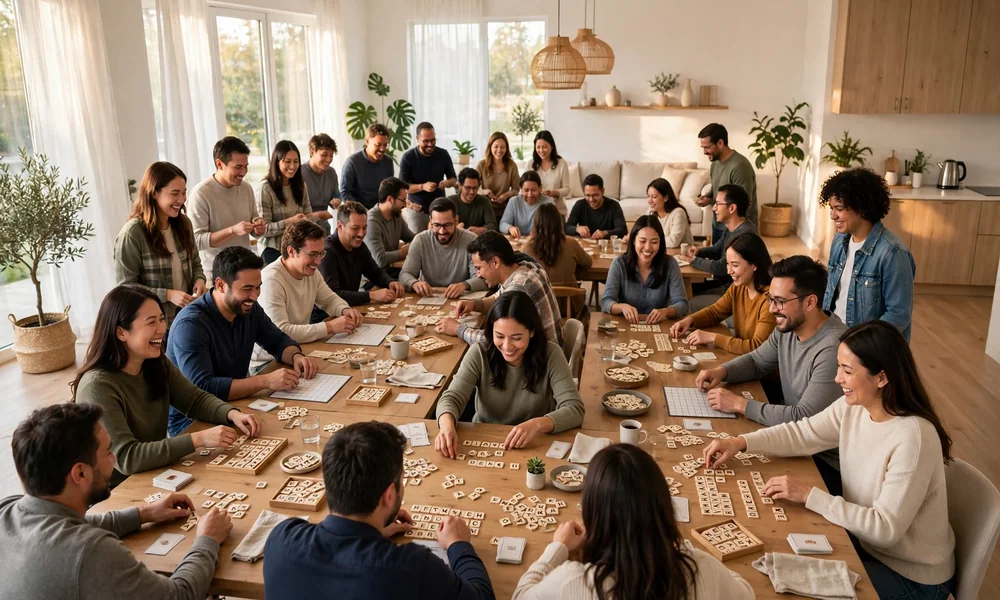
Why 71 Players Changes Everything About Word Games
Most word games are designed for two to eight players. The box says so, the components assume it, and the rules break quietly when you push past it. A word-building game with one set of tiles cannot serve 71 hands. A guessing game with one clue-giver leaves seventy people watching one person think. The first thing to accept is that the player count, not the game, decides the format.
The other thing 71 players changes is noise. Seventy-one people talking at once is loud, even when they are all having fun. Games that depend on quiet thinking or whispered clues struggle in a big room. Games that thrive on shouting answers, waving hands, and friendly arguing do very well. Choose games where the noise is part of the fun, and put the quiet puzzle rounds early, before the room warms up.
How to Run Word Games for 71 Players
There are three formats that work for a group this large, and every game in this guide fits at least one of them. The team tournament is the most reliable. You divide the room into teams, every team plays the same round at the same time, and scores are compared after each round. Nobody waits, nobody watches from the sidelines, and the whole room finishes each round together.
The station rotation works well when you have several rooms or a large hall with separate tables. Each team spends ten minutes at a word game station, then moves to the next one. A team might play a word-building game at one table, a guessing game at the next, and a speed round at the third. Stations need more helpers and more copies of each game, but they give players variety and keep the event moving even if one game runs long.
Team Size and Seating That Actually Work
Teams of five to eight players hit the right balance for word games. In a team of five, everyone gets to speak. In a team of eight, quieter players can still contribute without being put on the spot. Go bigger than eight and the loudest two people do all the talking while the rest check their phones. Go smaller than five and you end up with fifteen teams, which is hard for one host to track.
For 71 players, ten teams of seven plus one team of one extra player is a clean arrangement, giving you ten teams of seven and one team of eight only if you count carefully. A simpler plan is nine teams of eight, which covers 72 seats, so one team simply plays with seven. Either way, write the team list before the event, post it where everyone can see it, and let teams pick a name. Named teams compete harder and remember the night better.
Scoring and Timing for a Big Room
Keep the scoring simple enough that a volunteer can update it between rounds. Five points for a correct answer, three for a close answer, one point for every team that attempts a hard round, and a small bonus for the fastest correct team. Avoid scoring systems that need a calculator or a judge’s ruling, because disputes in a room of 71 people take ten minutes to settle and sour the mood.
The Best Word Games for 71 Players
The games below are ranked by how well they scale, not by how famous they are. Each one works for 71 players in at least one of the three formats above, and each one keeps every team playing at the same time. If you have played the classic versions with a small group, the team versions will feel familiar, just bigger and louder.
1. Team Word Building Relay
The word building relay is the most flexible game on this list. Each team gets a set of letter tiles or a stack of letter cards, and the host calls out a category. Teams race to build the longest valid word that fits the category, and the longest word on the table wins the round. It takes one minute to explain, needs almost no equipment, and works just as well for ten teams as it does for two.
2. Giant Crossword Race
A giant crossword race turns a quiet solo puzzle into a team sport. Print a large crossword, or project one onto a screen, and give every team the same clues. Teams race to fill the grid, and the first team to finish with all correct answers wins. For 71 players, the projected version is better, because every team can see the same grid and the host can fill in answers as teams call them out.
3. Word Chain Tournament
In a word chain, each new word must begin with the last letter of the previous word. Apple leads to elephant, elephant leads to tiger, tiger leads to rabbit, and the chain continues until a team cannot answer in time. Played as a tournament, two teams face off while the rest of the room watches and the winners advance. Played as a simultaneous round, every team builds its own chain and the longest chain wins.
4. Anagram Sprint
An anagram sprint gives every team the same jumbled letters and a short time limit. Unscramble the letters into as many real words as possible, and the team with the most valid words wins the round. Use a mix of short and long letter sets so that every team can score something while the strongest teams chase the big words.
5. Category Word Dash
The category word dash is the word game version of a quiz sprint. The host names a letter and a category, and every team has thirty seconds to write down as many words as they can that start with that letter and fit the category. Letter S, category animals, might give you snake, seal, spider, and squirrel. The team with the most valid words wins the round.
6. Guess the Word Relay
In a guess the word relay, one player per team sees a secret word and must get their team to guess it without saying the word itself. They can describe it, act it out, or give rhyming clues, depending on the house rules you set. Each correct guess earns a point, and the clue-giver role rotates so that every player gets a turn in the spotlight.
7. Word Bingo for a Crowd
Word bingo scales better than almost any other party game. Every player gets a bingo card filled with words instead of numbers, and the host calls out definitions or clues. Players mark the matching word, and the first team to complete a row or a full card wins. Because every player has their own card, all 71 players are involved from the first clue to the last.
8. Rhyme Race
A rhyme race is simple to run and surprisingly competitive. The host gives a starting word, and teams take turns calling out words that rhyme with it. When a team cannot answer in time, it loses a life, and the last team standing wins. Played simultaneously, every team writes down as many rhymes as it can in one minute, and the longest list wins.
9. Hidden Word Hunt
A hidden word hunt turns the whole venue into the game board. Hide word cards around the room, or hand each team a word search grid, and race to find the hidden words. The room version gets people moving, which is a welcome change after an hour of sitting, and the grid version keeps the game calm when the room is already loud.
10. Team Hangman Showdown
Team hangman takes the classroom classic and turns it into a crowd game. The host picks a secret word or phrase, teams take turns guessing letters, and the team that guesses the word wins the round. Played on a screen in front of the whole room, hangman becomes a shared puzzle that all 71 players can follow at once.
Word Games for 71 Players Compared
Choosing between these games is easier when you can see them side by side. The table below compares each game on the things that matter most at this scale: how it is played, how much equipment it needs, how long a round takes, and how well it keeps a big room engaged.
| Game | Best format | Equipment needed | Round length | Energy level |
|---|---|---|---|---|
| Word Building Relay | Team tournament | Letter tiles or cards | 10 minutes | High |
| Giant Crossword Race | Host-led | Projector or printouts | 15 minutes | Medium |
| Word Chain Tournament | Tournament or simultaneous | None | 10 minutes | High |
| Anagram Sprint | Host-led | Printed letter sets | 5 minutes | Medium |
| Category Word Dash | Host-led | Answer sheets | 5 minutes | High |
| Guess the Word Relay | Stations or teams | Word cards | 10 minutes | Very high |
| Word Bingo | Host-led | Printed bingo cards | 15 minutes | Medium |
| Rhyme Race | Host-led | None | 5 minutes | High |
| Hidden Word Hunt | Stations | Word cards or grids | 15 minutes | Medium |
| Team Hangman Showdown | Host-led | Screen or whiteboard | 10 minutes | High |
If you are running the event on your own with no helpers, pick the games that need no equipment or only answer sheets: the word chain, the anagram sprint, the category dash, and the rhyme race. If you have helpers and a projector, add the crossword race and the hangman showdown for variety. The best evenings mix two fast games, two medium games, and one big finale, and the same team and station formats carry over neatly to the board games for 69 players that work at a similar scale.
Checklist for Running Word Games for 71 Players
Use this checklist in the week before your event, and run through it once more on the day itself. Every item on it prevents a problem that has ruined a real game night, and none of them takes more than a few minutes.
- Confirm the final player count and divide the room into teams of five to eight players, with team names posted before the event starts.
- Choose four to six games from this list that fit your room, your helpers, and your group’s confidence with word games.
- Print answer sheets, score sheets, bingo cards, and letter sets in advance, with at least ten percent extra for mistakes and late arrivals.
- Test the microphone, projector, and timer in the actual room, and have a backup plan if the projector fails.
- Brief the host and every volunteer on the rules, the scoring, and the schedule, and run one practice round together.
- Prepare small prizes for the winning team and a fun prize for the team that finishes last, so every team has something to play for.
Frequently Asked Questions
Can one word game really work for 71 players?
Yes, but only in a team format. No boxed word game seats 71 people at one table, so the game has to be played by teams of five to eight players, with every team playing the same round at the same time. The games on this list were chosen because they adapt to that format without losing what makes them fun.
How many teams should 71 players form?
Nine teams of eight covers 72 seats, so nine teams works well with one team playing a player short. Ten teams of seven, with one team of eight, is another clean split. Either arrangement works, and the exact split matters less than keeping teams between five and eight players.
What is the best word game for a large group with no equipment?
The word chain tournament and the rhyme race are the best choices when you have no equipment at all. Both need only a host, a timer, and a scoreboard, and both keep every team playing at once. The category word dash is a close third, needing only paper and pens.
How long should a word game event for 71 players last?
Ninety minutes is the right length for most groups. That allows a welcome, a practice round, four to six scored rounds, a short break, and a finale. Two hours works if the group is enthusiastic, but anything longer than that will tire the room, especially if the event is in the evening.
Do I need a host, or can teams run the games themselves?
You need a host for a group of 71 players. The host keeps the rounds on time, reads the clues, settles disputes, and keeps the energy up between rounds. Volunteers can run stations, but one person needs to own the schedule and the scoreboard, or the event will drift.
What if some players are much stronger at word games than others?
Mix the teams so that strong players are spread evenly, and choose games that reward different skills. The crossword race rewards general knowledge, the category dash rewards speed, word bingo rewards attention, and the guess the word relay rewards creativity. A varied program means no single skill decides the night, and if you want more ideas for a slightly smaller crowd, the word games for 70 players that sit one seat below this list use the same team formats and work just as well.
Bottom Line
The best word games for 71 players are the ones that turn a huge crowd into a room full of small teams, all playing the same round at the same time. Start with the category word dash as a warm-up, run the word building relay and the anagram sprint as your main rounds, and finish with the guess the word relay or the team hangman showdown while the energy is high. Keep teams between five and eight players, keep rounds under ten minutes, and let one confident host run the room. Do that, and 71 players will feel like the perfect size for a word game night, not an impossible one. If your group skews older or prefers calmer play, the word games for adults on this site offer the same team-friendly formats with a gentler pace.