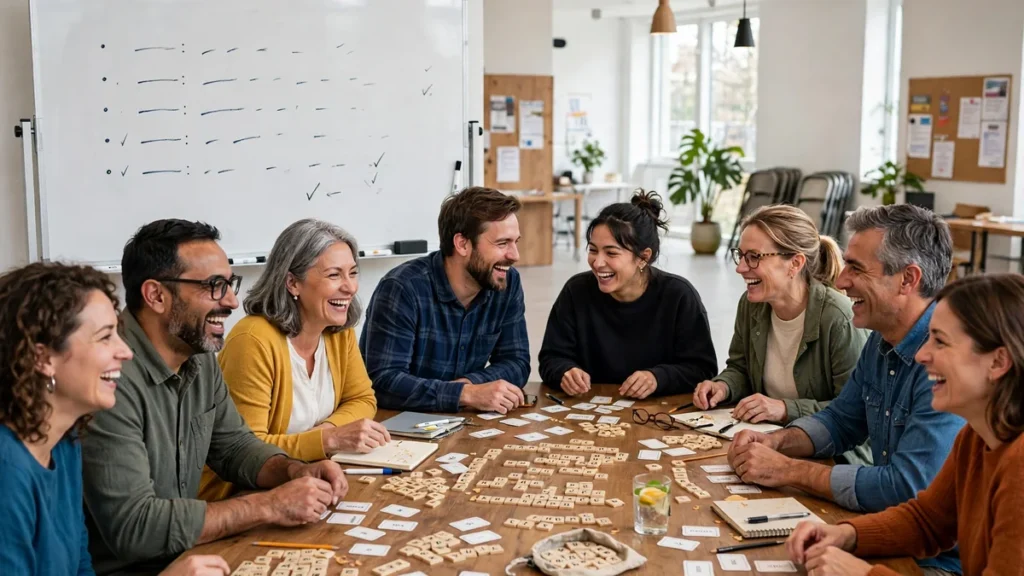
Finding the best word games for 62 players sounds like a puzzle in itself, but it is one of the most rewarding party challenges you can take on. Sixty-two people is a big crowd — too many for a single board game box, yet the perfect size for a room buzzing with teams, shouting clues, and racing to solve word puzzles together. Word games are ideal for a group this large because they need almost no equipment, they work for every age and skill level, and they keep everyone involved at the same time.
The trick is choosing games that scale. A word game that works beautifully for six friends can fall flat for sixty-two unless you split the crowd into teams, run several rounds at once, and keep the rules simple enough to explain in under a minute. The games in this guide do exactly that. They are built around teams of five to eight players, short rounds, and clear scoring, so a school hall, a company event, or a family reunion can play together without chaos.
In this guide you will find twelve tested word games for 62 players, a comparison table, a setup checklist, and answers to the questions organisers ask most often. Every game here runs with pens, paper, and a whiteboard or projector, and most need no special purchases at all.
Key takeaways
- Split 62 players into 8 to 10 teams of 6 to 8 people so everyone plays at once and no one waits for a turn.
- Choose word games with short rounds of 5 to 10 minutes to keep energy high across a large room.
- Use a whiteboard, projector, or printed sheets so clues and scores are visible to the whole group.
- Mix quick guessing games with slower puzzle games to suit different players and keep the evening balanced.
- Appoint one host and one scorekeeper per game so rounds run smoothly and results are never disputed.

Why Word Games Work So Well for 62 Players
Word games are one of the few kinds of party game that genuinely get better as the group grows. With 62 players, a single clever clue can travel across a whole room, a team of eight can pool very different vocabularies, and the noise level alone creates an atmosphere smaller games cannot match. Unlike physical games, they do not need a large space per player, and unlike video games they need no screens or controllers.
Word games are also fair in a way that many party games are not. They reward vocabulary, quick thinking, and teamwork rather than speed, strength, or luck. A quiet player who knows unusual words can be the hero of a round, and a team that listens well often beats a team full of loud talkers. That balance matters in a group of 62, where people arrive with very different ages, backgrounds, and confidence levels. If your group size changes on the day, you can add or remove a team without rewriting the rules.
How to Run Word Games for a Group of 62
Running word games for 62 players is mostly about organisation, not about the games themselves. Start by dividing the group into 8 to 10 teams of 6 to 8 players. Give each team a name, a table or a corner of the room, and a captain who collects answers and reports scores. Teams of this size are large enough to share ideas but small enough that everyone can be heard.
Choose a host who explains the rules, reads out the clues, and keeps the pace moving. A separate scorekeeper tracks points on a whiteboard or a projected sheet so everyone can see the standings. Announce the schedule at the start — for example, four games of 15 minutes each with a short break — so players know what is coming and the evening keeps its rhythm. Prepare materials before anyone arrives, print answer sheets and scorecards in advance, and test any projector or speaker you plan to use. Keep the rules short: if a game takes more than a minute to explain, simplify it.
The 12 Best Word Games for 62 Players
1. Word Bingo
Word Bingo is the easiest way to get 62 players involved at the same time, and it works as a warm-up or a closing game. Each player receives a bingo card filled with words instead of numbers, and the host calls out definitions or clues rather than the words themselves. Players mark the matching word, and the first to complete a row, column, or full card wins the round. Print several different card layouts so no two neighbours share the same grid. A round takes about 10 minutes, and you can play three or four rounds with themes such as animals, food, or travel. The clues can be made as easy or as hard as the group needs.
2. Scattergories Team Challenge
Scattergories adapts beautifully to a large group. Divide the 62 players into teams and give each team a list of categories — a fruit, a city, a job, an animal — plus a random letter. Teams have three minutes to write one answer per category beginning with that letter, and unusual answers score more than common ones. With eight teams playing at once, the judging round becomes a lively debate, and duplicate answers cancel each other out. Play five or six rounds with a new letter each time and keep a running total on the scoreboard.
3. Codenames Team Tournament
In Codenames, a spymaster gives one-word clues that link several words on a grid, and their team must guess the right ones without touching the rival team’s words or the assassin. For 62 players, run it as a tournament: set up four or five grids on separate tables, let teams play short matches, and bring the winners together for a final. Each match takes about 15 minutes. Print the word grids large or show them on a screen so the whole team can see them.
4. Bananagrams Relay
Bananagrams is normally a fast word-building game with letter tiles, but for 62 players it works best as a relay. Each team gets a set of tiles and must build a connected crossword grid on their table, using every tile before the other teams. Run the relay in heats so several teams play at once, then hold a final between the heat winners. A round takes 10 to 15 minutes, and the game suits confident spellers while still letting weaker players contribute by spotting short words and filling gaps.
5. Taboo Team Edition
In Taboo, one player describes a word without using a list of forbidden words, while their team guesses it against the clock. For 62 players, run it as a team relay: each team sends one describer to the front, and the team has 60 seconds to guess as many words as possible. Rotate the describer each round so everyone gets a turn at the front. Taboo produces the loudest laughter of any game in this guide, because forbidden words slip out at the worst moments. A full session runs about 20 minutes for eight teams.
6. Word Chain Relay
Word Chain Relay is a simple, fast game that needs no materials at all, which makes it perfect for filling a gap in the schedule. Teams stand in lines, and the first player says a word. The next player must say a word beginning with the last letter of the previous word, and so on down the line. Any hesitation longer than five seconds, or any repeated word, sends the player to the back of the line. The team that completes the most valid links in three minutes wins the round. You can run two lines at once, or run all teams simultaneously with a judge per team.
7. Anagram Race
Anagram Race turns a quiet puzzle into a loud competition. The host displays a scrambled word or phrase on a board or screen, and teams race to unscramble it and write the answer on their sheet. The first team to hold up the correct answer scores the point. Start with short words of five or six letters, then build up to long phrases and themed sets such as film titles, country names, or food words. A full race of 15 anagrams takes about 15 minutes, and it works well as a calmer mid-evening challenge after a noisy round of Taboo.
8. Team Spelling Bee
A spelling bee is a natural fit for a large group when run as a team event. Each team nominates a speller for each round, the host reads a word aloud and uses it in a sentence, and the speller must spell it correctly. Teams can discuss the spelling for 20 seconds before answering, which turns a solo test into a group effort. Use a graded word list that starts easy and grows harder. A team spelling bee takes 20 to 25 minutes and works well as a headline event, giving quiet, careful players a moment to shine.
9. Hangman Tournament
Hangman becomes a genuine tournament with 62 players. Set up a bracket in which teams face each other head to head: one team picks a word and the other team guesses letters to reveal it, with a limited number of wrong guesses. Winners advance, losers drop into a consolation round, and the final is played in front of the whole room. Each match takes about five minutes. Hangman needs only a whiteboard and a marker, and teams can choose words to match their opponents.
10. Crossword Race
Crossword Race gives each team the same blank crossword grid and the same set of clues, and the first team to complete the grid correctly wins. Print the grids large enough for a whole team to gather around. A standard race grid has 15 to 20 clues and takes 15 to 20 minutes to solve, which makes it a good longer game for the second half of the evening. It rewards steady teamwork over speed alone, because a team that splits the clues by topic usually finishes faster than a team that works through the list in order.
11. Word Association Chain
Word Association Chain is a game of connections: the host says a word, and each team must write a chain of ten associated words, each linked to the one before it. Starting from “rain”, a chain might run rain, umbrella, storm, thunder, lightning, sky, cloud, snow, winter, fire. Teams score points for valid links and bonus points for the most creative chain, judged by the host. The game takes about 10 minutes per round and every team plays at the same time. It suits creative groups and works as a calm game between louder rounds.
12. Categories Sprint
In Categories Sprint, the host names a category — countries, animals, or films — and teams have 60 seconds to write as many correct answers as they can. Each valid answer scores a point, and duplicate answers across teams still count, so the emphasis is on volume rather than originality. Play six to eight categories in a row, and the whole game takes about 15 minutes. Categories Sprint is the best closing game in this guide because it is fast, simple, and anyone can contribute at least one answer. It also works as an icebreaker if you choose easy, familiar categories.
Comparison Table: Best Word Games for 62 Players
| Game | Players per team | Round length | Equipment needed | Best for |
|---|---|---|---|---|
| Word Bingo | Individual | 10 minutes | Printed cards, pens | Warm-up, all ages |
| Scattergories Team Challenge | 6 to 8 | 15 minutes | Category sheets, pens | Creative thinking |
| Codenames Team Tournament | 6 to 8 | 15 minutes | Word grids, timer | Strategy, finals |
| Bananagrams Relay | 6 to 8 | 15 minutes | Letter tiles or cards | Fast spellers |
| Taboo Team Edition | 6 to 8 | 20 minutes | Word cards, timer | Laughter, energy |
| Word Chain Relay | 6 to 8 | 10 minutes | None | Quick filler game |
| Anagram Race | 6 to 8 | 15 minutes | Whiteboard or screen | Puzzle lovers |
| Team Spelling Bee | 6 to 8 | 25 minutes | Word list, microphone | Headline event |
| Hangman Tournament | 6 to 8 | 30 minutes | Whiteboard, marker | All ages, brackets |
| Crossword Race | 6 to 8 | 20 minutes | Printed grids, pens | Steady teamwork |
| Word Association Chain | 6 to 8 | 10 minutes | Paper, pens | Creative groups |
| Categories Sprint | 6 to 8 | 15 minutes | Paper, pens, timer | Closing game |
How to Choose the Right Games for Your Group
Not every group of 62 needs the same mix of games, so pick your lineup to match the occasion. For a family reunion with children and grandparents, lean on Word Bingo, Hangman, and Categories Sprint, and keep the word lists simple. For a company event, Scattergories, Codenames, and the Team Spelling Bee work well because they reward collaboration and clear communication. For a school group, the Anagram Race and Crossword Race fit neatly into a lesson-length session.
Think about timing as well. A one-hour session fits four short games such as Word Bingo, Word Chain Relay, Anagram Race, and Categories Sprint. A full evening of two to three hours can include a tournament format such as Codenames or Hangman, plus a headline event like the Team Spelling Bee. If you are planning a similar night for a slightly smaller crowd, the best word games for 61 players use the same team structure and most of the same games, so you can borrow the format directly. Finally, balance noisy games with quiet ones: alternating a loud game like Taboo with a calm one like the Crossword Race keeps the room’s energy steady.
Checklist: Setting Up Your 62-Player Word Game Night
- Divide 62 players into 8 to 10 teams of 6 to 8, give each team a name, a table, and a captain before the first game starts.
- Print answer sheets, word lists, bingo cards, and crossword grids in advance, with at least two spare sets for late arrivals or mistakes.
- Test the whiteboard, projector, timer, and microphone before guests arrive, and keep spare pens, paper, and markers within reach.
- Appoint one host to run the games and one scorekeeper to track points on a visible scoreboard throughout the evening.
- Prepare a simple prize for the winning team, such as a small trophy, a box of treats, or a printed certificate for each member.
- Plan the running order in advance, mixing loud and quiet games, and build in a 10-minute break halfway through the session.
Frequently Asked Questions
How do you split 62 players into teams for word games?
Divide 62 players into 8 teams of 7 or 8 players, or 10 teams of 6 players with two players joining as floating helpers or judges. Teams of 6 to 8 work best because everyone can hear each other and contribute, while the group is large enough to cover different strengths. Mix ages and abilities across teams, and give each team a captain to collect answers.
What is the best word game for a large group of 62?
Word Bingo is the best starting game for 62 players because everyone plays at the same time, it needs almost no explanation, and it suits every age. For the main event, the Codenames team tournament and the Team Spelling Bee are the strongest choices, since they build excitement across several rounds and give the whole room something to watch in the final.
How long should a word game night for 62 players last?
Plan for 90 minutes to two hours, including a short break — enough for four to six games with a mix of short and long rounds. A one-hour session works if you choose only quick games such as Word Bingo, Word Chain Relay, and Categories Sprint.
Do word games for 62 players need special equipment?
Most do not. Paper, pens, a whiteboard, and a timer cover nearly every game in this guide. A projector or large screen helps for Anagram Race and Codenames so the whole room can see the clues, and a microphone helps the host be heard in a large hall. Only Bananagrams needs bought tile sets, and printed letter cards work as a substitute.
Can children play word games with adults in a group of 62?
Yes, and mixed-age teams often do best, because children bring quick recall and fresh ideas while adults bring wider vocabulary. Choose games with adjustable difficulty, such as Word Bingo and Categories Sprint, and keep word lists age-appropriate. In team games, let children take the first turn so they stay involved.
What if some players arrive late or the group size changes?
Word games for 62 players are easy to adjust. Late arrivals can join any team with space, and if the group grows, add a new team rather than overloading the existing ones. If the group shrinks, merge two small teams into one. Because most games run in parallel rounds, changing the team count mid-evening rarely disrupts the schedule, and if you want more ideas for a different group size, the best party games for 61 players and the best board games for 61 players follow the same team format and can be mixed into your evening.
Bottom Line
The best word games for 62 players are the ones that split a big crowd into small teams, keep rounds short, and let everyone play at once. Start with Word Bingo to warm the room up, build the evening around a tournament game like Codenames or a headline Team Spelling Bee, and close with the fast, cheerful Categories Sprint. Prepare your materials in advance, keep a visible scoreboard, and mix loud games with quiet ones so the energy stays high from start to finish. With these twelve games, 62 players is not a problem to manage — it is the reason the night works so well.


