Finding the best board games for 50 players starts with one honest fact: no single board game seats 50 people around one table. The games that work for a crowd this size do it differently. They use teams, multiple copies, parallel tables, or one giant shared game where everyone plays at the same time. Once you understand those four formats, planning a 50-player game night becomes easy.
This guide covers the eight games that handle 50 players best, the exact number of copies you need for each one, a ready-made station plan, and the practical details that keep a huge group moving. Every recommendation below uses real player counts, setup times, and the format that makes it work for 50.
Key takeaways
- Ultimate Werewolf is the only game in this guide that genuinely plays 50 people in a single game, with the box supporting up to 75 players.
- Most of the best board games for 50 players work through teams or parallel tables, so plan on two to six copies of each title.
- Codenames, Wavelength, and Monikers are the strongest team games for a crowd, because the whole table plays on every turn and nobody waits.
- Telestrations and Dixit are the best choices when your group includes mixed ages, because the rules take two minutes to learn.
- Plan three or four stations of 12 to 16 players each, rotate every 30 minutes, and finish with one giant game of Ultimate Werewolf.

Why 50 Players Changes Everything
Most board games are designed for two to six players. That is the size of a family around a kitchen table, and it is the size most designers test for. A group of 50 breaks every assumption those games are built on. Turns take too long, pieces run out, and half the room is waiting while the other half plays. The first step in planning is accepting that a 50-player night is a different kind of event, closer to a party with games than to a traditional game night.
The third change is attention. In a group of 50, nobody can watch everything, so the best games are the ones where every player is involved on every turn. Team guessing games, drawing games, and social deduction games all share this quality. Games with long individual turns or silent planning will lose a crowd of 50 within ten minutes, no matter how good they are at four players.
The Four Formats That Work at 50 Players
Every successful 50-player game night uses one or more of four formats. Match each game to the format it fits best, and stop trying to force a small-group game to do a job it was never built for.
One Giant Game
In this format, all 50 players share a single game. Only a handful of titles can do this, and Ultimate Werewolf is the best of them. One moderator runs the game, everyone gets a secret role, and the whole room plays together. It needs a confident host and a room where everyone can hear.
Team Games
Team games split 50 players into two or four large teams. Codenames and Wavelength work this way. Each team discusses every clue together, so all 50 people are thinking at once even though only a few are speaking. You need only one or two copies of the game and one table per team.
Parallel Tables
Parallel tables mean running the same game at several tables at the same time. If a game seats eight, you need seven copies for 50 players. Telestrations and Dixit work well this way. Everyone plays the same game and can compare results afterwards, which creates a shared story for the night, so this format works best with inexpensive party games.
Stations
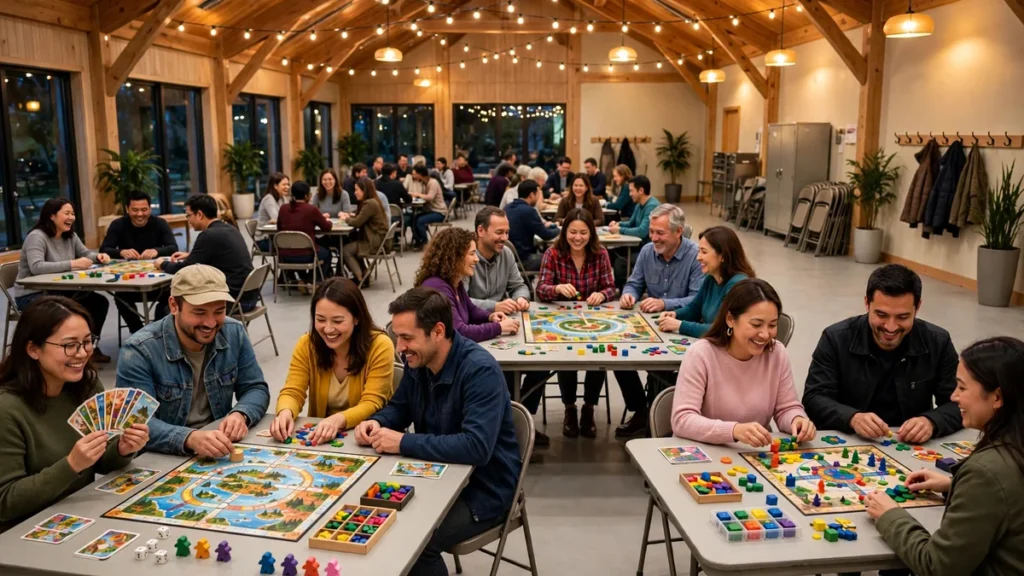
Stations are the most practical format for a full evening. You set up three or four different games at different tables, split the group into teams of 12 to 16, and rotate every 30 minutes. Every player tries several games, nobody waits long, and the night feels varied. For most hosts, stations are the backbone of the night, with one giant game as the finale.
The 8 Best Board Games for 50 Players
The games below are ranked by how well they actually handle 50 players, not by how popular they are at four players. Each entry gives the real player count, the copies you need, the setup time, and the format that makes it work. If you are planning a night for a slightly smaller crowd, the same picks apply, and our guide to the best board games for 48 players covers the same games with copy counts for 48.
1. Ultimate Werewolf
Ultimate Werewolf is the only game on this list that plays 50 people in a single game, and that alone makes it the most important title for a crowd this size. The box supports up to 75 players, with roles for werewolves, villagers, a seer, a doctor, and many more. One player acts as moderator, guiding the group through day and night rounds while everyone debates, accuses, and defends.
A full game takes 30 to 45 minutes, which is perfect for a finale. Setup takes about five minutes: hand out a role card to each player and explain the rules in two minutes. The game needs no table at all, so you can play it with everyone seated in rows or standing in a hall. The only requirement is a moderator who is comfortable speaking to a large room and keeping the debate moving.
Ultimate Werewolf works best as the last game of the night, when the group already knows each other a little and the energy is high. Every round creates a story people talk about afterwards: the quiet guest who turned out to be a werewolf, the bold accusation that backfired. Buy one copy and you are done.
2. Codenames
Codenames is the strongest team game for a large group, and the easiest to scale. At 50 players you simply make the teams bigger: 25 players per team, with one spymaster per team giving one-word clues while the rest of the team debates which words the clue points to. Every player is involved in every turn, because the whole team discusses each clue together.
You need only one copy for a two-team game, or two copies for four teams of 12 to 13 players competing in parallel. A game takes 15 to 20 minutes, setup takes two minutes, and the rules take one minute to explain, which matters when you have 50 people to brief.
3. Wavelength
Wavelength is a team guessing game built around a simple idea: one player gives a clue that places a hidden target on a scale between two opposites, such as hot and cold, and the team guesses where the target sits. It seats two to 12 players per set, so for 50 players you need four to five copies at parallel tables, or you can play it as a team game with the whole room split into two large teams and one copy on a central table.
A game takes 20 to 30 minutes, and the rules take two minutes to explain. Wavelength shines because the clues start conversations: a clue like “slightly more exciting than a dentist appointment” will have a whole table arguing and laughing. Plan on four copies.
4. Monikers
Monikers is a party game where players give clues to help their team guess the names on a deck of cards, across three rounds that reuse the same cards: first with any words, then with one word, then with silent gestures only. It seats four to 16 players, but at 50 players it works brilliantly as a team game with two teams of 25, or as a station game with three copies at three tables of 16 to 17 players each.
A full game takes 30 to 45 minutes, and setup takes five minutes. The cards become funnier as the rounds go on, because the same names come back with fewer and fewer words allowed. By the third round, a single gesture can make the whole team shout the right answer. Plan on two to three copies.
5. Two Rooms and a Boom
Two Rooms and a Boom is a social deduction game designed for large groups, supporting six to 30 players per set. For 50 players, run two copies in two separate rooms or areas, with 25 players in each. Players are secretly split into a red team and a blue team, with a bomber and a president hidden among them. In timed rounds, players are swapped between rooms and try to work out who is on their team.
A game takes about 15 minutes, and setup takes five minutes. The game is physical and energetic: players move between rooms, negotiate in small groups, and try to read each other under time pressure. That movement gets people out of their seats and talking to people they have not met yet.
6. Telestrations
Telestrations is a drawing and guessing game that seats four to eight players per set, with a 12-player party pack available. For 50 players, you need five to seven copies at parallel tables. The game is simple: draw the word you are given, pass the sketchbook on, guess what the drawing shows, and watch the word change beyond recognition by the end of the round.
A game takes 20 to 30 minutes, and the rules take one minute to explain. Telestrations is the best choice on this list for mixed-age groups, because drawing needs no vocabulary, no strategy, and no prior experience. Children, grandparents, and complete beginners can all play together. Plan on six copies, and buy the party packs where you can.
7. Dixit
Dixit is a storytelling and picture-guessing game where players choose a beautifully illustrated card that matches a clue, and the other players try to work out which card was chosen. The base game seats three to six players, and the Odyssey expansion raises that to 12, so for 50 players you need five to six copies at parallel tables, or four copies of the Odyssey version.
A game takes 30 minutes, and the rules take three minutes to explain. Dixit is the most beautiful game on this list: the cards are works of art. That beauty makes it a good choice for a relaxed station, especially at a wedding reception or a family gathering where the mood is gentle rather than competitive. Plan on five copies.
8. Herd Mentality
Herd Mentality is a simple party game where players answer a question and score points by matching the majority answer, with a pink cow token going to anyone who gives a unique answer. It seats four to 20 players per set, so for 50 players you need three copies at three tables of 16 to 17 players each, or you can play it as one giant game with the whole room answering together.
A game takes 20 minutes, and the rules take one minute to explain, which makes it the simplest game on this list to teach. The questions are funny and the answers reveal how the group thinks. When 49 people answer one way and one person answers differently, the whole room laughs, and that person gets the cow. It is a great icebreaker for the first station of the night.
The game is inexpensive, light, and easy to carry, so buying three copies is no burden. It also works well for groups that include people who dislike strategy or competition, because there is nothing to study and no way to fall behind. For a host who wants a low-effort, high-laugh game to open the evening, Herd Mentality is hard to beat. Similar large-group picks appear in our guide to the best board games for 47 players, which uses the same station format for a slightly smaller crowd.
Best Board Games for 50 Players Comparison Table
| Game | Players per copy | Copies for 50 | Time | Best format |
|---|---|---|---|---|
| Ultimate Werewolf | Up to 75 | 1 | 30 to 45 min | One giant game |
| Codenames | 4 or more | 1 to 2 | 15 to 20 min | Teams |
| Wavelength | 2 to 12 | 4 to 5 | 20 to 30 min | Teams or stations |
| Monikers | 4 to 16 | 2 to 3 | 30 to 45 min | Teams or stations |
| Two Rooms and a Boom | 6 to 30 | 2 | 15 min | Two rooms |
| Telestrations | 4 to 8 | 5 to 7 | 20 to 30 min | Parallel tables |
| Dixit | 3 to 6 | 5 to 6 | 30 min | Parallel tables |
| Herd Mentality | 4 to 20 | 3 | 20 min | Stations |
How to Run a 50-Player Game Night
A good plan matters more than a good game. Fifty people without a plan will spend the first hour standing around, and by the time the games start, the energy is gone. Aim for a three-hour evening: 30 minutes for arrival and a warm-up game, two hours of stations, and 30 minutes for the finale.
Start with Herd Mentality or Codenames as a warm-up while people arrive. Both games can absorb latecomers without restarting, which is essential when 50 people arrive at different times. Put the warm-up game on a central table where newcomers can see it and join in.
For the main part of the evening, set up four stations: Codenames, Wavelength, Monikers, and Telestrations. Split the group into four teams of 12 to 13 players, give each team a colour or a name, and rotate every 30 minutes. Announce the rotation clearly, and put a printed rotation card on each table so people remember where they are going.
Finish with Ultimate Werewolf as the finale. Bring everyone together, hand out role cards, and let the moderator take over. The finale works best when the room is already warm from two hours of play, because people are relaxed and ready to accuse their friends. If you want more ideas for a big-group evening, our guide to the best party games for 48 players covers party formats that pair well with these board games.
Timing That Works
Keep every game to 30 minutes or less. Longer games lose a large group, because attention fades and the rotation falls behind. If a game runs long, end it early: a finished game that felt short is better than a long game that felt endless. Build in ten minutes of slack, because 50 people always move slower than you expect.
Hosts and Helpers
One host cannot run a 50-player night alone. You need at least one helper per station, plus a moderator for the finale. Station helpers explain the rules, keep score, and keep the game moving. Brief them before the night, so they are not learning the rules at the same time as the players.
Checklist for a 50-Player Board Game Night
- Book a venue with four tables, good lighting, and enough space between tables for teams to talk.
- Buy or borrow the right copies: one Ultimate Werewolf, two Codenames, four Wavelength, three Monikers, two Two Rooms and a Boom, six Telestrations, five Dixit, and three Herd Mentality.
- Recruit four station helpers and one finale moderator, and brief each of them on their game before the night begins.
- Print a rotation card for each table, a score sheet, and a one-page rules summary for each game.
- Prepare name tags or coloured wristbands so teams can find each other during rotations.
- Set a clear schedule: 30 minutes to arrive and warm up, two hours of stations in 30-minute rounds, and 30 minutes for the Werewolf finale.
Frequently Asked Questions
Can one board game really play 50 people?
Only a few can. Ultimate Werewolf supports up to 75 players in a single game, which makes it the best choice for a one-game finale. Most other games need teams, parallel tables, or stations to reach 50 players.
How many copies do I need for 50 players?
It depends on the game. One copy of Ultimate Werewolf or Codenames is enough, because they scale through teams. Telestrations and Dixit need five to seven copies, because each copy seats only a small table. The comparison table above gives the exact number for every game in this guide.
What is the best board game for 50 players at a wedding?
Telestrations and Dixit are the best choices for a wedding, because they are gentle, beautiful, and easy for mixed-age guests to join. Add Codenames as a livelier station, and finish with Ultimate Werewolf only if the crowd is comfortable with playful accusations.
What is the best board game for 50 players at work?
Codenames and Wavelength are the best choices for a work event, because they encourage teamwork and conversation without putting anyone on the spot. Monikers and Two Rooms and a Boom are better for teams that already know each other well and enjoy a louder, sillier atmosphere.
How long should a 50-player game night last?
Three hours is the right length: 30 minutes for arrival and a warm-up game, two hours of stations in 30-minute rounds, and 30 minutes for the finale. Longer evenings tire a large group, and shorter ones leave no time to try more than one game.
Do I need a separate room for Two Rooms and a Boom?
Yes, the game is designed for two separate spaces. If your venue has only one hall, split it with a divider, a curtain, or a row of tables, as long as the two groups cannot hear each other planning. Without some separation, the game loses its main mechanic.
The Bottom Line
The best board games for 50 players are the ones that keep all 50 people involved on every turn: Ultimate Werewolf for the finale, Codenames and Wavelength for teams, Monikers for laughter, Two Rooms and a Boom for energy, and Telestrations, Dixit, and Herd Mentality for stations anyone can join. Buy the right number of copies, set up four stations, rotate every 30 minutes, and finish with one giant game.