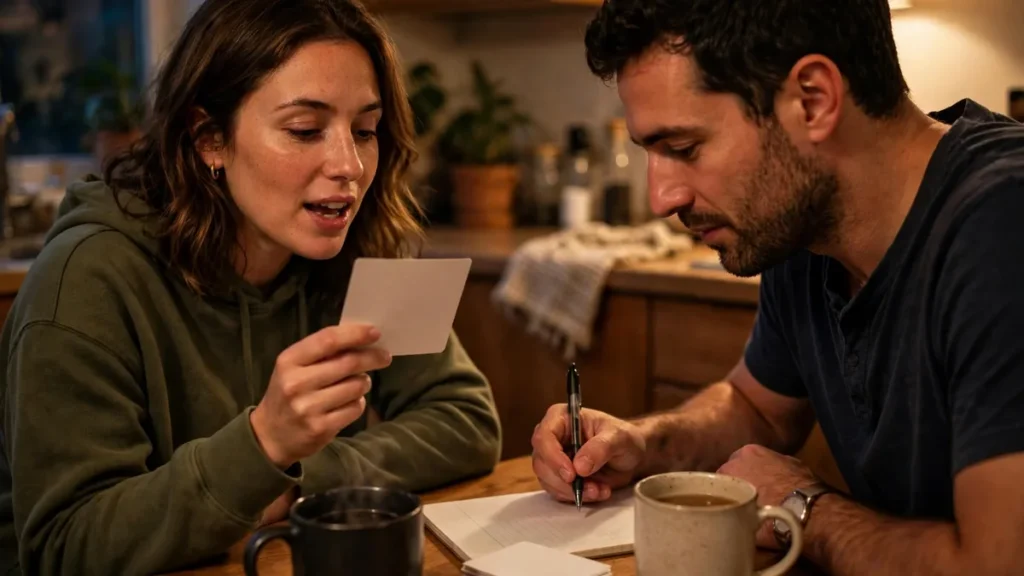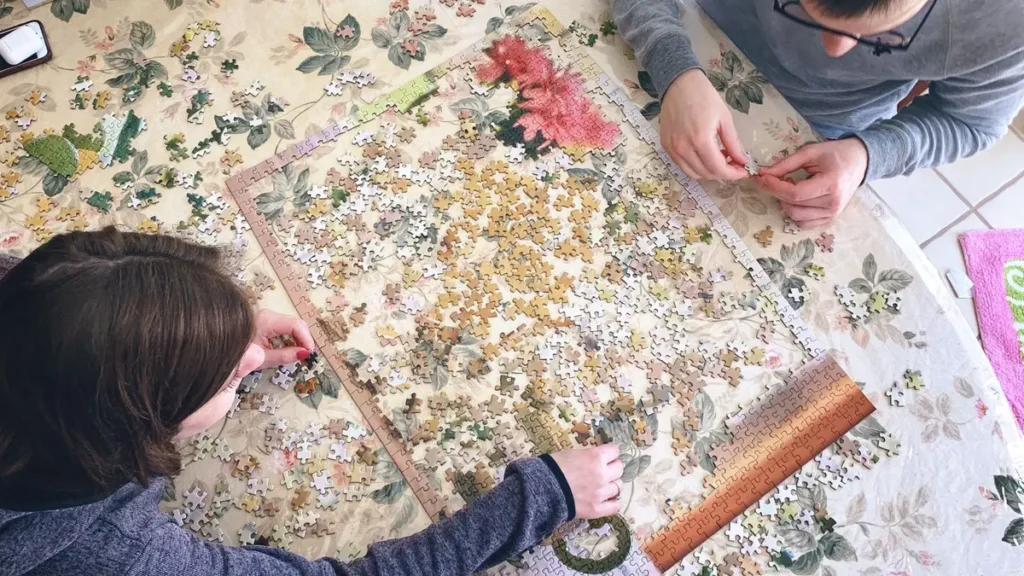
It was a Tuesday, raining, the kind of evening where the light goes grey at four o’clock. Dinner was done, the plates were in the sink, and the two of us were standing in the living room doing nothing in particular. On the coffee table sat a half-finished jigsaw, the border done, a corner of sky taking shape. On the arm of the sofa sat the remote. My hand moved towards the remote on its own. I stopped it halfway there, suddenly wanting to know what would happen if we chose the box instead.
We chose the box, sorted a few pieces, found three that fitted, and argued briefly about whether a piece was sky or water. Nothing dramatic happened. But when we stood up, the evening felt as though it had belonged to us, rather than having simply passed through us. That small difference is my whole argument: puzzles are better than television, not because television is worthless, but because of what each one does with an evening, and with the people in it.
The Remote Wins Before You Have Decided Anything
The first thing to admit is that this is not a fair fight, and the unfairness runs in television’s favour. Watching takes no decision at all. You sit down, you press a button, and something begins. The programme was made by hundreds of professionals whose job is to hold your attention. The next episode starts by itself.
A puzzle, by contrast, starts with a small act of resistance. You have to open the box, tip the pieces out, turn them over, and accept that the first twenty minutes will look like nothing at all. There is no music, no opening credits, no cliffhanger pulling you forward — just a table covered in cardboard shapes. On a tired evening, that is a hard sell, and I have lost this argument with myself more often than I have won it.
But that ease is worth looking at closely, because it is not neutral. Television does not ask you to choose it; it asks you to fail to choose anything else. Nobody sits down at seven and announces they will watch four hours of programmes they only half like. They sit down for one episode, and then the next one starts, and then it is half past ten, and the evening is gone. A puzzle cannot steal an evening like that. It can only borrow the time you give it, one piece at a time.
A Puzzle Will Not Do the Work for You
Watching television is mostly receiving. That is not an insult; receiving can be wonderful. A great drama, a sharp comedy, a documentary about a world you will never visit — these are real pleasures, and they ask something genuine of you: attention, sympathy, the willingness to follow a story. But the work television asks of you is the work of following, and following is a narrower thing than doing.
A puzzle asks you to do. Not in the grand sense — nobody is building a bridge — but in the small, concrete sense that the next step does not happen unless you make it happen. You pick up a piece, you turn it, you try it, you are wrong, you try it somewhere else. There is no progress without your participation. The puzzle sits there, patient and completely indifferent to whether you succeed. It does not flatter you. It simply waits.
That waiting changes the texture of an evening. When you watch television, the pace belongs to the programme. Scenes cut when the director decides, jokes land when the writer decides, the story ends when the episode ends. When you work on a puzzle, the pace belongs to you. You can stare at one corner for ten minutes, walk away and make tea, and come back to see, suddenly, the piece you were holding all along. The evening moves at the speed of your own mind.
There is something quietly satisfying about a task with a visible end. A jigsaw has a finished picture, a crossword a completed grid. Television rarely offers that feeling: a series ends, but another begins. You can watch for years and never once feel the small triumph of having finished something with your own hands. The puzzle was finished by you, tonight, at your own table.
The Talk That Happens Sideways
Here is the difference I notice most, and the one that keeps bringing me back to the puzzle box. When two people watch television together, they sit side by side, looking at the same screen. The conversation, if it happens, is about the screen: what just happened, what will happen next, whether that actor was in something else. The screen is the third person in the room, and it does most of the talking.
When two people work on a puzzle together, they also sit side by side, but they look down, at the table, and the conversation goes somewhere else entirely. It wanders. Somebody mentions a piece that looks like the sky over a holiday ten years ago, and suddenly you are talking about that holiday. The puzzle does not demand your eyes or your ears. It asks only for your hands and a corner of your attention, and it leaves the rest of you free to be with the person next to you.
None of this means television kills conversation. A shared favourite programme can give a family a language of its own, jokes and references that last for years. But that language is borrowed. The programme supplied the words. Over a puzzle, the words are your own. A child notices it too: doing a puzzle with a parent puts the adult and the child on the same side of the table, looking at the same small problem. Watching television with a parent is sharing an experience, certainly, but the adult’s attention is pointed at the wall, and the child knows it.
The Last Hour of the Day
There is a second test for any evening activity: how does it leave you at bedtime? A good evening should wind you down, not wind you up. It should leave you a little tired in the right way, the way a walk leaves you tired, rather than a little wired in the wrong way, the way a deadline leaves you wired.
Television is a mixed record here. Some programmes are genuinely soothing — a gentle documentary, a familiar comedy you have seen before. But much of what we watch late at night is not soothing at all. It is tense, or loud, or engineered to make you need one more episode, and the story ends on a question your brain keeps turning over after the lights go out. I have lost more sleep to the last ten minutes of a drama than to any worry I can name.
A puzzle is a natural off-ramp. It asks for focus, and focus is tiring in a gentle way. After an hour of sorting pieces, your mind feels used rather than stimulated, the way a muscle feels after a walk. There is no cliffhanger. The half-finished grid will be there in the morning, exactly where you left it. Puzzle evenings end with us drifting towards bed, a little drowsy, pleased with the corner we finished. Television evenings end with one of us saying, “Just one more,” and both of us knowing it will not be one more.
In Television’s Defence
It would be dishonest to make this case without giving television its due: it has done things for my evenings that no puzzle ever could. Some of the best stories of my life came to me through a screen. I have watched a finale with friends that left the whole room silent, then talking all at once, and I would not trade that evening for a thousand completed crosswords. I have watched documentaries that changed what I thought about the world, and comedies that arrived on exactly the right bad day and made it bearable. A puzzle has never made me laugh until I cried, or shown me the inside of a volcano.
And then there is comfort. There are evenings when you are ill, or grieving, or simply wrung out by a day that took more than it gave, and on those evenings the last thing you need is a task. You need to be looked after, and television looks after you. It asks nothing, offers warmth and company, and does not mind if you fall asleep halfway through. A puzzle on such an evening would sit there accusingly, its unfinished border a reminder of energy you do not have. On those nights, the remote is not the lazy choice. It is the kind choice, and I have reached for it gladly.
The Evenings I Still Reach for the Remote
So let me be specific about where my own argument stops, because an opinion that never admits its limits is not an opinion but a slogan. There are evenings when I choose television, and I choose it without guilt. The night a series I have followed for years reaches its ending, I will be on the sofa, and no jigsaw on earth will tempt me away. The night a big match is on, I want to be watching too, because the point is not the match but the fact that we are all in it together.
There are also evenings when the puzzle is the wrong shape for the people in the room. A puzzle is small and quiet, and some evenings need noise: a birthday, a reunion, a house full of people who have not seen each other in years. Those evenings belong to music and talk, with the television playing in the corner. And if the people in your house love television and do not love puzzles, then my argument is a hard sell, and I know it. You cannot impose a puzzle evening on a household that does not want one.
What I am arguing for is not a ban. It is a rebalancing. Television has won the evenings so completely that most of us no longer notice it winning. The screen is the default, and the default deserves questioning now and then — not because it is bad, but because a default you never question is not a choice at all. Word puzzles ask for the same quiet attention as a jigsaw, and riddles work the mind in a similar slow way, which is why I reach for them on the same kind of evening.
One Evening a Week
If any of this has sounded persuasive, I would not suggest a grand overhaul. Grand overhauls fail by the second week, and then the remote wins more thoroughly than before. I would suggest something smaller: one evening a week. After dinner, instead of reaching for the remote, tip out a puzzle: a jigsaw, a crossword, a Sudoku — whatever fits the people in the room. Give it an hour. If it is dull, go back to the screen, no harm done. If the hour goes well, a hosted puzzle night is the natural next step, and for a bigger occasion, a puzzle party turns the same idea into a whole evening with friends.
Notice, first, how the hour feels longer, in a good way. Television hours collapse into each other; you look up and three have gone. A puzzle hour has texture: the piece that took twenty minutes, the clue that made you laugh, the corner piece everyone had given up on. Notice, second, what happens to the talk. It will not be dramatic. But the conversation will be yours. If you have ever wondered why the evenings you remember best are rarely the ones you spent watching something, this is why. The remembered evenings are the ones where you did something, even something small, together.
And notice, third, how easy it is to stop. A puzzle does not beg you to stay. When you are tired, you put the lid back on the box, and the evening is over. The screen is always ready with one more thing, and it is very good at making “one more” feel like your own idea. A puzzle gives you back the ending of your own evening. That is what I am arguing for: not the superiority of cardboard over television, but the small dignity of an evening that ends when you decide it ends.
Our Tuesday-night puzzle is still on the table, a little further along than it was. The sky is done now, and someone has started on the roof of the cottage, which is either red tiles or autumn leaves — an argument that has already outlasted two cups of tea. The television is still in the room, and it is not going anywhere. But it is off, and the box is open, and the evening is ours. That is the case for puzzles. The remote will win most nights. It does not have to win them all.