Optical illusions reveal how the brain constructs reality using prediction, not just sight. Concepts like Predictive Coding and Top-Down Processing explain why we see shapes, motion, or colors that aren’t real. From the Kanizsa Triangle to the Checker Shadow Illusion, these mind-bending visuals highlight how perception can differ from reality.
The human brain is the most sophisticated computer on the planet, yet it can be “hacked” with nothing more than a few lines, a specific shade of gray, or a clever geometric pattern. In 2026, we are discovering that our vision isn’t a live camera feed of the world; it’s a predictive simulation. Your eyes gather data, but your brain writes the story—and sometimes, it gets the plot completely wrong.
At riddlepuzzle.com, we specialize in the intersection of logic and mystery. This year, new breakthroughs in neuroscience and digital art have produced optical illusions brain enthusiasts are calling “impossible.” From classic eye trick puzzles to modern visual brain teasers, this guide explores the science and the spectacle of mind bending illusions.
1. The Neuroscience: Why Your Brain “Glitches”
To understand why an illusion works, you have to understand “Recurrent Pattern Completion.” In late 2025, researchers at Berkeley Neuroscience discovered specialized neurons—dubbed “IC-encoders”—specifically designed to perceive illusory contours.
The Survival Mechanism
Your brain didn’t evolve to see the world accurately; it evolved to see the world quickly.
-
Top-Down Processing: Your higher brain functions send signals back down to the visual cortex, filling in gaps before you even realize they are there.
-
Predictive Coding: If your brain sees three “Pac-Man” shapes facing each other, it doesn’t see three circles with missing chunks—it sees a triangle. This is your brain “guessing” the most likely shape to save time.
2. Top Mind Bending Illusions of 2026
The following table categorizes the most effective visual brain teasers making waves this year.
| Illusion Type | Name | The “Eye Trick” | Why It Breaks Your Brain |
| Luminance | Checker Shadow | Square A and B are the same color. | Your brain overcompensates for perceived shadows. |
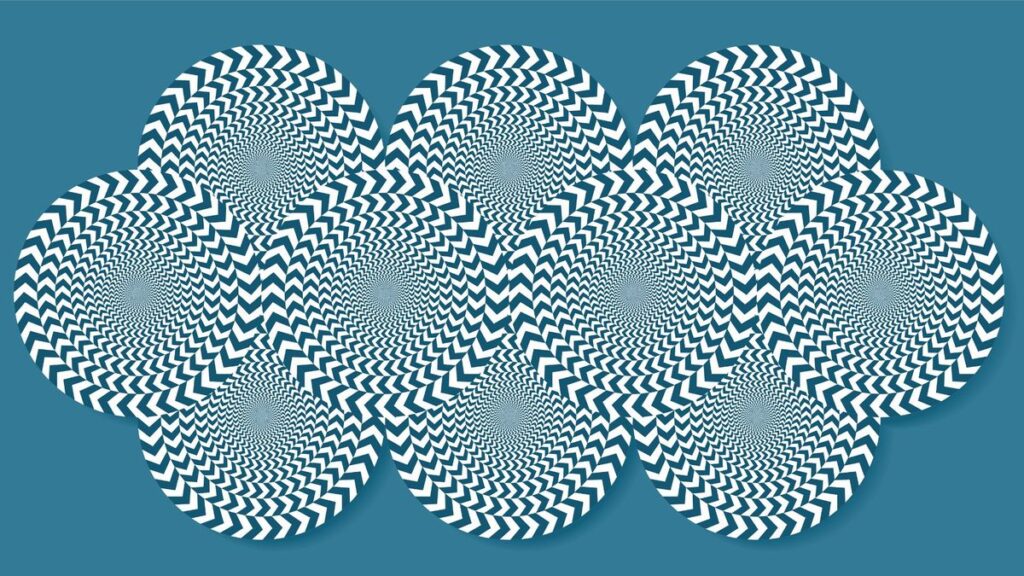
| Geometric | Fraser Spiral | Concentric circles look like a spiral. | The “twisted cord” pattern misleads the directional sensors. |
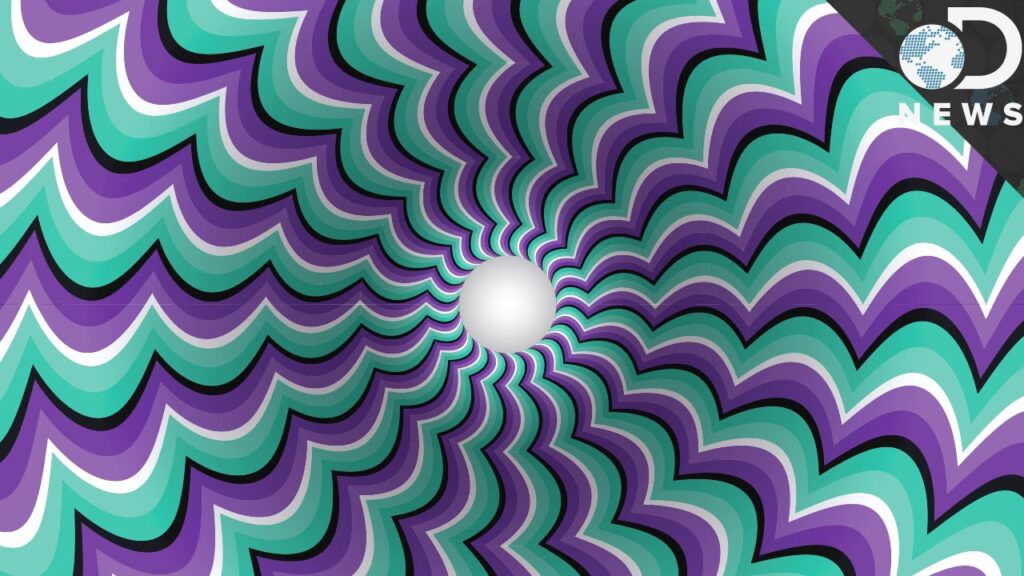
| Ambiguous | The “2026” Black Hole | A hand-drawn hole looks like it’s sinking. | Shading creates a fake 3D depth on a 2D plane. |
| Motion | Peripheral Drift | Still circles appear to rotate. | High-contrast colors “trick” the motion detectors in your retina. |
| Cognitive | Kanizsa Triangle | You see a triangle that isn’t there. | The brain completes a pattern to create a solid object. |
3. Visual Brain Teasers: The Luminance Trap
One of the most frustrating optical illusions brain experts use to demonstrate “color constancy” is the Adelson’s Checker-shadow.
The Experiment
Imagine a green cylinder casting a shadow over a checkerboard. Square A (outside the shadow) and Square B (inside the shadow) appear to be vastly different shades.
-
The Reality: If you use a color-picker tool or isolate the squares, they are exactly the same shade of gray.
-
The Breakdown: Your brain “knows” that shadows make things darker. To determine the “true” color of the square, it automatically lightens Square B in your mind to compensate for the shadow. Even when you know the truth, you cannot stop seeing the lie.
4. Eye Trick Puzzles: The 2026 “Impossible” 3D Drawings
This year has seen a surge in 3D anamorphic art. Digital artists on platforms like riddlepuzzle.com have mastered the art of “Perspective Warping.”
-
The Golden 2026 Hole: A viral 2026 drawing shows the numbers “2026” rising out of a black void. When viewed from a specific 45-degree angle, the paper appears to vanish into a bottomless pit.
-
How it works: This uses isometric projection. By stretching the base of the drawing and using hyper-realistic shadows, the artist forces your brain to interpret “length” as “depth.”
5. The “Peripheral Drift” Effect: Motion Without Movement
Have you ever looked at a static image and felt like the edges were swirling? This is the Peripheral Drift Illusion.
Try This: Look at a “Rotating Snakes” image.
-
Stare directly at the center of one circle; it will stop moving.
-
Shift your gaze to a different circle; the first one will begin to rotate in your peripheral vision.
-
The Science: This occurs because the brain processes high-contrast color sequences (black-blue-white-yellow) at different speeds. This “timing lag” in the neurons is interpreted by the visual cortex as motion.
6. Digital Illusions: VR and AR in 2026
In 2026, optical illusions brain research has moved into Augmented Reality (AR). With the rise of advanced smart glasses, we are now experiencing “World-Scale Illusions.”
-
Forced Perspective in AR: New apps can make a 10-foot “vortex” appear in the middle of a city street. Because your brain receives depth cues from the actual physical environment (like the sidewalk and buildings), the illusion becomes 10x more convincing than on a flat screen.
-
The “Hollow Face” VR Experience: In a virtual environment, a concave mask of a face will always appear convex (protruding). Because your brain is so conditioned to see faces as protruding, it literally overrides the depth data coming from your VR headset.
7. The Evolution of “What You See”
Our understanding of mind bending illusions has shifted from “cool party tricks” to vital medical tools.
-
Schizophrenia Research: Studies in 2026 have shown that people with certain types of schizophrenia are actually less susceptible to some optical illusions (like the Hollow Mask). Their brains don’t use “Top-Down” processing in the same way, making them more “accurate” but less “contextual.”
-
AI Training: AI models are now being “tested” with eye trick puzzles. If an AI can be “tricked” by an illusion, it means it is finally starting to perceive the world through a human-like lens of pattern recognition.
8. How to Break Your Own Brain: A Quick Guide
If you want to experience a “visual glitch” right now, try these three visual brain teasers:
-
The Troxler Fading: Stare at a single point in a fuzzy, low-contrast image for 30 seconds. The rest of the image will slowly disappear as your neurons stop responding to unchanging stimuli.
-
The Hermann Grid: Look at a grid of black squares with white “gutters.” You will see gray dots appearing and disappearing at the intersections. (Pro tip: Try to look directly at a gray dot—it will vanish!)
-
The Waterfall Effect: Stare at a moving object (like a scrolling credits list) for 60 seconds, then look at a still wall. The wall will appear to “flow” in the opposite direction.
Conclusion: The Truth Behind the Trick
Optical illusions brain prove that “believing is seeing,” not the other way around. Our brains are constantly making a “best guess” about the world around us. At riddlepuzzle.com, we celebrate these glitches because they remind us of how incredibly complex and creative the human mind truly is.
In 2026, as we merge the physical and digital worlds through AR and AI, the line between “real” and “perceived” will continue to blur. But one thing is certain: your brain will always find a way to surprise you.
FAQs
Q1: Can optical illusions damage your eyes?
No. Eye trick puzzles are a neurological phenomenon, not a physical one. They are “brain tricks,” and while they might cause slight eye strain or a “dizzy” feeling if you stare too long, they do not cause permanent damage.
Q2: Why do some people see illusions differently?
Factors like age, culture, and even your “visual vocabulary” play a role. For example, some cultures that don’t use “square” architecture are less susceptible to the Müller-Lyer (arrow) illusion.
Q3: What is the most famous optical illusion?
Historically, the “My Wife and My Mother-in-Law” (ambiguous figure) is one of the most famous, but in recent digital history, “The Dress” (Blue/Black vs. White/Gold) remains the most debated.
Q4: Do animals see optical illusions?
Yes! Experiments have shown that dogs, cats, and even honeybees are susceptible to certain mind bending illusions, suggesting that these “visual shortcuts” are common across many species.
Q5: Are there new illusions being discovered in 2026?
Absolutely. With the help of AI-generated patterns, scientists are discovering “Super-Normal Stimuli”—patterns that trigger the brain’s motion or depth sensors more powerfully than anything found in nature.