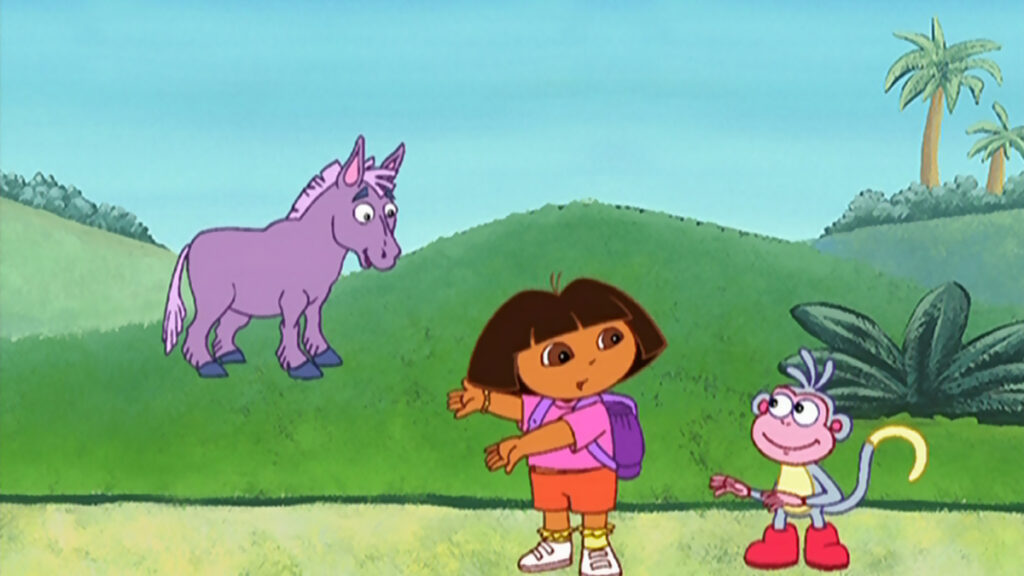
In the world of Dora, riddles aren’t just for fun—they are “gatekeepers.” These Dora riddles appear across TV episodes, mobile apps, board games, and even printable activity sheets. Their primary purpose is educational; they are designed to help children between the ages of 3 and 7 develop logical thinking, bilingual English-Spanish vocabulary, and pattern recognition.
The most famous of these is the game wall puzzle. This specific mechanic usually involves a wall with different symbols or doors that will only open once a specific logic puzzle is solved. It’s a classic trope in the show that has migrated perfectly into the digital games, often serving as the “boss level” of a particular stage.
Fun Fact: Did you know Dora’s last name is Márquez? Now you’re ready for a trivia night!
2. The Game Wall Puzzle — Full Breakdown
The game wall is the ultimate test in many Dora adventures. Usually, the “Game Control” or a specific character will present a series of clues. To beat the level, the player must match the clues to the correct images on the wall.
How the Puzzle Works:
-
The Clue: A verbal or text-based hint describes an object.
-
The Selection: The child must click or point to the object on the wall that matches the description.
-
The Result: Correct answers light up a path or open a door.
The Standard Game Wall Solutions:
-
Clue 1: “I have a long trunk and big ears. Who am I?”
-
Answer: The Elephant.
-
-
Clue 2: “I am yellow, I am hot, and I shine in the sky. What am I?”
-
Answer: The Sun (El Sol).
-
-
Clue 3: “I have keys but no locks, and I make beautiful music. What am I?”
-
Answer: The Piano.
-
Tip for Parents: Instead of just giving the dora puzzle answers, try asking leading questions. For the elephant clue, ask: “Which animal on the wall has a really long nose?” This helps the “aha!” moment belong to the child.
3. Dora Riddles With Answers — The Full List
Here is a collection of the most popular kids riddle game questions found throughout the Dora franchise. We’ve grouped them by category so you can find the one you need.
Nature & Weather Riddles
-
Riddle: I fall from the clouds but I never get hurt. What am I?
-
Difficulty: ⭐
-
Answer: Rain (La Lluvia).
-
-
Riddle: I have many colorful petals and I grow in the garden. What am I?
-
Difficulty: ⭐
-
Answer: A Flower (Una Flor).
-
Animal Riddles
-
Riddle: I am green, I like to hop, and I say “Ribbit.” Who am I?
-
Difficulty: ⭐
-
Answer: A Frog (Rana).
-
-
Riddle: I carry my house on my back and I move very slowly. Who am I?
-
Difficulty: ⭐⭐
-
Answer: A Snail (Caracol) or a Turtle (Tortuga).
-
-
Riddle: I have stripes like a shirt and I look like a horse. Who am I?
-
Difficulty: ⭐
-
Answer: A Zebra.
-
Number & Shape Riddles
-
Riddle: I have three sides and three corners. What shape am I?
-
Difficulty: ⭐⭐
-
Answer: A Triangle (Triángulo).
-
-
Riddle: I come after two but before four. What number am I?
-
Difficulty: ⭐
-
Answer: Three (Tres).
-
4. Dora Game Questions — Episode & App Edition
If your child is playing the Dora’s Great Big World app or online flash games, they might encounter specific dora game questions that repeat across different versions.
-
The Bridge Riddle: Often, the Grumpy Old Troll will ask a question before letting Dora cross.
-
Question: “What has a neck but no head?”
-
Answer: A bottle or a shirt.
-
-
The Backpack Prompt: “Which tool do we need to see things that are far away?”
-
Answer: Binoculars (Los binoculares).
-
-
The Map Logic: “To get to the Tall Mountain, do we go through the Woods or the Desert first?” (Always check the Map’s song for this one!)
5. How to Play the Dora Riddle Game at Home
You don’t need a TV or a tablet to enjoy a kids riddle game. You can recreate the experience in your living room or backyard with these three steps:
-
Set the Scene: Tell your child they need to reach “Snack Mountain” (the kitchen), but the “Living Room Wall” is blocking the way.
-
Use a Prop: If you have a purple backpack or a rolled-up piece of paper (The Map), use it!
-
Ask and Celebrate: Use one of the bilingual riddles above. When they get it right, do the “We Did It!” dance together.
6. Why Riddle Games Are Great for Development
Beyond just being fun, riddles are cognitive powerhouses for children aged 3 to 7. Engaging with dora riddles offers:
-
Critical Thinking: Children learn to associate descriptive clues with physical objects.
-
Language Skills: The bilingual nature of Dora helps kids pick up Spanish nouns in a low-pressure environment.
-
Patience: Waiting for the clue to finish before answering builds self-regulation.
Conclusion — Keep Exploring!
Whether you’re navigating the Grumpy Old Troll’s bridge or solving the giant game wall, Dora riddles are a fantastic way to bond with your child while they learn. By using this guide, you can help them feel like a hero every time they shout, “The answer is El Sol!”
Did your little explorer solve a tricky riddle today? Tell us which one was their favorite in the comments! For more brain-teasing challenges and interactive fun, visit us at riddlespuzzle.com.
¡Vámonos! Let’s keep exploring!
FAQs — Dora Puzzle Answers
Q1: What is the answer to the Dora wall puzzle? The answer depends on the specific episode or game level, but it usually involves selecting the correct object based on three descriptive clues. Common answers include the Sun (El Sol), an Elephant, or a Star (Estrella).
Q2: What are the 3 clues in the Dora game? In the classic game wall format, the clues typically describe an animal’s physical traits, a weather element, and a musical instrument. For example: “I have a trunk,” “I am yellow and hot,” and “I have keys but no locks.”
Q3: How do you beat the Dora riddle level? Listen for the “key descriptors” Dora emphasizes. She often repeats words like “colors,” “shapes,” or “sounds” to help children identify the matching object on the wall.
Q4: Are Dora riddles available in Spanish? Yes! Most Dora riddles are bilingual. They often introduce a concept in English and ask the child to identify the answer using the Spanish equivalent, such as “A Frog” being “Una Rana.”
Q5: What age group are these riddle games best suited for? These kids riddle games are specifically designed for preschoolers and early elementary students, typically between the ages of 3 and 7, to build foundational logic and vocabulary.