A daily riddle is a short puzzle or question designed to challenge your thinking. It may involve wordplay, logic, numbers, objects, or everyday situations. Solving one riddle each day provides a quick and entertaining activity for people of different ages. From easy questions to difficult brain teasers, daily riddles offer something for beginners and experienced puzzle lovers.
Key Takeaways
- A daily riddle provides a short mental challenge to enjoy every day.
- Riddles can involve words, numbers, logic, and everyday objects.
- Easy riddles are suitable for beginners and children.
- Difficult riddles encourage deeper thinking and creative problem-solving.
- Sharing riddles with friends and family makes them more entertaining.
- Reading the question carefully can help you avoid common mistakes.
1. What Is a Daily Riddle?
A daily riddle is a puzzle presented as a question, statement, or short description. The person solving it must figure out the hidden meaning and identify the correct answer.
Unlike ordinary questions, riddles often use unusual descriptions, wordplay, or misleading clues. The answer may be something familiar, but reaching it requires looking at the question from a different perspective.
For example:
Riddle: What has hands but cannot clap?
Answer: A clock.
The answer is simple once you understand that the word “hands” refers to the parts of a clock rather than human hands.
Daily riddles can be shared through websites, puzzle books, social media, and messaging groups. Some people enjoy solving them alone, while others use them as conversation starters with friends.
2. Easy Daily Riddle Questions With Answers
Easy riddles are a good starting point for anyone who enjoys quick puzzles. They usually have familiar answers and straightforward clues, making them suitable for beginners and younger readers.
Here are some simple daily riddles to try:
Riddle 1: What has a face and two hands but no arms or legs?
Answer: A clock.
Riddle 2: What gets wetter the more it dries?
Answer: A towel.
Riddle 3: What has a neck but no head?
Answer: A bottle.
Riddle 4: What has many teeth but cannot bite?
Answer: A comb.
Riddle 5: What goes up but never comes down?
Answer: Your age.
These questions are short and easy to remember. You can use them as a quick challenge during a break or share them with someone who enjoys simple brain teasers.
3. Hard Daily Riddle Challenges for Adults
If you enjoy more complicated puzzles, hard riddles offer a greater challenge. They often include misleading clues, unusual situations, or answers that are not immediately obvious.
Try solving these before looking at the answers.
Riddle 1: A man looks at a photograph and says, “Brothers and sisters, I have none. But that man’s father is my father’s son.” Who is in the photograph?
Answer: His son. Since he has no siblings, “my father’s son” refers to the man himself.
Riddle 2: What can travel around the world while staying in one corner?
Answer: A postage stamp.
Riddle 3: The more you take, the more you leave behind. What are they?
Answer: Footsteps.
Riddle 4: What has cities but no houses, forests but no trees, and rivers but no water?
Answer: A map.
Riddle 5: I can be broken without being touched or held. What am I?
Answer: A promise.
Hard daily riddles encourage you to question your first interpretation. Sometimes the best approach is to think about the exact meaning of every word.
4. Funny Daily Riddle Questions
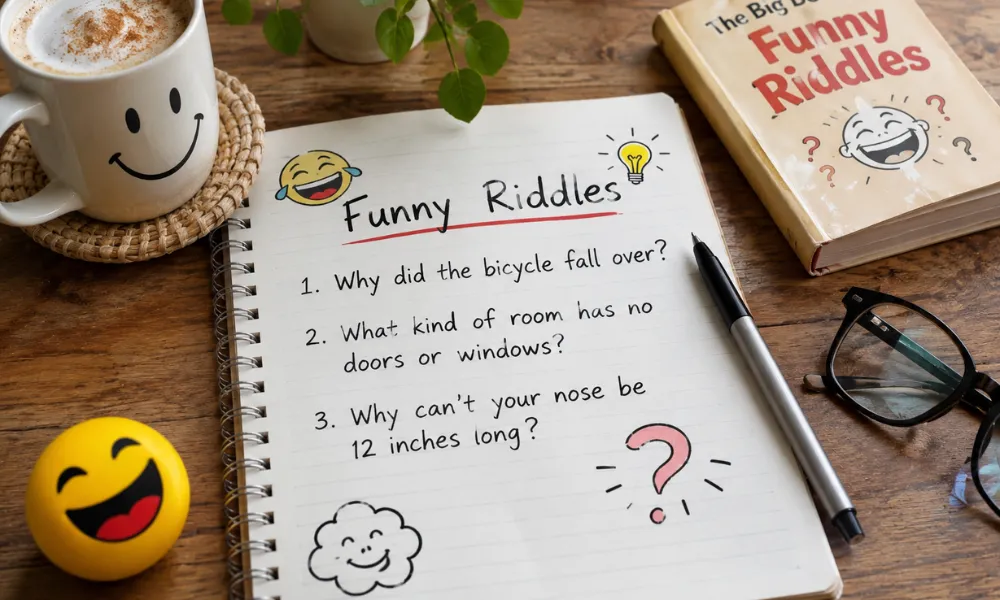
Not every riddle needs to be difficult. Funny riddles combine simple wordplay with unexpected answers, making them ideal for sharing with friends, family, or classmates.
Here are a few entertaining examples:
Riddle 1: Why did the bicycle fall over?
Answer: Because it was two-tired.
Riddle 2: What kind of room has no doors or windows?
Answer: A mushroom.
Riddle 3: Why can’t your nose be 12 inches long?
Answer: Because then it would be a foot.
Riddle 4: What has four wheels and flies?
Answer: A garbage truck.
Riddle 5: What do you call a bear with no teeth?
Answer: A gummy bear.
These funny riddles are easy to share and can make a simple conversation more entertaining.
5. Daily Math Riddles to Test Your Number Skills
Math riddles combine numbers, calculations, and logical reasoning. Some require basic arithmetic, while others involve identifying patterns or understanding a mathematical trick.
Try these number-based challenges:
Riddle 1: I am an odd number. Remove one letter, and I become even. What number am I?
Answer: Seven. Remove the letter “S” and the word becomes “even.”
Riddle 2: If you multiply me by any other number, the answer always remains the same. What number am I?
Answer: Zero.
Riddle 3: What three positive numbers give the same result when multiplied and added together?
Answer: 1, 2, and 3. Their sum and product are both 6.
Riddle 4: A farmer has 17 sheep. All but nine run away. How many sheep remain?
Answer: Nine.
Riddle 5: What comes next in this sequence: 2, 4, 8, 16, 32?
Answer: 64. Each number is doubled.
Math riddles are useful for practicing number patterns and thinking carefully about mathematical statements.
6. Daily Logic Riddles That Require Careful Thinking
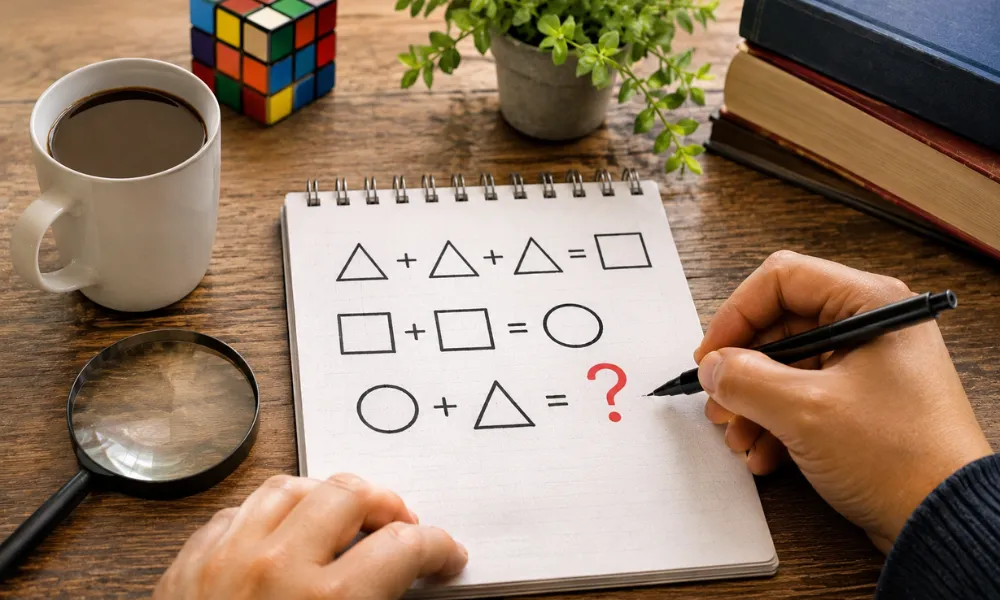
Logic riddles ask you to examine information and reach a conclusion. They may involve people, objects, situations, or a sequence of events.
Here are some examples:
Riddle 1: You enter a dark room with a candle, a fireplace, and a lamp. You have only one match. What do you light first?
Answer: The match.
Riddle 2: Two fathers and two sons go fishing. Each catches one fish, but they bring home only three fish. How is that possible?
Answer: There are only three people: a grandfather, his son, and his grandson.
Riddle 3: A plane crashes on the border between two countries. Where do they bury the survivors?
Answer: They do not bury survivors.
Riddle 4: Before Mount Everest was discovered, what was the highest mountain in the world?
Answer: Mount Everest. It was still the highest even before people discovered it.
Riddle 5: A woman has four daughters, and each daughter has one brother. How many children does the woman have?
Answer: Five. The four daughters share the same brother.
These puzzles show how small details can change the way you understand a question.
7. Short Daily Riddles for Quick Entertainment
Sometimes you only have a few minutes for a puzzle. Short riddles are perfect for quick breaks because they usually require just one clever observation.
Riddle 1: What has one eye but cannot see?
Answer: A needle.
Riddle 2: What has words but never speaks?
Answer: A book.
Riddle 3: What has a thumb and four fingers but is not alive?
Answer: A glove.
Riddle 4: What has a ring but no finger?
Answer: A telephone.
Riddle 5: What has branches but no fruit, trunk, or leaves?
Answer: A bank.
You can use these short questions as a daily guessing game or share one with someone whenever you want a quick challenge.
8. How to Solve a Daily Riddle More Easily

Some riddles seem confusing because their wording is designed to lead you toward the wrong answer. Instead of guessing immediately, take a moment to examine the clues. You can also practice with these printable riddles to sharpen your observation and problem-solving skills.
Try these simple techniques:
- Read the question twice: Important clues can be easy to miss when you read too quickly.
- Look for wordplay: Words may have more than one meaning.
- Think beyond the obvious: The answer might be an everyday object described unusually.
- Break the question into parts: Examine each clue separately before connecting them.
- Avoid unnecessary assumptions: Do not add information that the riddle does not provide.
- Check your answer: Make sure your solution explains every important part of the question.
With regular practice, you may become more comfortable recognizing common riddle patterns and solving unfamiliar questions.
9. Benefits of Solving a Daily Riddle
Riddles are primarily a form of entertainment, but they also provide opportunities to practice different thinking skills.
Some potential benefits include:
- Creative thinking: Riddles encourage you to consider unusual explanations.
- Problem-solving practice: You learn to examine clues and compare possible answers.
- Vocabulary development: Word-based riddles introduce different meanings and expressions.
- Attention to detail: Small words can contain important clues.
- Social interaction: Sharing riddles creates opportunities for friendly conversations.
- Entertainment: A short puzzle can provide an enjoyable break from everyday activities.
Riddles are not a guaranteed way to improve intelligence or memory, but they can make everyday problem-solving practice more enjoyable.
10. How to Make Daily Riddles Part of Your Routine
You do not need to spend hours solving puzzles to enjoy them. A few minutes each day can be enough to make riddles a regular activity.
Start by choosing one riddle each morning and trying to solve it before checking the answer. You can also write down interesting riddles in a notebook or save them on your phone.
If you enjoy social challenges, send a daily riddle to friends or family and see who solves it first. You can even create a small weekly competition with points for correct answers.
Try different categories throughout the week, such as word riddles on Monday, math riddles on Tuesday, and logic challenges on Wednesday. You can explore more riddles with answers to discover fresh challenges and keep the experience varied and interesting.
FAQs About Daily Riddle
1. What is a daily riddle?
A daily riddle is a short puzzle or question designed to challenge your thinking. It may involve wordplay, logic, numbers, or everyday objects, and usually has one intended answer.
2. Where can I find a daily riddle?
You can find daily riddles on puzzle websites, blogs, social media pages, mobile apps, and in printed puzzle books. Many websites publish new riddles regularly.
3. Are daily riddles good for adults?
Yes. Adults can enjoy riddles as a form of entertainment and a way to practice creative thinking, vocabulary, and problem-solving.
4. What is the difference between an easy and a hard daily riddle?
Easy riddles usually contain familiar clues and straightforward answers. Hard riddles often involve multiple clues, wordplay, or situations that require more careful reasoning.
5. Can I play daily riddles with friends?
Yes. Riddles are easy to share through messages, social media, or in-person conversations. You can take turns asking questions and award points for correct answers.
Conclusion: Make Every Day More Interesting With a Daily Riddle
A daily riddle is a simple way to add fun and curiosity to your everyday routine. Whether you prefer easy questions, difficult brain teasers, funny wordplay, or number challenges, there is always another puzzle to explore.
Start with simple riddles and gradually try more challenging ones as you become comfortable with different styles. Share your favorite questions with friends, compare answers, and enjoy the process of finding creative solutions.
The best part of a daily riddle is that it does not require special equipment or a lot of time. All you need is a curious mind and a willingness to think differently.