Every kid loves a good game, and the best games do more than fill an afternoon. Brain training games for kids sharpen memory, logic, focus, and problem-solving while kids are having so much fun they never notice they are learning. Whether your child is five or twelve, a quick daily game builds thinking skills that help at school, in sports, and in everyday life.
The secret is variety. A memory game trains recall, a logic puzzle builds reasoning, a word game grows vocabulary, and a speed challenge improves focus under pressure. Rotating through different kinds of games keeps young minds engaged and stops practice from feeling like homework. The sixty games in this guide are all free, need little or no equipment, and can be played at the kitchen table, in the car, or on a rainy afternoon indoors.
Below are games sorted by skill, from memory and logic to words, numbers, and speed. Each game comes with a clear answer or a simple way to check who wins. Pick one or two a day, keep score on the fridge, and watch your child’s confidence grow. For even more ideas, explore our roundup of the best brain games for kids to mix into your weekly routine.
Key Takeaways
- Sixty original brain training games are grouped by skill: memory, logic, words, numbers, focus, and speed.
- Every game includes an answer or a clear winner, so kids can play and check their work independently.
- Most games need no equipment at all, and the rest use paper, cards, or everyday household objects.
- Ten to fifteen minutes a day is enough to build real memory, reasoning, and concentration skills.
- Rotate game types through the week so your child trains every part of the brain, not just one.
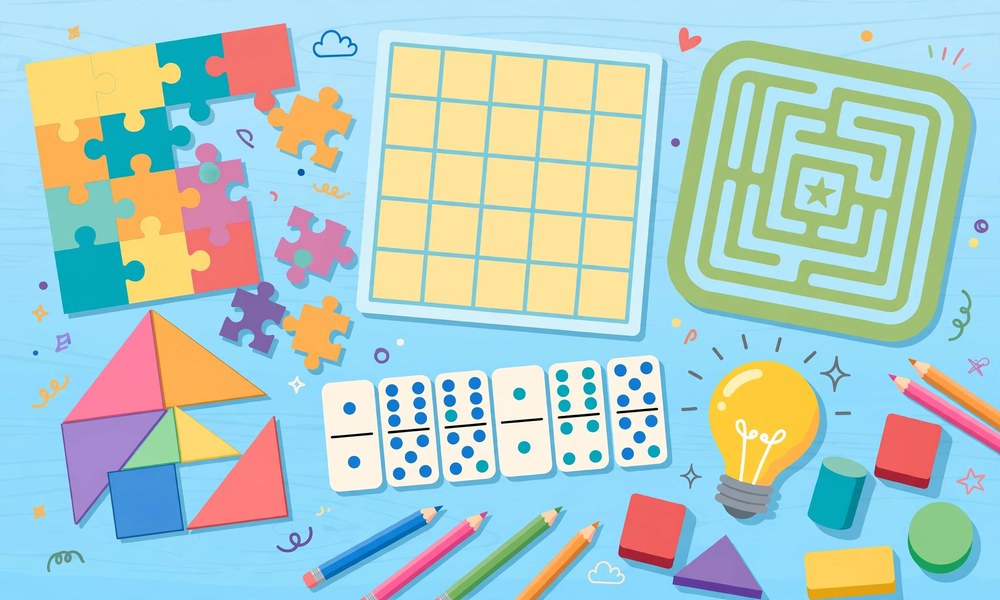
How to Use This Guide
Start with your child’s age and interests. Younger kids do best with memory and matching games, while older kids enjoy logic puzzles and word challenges. Play together the first few times, then let your child take the lead. Keep sessions short, celebrate effort, and stop while the game is still fun.
Quick Guide: Which Game Trains What
| Game Type | Best Ages | Main Skill | Time Needed |
|---|---|---|---|
| Memory games | 5 to 10 | Recall and attention | 5 to 10 minutes |
| Logic puzzles | 7 to 12 | Reasoning and planning | 10 to 15 minutes |
| Word games | 6 to 12 | Vocabulary and spelling | 5 to 15 minutes |
| Number games | 6 to 12 | Maths and mental speed | 5 to 10 minutes |
| Focus games | 5 to 12 | Concentration and calm | 5 minutes |
| Speed games | 7 to 12 | Quick thinking | 5 to 10 minutes |
1. Memory Games
1. Tray Peek: Place ten small objects on a tray, show them for thirty seconds, cover the tray, and ask your child to name them all. Answer: the ten objects you placed, and a perfect score is naming all ten.
2. Missing Object: Line up eight toys, let your child study them, then remove one while their eyes are closed. Answer: whichever toy you secretly took away, and a bonus point for describing where it sat.
3. Story Chain: Take turns adding one sentence to a story, repeating the whole story from the start each time. Answer: the full chain in the correct order, with the last player reciting it perfectly winning.
4. Number Echo: Read out numbers, such as 4, 9, 2, 7, and ask your child to repeat them backwards. Answer: 7, 2, 9, 4, and longer strings earn more points.
5. Card Pairs: Lay twelve cards face down and flip two at a time to find matching pairs. Answer: the player with the most pairs wins, and a perfect game clears the board in six turns.
6. Picture Recall: Show a busy picture for one minute, hide it, and ask ten questions about the details. Answer: the details in the picture, such as three red birds, with one point per correct detail.
2. Logic Puzzles
7. The Farmer’s Crossing: A farmer must carry a fox, a chicken, and grain across a river in a boat that holds only one item, and the fox cannot be left with the chicken. Answer: take the chicken first, return alone, take the fox, bring the chicken back, take the grain, then return for the chicken.
8. Three Switches: Three switches control three bulbs in another room, and you may enter it only once. Answer: turn on switch one for five minutes, turn it off, turn on switch two, then feel the bulbs: the warm off bulb belongs to switch one.
9. Odd One Out: Which does not belong: apple, banana, carrot, grape? Answer: the carrot, because it is a vegetable while the others are fruits.
10. Next in Line: What comes next: 2, 4, 8, 16? Answer: 32, because each number doubles the one before it.
11. The Locked Box: A box has a three-digit code where the first digit is double the second and the digits add to twelve. Answer: 642, since 6 is double 3 and 6 plus 4 plus 2 equals 12.
12. Bridge Riddle: Four friends cross a bridge at night with one torch, taking 1, 2, 5, and 10 minutes, with only two crossing at once. Answer: 17 minutes: send the two fastest first, then the two slowest together, with the fastest shuttling the torch back.
3. Word Games
13. Word Ladder: Change CAT into DOG by changing one letter at a time, making a real word each step. Answer: CAT, COT, COG, DOG, in just three moves.
14. Alphabet Race: Name an animal for every letter of the alphabet in order. Answer: a complete list from ant to zebra, with a point for each correct animal and a bonus for finishing without a pause.
15. Rhyme Time: Say a word and take turns giving rhymes until someone cannot think of one. Answer: the last player to give a valid rhyme wins, and “cat” can start a chain of hat, bat, mat, and sat.
16. Backwards Spelling: Spell a word backwards out loud, such as STAR. Answer: RATS, and longer words like ELEPHANT become TNAHPELE, which is much trickier than it looks.
17. Word in a Word: How many small words can you find inside ELEPHANT? Answer: at least ten, including ANT, ELAN, LEAP, HEAT, and PAN, with the longest list winning.
18. Category Sprint: Pick a letter and a category, then name five things in ten seconds. Answer: five correct answers, such as five red things starting with S: strawberry, sunset, sock, soup, and star.
4. Number Games
19. Make 24: Use the numbers 3, 3, 8, 8 to make 24. Answer: 8 divided by (3 minus 8 divided by 3) equals 24.
20. Times Table Race: Two players race to answer multiplication questions, such as 7 times 8. Answer: 56, and the first player to answer five questions correctly wins the round.
21. Number Pyramid: Each brick is the sum of the two below it, and the bottom row is 2, 3, and 4. Answer: the middle row is 5 and 7, and the top brick is 12.
22. Guess My Number: Think of a number between 1 and 100, and your child guesses with hotter or colder clues. Answer: the secret number, and clever guessers find it in seven guesses by always guessing the middle of the remaining range.
23. Odd or Even Hunt: Count the windows in your house and guess if the total is odd or even. Answer: count them together to check, and a correct guess earns a point.
24. Dice Addition: Roll two dice and add the numbers, then race to say the total. Answer: the sum of the two dice, such as 4 plus 5 equals 9, and the fastest correct answer wins the point.
5. Focus and Attention Games
25. Simon Says Focus: Follow instructions only when they start with “Simon says,” and ignore the rest. Answer: players who move without hearing “Simon says” are out, and the last player standing wins.
26. Statue Challenge: Freeze like a statue for one full minute while someone tries to make you laugh. Answer: the player who stays still and silent for the whole minute wins, and giggling means starting over.
27. Colour Confusion: Read the word RED printed in blue ink and say the colour of the ink, not the word. Answer: blue, and the trick trains the brain to slow down and focus on the right detail.
28. Listening Bingo: Listen to a story and tick off words from a bingo card as you hear them. Answer: the first player to tick a full row wins.
29. Spot the Difference: Study two nearly identical pictures and find five differences. Answer: the five changed details, such as a missing hat, a flipped shoe, and an extra cloud.
30. Counting Backwards: Count backwards from 100 by sevens. Answer: 100, 93, 86, 79, 72, 65, 58, and reaching the end without a mistake wins.
6. Visual and Spatial Games
31. Tangram Animals: Use seven flat shapes to build a cat, a fish, or a house. Answer: a completed picture with no gaps and no overlapping pieces, and the fastest builder wins.
32. Mirror Drawing: Draw a simple shape while looking only in a mirror. Answer: a recognisable shape, and the wobblier the first try, the bigger the improvement by the third.
33. Block Tower: Build the tallest tower you can from twenty blocks in one minute. Answer: the tallest tower still standing when the timer ends.
34. Maze Race: Draw a maze on paper and race to solve each other’s mazes. Answer: the quickest path from start to finish without crossing a wall, and the fastest solver wins.
35. Shadow Match: Match five objects to their shadows on a worksheet. Answer: the correct pair for each shadow, and a perfect score is five out of five.
36. Pattern Blocks: Copy a pattern of coloured shapes from memory after seeing it for ten seconds. Answer: the exact pattern, with one point per shape in the right place.
7. Riddles and Brain Teasers
37. The Echo Riddle: I speak without a mouth and hear without ears, and I have no body but come alive with wind. What am I? Answer: an echo.
38. The More You Take: The more of me you take, the more you leave behind. What am I? Answer: footsteps.
39. The Invisible Key: What has keys but cannot open a single lock? Answer: a piano.
40. The Growing Shadow: I get bigger the more you take away from me. What am I? Answer: a hole.
41. The Two Coins: I have two coins that add up to thirty cents, and one of them is not a nickel. What are they? Answer: a quarter and a nickel, because only one of them is not a nickel.
42. The Light Riddle: What can you catch but never throw? Answer: a cold. If your child loved these, our collection of funny brain teasers for kids has plenty more giggles waiting.
8. Strategy Games
43. Tic-Tac-Toe Tournament: Play five rounds of noughts and crosses and keep a running score. Answer: the player with the most wins takes the trophy, and a draw scores half a point each.
44. Connect Four Plan: Drop counters to make four in a row while blocking your opponent. Answer: the first player to connect four counters horizontally, vertically, or diagonally wins the game.
45. Checkers Challenge: Play checkers and try to capture three pieces in one turn. Answer: the player who captures all of the opponent’s pieces, or blocks them so they cannot move, wins.
46. Chess for Beginners: Learn how the knight moves and capture three pawns with it. Answer: the knight jumps in an L shape, two squares one way and one square sideways, and it is the only piece that can jump over others.
47. Nim Sticks: Start with twelve sticks and take turns removing one, two, or three, and the player who takes the last stick wins. Answer: the winning trick is to leave your opponent with four sticks, then take the last one.
48. Dots and Boxes: Draw a grid of dots and take turns joining two dots, winning a box by completing its fourth side. Answer: the player with the most boxes when the grid is full wins, and a clever move can win two boxes at once.
9. Creative Thinking Games
49. What Else Could It Be: Pick a paperclip and name ten other things it could be. Answer: ten ideas, such as a hook, a tiny sword, a bookmark, or a fishing lure, with the silliest earning a bonus point.
50. Story Dice: Roll picture dice and invent a story using every picture shown. Answer: a complete story that includes all of the pictures in any order, told in under two minutes.
51. Invent an Animal: Combine two animals into one and describe what it eats and where it lives. Answer: a brand new creature, such as a “doggiraffe” that eats leaves from tall trees and barks at the moon.
52. The Backwards Day: Describe your morning routine in reverse order, starting with going to bed. Answer: the full routine backwards without missing a step, and the funniest mistake wins a laugh.
53. Build a Better Backpack: Design a backpack with five impossible features. Answer: five inventions, such as a snack fridge and a homework robot, with the most useful design winning.
54. Twenty Questions: Think of an object and answer only yes or no while your child guesses it in twenty questions. Answer: the secret object, guessed before the twentieth question, with smart questions about size, colour, and use winning fastest.
10. Speed and Quick Thinking Games
55. Word Snap: Shout a word starting with the last letter of the previous word, such as CAT, then TIGER. Answer: a chain with no repeats and no pauses longer than three seconds, and the longest chain wins.
56. Sixty Second Maths: Answer as many simple sums as you can in one minute. Answer: your total score, and beating your best by three earns a star on the chart.
57. Name Five: Name five animals that live in the ocean in ten seconds. Answer: five correct animals, such as whale, shark, octopus, seahorse, and dolphin, with no repeats allowed.
58. Quick Draw: Draw a cat, a house, and a rocket in thirty seconds. Answer: three recognisable drawings before the timer ends, and the funniest rocket earns a bonus point.
59. Opposite Day: Answer every question with the opposite answer for one minute, such as saying “night” when asked about day. Answer: surviving the full minute without a single correct answer, which is harder than it sounds.
60. Alphabet Backwards: Say the alphabet backwards from Z to A. Answer: Z, Y, X, W, V, U, T, S, R, Q, P, O, N, M, L, K, J, I, H, G, F, E, D, C, B, A, and finishing without a mistake wins.
Building a Weekly Brain Game Routine
Try memory games on Mondays, logic puzzles on Tuesdays, word games on Wednesdays, number games on Thursdays, and a free choice on Fridays. Keep a score chart on the fridge and celebrate every personal best. Short daily sessions beat one long weekend marathon. For ready-made logic challenges, our easy logic puzzles for kids are a perfect next step.
Your Brain Training Checklist
- Pick two games from different sections for each session so you train more than one skill.
- Keep every session to ten or fifteen minutes and stop while the game is still fun.
- Use the score chart on the fridge to track personal bests and celebrate improvement.
- Let your child choose the game at least once a week so they stay in charge of the fun.
- Play together the first few times, then step back and let your child play independently.
- Rotate in new games every week so the brain keeps meeting fresh challenges.
Frequently Asked Questions
How long should kids play brain training games each day?
Ten to fifteen minutes a day is plenty. Short, regular sessions build skills better than long, tiring ones.
What age are these brain training games best for?
Most suit ages five to twelve. Younger kids will love the memory and matching games, while older children will enjoy the logic puzzles, strategy games, and speed challenges.
Do brain training games really help with school?
Yes. Memory games help with spelling and times tables, logic puzzles help with maths and science, and word games grow vocabulary for reading and writing.
Can kids play these games alone?
Many do. Memory games, mazes, word ladders, and number pyramids all work solo, and every game here includes an answer so your child can check their own work.
What if my child finds a game too hard?
Make it easier and celebrate the effort. Use fewer objects, shorter number strings, or simpler words, then build up gradually as confidence grows.
How often should I introduce new games?
Introduce one or two new games each week and keep favourites in rotation. Fresh challenges keep the brain growing, while familiar games build confidence and speed.
The Bottom Line
Sixty games, ten skills, and a few minutes a day is all it takes to give your child a sharper memory, stronger logic, and a love of thinking. Start with the games that make your child smile and enjoy watching a young brain grow stronger.
Note: These games are designed for fun family play and gentle skill building. Every child learns at their own pace, so adjust the difficulty, celebrate effort over speed, and keep the focus on enjoying time together.