Finding the Best Word Games for 259 Players is a very different challenge from picking a game for a family night or a classroom of thirty. With 259 people in the room, a game only works if everyone can take part at the same time, follow the rules without a long explanation, and stay involved from the first round to the last. Word games are a natural fit for a crowd this size because they need almost no equipment, they scale easily from ten players to hundreds, and they reward quick thinking rather than speed or physical ability.
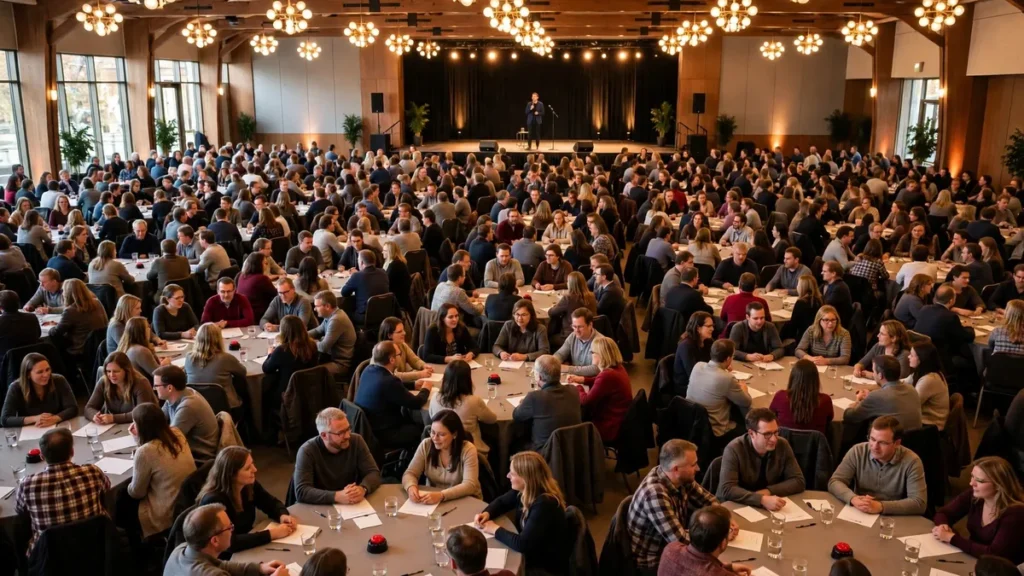
A group of 259 players usually means a school assembly, a company event, a conference, a youth camp, or a large community gathering. In settings like these, the best format is almost always team play. Splitting 259 people into teams of ten to fifteen creates manageable groups, gives every player a role, and keeps the energy high without chaos. A single host with a microphone and a large screen can run the whole event, while team captains handle answers, scoring, and communication inside their own groups.
This guide covers the word games that genuinely work at this scale, how to organise them, and the practical details that keep a 259-player event running smoothly. Every game below has been chosen because it can be played by hundreds of people at once, uses simple rules, and keeps the focus on words, wit, and teamwork rather than on complicated equipment or long setup times.
Key takeaways
- Split 259 players into teams of ten to fifteen so every player has a role and no one is left waiting.
- Use one host, a microphone, and a large screen so instructions and word prompts reach the whole room at once.
- Choose games with simple rules that can be explained in under two minutes.
- Rotate roles inside each team so quieter players get turns as captain, speller, or guesser.
- Keep rounds short, score visibly on a leaderboard, and finish with a final round that every team can win.
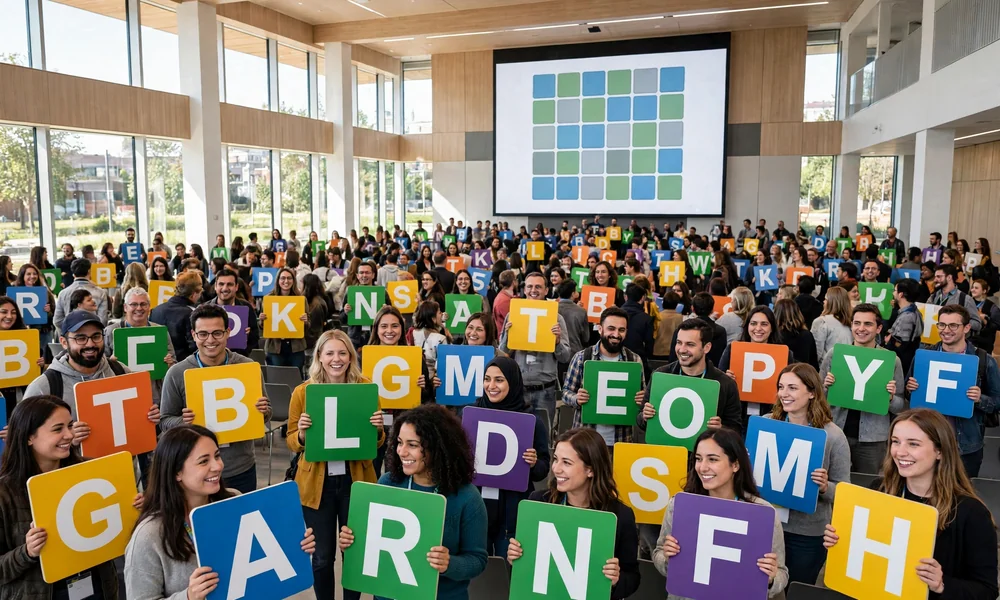
Why Word Games Work for 259 Players
Word games suit very large groups for a simple reason: words are free, portable, and familiar to everyone. Unlike board games, which need one set per table, or sports, which need space and equipment, a word game needs only a prompt and a way for players to answer. That makes it possible to run a single game for 259 people without buying hundreds of copies of anything or splitting the room into dozens of separate sessions.
Word games also level the playing field. A twelve-year-old and a sixty-year-old can both be strong at anagrams, word chains, or guessing games, because success depends on vocabulary and lateral thinking rather than on age, fitness, or specialist knowledge. In a mixed crowd of 259 players, that fairness matters. People stay engaged when they feel they have a genuine chance to contribute, and word games give every team member a way to help, whether they are the fastest thinker, the best speller, or the person who notices a pattern everyone else missed.
Word games are also flexible. They can fill ten minutes between sessions or run for a full two hours, rounds can be added or dropped on the day, and difficulty can be adjusted by changing the prompts. Few other formats adapt that easily, which is why organisers return to them for large gatherings.
How to Run Word Games for 259 Players
Running a word game for 259 players is mostly a logistics exercise. The games are simple, but the organisation decides whether the event feels exciting or chaotic. A few clear decisions made before the day will make everything run smoothly.
Split the Room into Teams
Divide 259 players into teams of ten to fifteen. That gives you roughly eighteen to twenty-six teams, depending on the exact split. Teams of this size are small enough for everyone to talk to each other, but large enough to include a mix of skills. Assign team numbers and colours, give each team a table or a marked area, and ask each team to choose a captain and a name. The captain collects answers and communicates with the host, which keeps the room from turning into 259 people shouting at once.
Use a Host, a Microphone, and a Screen
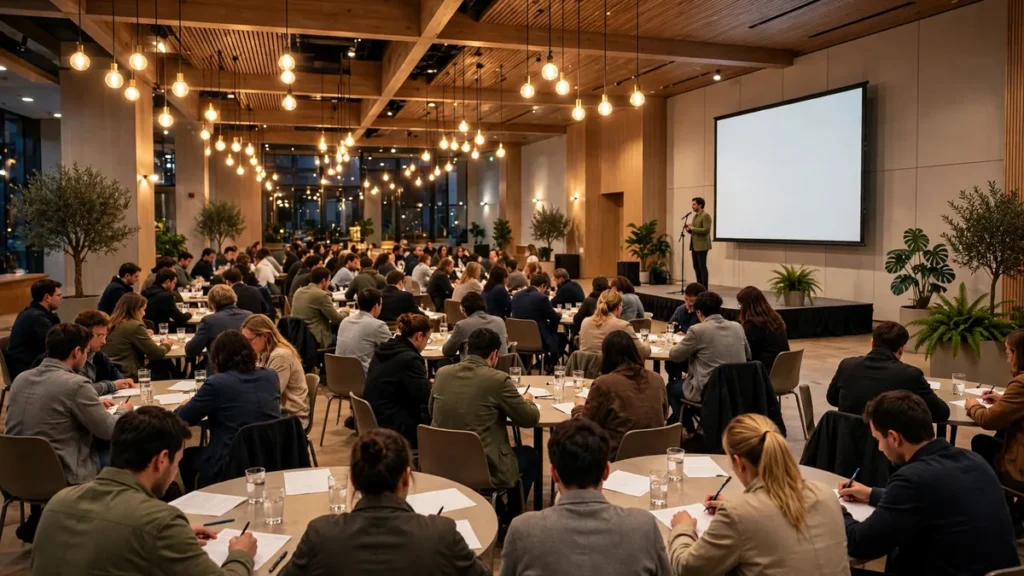
One confident host should run the event, with a microphone and a large screen or projector showing each prompt. The screen is essential: with 259 players, spoken instructions alone will be missed by people at the back. Show the word, the category, the time limit, and the score on screen for every round. If possible, have a second person managing the timer and the scoreboard so the host can focus on energy and commentary.
Keep Rounds Short and Scores Visible
Keep each round to three to five minutes, and update a visible leaderboard after every round. Short rounds keep the pace up and stop attention from drifting, while a visible scoreboard gives every team a reason to keep trying. A team in last place after round two can still climb back, so make sure the points on offer stay meaningful in later rounds. Plan a final round worth double points so the event stays competitive right to the end.
The Best Word Games for 259 Players
The games below are ordered from the easiest to set up to the ones that need a little more preparation. All of them work for 259 players in a team format, and most of them can be mixed and matched into a single event.
1. Word Chain Relay
In a word chain relay, each team builds a chain of words where every new word begins with the last letter of the previous word. The host gives a starting word, such as elephant, and teams have three minutes to build the longest valid chain they can. Each word must be a real English word, no word can be repeated, and proper nouns are not allowed. Teams write their chains on paper or a whiteboard, and the longest correct chain wins the round.
This game works brilliantly at scale because every team works independently and simultaneously, so 259 players are all active at once. It also rewards teamwork: one player might spot that a chain is stuck on the letter X, while another finds a word that opens up ten new options. For a harder round, restrict the chain to a category such as animals, food, or countries, which forces teams to think more carefully about every choice.
2. Giant Anagram Race
An anagram race gives every team the same set of scrambled letters and asks them to find as many real words as possible in a fixed time. Use a long word or a nine-letter set, display it on the screen, and give teams four minutes. Short words score one point, longer words score more, and any team that finds the full nine-letter word earns a bonus.
The format is ideal for a huge group because the screen does all the work: everyone sees the same letters, and there is no equipment to hand out. Choose letter sets with plenty of possible words and check answers against a standard word list.
3. Twenty Words
Twenty Words is a guessing game played on a grand scale. The host thinks of a word and the room has twenty yes-or-no questions to work it out. Each team submits one question per round through its captain, and the host answers for the whole room to hear. Teams can also submit a guess at any point, and the first team to guess correctly wins the points.
With 259 players, take questions in an orderly rotation so every team gets a turn. Number the teams and call on them in sequence, which keeps things fair and stops the loudest teams from dominating. Choose words that are familiar but not obvious, such as lighthouse, volcano, or saxophone.
4. Category Sprint
A category sprint gives teams a letter and a set of categories, and asks them to find one word for each category beginning with that letter. For example, with the letter B and the categories animal, country, food, job, and sport, a team might answer bear, Brazil, bread, baker, and badminton. Teams have three minutes, and each correct answer scores a point, with a bonus for completing every category.
This game is fast, loud, and easy to run for a crowd. It works well as an opening round because the rules take thirty seconds to explain and everyone understands the task immediately. For variety, use a different letter each round and change the categories to match the event, such as school subjects for a school assembly or company departments for a workplace event.
5. Word Bingo
Word bingo adapts the classic game for a word-loving crowd. Each team receives a bingo card filled with words instead of numbers. The host reads out definitions, synonyms, or clues, and teams mark the matching word on their card. The first team to complete a row, column, or full card shouts bingo and wins the round.
Preparing cards for twenty or more teams takes some work, but a bingo card generator can produce unique cards in minutes, and the same set can be printed or shown on team tablets. Word bingo is a good middle round because it is calmer than a relay or a sprint, giving the room a breather while keeping everyone involved.
6. Spelling Showdown
A spelling showdown turns a familiar school format into a team event. The host reads out a word, and each team writes down the spelling. After ten words, teams swap answer sheets with a neighbouring team for marking, and the scores are added to the leaderboard. Words should range from easy to challenging, so every team scores something in the early rounds before the harder words separate the leaders.
To keep 259 players engaged, use words that are fun to hear and spell, and mix everyday words with surprising ones. Announce the correct spelling on screen after each round so teams can learn from their mistakes.
7. Rhyming Relay
In a rhyming relay, the host gives a starting word and each team must produce as many rhyming words as possible in two minutes. Only real words count, and near-rhymes do not score. Teams with the most valid rhymes win the round, and a bonus goes to any team that finds an unusual rhyme nobody else thought of.
This is one of the quickest games to run and one of the most entertaining to watch, because the room fills with laughter as teams discover how few words rhyme with orange or silver. It is best used as a short, high-energy round between longer games. For an extra twist, ask teams to use their rhyming words in a single sentence, which tests creativity as well as vocabulary.
8. The Big Word Auction
In the big word auction, each team receives a budget of imaginary points and bids on word clues shown on the screen. A clue might be a definition, a set of letters, or a category, and the winning team must give the correct word to keep the points. Teams that bid too much on a hard clue lose points, so the game rewards judgement as well as word knowledge.
The auction format adds strategy and drama, and it works well as a closing round because every team can still win by bidding wisely. Keep the bidding rounds short, the clues visible on screen, and let the host build excitement with a countdown.
If your group also enjoys other kinds of large-group play, it is worth comparing formats. The best trivia games for 259 players use a similar team structure but test general knowledge instead of vocabulary, while the best puzzle games for 259 players suit groups that prefer logic and problem solving. For a smaller crowd, the best word games for 257 players show how the same ideas adapt to a slightly different group size.
Word Games for 259 Players Compared
Choosing the right mix matters more than choosing a single best game. A good event combines fast rounds with slower ones, quiet thinking games with noisy team games, and easy openers with a challenging finale. The table below compares the eight games in this guide so you can build a balanced programme for your group.
| Game | Round Length | Setup Needed | Best For | Energy Level |
|---|---|---|---|---|
| Word Chain Relay | 3 minutes | Paper and pens | Opening round | High |
| Giant Anagram Race | 4 minutes | Screen only | Whole-room play | Medium |
| Twenty Words | 5 minutes | Screen and microphone | Building suspense | Medium |
| Category Sprint | 3 minutes | Paper and pens | Fast warm-up | High |
| Word Bingo | 10 minutes | Printed cards | A calm middle round | Low |
| Spelling Showdown | 10 minutes | Paper and pens | Semi-final | Medium |
| Rhyming Relay | 2 minutes | Screen only | Quick energy boost | High |
| Big Word Auction | 15 minutes | Screen and scoreboard | Grand finale | High |
A two-hour event might use five or six of these games, while a shorter session can pick three. Start with a fast game such as the category sprint, move into a thinking game such as the anagram race, take a breather with word bingo, and finish with the word auction. That shape keeps energy high at the start, gives the room time to settle, and ends with a dramatic finale.
Checklist for Running Word Games with 259 Players
Use this checklist when you plan your event so nothing important is missed on the day.
- Confirm the venue, seating plan, screen, microphone, and sound system at least a week before the event.
- Divide 259 players into teams of ten to fifteen, and prepare team numbers, colours, and answer sheets in advance.
- Prepare all word lists, prompts, and answer keys before the day, and test them with a small group first.
- Appoint a host, a timekeeper, and a scorekeeper, and agree on the rules and the scoring system with them.
- Print spare answer sheets and pens, and keep a backup of every prompt on a second device in case of a technical problem.
- Plan a prize for the winning team and a small recognition for every team, so the event ends on a positive note for all 259 players.
Frequently Asked Questions
What is the best word game for 259 players?
The best all-round choice is the giant anagram race, because it needs only a screen, every team plays at the same time, and the rules take less than a minute to explain. For a full event, combine it with a word chain relay for energy, a category sprint for speed, and the big word auction as a finale.
How do you split 259 players into teams?
Split 259 players into teams of ten to fifteen, which gives you roughly eighteen to twenty-six teams. Aim for a mix of ages and abilities in each team rather than grouping friends together, and give each team a number, a colour, and a captain. Teams of this size are small enough for everyone to contribute and large enough to include a range of word skills.
How long does a word game event for 259 players take?
A good event lasts between ninety minutes and two hours, including introductions, six rounds, and a prize ceremony. Shorter sessions of forty-five minutes work well with three games, such as a category sprint, an anagram race, and a rhyming relay. Allow extra time for team formation and scoring, because moving 259 people and collecting answer sheets always takes longer than expected.
What equipment do you need for word games with 259 players?
You need a microphone, a large screen or projector, answer sheets, pens, and a visible scoreboard. Most games in this guide need nothing more. Word bingo needs printed cards, and the word auction needs a scoreboard that can be updated quickly. Always bring spares and a backup device with the prompts saved offline.
Can word games work for a mixed-age group of 259 players?
Yes, word games work well for mixed-age groups because they reward vocabulary and thinking rather than age or physical ability. Choose prompts that are familiar across generations, avoid slang that only one age group knows, and rotate roles inside each team so younger and older players both get turns as captain, speller, and guesser.
How do you keep 259 players engaged for a whole event?
Keep rounds short, update the leaderboard after every round, and vary the games so the pace changes. Mix fast, noisy rounds with slower thinking games, give every team a chance to win the final round with double points, and let the host build excitement with commentary and encouragement. Short breaks between rounds also help, especially for events lasting more than an hour.
The Bottom Line
The Best Word Games for 259 Players are the ones that let every player take part at the same time, use simple rules, and reward teamwork over individual speed. Split the room into teams of ten to fifteen, use a host, a microphone, and a screen, and build a programme that mixes fast sprints with slower thinking games and finishes with a dramatic final round. With the games, table, and checklist in this guide, a group of 259 players can enjoy a word game event that is fair, fast-paced, and memorable for everyone involved.