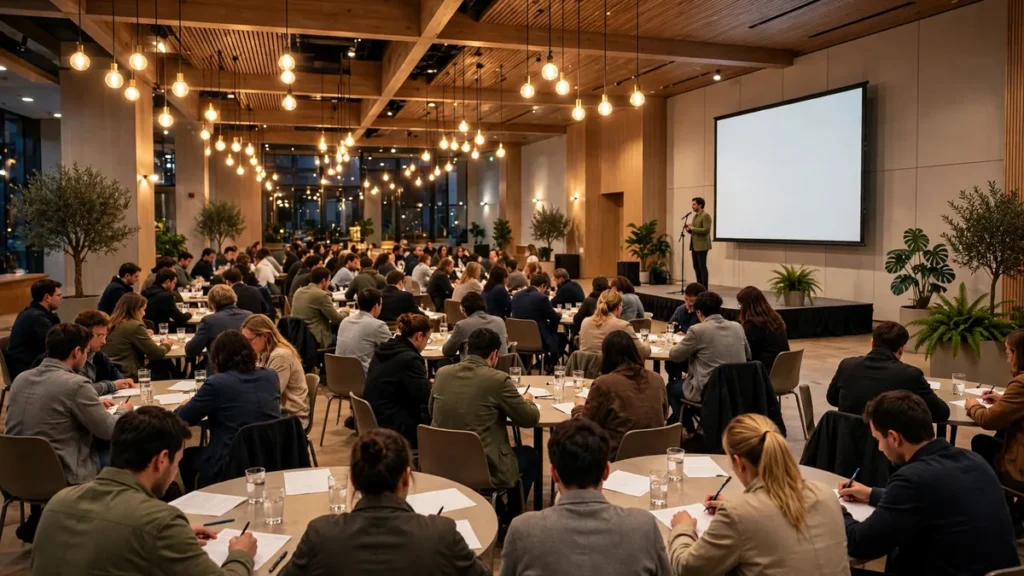
Finding the Best Trivia Games for 264 Players is a very different challenge from picking a quiz for a dozen friends around a table. At this scale, you are not hosting a party game — you are running a live event. Two hundred and sixty-four players means dozens of teams, a room that needs real sound and staging, and a format that keeps every single person involved from the first question to the final scores. The good news is that trivia scales beautifully to a crowd this size, as long as you choose the right format.
A group of 264 players works best when split into teams of four to eight, giving you roughly 33 to 66 teams competing at once. That is a tournament-sized field, and it calls for formats built for volume: table-based team trivia, buzzer brackets, quiz-bowl style head-to-head rounds, and phone-based audience-response games that let hundreds of people answer at the same time. The best nights often mix two or three of these formats across the evening, so no single style has to carry the whole event.
This guide covers the formats that work best for 264 players, how to structure the night, how to score dozens of teams fairly, and the planning that keeps a very large quiz running smoothly. Whether you are organising a company social, a school fundraiser, or a charity quiz night, the ideas below will help you build an evening that feels exciting rather than chaotic.
Key takeaways
- Split 264 players into teams of four to eight, creating roughly 33 to 66 teams for a balanced tournament field.
- Team table trivia is the most reliable core format, because every team answers every question at the same time.
- Mix in buzzer rounds, audience-response games, and picture or music rounds to keep energy high across the evening.
- Use a simple, visible scoring system with one scorekeeper per section, and publish the leaderboard after every round.
- Plan the room, sound, and timing first: a large quiz succeeds or fails on logistics, not on the questions alone.

Why 264 Players Changes Everything
With a small group, a host can read a question, wait for a show of hands, and keep score on a single sheet of paper. With 264 players, every part of that process has to change. Questions must be visible as well as audible, answers must be collected from dozens of tables at once, and scoring must be fast enough that nobody is sitting idle for ten minutes between rounds. The format has to do the heavy lifting, because no host can manage 264 people one by one.
The first thing to accept is that not everyone will answer every question out loud. In a well-run large trivia night, most of the action happens inside each team: players discuss, debate, and agree on one answer that represents the whole team. Teams of four to eight give everyone a voice without turning discussion into a shouting match, and they keep the number of answer sheets manageable.
Timing also changes at this scale. A round that takes fifteen minutes for ten teams can take twenty-five for sixty if collection and marking are slow. Smart hosts build in that extra time, use runners to collect answer sheets, and mark while the next round is already under way. The aim is a steady rhythm: question, discussion, answer, score, next round.
The Best Trivia Games for 264 Players
The six formats below are the strongest choices for a crowd of 264, and most large events combine at least two of them. Start with team table trivia as your foundation, then add one fast format and one visual or musical format for variety.
1. Team Table Trivia
Team table trivia is the backbone of almost every large quiz night. The host reads each question aloud and shows it on a large screen, teams write their answers on a sheet, and runners collect the sheets at the end of each round. Every team plays every question, nobody is eliminated early, and every team faces the same questions under the same conditions.
For 264 players, plan six to eight rounds of eight to ten questions, mixing general knowledge, picture questions, music clips, and one themed round. Keep questions short enough to fit on a screen in large type, read each one twice, and allow about thirty seconds per question. The approach in our guide to the best trivia games for 263 players follows the same structure for a nearly identical crowd size.
2. Buzzer Tournament Brackets
Buzzer rounds add theatre. Two teams face each other, the host asks a question, and the first team to buzz in gets the chance to answer. You cannot run a buzzer round for everyone at once, so use it as a knockout bracket for the top teams after the table rounds. Take the top eight or sixteen teams, pair them off, and let the room watch the finals unfold on stage.
Buzzer brackets need a reliable buzzer system, physical or phone-based, and a host who can judge answers quickly. Keep questions shorter and punchier than in the table rounds, and use a clear rule for wrong answers, such as letting the other team answer. Run the early rounds quickly, then slow down for the semi-finals and final so tension can build.
3. Quiz-Bowl Style Head-to-Head
Quiz-bowl style play is a more structured cousin of the buzzer round. Two teams sit opposite each other, answer toss-up questions to earn the right to answer bonus questions, and build their score across short matches. It suits 264 players because you can run many matches at the same time in different parts of the room, then bring the winners together for the later rounds.
This format works best with enough moderators to run several tables at once, so recruit volunteers and give each one a simple script and score sheet. Keep matches to ten or fifteen minutes and rotate teams on a fixed schedule so nobody waits too long. Quiz-bowl rounds make a good middle section, after the opening table rounds and before the final buzzer stage.
4. Audience-Response Trivia
Audience-response trivia uses phones, tablets, or handheld clickers so every player can answer at the same time. The host shows a question and four options on the main screen, players tap their answer, and the results appear live as a chart or leaderboard. It removes the bottleneck of collecting paper sheets, gives instant feedback, and lets you include fast rounds where speed earns extra points.
The main risk is technical: the venue needs strong Wi-Fi or mobile signal, and players need a simple way to join without a complicated app. Test the system with as many devices as you can gather, and always have a paper backup round ready in case the connection drops. When it works, this is the most energetic format on this list, and it is perfect for a quick warm-up round.
5. Rotating Station Trivia
Rotating station trivia turns the quiz into a journey around the room. Set up six to eight stations, each with a different theme, such as geography, food, music, sport, science, or local history. Teams spend ten minutes at each station, answer a short set of questions, and move on to the next one. It spreads the crowd out, reduces noise in any one area, and gives teams something new every ten minutes.
Stations need a clear layout, visible signs, and a volunteer at each one to hand out questions and keep time. Use a simple rotation plan, such as a numbered map on each table, so teams always know where to go next. It suits venues with several rooms or a large hall divided into zones, and family events where players enjoy moving around.
6. Picture and Music Rounds
Picture and music rounds are the crowd-pleasers that break up a long night of spoken questions. In a picture round, teams identify famous places, films, foods, or faces from images on the main screen. In a music round, they name the song, the artist, or the film a short clip comes from. Everyone can see and hear them at the same time, and they give less confident players a real chance to score.
Choose images that are large, clear, and easy to read from the back of the room, and keep music clips to ten or fifteen seconds. Mix easy and hard items so every team scores something, and avoid questions that depend on tiny details nobody at the back could see. Save a picture round for the middle of the evening, when energy usually starts to dip.
| Format | Best for | Players at once | Setup needed | Energy level |
|---|---|---|---|---|
| Team table trivia | Core rounds for everyone | All 264 | Screen, sound, answer sheets | Steady |
| Buzzer tournament brackets | Finals and top teams | 2 teams per match | Buzzers, stage, host | Very high |
| Quiz-bowl head-to-head | Competitive middle rounds | Many matches at once | Moderators, score sheets | High |
| Audience-response trivia | Warm-up and fast rounds | All 264 | Wi-Fi, phones, live display | Very high |
| Rotating station trivia | Family and community events | All 264 | Stations, signs, volunteers | High |
| Picture and music rounds | Mid-evening energy boost | All 264 | Screen, speakers, clips | High |
How to Structure a 264-Player Trivia Night
A good structure for 264 players runs for about two to two and a half hours, including breaks. Start with a short welcome and one quick audience-response warm-up, so everyone learns how the night works before serious scoring begins. Follow with three or four table rounds, then a picture or music round to lift the energy. After a short break, run quiz-bowl or station rounds, then return to table trivia before the buzzer final.
Breaks matter more at this scale than most hosts expect. With 264 people, even a simple refreshment break takes ten to fifteen minutes, so plan two breaks and use them to mark sheets and update the leaderboard. Announce scores at the start of each new section so teams can see where they stand. Our guide to the best trivia games for 262 players uses a comparable two-hour structure with the same mix of table rounds and a buzzer finish.
Keep the host in charge of the clock. Appoint a timekeeper if the host is also reading questions, and use a visible timer on the screen. When a round runs over, trim the next one rather than letting the evening drift late. Players remember a night that finished on time far more fondly than one that dragged on for an extra hour.
Scoring That Stays Fair at Scale
Fair scoring starts with simple rules everyone understands before the first question. Award one point per correct answer, with a small bonus for a perfect round. For buzzer and quiz-bowl rounds, state clearly what happens after a wrong answer, and apply the same rule every time. Publish the rules on each table and on the main screen at the start of the night.
Divide the room into sections of eight to ten tables, assign one scorekeeper and one runner to each section, and give every team a fixed number that stays with them all night. Collect sheets by section, mark them in pairs so two people check each sheet, and record scores on a single master sheet. Update the leaderboard after every round and show the top ten teams on the screen.
Ties are common with this many teams, so decide your tie-breaker in advance: a sudden-death question, a closest-guess question, or a short buzzer round. Announce it before the final round. The key is transparency: when players can see the scores and watch the tie-breaker happen in front of them, they accept the result even if their team does not win.
Equipment and Setup Checklist
The right equipment makes a 264-player quiz possible, and the wrong equipment can spoil it. Use this checklist when you plan the night, and test everything in the venue the day before if you can.
- Large screen or projector and a sound system that reaches the back row clearly, with a spare microphone and spare batteries.
- Printed answer sheets, pens, and a team number card for every table, plus extra sheets for late arrivals and mistakes.
- One scorekeeper and one runner per section of eight to ten tables, with a master score sheet and a visible leaderboard.
- A buzzer system or audience-response app, tested with many devices, plus a paper backup round in case of technical trouble.
- Clear signs, a numbered table plan, and a rotation map if you are running station rounds in different parts of the venue.
- Prizes for the winning team, a prize for the best team name, and a small prize for the team in last place to keep the mood friendly.
Common Mistakes to Avoid
The most common mistake with a crowd of 264 is choosing questions that are too hard. A good quiz night should let every team score in every round, with a few hard questions to separate the top teams. If most teams score two or three out of ten, the room will go quiet. Aim for a mix where an average team scores six or seven out of ten, and save the toughest questions for the final rounds.
Another common mistake is underestimating the sound and the screen. A host heard clearly at the front but not at the back will lose half the room within twenty minutes. Walk to the back during the sound check, look at the screen from the furthest table, and ask a volunteer there to confirm they can hear and see everything. If they cannot, add speakers or rearrange the tables before players arrive.
Finally, avoid scoring delays. Nothing kills the energy of a big quiz faster than a ten-minute silence while the scoring team works through a pile of sheets. Mark in pairs during the next round, and keep the host talking with a filler question or music clip while scores are counted. A short update, such as saying scores will be ready in two minutes, keeps players patient.
Frequently Asked Questions
How many teams should 264 players be split into?
Split 264 players into teams of four to eight, giving roughly 33 to 66 teams. Teams of six are a good default, producing 44 teams, because six people can discuss a question without the table becoming crowded. Teams of four suit competitive events, while teams of eight suit social and fundraising nights.
How long does a trivia night for 264 players take?
Plan for two to two and a half hours, including two short breaks. Six to eight table rounds take about ninety minutes, and a buzzer final adds another twenty to thirty minutes. Add time for welcome, scoring, and prizes, and do not squeeze in extra rounds at the end. A night that finishes on time feels polished, while one that runs late feels tiring.
What is the best format for a first-time host with 264 players?
Team table trivia is the best format for a first-time host, because it is simple to run and every team plays every question. Add one picture or music round for variety, and use a short audience-response warm-up to get everyone comfortable. Save buzzer brackets and quiz-bowl rounds for a second event, once you have a team of volunteers and a clear sense of how the room flows.
Do I need special equipment for 264 players?
You need a large screen, a sound system that reaches the back row, printed answer sheets, and enough scorekeepers and runners to collect and mark dozens of sheets quickly. A buzzer system or audience-response app is useful but not essential for a first event. The most important equipment is the sound system, so test it from the furthest table before the night begins.
How do I keep scoring fair with more than 40 teams?
Use fixed team numbers, one scorekeeper and one runner per section, and mark sheets in pairs so two people check each one. Record every score on a single master sheet, update the leaderboard after every round, and decide your tie-breaker before the final round. Our guide to the best trivia games for 261 players uses the same section-based system for a crowd of almost the same size.
Can 264 players all play at the same time?
Yes, in table trivia, audience-response trivia, station trivia, and picture and music rounds, all 264 players can play at the same time. Only buzzer and quiz-bowl formats limit play to a few teams at once, which is why they work best as finals or parallel matches. A good night mixes formats so everyone plays together for most of the evening, then watches the top teams compete at the end.
The Bottom Line
The Best Trivia Games for 264 Players work because they treat a huge crowd as dozens of small teams, not as one unmanageable audience. Build the night around team table trivia, add a buzzer final for drama, and use picture, music, or audience-response rounds to keep the energy high. Plan the room, the sound, and the scoring as carefully as the questions, and keep the rhythm steady from the first warm-up to the final scores. Do that, and 264 players will leave talking about the night they played together, not the night they waited around.


