Finding the best trivia games for 73 players takes more than picking a popular quiz and hoping for the best. A group this large cannot sit around one table, share one buzzer, or shout answers at the same time, so the format matters just as much as the questions. The games that work at this scale are the ones built for teams, multiple tables, and a host who can keep dozens of players moving in step.
Here is the honest starting point: no single trivia game seats 73 players at once. Every option in this guide works because it splits the room into teams, runs several tables at the same time, or turns the whole room into one big playing field. Some use printed answer sheets and a live host, others use phones and a screen, and a few run as tournaments where teams rotate through rounds until a winner emerges.
This guide covers the formats that actually hold up with 73 players, how to set them up, what to buy or print, and how to keep the night fair and fast. Whether you are planning a company social, a school fundraiser, a church hall evening, or a big birthday party, you will find a setup that fits your room, your budget, and your crowd.
Key takeaways
- No trivia game seats 73 players at one table, so every workable format uses teams of six to eight players across multiple tables.
- Pub-style team trivia with printed answer sheets is the simplest and most reliable format for a group of 73.
- A single host with a microphone, a screen, and a clear scoring system keeps a large room on schedule.
- Mixing question types, including picture rounds, music rounds, and speed rounds, keeps every team engaged.
- Plan for about two hours, five or six rounds, and a short tiebreaker so the night ends on a high note.
Why 73 Players Changes the Game
Most trivia games are designed for two to eight players. A boxed game expects everyone to hear the same question, see the same cards, and take turns in a tight circle. With 73 people, that model breaks down completely. Someone at the back cannot hear, the cards never reach the far side of the room, and a single turn takes so long that half the group stops paying attention.
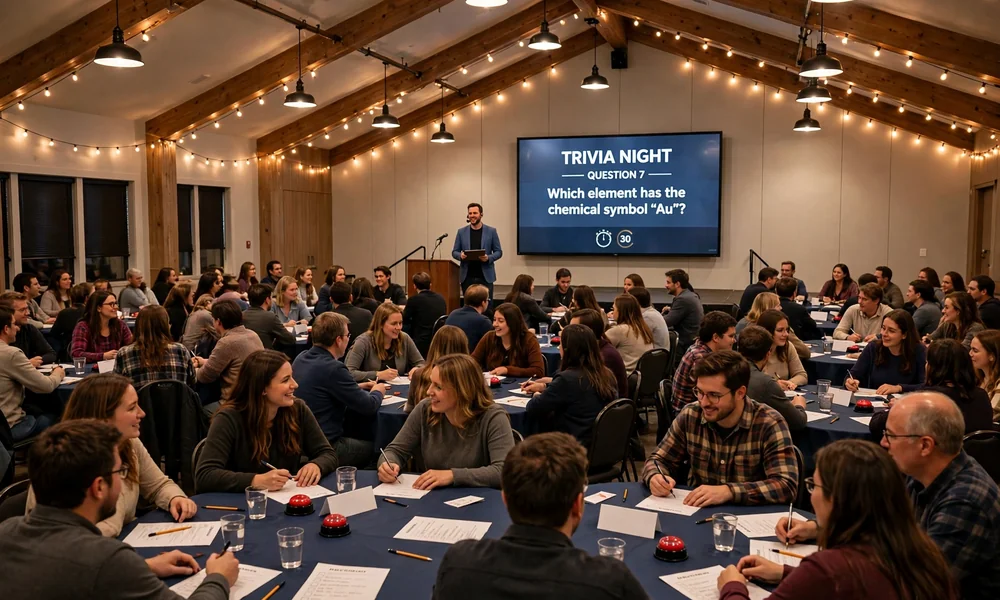
The fix is to stop thinking of 73 players as one game and start thinking of them as ten or twelve teams playing the same game at the same time. Each team of six to eight players works together at its own table, writes answers on a shared sheet, and hands the sheet in for marking. The host reads every question once, the room answers together, and the scores are compared across teams. That structure is why pub quizzes scale so well, and it is the backbone of every recommendation below.
Team size matters more than most hosts expect. Teams of six to eight give everyone a chance to contribute without the loudest voice taking over. Smaller teams of four or five work too, but they mean more tables and more marking. Teams larger than eight tend to split into side conversations, and quieter players go unheard. For 73 players, aim for ten teams of seven and one team of three, or eleven teams of six and one team of seven, depending on how your tables are arranged.
How We Picked the Best Trivia Games for 73 Players
Every format in this guide was judged on five points: it must work for 73 players without changing the rules beyond recognition, it must keep every team involved in every round, it must be easy for one host to run, it must fit into an evening of about two hours, and it must be fun for a mixed crowd with different ages and interests.
The Best Trivia Games for 73 Players
1. Classic Pub-Style Team Trivia
Pub-style trivia is the gold standard for large groups, and it is the safest choice if you have never hosted before. The host reads ten questions per round, teams write answers on a sheet, and a marking break follows each round. Five or six rounds cover general knowledge, music, pictures, sport, and a specialist topic chosen by the crowd.
For 73 players, print one answer sheet per team per round, plus a spare set in case a sheet gets lost or soaked. Number the sheets by team so marking stays simple. Collect sheets at the end of each round and mark them while the next round runs, or swap sheets between teams and let them mark each other with the host reading the answers aloud. Swapping saves time and adds a little friendly rivalry.
2. Buzzer-Style Tournament Trivia
A buzzer tournament turns trivia into a spectator event. Two teams face off at a time, a host reads a question, and the first team to buzz in answers. With 73 players, run it as a bracket: early rounds use quick head-to-head matches while the rest of the room watches, cheers, and plays along on paper.
This format works best as one round inside a longer night rather than the whole evening, because only two teams play at a time. Use it as a headline event after the main quiz, or as a fast knockout between the top four teams. A simple app or a set of cheap buzzers is enough, and a big screen showing the bracket keeps the room involved.
3. Whole-Room Picture Rounds
Picture rounds are the great leveller in a large trivia night because everyone can see the same image at the same time. Show ten pictures on a screen, one per question, and ask teams to name the person, place, film, or object. Famous landmarks, classic film stills, flags, and food close-ups all work well.
The trick is making the images big and clear enough to read from the back of the hall. Test your slides from the farthest table, use high-contrast images, and avoid tiny details that only the front row can see. Print a small copy of the picture sheet for each table as a backup, so a team is never stuck squinting at a distant screen.
4. Music and Audio Rounds
Music rounds are the loudest and most popular part of many quiz nights. Play ten short clips, usually five to ten seconds each, and ask teams to name the song, the artist, or both. A mix of decades keeps the room fair: a crowd of 73 will include people who know the 1980s by heart and others who only know the last five years.
Sound quality matters more than the playlist. Test the speakers from the back of the room, keep the volume high enough to hear over chatter, and play each clip twice so no team misses it because someone coughed. If your venue has weak speakers, bring a portable speaker and place it in the middle of the room.
5. Speed Rounds and Relay Trivia
Speed rounds test quick thinking rather than deep knowledge. Give teams sixty seconds to list as many items as they can in a category, such as countries beginning with B, films with a colour in the title, or animals that live in the desert. The team with the most correct answers wins the round.
Relay trivia adds movement to the night. Place a question station at the front of the room, send one player from each team to answer, then rotate to the next player. It works well as a short break between seated rounds, and it gets people talking to teams they have not met. Keep relay questions short and visual so the queue moves quickly.
6. Phone-Based Digital Trivia
Digital trivia platforms let every player answer on a phone, which solves the marking problem for a group of 73. The host projects questions on a screen, teams discuss, and one player per team submits the answer through the app. Scores update live, and the leaderboard adds drama to every round.
The main risk is the venue’s internet connection. Test the Wi-Fi with several phones at once before the night, and have printed answer sheets ready as a backup. Ask teams to appoint one phone operator so answers are not submitted twice, and remind everyone to keep phones charged. A platform with a free tier is fine for a one-off night, but check the player limit before you commit.
7. Themed Trivia Nights
A themed night gives 73 players a shared reason to dress up and get competitive. Film trivia, sports trivia, science trivia, and decade nights all work, as long as the theme is broad enough for a mixed crowd. A night devoted to one narrow topic will leave half the room behind, so pick themes with plenty of entry points.
Build the night in layers: two general rounds, two themed rounds, one picture round, and one music round drawn from the theme. That mix keeps specialists happy without shutting out everyone else. Announce the theme in advance so teams can prepare, and offer a small prize for the best team name or best dressed table.
8. Family-Friendly Mixed-Age Trivia
When your 73 players include children, teenagers, and grandparents, the questions need to work for everyone. Mix rounds by age: a round of children’s book characters, a round of modern pop culture, a round of classic general knowledge, and a round of food and animals that anyone can answer.
Seat families together where possible, and let younger players take the lead on rounds that suit them. A junior joker rule, where a team can double its score on one round chosen in advance, gives every team a tactical decision and keeps the scores close. Avoid questions that depend on adult-only knowledge, and keep the language simple and clear.
Comparison Table
| Format | Teams at once | Prep time | Best for |
|---|---|---|---|
| Pub-style team trivia | All teams | 2 to 3 hours | First-time hosts and mixed crowds |
| Buzzer tournament | 2 teams at a time | 1 hour | A headline finale or top-four playoff |
| Picture rounds | All teams | 1 hour | Visual learners and mid-night energy |
| Music rounds | All teams | 1 to 2 hours | Lively crowds and mixed ages |
| Speed and relay rounds | All teams | 30 minutes | Breaking up long seated sessions |
| Phone-based digital trivia | All teams | 1 to 2 hours | Fast scoring and live leaderboards |
| Themed trivia nights | All teams | 3 to 4 hours | Fundraisers and office parties |
| Family-friendly trivia | All teams | 2 hours | Mixed-age groups and early evenings |
Setting Up a 73-Player Trivia Night
Good setup is what separates a smooth trivia night from a chaotic one. Start with the room: arrange ten or eleven round tables with six to eight chairs each, leave a clear aisle for the host and for collecting answer sheets, and place the screen where every table can see it. Put the sound system in the middle of the room rather than at the front, so the back tables hear as well as the front.
For a group of this size, the closest comparison is a slightly smaller night, and the lessons carry over well. The best trivia games for 72 players use the same team structure and round lengths, so any format that works there will work here with one extra seat filled. The main difference is table layout, not the games themselves.
Choosing Your Teams
Let people choose their own teams where possible, because friends play better together. If the night is for a company or a school, mix departments or classes so people meet new faces. Cap teams at eight players and avoid teams of two or three, which struggle on broad rounds. If you end up with an odd number, let the smallest team pick a joker round to keep things fair.
Give every team a number and a name card for the table. Numbered answer sheets match the team numbers, which makes marking fast and avoids lost sheets. Announce team numbers at the start so the host can call out scores without confusion.
Writing Questions That Work for 73 Players
Write questions with one clear answer and no room for argument. Avoid questions where two answers could be right, and avoid questions that depend on a single year or a tiny detail unless the round is meant to be hard. Read every question aloud before the night to catch awkward wording, and test the set on two or three friends.
Balance is everything. A good night has easy questions that make teams feel clever, medium questions that reward general knowledge, and a few hard ones that separate the leaders. If you are borrowing questions from a book or a website, rewrite them in your own words and check the answers, because old quiz sources often carry errors.
Timing the Night
Plan for about two hours of play plus breaks. Five rounds of ten questions, with a short marking break after each round, fills an evening nicely. Add fifteen minutes at the start for welcome and team setup, and ten minutes at the end for the final scores and prizes. A night that runs past two and a half hours loses the room, so keep the pace brisk and the breaks short.
Use a visible timer for answer periods, usually thirty seconds per question and one minute for picture rounds. Announce the last ten seconds clearly so teams finish writing. If a round runs long, trim a question or two rather than cutting a break, because tired players make mistakes and lose interest.
Checklist: Your 73-Player Trivia Night
Run through this checklist in the week before the night, and again on the day itself. A little preparation removes most of the problems that spoil large quiz nights.
- Book a hall with ten or eleven round tables, enough chairs for 73 players, a screen, and a sound system that reaches the back row.
- Write five or six rounds of ten questions each, mixing general knowledge, pictures, music, and one specialist topic your crowd will enjoy.
- Print one numbered answer sheet per team per round, plus pens, spare sheets, and a marking key for the host.
- Test the screen, speakers, microphone, and Wi-Fi from the farthest table, and prepare printed sheets as a backup for any digital rounds.
- Arrange prizes for the winning team, the best team name, and a wooden spoon for last place, so every team has something to play for.
- Plan the running order, including welcome, rounds, breaks, scoring announcements, and a single sudden-death tiebreaker question.
Frequently Asked Questions
Can one trivia game really handle 73 players?
No single boxed game seats 73 players, but the formats in this guide do. They split the room into teams of six to eight, run every team through the same rounds at the same time, and compare scores across the room. Team play is what makes a group of 73 workable, and it is how real pub quizzes handle large crowds every week.
How many teams should 73 players form?
Ten or eleven teams is the sweet spot. Ten teams of seven plus one team of three works, or eleven teams of six plus one team of seven. Teams of six to eight give everyone a voice without letting one person dominate, and ten teams are easy for one host to track on a scoreboard.
What equipment do I need for a 73-player trivia night?
At minimum you need a microphone, a screen or projector, printed answer sheets, pens, and a marking key. A laptop with slides, a portable speaker, and a visible timer make the night smoother. Phone-based platforms are optional and useful, but paper sheets are a reliable backup if the Wi-Fi fails.
How long should a trivia night for 73 players last?
About two hours of play, plus fifteen minutes for welcome and ten minutes for results and prizes. Five or six rounds of ten questions fit that window comfortably. Nights that run past two and a half hours tend to lose energy, so keep breaks short and the pace brisk.
What if some players have never done trivia before?
Mix easy questions into every round so new players can contribute from the start. Picture rounds, music rounds, and food questions are friendly entry points for beginners. A joker round, where a team doubles its score on one round of its choice, also helps new teams stay competitive and involved.
Should I use a digital platform or paper answer sheets?
Paper sheets are the safest choice for a first night, because they need no Wi-Fi and no app. Digital platforms score faster and show a live leaderboard, which adds excitement, but they depend on a strong connection and on every team having a working phone. Many hosts use paper as the main method and a screen for the questions, which gives the best of both worlds.
The Bottom Line
The best trivia games for 73 players are not the ones with the fanciest boxes or the cleverest rules. They are the formats that split a big room into teams, keep every team playing every round, and let one host run the night without chaos. Pub-style team trivia is the safest starting point, picture and music rounds add variety, and a short buzzer tournament or speed round gives the evening a finish worth cheering for.
If you are building a wider game night around the quiz, the best board games for 73 players make a strong follow-up, since they use the same team structure and table layout. And if the quiz leaves your crowd wanting more, the best party games for 73 players will keep the room going long after the final scores are read out. Pick your format, write your questions, set your tables, and let 73 players discover that the best trivia night is the one where everyone gets to play.