The best board games for 320 players are not the games you would pick for a quiet night with four friends. At this scale, a single box on a single table cannot hold everyone, and the usual rules about turn order, player counts, and table space stop working. A gathering of 320 people needs a different kind of plan, one built around many tables running at the same time, teams that play together, and games that stay fun when the room is loud, busy, and full of energy.
That does not mean the evening has to feel like a school assembly or a corporate lecture. With the right mix of games, the right layout, and a clear schedule, 320 players can enjoy real board games, real competition, and real conversation. Some tables will play quick party games, others will run longer strategy games, and a central stage or scoreboard can tie the whole event together. The key is to choose games that scale, teach fast, and keep every player involved from the first minute to the last.
This guide explains how to run board games for 320 players, which types of games work best at that size, and how to pick the right titles for your group. You will find practical advice on tables, teams, and scoring, plus a comparison table, a planning checklist, and answers to the questions organisers ask most often. Whether you are planning a school event, a company social, a community festival, a church gathering, or a very large family reunion, the ideas below will help you turn a huge crowd into a room full of happy players.
Key Takeaways
- No single board game seats 320 people, so the best format is many tables playing at the same time, linked by teams, rounds, and a shared scoreboard.
- Choose games that teach in five minutes or less, play in 30 minutes or less, and keep every player involved on every turn.
- Mix quick party games, team guessing games, social deduction games, and short strategy games so different kinds of players all find something they enjoy.
- Plan one table host per table, clear signs, spare copies of popular games, and a simple scoring system that anyone can follow.
- Run the event in rounds with breaks, rotate players between tables, and finish with a short final round or awards moment that brings everyone together.

How Board Games Work for 320 Players
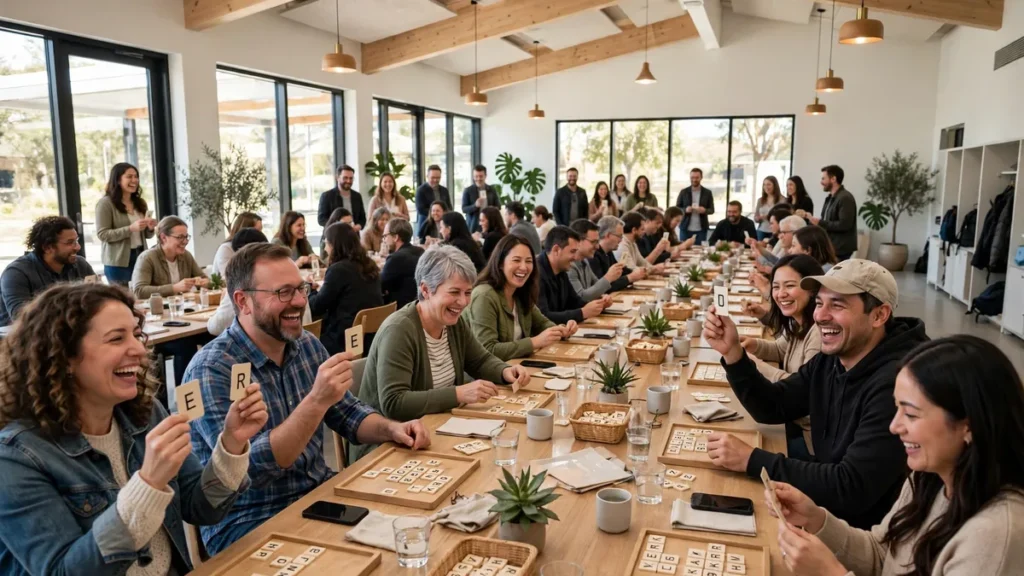
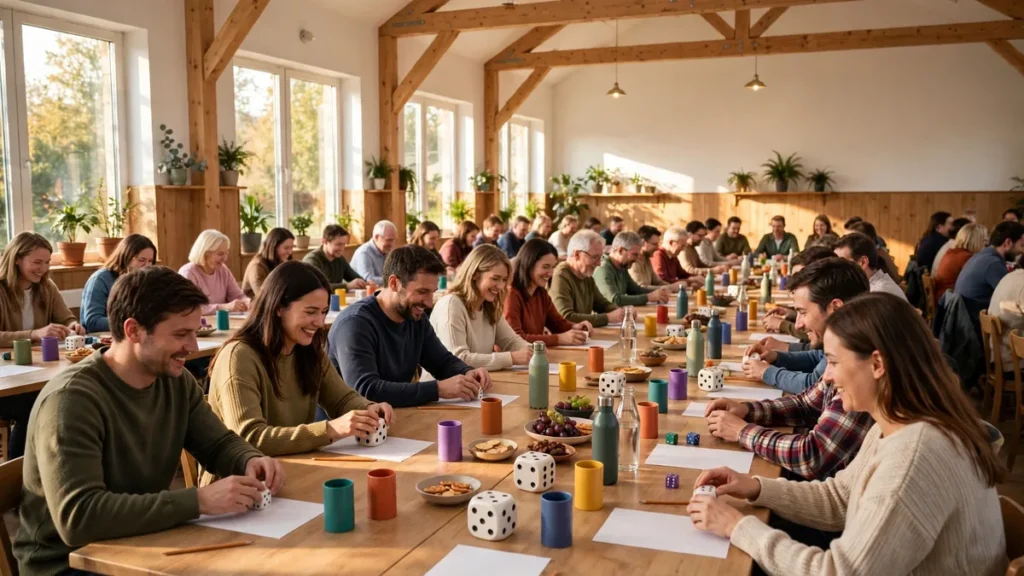
A group of 320 players sounds impossible for board games until you break it into smaller pieces. Forty tables of eight players, or fifty tables of six to seven players, is a very normal board game event. Each table becomes its own small game night, and the event as a whole becomes a festival of many small game nights happening side by side. That is the whole secret. You do not need one giant game. You need many good games, played well, at the same time.
Most organisers use one of three formats, and the best events often combine all three. In the first format, every table plays the same game at the same time, which works well for a tournament or a school event where fairness matters. In the second format, each table chooses from a menu of games, which suits a relaxed social evening where people want variety. In the third format, players move between tables in rounds, like a games fair, so everyone tries several different games during the night. All three formats work for 320 players, as long as the schedule is simple and the instructions are clear.
Teams are the other building block. When a game says it supports eight players, a team of four can share one set of pieces and make decisions together, which doubles the number of people who can play. Team play also helps shy players, younger players, and newcomers, because they can talk through a move with a teammate before they commit to it. It turns a quiet strategy game into a lively group discussion, and it means a table of eight can really hold sixteen people without anyone feeling left out. For a group this large, team play is not a compromise. It is one of the best tools you have.
What Makes a Game Work at This Scale
The best board games for 320 players share three qualities, and you can use them as a checklist when you are choosing titles. First, the rules must be simple to explain. If a host cannot teach the game in five minutes, it will eat into playing time at every table, and confused players will slow the whole event down. Look for games with one main action per turn, clear scoring, and very few exceptions. A short how-to-play card on each table helps even more, because players can check the rules without waiting for a host.
Second, the game must be easy to see and handle. Small cards with tiny text, fiddly pieces, and boards that only two people can read will not work across a table of eight, let alone in a hall of 320. Choose games with large cards, bold colours, chunky pieces, and boards that are easy to read from the far side of the table. If a game has small text, print a large reference sheet for each table. Good visibility keeps the game moving and stops players from asking the same question again and again.
Third, the game must suit a mixed crowd. A group of 320 people will include keen gamers, casual players, children, older guests, and people who have never played a modern board game before. The best programme includes something for each of them, and nothing that makes a newcomer feel lost or embarrassed. Party games and word games are friendly entry points, while strategy games give experienced players the depth they want. If you are looking for ideas at a similar scale, the guide to board games for 318 players shows how the same principles work for another very large group.
Best Board Games for 320 Players
The games below are grouped by the job they do at a large event. You do not need every title on the list. A strong programme for 320 players usually needs about twelve to fifteen different games, with several copies of the most popular ones, so that each table has a real choice. Start with the categories that suit your crowd, then add one or two games from the other categories for variety.
Team Party Games That Fill a Whole Table
Team party games are the backbone of any event for 320 players, because they are built for large groups and they create noise, laughter, and energy. Codenames is a natural first choice. Two teams compete to find their secret words on a grid, with one clue giver per team, and the whole table can join in the discussion. It plays well with eight players, works even better in teams, and a single copy can keep a table busy for several rounds. The pictures version, Codenames Pictures, is a good alternative for mixed-age groups or for players who prefer images to words.
Social Deduction Games for Big Groups
Social deduction games are made for large numbers, and they are some of the most memorable games you can run for 320 players. Ultimate Werewolf can handle very large groups in a single game, with villagers trying to find the hidden werewolves among them. A skilled host with a microphone can run a game for thirty, forty, or even more players at once, which makes it ideal as a headline event in the middle of the evening. It needs a confident host, a quiet room for the night phase, and players who enjoy bluffing and debate, but when it works, it is the game people talk about for weeks.
Simultaneous Table Games and Tournaments
Some of the best games for 320 players are not party games at all. They are classic board games played as a tournament, with many tables running the same game at the same time. Ticket to Ride is a perfect tournament game. It teaches in five minutes, plays in about forty-five minutes, and the board is large, colourful, and easy to read. With ten copies and ten tables, forty to fifty players can play at once, and winners can move on to a final table at the end of the night. The same approach works for Catan, Carcassonne, Azul, and Splendor, all of which are easy to learn, satisfying to play, and fair to score.
Creative Drawing and Guessing Games
Drawing and guessing games are ideal for 320 players, because they need almost no setup, they work across ages, and they create the kind of laughter that fills a hall. Dixit is a gentle, beautiful choice. Players choose a picture card that matches a clue, everyone votes on which card they think is the clue giver’s, and points are scored for clever clues and smart guesses. It plays with three to six players per copy, but it works well in teams, and the artwork alone is worth showing off. It is a calm, thoughtful game, so it suits a quiet corner away from the noisiest tables.
Mega Games and Whole-Room Events
If your venue and budget allow it, a mega game such as a large-scale Diplomacy or a custom team challenge can be a real highlight. These games involve negotiation, alliances, and long-term planning, and they are designed for dozens of players at once. They need experienced hosts, clear rules, and several hours, so they suit a full-day event more than a two-hour evening. For most organisers, a Werewolf headline game and a final awards round will give the same sense of togetherness with far less risk. The party game ideas in the guide to party games for 318 players are a useful starting point if you want more whole-room options for a crowd this size.
Best Board Games for 320 Players Compared
| Game | Players per copy | Playing time | Best for | Difficulty to teach |
|---|---|---|---|---|
| Codenames | 4 to 8 | 15 to 30 minutes | Team word play | Very easy |
| Ultimate Werewolf | 10 to 40 | 30 to 45 minutes | Whole-room headline game | Easy with a good host |
| Ticket to Ride | 2 to 5 | 30 to 60 minutes | Relaxed tournament play | Very easy |
| Azul | 2 to 4 | 30 to 45 minutes | Quick strategy tables | Very easy |
| Wavelength | 2 to 12 | 20 to 40 minutes | Team discussion | Very easy |
| Telestrations | 4 to 12 | 20 to 30 minutes | Drawing and laughter | Very easy |
| Two Rooms and a Boom | 6 to 30 | 15 to 30 minutes | Active large-group play | Moderate |
| Just One | 3 to 7 | 20 minutes | Cooperative word play | Very easy |
| Catan | 3 to 4 | 60 to 90 minutes | Strategy zone | Easy |
| Wits and Wagers | 3 to 7 | 25 minutes | Trivia and betting | Very easy |
Use the table as a starting point, not a strict ranking. A game that is perfect for a school group may be too quiet for a company social, and a game that works brilliantly in a hall with a microphone may fall flat in a noisy community centre. For more ideas on scaling a games night up or down, the guide to board games for 276 players shows how a slightly smaller event uses the same mix of tables, teams, and rounds. Think about your players first, then match the games to them. If in doubt, choose the simpler game.
Planning Checklist for 320 Players
Use this checklist when you are planning your event, and work through it in order. Most problems at large game nights come from small details that were missed in advance, such as a missing set of dice, a table without a host, or a schedule that nobody can follow. A little preparation will save you a lot of stress on the night.
- Confirm the venue, the date, and the final player count, and check that the hall has enough tables, chairs, lighting, and power for 320 players.
- Choose twelve to fifteen games, buy or borrow several copies of the most popular titles, and test each game with your hosts before the event.
- Recruit one host per table, give each host the game they will run, and make sure they have played it at least once.
- Print a programme, table signs, score sheets, and how-to-play cards, and prepare a simple scoring system that every table can follow.
- Pack spares, including dice, pencils, timers, score sheets, extra cards, and a first aid kit for damaged games, and set up a welcome desk with a clear sign.
- Plan the schedule in rounds with breaks, arrange the room so quiet and noisy games are apart, and finish with a short final round or awards moment for everyone.
Common Mistakes to Avoid
The most common mistake is choosing games that are too long or too complicated. A two-hour strategy game may be a favourite at home, but it will not work when 320 people need to finish at the same time. Save long games for a dedicated zone, and keep the main programme short and fast. The second mistake is having too few hosts. A table without a host will spend the first fifteen minutes reading rules, arguing about setup, and waiting for help, while the rest of the room is already playing. One confident host per table is worth more than ten extra games.
The final mistake is running out of time for the ending. Many events plan the games carefully and then forget the finish, so the night fizzles out with tables packing up at different times. Plan a clear ending, whether it is a final round, a Werewolf headline game, a quiz, or a short awards ceremony. Bring everyone together, thank the hosts and the players, announce the winners, and give people a reason to remember the night. A strong ending turns a good games night into a great one, and it makes people want to come back next time.
Frequently Asked Questions
Can one board game really seat 320 players?
No single standard board game seats 320 players at one table. The best approach is to run many tables at the same time, with teams, rounds, and a shared scoreboard linking them together. A few games, such as Ultimate Werewolf and Two Rooms and a Boom, can handle very large groups in one game with a skilled host, but most of the evening will be many smaller games played side by side.
How many tables do I need for 320 players?
It depends on the size of your tables, but a useful starting point is forty tables of eight players, or fifty tables of six to seven players. Round tables usually seat six to eight people, while long tables seat eight to ten. Leave wide aisles between tables, keep a few spare tables for late arrivals, and put the welcome desk near the entrance so players can find their first game quickly.
How many copies of each game should I buy?
Buy or borrow several copies of the most popular games, and one copy of the less popular ones. For a programme of twelve to fifteen titles across forty tables, you will need roughly thirty to forty copies in total, with a few spares. Party games such as Codenames, Wavelength, and Telestrations are worth having in multiple copies, because they fill tables quickly and suit a wide range of players.
What is the best game for a mixed-age group of 320?
Codenames, Just One, Telestrations, and Ticket to Ride are all strong choices for a mixed-age group, because they are easy to learn, they work in teams, and they do not need specialist knowledge. Avoid games with mature themes, complex rules, or very small text for a family event. Team play helps a lot, because children can play alongside adults and learn from their teammates.
How long should a board game event for 320 players last?
Three to four hours works well for most events, including a welcome, three or four game rounds, breaks, and a short final round or awards moment. Shorter events of two hours can work if you keep the games very quick and the schedule tight. Longer events of five hours or more suit a full-day festival, but you will need more games, more breaks, and a separate quiet area where players can rest.
Do I need a host for every table?
Yes, if you can arrange it. One host per table makes the biggest difference to how smoothly the night runs, because the host teaches the rules, keeps the game moving, and welcomes new players. Hosts do not need to be experts. They need to have played the game once, to know the basic rules, and to be friendly and organised. If you cannot find forty hosts, train a smaller team of roaming hosts who each look after three or four nearby tables.
The Bottom Line
The best board games for 320 players are the ones that scale, teach fast, and keep everyone involved. Build your event around many tables, team play, and short rounds, choose a mix of party games, social deduction games, and quick strategy games, and give every table a host, a clear sign, and a simple score sheet. Do that, and 320 players will not feel like a crowd. They will feel like a room full of game nights, all happening at once, and all worth coming back for.