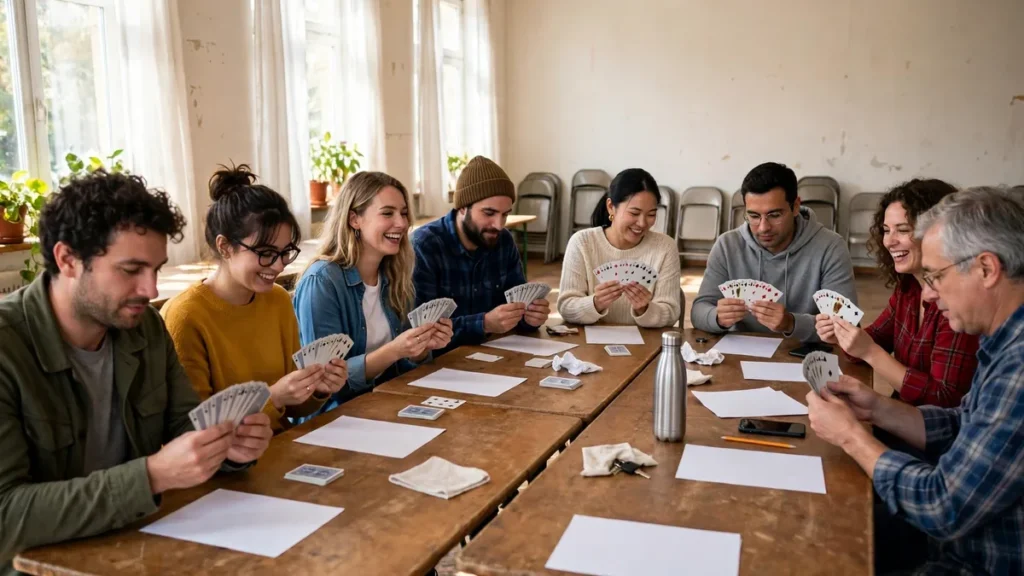
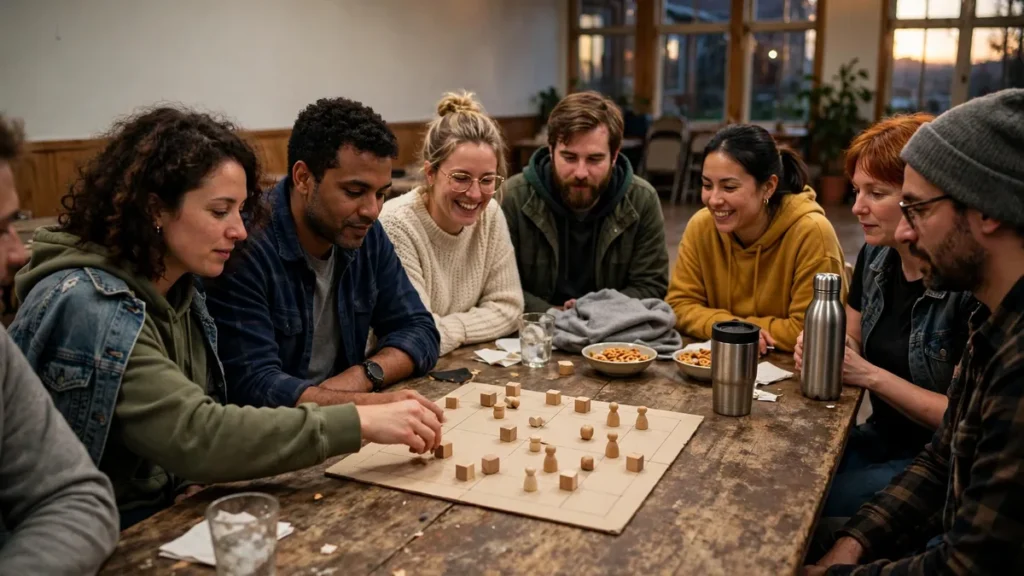
Five hundred and forty-seven people, nine rounds, one long evening of questions. That is the shape of this quiz: every person in the room plays, every round has ten questions, and every answer sheet counts toward a single shared tally. The night works because the format stays simple — a host reads, teams talk, pens move, and the tally grows one question at a time.
The nine rounds below mix animals, fast water, sweet pastry and dance, so no single kind of knowledge carries the night. Geckos open the evening, kiwi birds follow, and the last round turns to belly dancers. Between them sit crows, dingoes, Tasmanian devils, rapids, strudels and baklavas — nine very different kinds of famous, each with ten questions that reward close looking rather than quick recall. If you want a shorter warm-up first, the trivia games for 544 players build their rounds around lynxes, servals and capuchins, which makes a lively contrast with the animals here.
Everything here is built for a very large room. Groups of six to eight work best, which gives about seventy to ninety groups across the hall, and the host keeps the pace with a microphone and a large screen. Read the checklist near the end before the night begins, print the answer sheets in advance, and keep one relief host ready in case the main host loses their voice.
Key takeaways
- Nine rounds, ten questions each — 90 questions in about two hours.
- Groups of six to eight keep every person talking; larger groups leave people unheard at the edges.
- One sample question sits inside each round below, with its answer beside it.
- A single tie-break question settles a tied top, so bring three extras.
- Print the answer sheets early, test the sound, and brief two hosts.

How the Night Runs
The host reads each question twice, slowly, then gives teams about thirty seconds to agree on an answer. Answers go on the sheet in pen, one line per question, and the sheet moves to another group for scoring after each round. That swap keeps the scoring honest and gives everyone a short pause between rounds.
Keep the rounds in order. The animal rounds open the night while energy is high, the rapids round lands in the middle as a change of pace, and the two pastry rounds give the room something warm to think about before the closing dance round. The order matters more than the difficulty: a room that laughs early stays with you to the last question.
The host needs two helpers at minimum: one to collect sheets and one to work the sound and the screen. With 547 people in the room, a single host cannot do both jobs and keep the questions moving. Brief both helpers before the doors open, walk the room once to check that the back rows can hear, and agree on hand signs for “louder”, “slower” and “one more time”.
The Nine Rounds at a Glance
| Round | Famous | Questions | Minutes |
|---|---|---|---|
| Round 1 | Famous Geckos | 10 | 12 |
| Round 2 | Famous Kiwis | 10 | 12 |
| Round 3 | Famous Crows | 10 | 12 |
| Round 4 | Famous Dingoes | 10 | 12 |
| Round 5 | Famous Tasmanian Devils | 10 | 12 |
| Round 6 | Famous Rapids | 10 | 12 |
| Round 7 | Famous Strudels | 10 | 12 |
| Round 8 | Famous Baklavas | 10 | 12 |
| Round 9 | Famous Belly Dancers | 10 | 12 |
The Nine Rounds
Each round below has ten questions. The notes give the host the facts behind the questions, and one sample question shows the tone. Keep the sample questions in the running order — they are written to be read aloud exactly as printed.
Round 1: Famous Geckos
The gecko round opens with the animal most people have seen only in pictures. Geckos climb smooth walls on toe pads lined with tiny hairs, they lick their own eyeballs to keep them clean, and many can drop their tails and grow a new one. The tokay gecko of Southeast Asia calls its own name through the night, a loud two-note sound that carries across a whole neighbourhood. The crested gecko of New Caledonia sleeps through the day and hunts at night, while the giant day gecko of Madagascar glows green in daylight and laps nectar from plants.
Sample question: What do geckos use to climb smooth walls and ceilings? Answer: tiny hair-like pads on their toes.
Host tip: read the gecko facts slowly — most teams will know the tail fact and miss the eyeball one.
Round 2: Famous Kiwis
The kiwi bird gives this round its gentle charm. Kiwis cannot fly, they hunt at night by smell, and their nostrils sit at the tip of a long curved beak — a feature no other bird shares. A kiwi egg can weigh about one fifth of the mother’s body weight, which makes it one of the largest eggs, relative to body size, of any bird. The bird is the national symbol of New Zealand, and the name has become a warm nickname for the people of New Zealand too.
Sample question: A kiwi egg can weigh about one fifth of the mother’s body weight — true or false? Answer: true.
Host tip: ask the egg question last in the round — it always gets the room talking.
Round 3: Famous Crows
The cleverest round of the night belongs to the crow. New Caledonian crows shape found objects into curved probes to pull grubs from bark, and they remember the faces of people who have fed them — and of people who have not. Carrion crows in Japan drop hard food at road crossings and wait for passing cars to crack it open, then collect the pieces when the traffic stops. American crows gather in huge roosts when the cold arrives, and their calls carry a surprising range of meanings.
Sample question: Crows can recognise individual human faces — true or false? Answer: true.
Host tip: the Japan story works best read slowly, with a pause before the punchline.
Round 4: Famous Dingoes
The wild dogs of Australia sound nothing like the dogs most teams know. A dingo howls instead of barking, it hunts alone or in small family groups, and its sandy coat blends into dry grass and red earth. Dingoes can live in the hottest, driest parts of Australia, where they hunt small mammals and travel long distances for water. Early settlers feared them, and the animals have stayed wild despite centuries of contact with people.
Sample question: What does a dingo mostly do instead of barking? Answer: howl.
Host tip: play the howl question early in the round — teams love a sound question.
Round 5: Famous Tasmanian Devils
The Tasmanian devil is a small marsupial with the strongest bite, relative to body size, of any land mammal. Devils hunt at night, they argue over food with loud screams, and their black coats carry white patches on the chest and rump. The animals now live wild only in the Australian state of Tasmania, where a facial tumour disease has cut their numbers sharply. Conservation teams raise devils in protected places and release them back into the wild, and the numbers are slowly recovering. The devil round pairs well with the animal rounds in the trivia games for 545 players, where larks, wrens and jays fill the bird rounds.
Sample question: Wild Tasmanian devils now live only in which Australian state? Answer: Tasmania.
Host tip: warn teams before the scream fact — the sound is wilder than most people expect.
Round 6: Famous Rapids
This round moves through the grades from gentle to wild. Grade one water is smooth and easy, grade three brings waves that can fill a small open vessel, and grade six is so dangerous that only the most skilled paddlers attempt it — and many do not. The Zambezi in southern Africa carries some of the most famous white water anywhere, and the Colorado through the American southwest has rapids with names that paddlers remember for years. The grading scale was written so that paddlers in different places could agree on what “hard” means.
Sample question: White-water rapids are graded on a scale that runs from one to what top number? Answer: six.
Host tip: read the grade numbers slowly — teams often mix up grade three and grade six.
Round 7: Famous Strudels
Strudel is a pastry of paper-thin dough, and this round follows it from old Vienna across Europe. The dough is stretched by hand until it is thin enough to read through, then brushed with melted butter, rolled around a filling, and baked until crisp. The best-known strudels come from Austria, Germany and Hungary, where they have been sold for centuries. Poppy seed strudel is a favourite in the east, and the pastry travelled with the baking of the old Ottoman kitchens across Europe.
Sample question: Strudel dough is stretched until it is thin enough to read through — true or false? Answer: true.
Host tip: hold a sheet of paper in one hand when you read this round — the thin-dough fact lands better with something to show.
Round 8: Famous Baklavas
Baklava is built from many thin layers of pastry, each brushed with melted butter, with chopped pistachios and almonds between the layers and a sweet glaze to finish. The pastry comes from the old Ottoman kitchens, and it spread across the eastern Mediterranean and the Middle East, where every region claims its own version. Greek baklava and Turkish baklava differ in the filling, the glaze and the cut, and the arguments about which version is correct have run for generations.
Sample question: Baklava is built from many thin layers of pastry brushed with melted butter — true or false? Answer: true.
Host tip: this round runs best just after the strudel round, while pastry is still on everyone’s mind.
Round 9: Famous Belly Dancers
Belly dancing closes the night, and this round looks at the dancers who made it famous. Raqs sharqi, the dance of the east, is built on hip movements, shimmies and flowing shawls, and it has been performed in Egypt for generations. Samia Gamal brought the dance to the screen in the middle of the last century, Tahia Carioca made it the heart of Egyptian shows, and Naima Akef danced it into the homes of a whole generation. The round asks about the dancers and the costumes, and it rewards teams who know the names behind the art.
Sample question: In Egypt, belly dancing is traditionally known as raqs sharqi — true or false? Answer: true.
Host tip: save this round for last — the names are hard, and a hard last round keeps the tally close.
How 547 Players Fit Into One Day
Five hundred and forty-seven is an awkward number, and the honest way to handle it is to plan for groups of six and seven. Seventy-three groups of seven hold 511 people, and six groups of six hold the remaining 36, which gives 79 groups across the hall. Groups of six or seven keep every person in the conversation; larger groups leave people unheard at the edges, and smaller groups run out of ideas too fast.
The day runs in three blocks: the first three rounds before a short pause, the middle three rounds, and the last three rounds with scoring at the end. Each round takes about twelve minutes — two minutes to read, eight to answer and score, and two to move on — which puts the nine rounds at just under two hours with pauses. For a smaller room, the trivia games for 543 players run the same shape with gibbons, aerialists and dugongs in the rounds.
Arrive early, walk the room, and sit in the back row to check the sound. Put the answer sheets on every table before the doors open, keep the tie-break questions folded in the host’s pocket, and have a second host ready to step in. A large night fails on small details, and most of those details can be fixed in the hour before the first question.
Scoring, Ties and Fair Play
One point per correct answer keeps the scoring simple, and the tally after nine rounds runs to a maximum of 90. Teams score another group’s sheets after each round, and the host reads the correct answers aloud while the room follows along. Disputed answers go to the host, whose word is final, and the host should decide quickly so the night keeps moving.
Ties at the top are settled with a single extra question, read to the tied groups only, and the first correct answer takes the night. Bring three tie-break questions, because two tied groups can tie again. Cheating is handled the same way in every large quiz: the host watches the room, helpers walk between the tables, and any group caught looking at another group’s sheet loses the round.
Checklist for the Night
- Book a hall with room for 79 groups and a clear view of the host from every table.
- Print nine answer sheets per group, plus extras, and a tally sheet for each helper.
- Test the microphone, the speakers and the screen the day before, not on the night.
- Brief two hosts and at least four helpers, and walk the room together before the doors open.
- Prepare three tie-break questions and keep them folded in the host’s pocket.
- Bring extra pens, drinking water for the hosts, and a small first-aid kit.
Frequently Asked Questions
How long does the full set of nine games take?
About two hours. Each round takes around twelve minutes, which puts the nine rounds at 108 minutes, and two short pauses bring the evening to about two hours from the first question to the last score.
How many teams should 547 players form?
Seventy-nine groups work best: seventy-three groups of seven and six groups of six. Groups of six or seven keep every person talking, while larger groups leave some people unheard at the edges.
Do we need special equipment for a crowd this size?
A microphone, speakers, a large screen and printed answer sheets are enough. Add a second microphone for the helpers, and test everything the day before the night.
How do we stop teams from cheating?
Swap the sheets between groups for scoring, walk the room during the rounds, and keep the tie-break questions out of sight until they are needed. A clear rule, read aloud at the start, does most of the work.
What happens if teams tie at the top?
The tied groups answer one extra question, and the first correct answer takes the night. Bring three tie-break questions in case the first one ties again.
Can children play in a 547-player trivia night?
Yes, with a parent or guardian beside them. The questions are written for adults, so younger players do best in mixed-age groups where an adult can explain the harder questions.
The Bottom Line
Nine rounds, ninety questions, and one room full of people who all get to play. The geckos open the night, the belly dancers close it, and everything in between rewards curiosity more than memorised facts. Print the sheets, brief the hosts, and let the questions do the work.