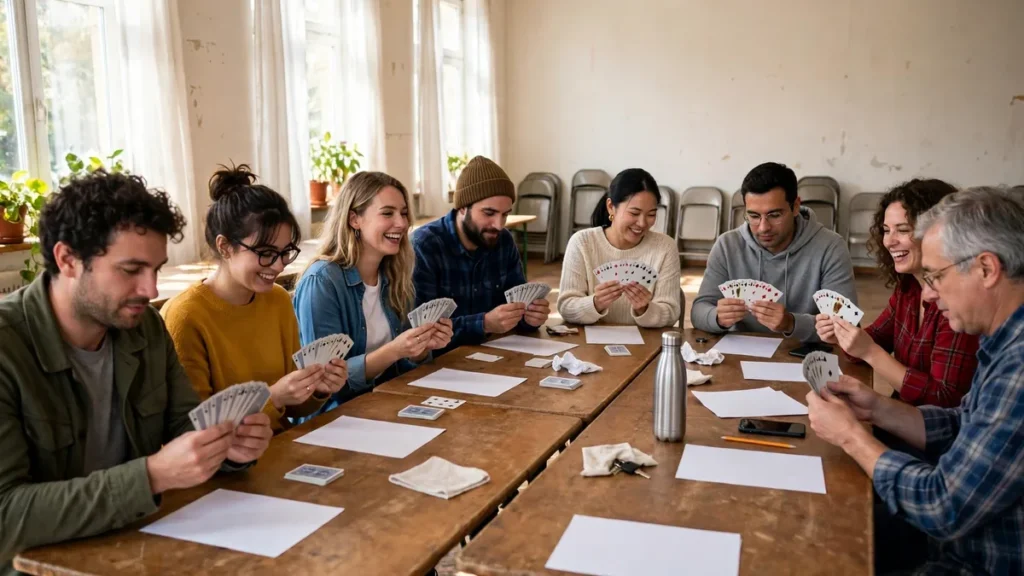
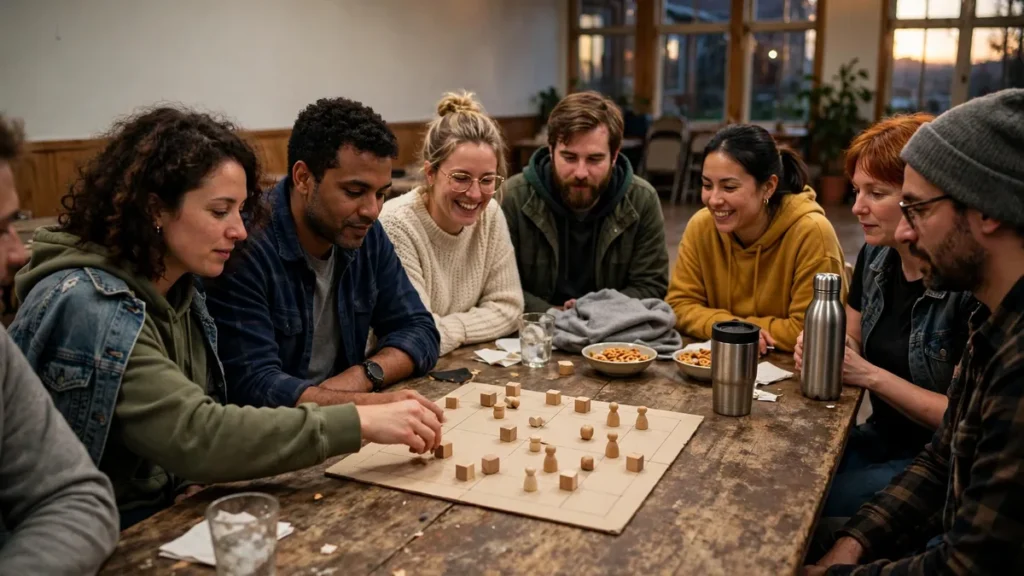
A trivia night for 546 players is a different kind of evening from a small pub quiz. The room holds 91 teams of six, the host speaks to a crowd that fills every table, and the marking alone needs a plan before the opening question. When the shape is right, though, a crowd this size brings an energy that a small room cannot match: every round lands with a low hum, every close score gets a gasp from a dozen tables at once, and the final tally feels like an event rather than a game.
The nine rounds below mix wildlife, food, voices and old buildings, so every team finds a round that suits it. Famous Quails opens the night with small ground birds, Famous Ocelots and Famous Civets follow with spotted night prowlers, and Famous Bandicoots and Famous Lyrebirds keep the wildlife run going. Famous Muffins and Famous Focaccias bring the food rounds, Famous Altos turns to low female voices, and Famous Gatehouses closes with arched entrances from grand old estates.
This article gives you all nine rounds, the evening order, and a short checklist that keeps a 546-player night on time. Each round carries one sample question, so you can feel the level before you write your own ten. If you want to see how a tight topic holds nine rounds together, our trivia games for 545 players show the same shape with one fewer player, and the lessons there transfer straight to a crowd of 546.
Key takeaways
- 546 players means 91 teams of six, one host, and a small group of marking helpers.
- Nine rounds of ten questions each fill about two and a half hours with pauses.
- Mix wildlife, food, voices and old buildings so every team finds a strong round.
- Keep answers short, single-word where you can, so marking stays fast.
- Have extra answer sheets ready and check the sound before the opening question.

Why 546 players changes the shape of a trivia night
With 546 players, the host cannot move from table to table, and no single person can mark every sheet. The night needs zones: a host at the front, helpers at the back with the extra sheets, and a marking table where two people work through each round while the next one plays. The questions stay the same shape as a small quiz, but the machinery around them, the sound, the sheets, the scores, has to grow with the crowd.
Big numbers also change the scoring. A gap of one point can separate twenty teams, so a clear tie-break matters more than it does with eight teams in a room. The table below gives an evening order that leaves room for marking and for two pauses, and the checklist near the end covers the small jobs that are easy to forget when 546 people are ready for the opening question.
The nine rounds
Each round has ten questions and one sample below. The samples show the level: specific enough to reward real knowledge, open enough that a good team can reason its way to most answers. Keep the answers short, and say each question twice, slowly, before moving on.
Round 1: Famous Quails
Quails are small ground birds that spend most of their lives on foot, scratching in low cover for food. The California quail wears a neat topknot that bobs as it walks, the bobwhite is named for its clear whistled call, and the common quail is one of the few members of its group that migrates long distances. A covey can hold a dozen birds or more, and the group stays close together, flushing in a sudden burst when startled.
Quail eggs are small and speckled, and the Japanese quail produces so reliably that it is kept in many countries for eggs alone. In the wild, quails rely on stillness and camouflage rather than pace, holding still while danger moves on. That mix of modesty and toughness makes them a good opening round: familiar enough for every team, specific enough to split the scores.
Sample question: What is a group of quails called? Answer: a covey.
Round 2: Famous Ocelots
The ocelot is a spotted wild carnivore of the Americas, ranging from the southern United States down through Central America to Argentina. An adult weighs between 8 and 16 kilograms, feeds mostly at night, and spends the day resting in dense cover. Its markings carry chains of dark spots and blotches that break up its outline in dappled light, and no two animals share quite the same arrangement of spots.
Ocelots were once killed in large numbers for their skins, and numbers fell sharply before legal protection and protected areas gave them room to recover. Today the species is listed as a species of least concern across most of its range, though the small population in Texas remains fragile and closely watched. The name comes from the Aztec word tlalocelotl.
Sample question: In which part of the world do ocelots live in the wild? Answer: the Americas, from the southern United States to Argentina.
Round 3: Famous Bandicoots
Bandicoots are small ground-dwelling marsupials from Australia and New Guinea, with long noses, pointed ears and a habit of digging neat conical holes as they look for food. The long-nosed bandicoot lives along the eastern side of the country, the eastern barred bandicoot is one of the rarest, and the southern brown bandicoot keeps to dense scrub where it can vanish in a moment. Their hind feet are long and strong, built for short bursts of pace rather than long chases.
Bandicoots are nocturnal, and a single animal can dig dozens of small holes in one night while looking for grubs and roots. Their pouches face backwards, which keeps dirt out while they dig, a neat piece of anatomy that always surprises new players. Habitat loss has hit several species hard, and the eastern barred bandicoot now survives mainly through captive care and release programs.
Sample question: What do bandicoots use their long noses for? Answer: digging for grubs and roots in the soil.
Round 4: Famous Lyrebirds
The superb lyrebird is one of the great mimics of the natural world, able to copy the calls of other birds, chainsaws, and mechanical sounds with uncanny accuracy. The male carries a tail of long, curved feathers that spread into the shape of a lyre when he displays, and he clears a small patch of earth to perform on. Albert’s lyrebird, the quieter cousin, lives in the rainforests of south-east Queensland and north-east New South Wales.
Lyrebirds feed on the ground, scratching through leaf litter for insects and worms. They are shy, and a player is more likely to hear one than to see one, which makes them a strong round for teams that notice sounds. The mimicry can include sounds the bird heard once and kept, so a single lyrebird can carry a whole collection of borrowed sounds in its head.
Sample question: What does a male superb lyrebird spread its tail feathers into the shape of? Answer: a lyre.
Round 5: Famous Civets
Civets are small nocturnal carnivores of Africa and Asia, with spotted markings, long tails and a taste for figs and small animals. The Asian civet lives high above the ground and moves with a slow, sure grip, while the African civet keeps to the ground and claims its range with a strong-smelling scent.
Civets are famous for the scent glands near their tails, whose strong musk was once prized in fine scents. Today the animals are better known as quiet night feeders high above the ground, and as a reminder that a small carnivore can be just as striking as a large one.
Sample question: Civets are most active at which time of day? Answer: at night.

Round 6: Famous Muffins
The muffin is a small baked treat made in a cup-shaped tray, and the best-known kind is the blueberry muffin, studded with blueberries and crowned with a crisp top. The English muffin is a different thing altogether: a flat, yeasted round, torn open and toasted, with the nooks and crannies that hold melted butter.
Muffins divide opinion: some love the soft centre, others prize the crisp top, and everyone argues over how much sweetness belongs in the mix. A good muffin rises high, domes a little on top, and stays moist inside, three things a team can argue about for hours.
Sample question: What is the best-known kind of muffin in the United States? Answer: the blueberry muffin.
Round 7: Famous Focaccias
Focaccia is a flat baked dough from Liguria, in north-west Italy, with a soft centre, a crisp base and dimples pressed into the top by hand. The Genoese version is the best known: thin, golden and brushed with oil, eaten warm on its own or alongside a meal. The name comes from a Latin word for the place where a home fire burned, a nod to the days when the dough was baked in the heat of a home fire.
Focaccia divides opinion almost as much as the muffin: some want it thin and crisp, others want it thick and soft, and everyone has a view on how much oil belongs on top. In Genoa, the classic version is eaten at any hour, torn into pieces and shared straight from the tray. A focaccia round works well late in the night, when teams want something familiar after five rounds of wildlife.
Sample question: From which region of Italy does focaccia come? Answer: Liguria.
Round 8: Famous Altos
The alto is the lowest female voice in a vocal ensemble, warm, dark and rich in the lower notes, and it often carries the inner lines that hold a piece together. Marian Anderson is the most famous alto of all: her 1939 open-air concert in Washington drew a crowd of 75,000 after she was refused a venue there. Kathleen Ferrier, a much-loved English alto, recorded performances that still move listeners today. Clara Butt was the leading alto of her day, famed for a voice that could fill the largest rooms without effort.
Altos often sing the parts that other voices cannot reach down to, and a good alto can make a simple line sound deep and full. In a quiz, the round rewards teams that know their vocalists rather than their arrangers. Janet Baker, another celebrated alto, spent a long career performing and recording, and her name still opens doors for young low voices.
Sample question: Which voice is the lowest female voice in a vocal ensemble? Answer: the alto.
Round 9: Famous Gatehouses
A gatehouse is the guarded entrance to a grand old estate, a building that is both a doorway and a stronghold, with thick stonework, narrow openings and heavy wooden doors. The gatehouse at Hampton Court is one of the best known, a red-brick Tudor entrance that still greets visitors today. Layer Marney gatehouse in Essex is another: a tall Tudor gatehouse with eight turrets, built to impress as much as to protect.
Gatehouses were built to control who came in and who stayed out, with a portcullis that could close in seconds and rooms above for the people who kept an eye on the road. Oxburgh gatehouse in Norfolk is a fine late example, all red brick and tall gables, while Stokesay gatehouse stands before a manor that has changed little in centuries.
Sample question: What could be lowered to close a gatehouse entrance in seconds? Answer: a portcullis.
How the evening runs
The table below shows one way to hold nine rounds and 546 players in about two and a half hours. Times are a suggestion, not a rule: if a round runs long, shorten the pause after it rather than rushing the questions. For another nine-round shape to compare, see our trivia games for 543 players.
| Segment | Minutes | What happens |
|---|---|---|
| Arrival and team lists | 10 | Teams find their tables and collect their answer sheets. |
| Rounds 1 to 3 | 30 | Three rounds, ten questions each, with a short pause for marking between rounds. |
| Pause | 10 | Helpers collect sheets, mark them, and hand back the scores. |
| Rounds 4 to 6 | 30 | Three more rounds, same shape, same pace. |
| Pause | 10 | A second pause for marking and for teams to stand and talk. |
| Rounds 7 to 9 | 30 | The last three rounds, then sheets are handed in for marking. |
| Marking and tie-break | 15 | Helpers mark the last rounds and decide any tie at the top. |
| Results and prizes | 10 | The host announces the top three scores and hands over the prizes. |
Teams, scoring and helpers
Teams of six work best at this size: small enough that everyone can join in, large enough that a team can fill the gaps in each other’s knowledge. Ninety-one teams of six make 546, and it is worth giving every table a name so helpers can find a team fast.
Scoring stays simple: one point per right answer, no half points, and the tie-break is a single extra question, closest answer wins. Helpers mark in pairs, one saying the answers aloud while the other writes the scores, and they change roles each round so no one person holds the whole night. If you want a smaller night first, our trivia games for 544 players run the same nine-round shape with two fewer players.
Checklist for the night
- Give every table a name and put 91 team lists on the doors.
- Have extra answer sheets ready and check the sound before the opening question.
- Check the loudspeaker and the handheld mic before anyone arrives.
- Brief your helpers on marking, timing and tie-breaks.
- Keep handsets switched off and out of sight during the rounds.
- Announce the top three scores, then hand over the prizes.
Frequently asked questions
How long does the full set of nine games take?
About two and a half hours, including two pauses and marking time. Ten questions per round, nine rounds, and the table above keeps the night moving. Without the pauses, you can finish in about two hours, but the marking helpers will thank you for the breathing room.
How many teams should 546 players form?
Ninety-one teams of six. Six is the sweet spot: every voice gets heard, and no team needs more than one answer sheet per round. If you have a few extra players, let them join the smallest teams rather than starting a team of two.
Do we need special equipment for a crowd this size?
A loudspeaker, a handheld mic, and enough answer sheets are the whole list. A big screen helps if the room is long, but it is not required: the host can say each question twice, and the helpers can bring the scores to the front.
How do we stop teams from cheating?
Keep handsets switched off and out of sight, mark with the answer side down, and ask teams to hand their sheets to the next table for marking. A clear rule, stated at the start, does most of the work: one warning, then the team loses the round.
What happens if teams tie at the top?
Play one extra question, closest answer wins. If teams are still level, play a second one. Pick a question with a number for an answer, so the closest answer decides it without argument.
Can children play in a 546-player trivia night?
Yes, with a few easier questions mixed in and a team shape that lets younger players join in. Keep the night to two and a half hours at most, and put the food rounds early, when younger players are at their sharpest.
The bottom line
A trivia night for 546 players works when the shape is simple: 91 teams of six, nine rounds of ten questions, one host, and a small group of helpers who mark fast and keep the scores moving. The rounds above give every team a fair shot, from the quails to the gatehouses, and the table and checklist give you the evening order to hold it all together.
Start with the quails, finish with the gatehouses, and let the middle rounds do the talking. If the scores are close at the end, that is how you know the night worked: 546 players, nine rounds, and a room full of people who want to return and do it again.