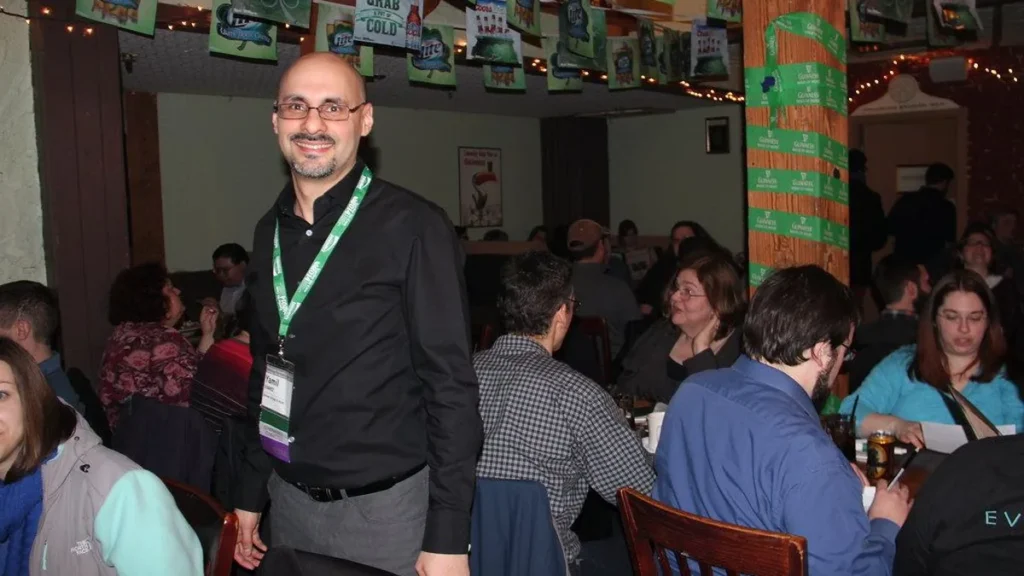
A trivia night for 519 players is a hall-scale event, and the best trivia games for 519 players are the ones that treat it that way. It is no longer a pub evening with a handful of tables. It is a full hall event, closer to a conference or a school assembly, where one host speaks to hundreds of people at once and every small delay is multiplied by the size of the crowd. The questions still matter most, but the room, the sound, the teams and the scoring matter almost as much.
A night this size works when the plan is simple and the pace is steady. Teams of six to eight players keep the hall manageable, nine rounds of ten questions keep the evening moving, and a clear scoring system keeps everyone honest about where they stand. The host reads a question, the teams write an answer, the papers move, and the scores go up on the board. With 519 players in the room, that simple loop has to run without a hitch, nine times in a row.
This guide sets out a complete plan for a 519-player trivia night: the room and the teams, nine fresh rounds built around admirals, snooker players, statues and other wide-ranging topics, a scoring system that handles ties without arguments, and a running order from the first welcome to the final results.
Key takeaways
- Split 519 players into teams of six to eight, giving you roughly 65 to 87 teams to manage.
- Run nine rounds of ten questions, with a mix of spoken, picture and music rounds to keep the energy up.
- Use a simple points system with a wager in the final round so the lead can still change at the end.
- Appoint table captains and runners so answer sheets move quickly between teams and the scoring desk.
- Keep the whole night under three hours, including breaks, so the crowd stays sharp to the last question.

The Nine Rounds at a Glance
| Round | Topic | Format | Questions |
|---|---|---|---|
| 1 | Famous Admirals | Spoken | 10 |
| 2 | Famous Snooker Players | Picture | 10 |
| 3 | Famous Darts Players | Spoken | 10 |
| 4 | Famous Statues | Picture | 10 |
| 5 | Famous Hourglass Makers | Written | 10 |
| 6 | Famous Morris Dancers | Music | 10 |
| 7 | Famous Rugby Players | Spoken | 10 |
| 8 | Famous Restaurants | Picture | 10 |
| 9 | Famous Obelisks | Wager | 10 |
How a 519-Player Trivia Night Works
A trivia night for 519 players is a logistics exercise before it is a contest. The host cannot walk between tables the way a host at a small evening can, and the scoring team cannot read out every result. Everything has to be set up so that information flows in one direction, from the stage to the teams, and answers flow back in an orderly way.
Seating matters just as much as sound. Arrange tables in rows facing the stage, with enough space between them for runners to pass without squeezing past chairs. Count every table and print the count on a small card so teams can find their seats quickly. When 519 people arrive at once, a clear seating plan saves twenty minutes of confusion at the door.
The host is the single most important person in the room. One confident host with a clear voice beats two hosts talking over each other, and a host who keeps to the schedule beats a lively host who lets rounds drift. Give the host a printed running order with timings, a backup set of questions in case of a printing error, and a direct line to the scoring desk. A similar scale of planning goes into the guide to trivia games for 517 players, which shows how a hall of this size stays organised from the first question to the last.
Sound and screens decide whether the back rows can play at all. Test the microphones and the speakers from the farthest table before anyone arrives, and put the question slides on a screen that every seat can see. Keep the slides plain: the question in large type, the round title at the top, and nothing else.
The Nine Rounds
The nine rounds below cover the sea, the stage, the sports field and the city square. The topics are broad enough that every team will know some answers, and specific enough that knowledge and guesswork both play a part. Mix spoken, picture and music rounds so that different strengths get their moment, and keep every round to ten questions so the scoring stays simple.
Round 1: Famous Admirals
Lord Nelson commanded the British fleet at Trafalgar in 1805 from HMS Victory, where he was killed in the hour of victory. Yi Sun-sin of Korea won the Battle of Myeongnyang in 1597 with thirteen ships against a fleet of more than a hundred, a feat still studied in naval colleges today. Chester Nimitz commanded the United States Pacific Fleet at Midway in 1942, the turning point of the Pacific war.
Heihachiro Togo destroyed the Russian Baltic Fleet at Tsushima in 1905, Michiel de Ruyter sailed up the Medway in 1667 and towed the English flagship home, and Francis Drake played his part in the defeat of the Spanish Armada in 1588. John Paul Jones fought the Serapis from the sinking Bonhomme Richard in 1779, while Zheng He led treasure voyages from China across the Indian Ocean between 1405 and 1433. Ask which admiral, which ship, which battle and which sea.
Round 2: Famous Snooker Players
Joe Davis won the first fifteen world titles between 1927 and 1946, a run nobody has come close to matching, and the World Championship has been played at the Crucible Theatre in Sheffield since 1977. A maximum break of 147 remains the perfect frame, and only a handful of players have made one on the biggest stage.
Stephen Hendry won seven world titles in the 1990s, and Ronnie O’Sullivan matched that tally with his seventh title in 2022. Steve Davis won six titles in the 1980s, Ray Reardon won six in the 1970s, Mark Selby has won four, John Higgins has won four, and Mark Williams has won three, including his 2018 title at forty-three. Judd Trump won in 2019 and Neil Robertson in 2010, the first Australian world champion of the modern era. Ask which player, how many titles, which year and which venue.
Round 3: Famous Darts Players
Phil Taylor won sixteen world titles and dominated the game for two decades, while Eric Bristow won five titles in the 1980s and John Lowe won three, throwing the first televised nine-dart finish in 1984. Raymond van Barneveld won five world titles, four in the BDO and one in the PDC after his switch in 2006.
Michael van Gerwen won three world titles in 2014, 2017 and 2019, Gary Anderson won back-to-back titles in 2015 and 2016, Peter Wright won in 2020 and 2022, Luke Humphries won in 2024, and Luke Littler won in 2025 at seventeen, the youngest world champion the sport has ever had. Three treble twenties make 180, the oche stands 2.37 metres from the board, and the PDC World Championship has been played at Alexandra Palace since 2008. Ask which player, which year, which score and which venue.
Round 4: Famous Statues
The Statue of Liberty has stood in New York Harbour since 1886, a present from France designed by Frédéric Auguste Bartholdi, rising 93 metres from the ground to the torch. Christ the Redeemer has looked over Rio de Janeiro since 1931, standing 38 metres tall including its pedestal. Michelangelo carved David in Florence between 1501 and 1504 from a single block of marble, a figure 5.17 metres tall.
The Little Mermaid has sat on the rocks of Copenhagen harbour since 1913, sculpted by Edvard Eriksen, while Auguste Rodin’s Thinker, cast in 1904, shows a seated figure bent over in thought. The Moai of Easter Island count nearly nine hundred statues, the Great Sphinx of Giza has guarded the pyramids for more than four thousand years, and the Leshan Giant Buddha in China, carved between 713 and 803, stands 71 metres tall. Ask which city, which sculptor, which year and how tall.
Round 5: Famous Hourglass Makers
A ship’s glass ran for thirty minutes, and each time it ran out the ship’s bell was struck, so that eight glasses made one four-hour watch. Without a reliable glass, a ship could not hold its course or keep its watch system, and the maker’s skill was a matter of safety as much as timekeeping.
The finest hourglasses came from the glassmakers of Murano, the island workshops of Venice, where the bulbs were blown thin and even so that the sand ran at a steady rate. The sand was ground marble dust or powdered eggshell, sieved fine and dried so that it flowed without clogging. One of the earliest pictures of an hourglass appears in Ambrogio Lorenzetti’s fresco Allegory of Good Government, painted in Siena in 1338. Ask which city made the finest glasses, how long a ship’s glass ran, what the sand was made of and which fresco shows one.

Round 6: Famous Morris Dancers
A side has six dancers and a musician, with a fool to keep the crowd laughing, and the dancers wear bells on their shins so that every step rings out. The great Cotswold traditions come from villages such as Headington Quarry, Adderbury, Brackley and Lichfield, each with its own steps, tunes and kit.
Cecil Sharp saw the Headington Quarry dancers on Boxing Day 1899 and wrote down their dances, a meeting that started the folk revival and saved the tradition from dying out. The Morris Ring was founded in 1934, and dancers still perform at dawn on May Day. Well-known dances include Bonny Green Garters and Bean Setting from Headington, and Laudnum Bunches from Adderbury. Ask which village, which collector, which year and which props.
Round 7: Famous Rugby Players
Jonah Lomu of New Zealand scored four tries against England in the 1995 World Cup semi-final, a performance that changed the game. Jonny Wilkinson of England kicked the drop goal that won the 2003 World Cup final against Australia, in the last minute of extra time. Richie McCaw won 148 caps for New Zealand and lifted the World Cup twice as captain, in 2011 and 2015.
Dan Carter scored 1,598 test points, the most in test history. Brian O’Driscoll won 133 caps for Ireland and eight more for the British and Irish Lions. Gareth Edwards was the scrum-half of the great Wales side of the 1970s, Serge Blanco was the flying full-back of France in the 1980s, David Campese scored 64 test tries for Australia, and Bryan Habana scored 67 test tries for South Africa and won the 2007 World Cup.
Teams that enjoy this round often do well in the trivia games for 516 players too, where the rounds run on the same mix of spoken, picture and music formats. Ask which player, which country, which year and how many tries, and the round rewards teams who follow the sport.
Round 8: Famous Restaurants
Noma in Copenhagen, run by René Redzepi, topped the World’s 50 Best list five times, in 2010, 2011, 2012, 2014 and 2021, with a menu built on Nordic ingredients and foraging. El Bulli in Spain, run by Ferran Adrià, closed in 2011 at the height of its fame and became a foundation for food research.
Osteria Francescana in Modena, run by Massimo Bottura, topped the list in 2016 and 2018, while The Fat Duck in Bray, run by Heston Blumenthal, became known for snail porridge and dishes that play with sound and scent. Sukiyabashi Jiro in Tokyo, run by Jiro Ono, seats ten people at a counter and was the subject of the 2011 film Jiro Dreams of Sushi. Le Bernardin in New York, run by Éric Ripert, holds three Michelin stars, Central in Lima topped the list in 2023, and Mirazur in Menton topped it in 2019. Ask which city, which chef, which year and how many stars.
Round 9: Famous Obelisks
The Luxor Obelisk stands in the Place de la Concorde in Paris, 23 metres tall, brought from Egypt and raised in 1836. Cleopatra’s Needles stand in London and New York, both shipped from Alexandria in the nineteenth century, each about 21 metres tall and weighing around 224 tonnes. The Washington Monument stands 169 metres tall and was completed in 1884.
The Lateran Obelisk in Rome stands 32.18 metres tall and is the tallest standing ancient Egyptian obelisk in the world, while the Vatican Obelisk in St Peter’s Square was moved to its present site in 1586 by Domenico Fontana, under Pope Sixtus V. The Obelisk of Theodosius stands in the old Hippodrome in Istanbul, and the Axum Obelisk was taken back to Ethiopia in 2005 after decades in Rome. Ask which city, which ruler, which year and how tall, and the final round gives every team one more chance to move up the board, with the wager still to play for.
Checklist for the Night
Before the doors open, run through this list. The guide to trivia games for 515 players uses a similar list, and it works just as well at this size.
- Book a hall that seats 519 people with room for runners to pass between the tables.
- Print one answer sheet per team for each round, plus spares for mistakes and late arrivals.
- Test the sound system and the screen from the back row before the first team arrives.
- Brief the table captains and the runners on the running order and the scoring rules.
- Prepare a tie-break set of five extra questions for a tie at the top of the board.
- Set out the prizes and a clear running order for the host, with break times marked.
Frequently Asked Questions
How long does a trivia night for 519 players take?
Plan for about two and a half hours, including two breaks. Nine rounds of ten questions take around ninety minutes of playing time, with a short break after round three and a longer break after round six. Allow fifteen minutes at the start for seating and fifteen at the end for the final scores and prizes. Keep the host to the timings on the running order.
How many teams should 519 players form?
Teams of six to eight players work best, which gives you roughly 65 to 87 teams. Teams of six keep everyone involved in every question, while teams of eight suit groups of friends who arrive together. Avoid teams of more than eight, as the quieter players stop contributing and the louder ones take over. Split a group of nine or ten into two teams seated side by side.
Do we need special equipment for a crowd this size?
You need a proper sound system with at least two speakers and two microphones, one for the host and one spare, plus a screen large enough for the back rows to read. Answer sheets, pens and a scoring spreadsheet cover the rest. Buzzers are not needed, though one buzzer round works well if you have a set. Test everything from the farthest table before the doors open.
How do we stop teams from cheating?
Keep the rules simple and state them at the start: no phones, no searching, and no shouting answers across the room. Table captains watch their own tables, and runners collect the sheets at the end of each round so answers cannot be changed later. Use a wager in the final round so that a team that has fallen behind can still win. Most teams play fair when the rules are clear and the host enforces them evenly.
What happens if teams tie at the top?
Play a tie-break round of five extra questions, read one at a time, with the first wrong answer knocking a team out. If two teams are still level after five questions, read sudden-death questions until one team answers wrong. Keep the tie-break questions short and factual, so the result turns on knowledge and not on guesswork. Announce the tie-break rules before the final round.
Can younger players take part in a 519-player trivia night?
Yes, and they often do well on the picture and music rounds. Seat younger players with adults they know. The rounds in this guide cover sport, food, statues and the sea, so a teenager with a good general knowledge can contribute from the first round. Offer a small prize for the best-placed team with younger players.
The Bottom Line
A trivia night for 519 players succeeds on planning, not on luck. Split the hall into teams of six to eight, run nine rounds of ten questions with a mix of spoken, picture and music formats, and keep the scoring simple enough that every team can follow it. The rounds in this guide give every team a chance to shine, from admirals and obelisks to darts players and restaurants.
Book the hall, print the sheets, test the sound, and let the host keep the pace. Do that, and 519 players will leave talking about the questions they got right, the ones they nearly had, and the night they will want to repeat.