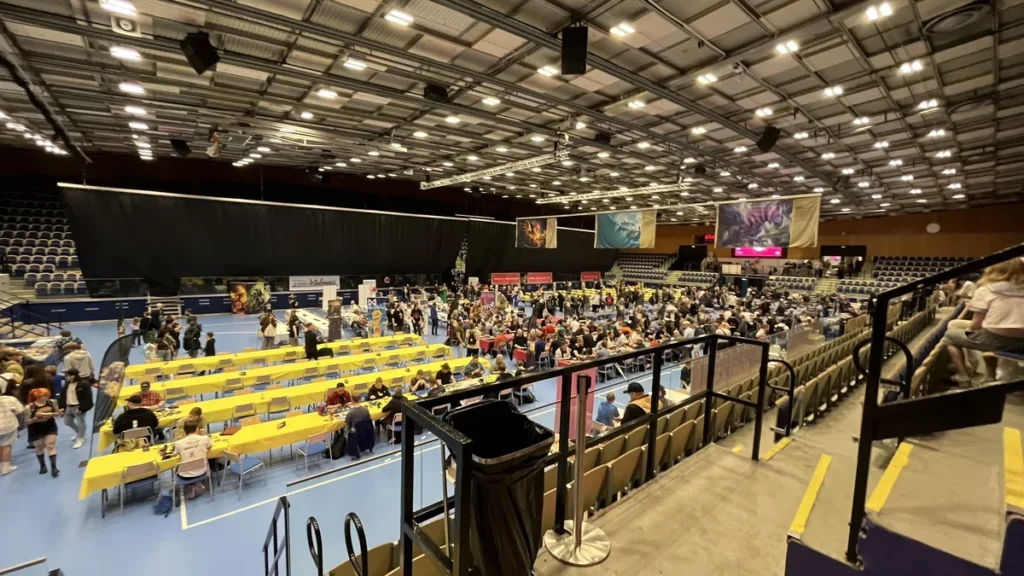
Four hundred and twenty-one players. One room, or one very long video call, and a single buzzer system standing between order and chaos. That is the scale of trivia we are tackling today, and it is a very different game from the cosy pub quiz most of us know. When the crowd is this large, every choice matters more: the questions have to land for the film buff in row three and the sports fan in row forty, the scoring has to be instant, and the host has to keep the energy up for two hours without losing the room.
This guide gives you a complete, ready-to-run trivia night for 421 players. It uses a buzzer format, so teams lock in their answers fast and the night keeps moving. There are nine rounds, each built around a famous-people theme, from actresses and screenwriters to mountaineers and marathon runners. Every round comes with sample questions and answers you can use as they are, or swap for your own, and the whole structure is designed so that no single team can run away with the night in the first twenty minutes.
Whether you are running a school fundraiser, a company social, a community hall night, or a charity event, the plan below scales. You will find the setup, the round-by-round questions, a comparison table to help you pick your difficulty, a checklist to run on the night, and answers to the questions hosts ask most. Our 419-player trivia night proved the format works at this scale, and this edition builds on it with nine brand-new rounds.
Key Takeaways
- Buzzer rounds keep 421 players engaged, because every team answers at the same moment instead of waiting for paper sheets to be collected.
- Nine themed rounds cover film, television, and sport, so every team has at least one round where it can shine.
- Split the room into teams of four to seven players, and run heats if your buzzer system only handles a few teams at once.
- Mix easy, medium, and hard questions in every round, so the leaderboard stays close until the final round.
- Keep rounds short, score instantly, and read the running totals aloud after every third round to hold the room.

How a 421-Player Trivia Night Works
The first decision is the team size. With 421 players, teams of six work well, giving you about seventy teams, while teams of four give you just over one hundred. Smaller teams mean more teams to track, but they also mean every player gets to contribute. Teams of five or six are the sweet spot: big enough that nobody feels exposed, small enough that everyone gets a say. Ask teams to register in advance with a team name, and hand each team a number on arrival so the scoreboard stays simple.
The buzzer is what makes the night work at this scale. In a buzzer round, the host reads the question, and the first team to buzz in gets to answer. If they get it wrong, the question passes to the next fastest team. That single rule changes everything. It stops the long waits of paper-based quizzes, it rewards quick thinking as well as knowledge, and it gives the audience something to watch. If your buzzer system only supports eight or ten teams at a time, run heats: groups of teams play short qualifying rounds, and the best teams from each heat meet in the final.
Scoring should be simple and visible. Give one point for a correct buzzer answer, and take nothing away for a wrong one in the early rounds, so teams keep buzzing instead of freezing. In the later rounds, you can add a two-point bonus question to each round, or a double-points final round, so a team that has fallen behind still has a reason to fight. Put the scores on a big screen or a whiteboard where everyone can see them, and read the top five teams aloud after every third round. Nothing holds a big room like a close leaderboard.
Sound and timing matter more than most hosts expect. A room of 421 people generates a lot of noise, so the host needs a good microphone and a second person running the buzzer desk and the scoreboard. Keep each question to about thirty seconds from reading to answer, and keep each round to around ten minutes. That pace gives you a two-hour night with breaks, which is about as long as a crowd this size stays sharp. Plan a ten-minute break halfway through, and have music playing while people stretch their legs.
The 9 Rounds at a Glance
Here is the whole night on one table. Each round has a theme, a natural audience, and a difficulty level, plus a buzzer tip to help the host keep it moving. The mix is deliberate: film and television rounds sit next to sport rounds, so a team that is weak on movies can catch up on athletics, and a team that knows nothing about golf can still score on screenwriters.
| Round | Theme | Best For | Difficulty | Buzzer Tip |
|---|---|---|---|---|
| 1 | Famous Actresses | Film lovers | Medium | Ask for the film, not just the name |
| 2 | Famous Producers | Behind-the-scenes fans | Hard | Accept the studio as a near miss |
| 3 | Famous Screenwriters | Movie and TV buffs | Medium | Name the film to confirm the writer |
| 4 | Famous Tennis Players | Sports fans | Easy | Let the crowd shout the score |
| 5 | Famous Golfers | Quiet experts | Medium | Give a clue about the nickname |
| 6 | Famous Boxers | Fight fans | Easy | Keep it to champions and legends |
| 7 | Famous Swimmers | Olympics watchers | Medium | Count medals, not just golds |
| 8 | Famous Runners | Athletics fans | Easy | Ask for the distance as well |
| 9 | Famous Mountaineers | Adventure lovers | Hard | Save this for the finale |
The 9 Rounds
Each round below has three sample questions with answers. Use them exactly as written, or treat them as a template and write your own in the same style. The questions are ordered from the most gettable to the hardest, so a team that buzzes early on the first question can build confidence before the round gets tough.
Round 1: Famous Actresses
Open with the stars everyone knows. This round rewards film lovers, but the questions are chosen so that even a casual moviegoer can buzz in on at least one of them. Keep the pace quick and let the room enjoy the glamour.
Question 1: Which actress has received more Academy Award nominations than any other performer in history, with 21 nominations? Answer: Meryl Streep.
Question 2: Which actress won the Academy Award for Best Actress four times, more than any other performer, for films including Morning Glory and The Lion in Winter? Answer: Katharine Hepburn.
Question 3: Which British actress starred in Roman Holiday and Breakfast at Tiffany’s, and later became a goodwill ambassador for UNICEF? Answer: Audrey Hepburn.
Round 2: Famous Producers
This is the hardest film round, because producers work behind the camera and their names are less famous than the stars. That is exactly why it works: the teams that know their producers earn their points. Offer a small clue, such as the studio or the franchise, if the room goes quiet.
Question 1: Which producer has overseen the Marvel Cinematic Universe from Iron Man onwards, becoming one of the highest-grossing producers in film history? Answer: Kevin Feige.
Question 2: Which producer, known for Top Gun and Pirates of the Caribbean, is one of the most successful blockbuster producers of the last forty years? Answer: Jerry Bruckheimer.
Question 3: Which producer has led Lucasfilm since 2012 and produced films in the Star Wars sequel trilogy? Answer: Kathleen Kennedy.
Round 3: Famous Screenwriters
Screenwriters are the hidden authors of the movies we love. This round sits between the two film rounds and gives television fans a chance too, since many great screenwriters moved between film and TV. Ask for the film as well as the writer when a team buzzes in.
Question 1: Which screenwriter wrote The Social Network and created the television series The West Wing? Answer: Aaron Sorkin.
Question 2: Which screenwriter wrote When Harry Met Sally and Sleepless in Seattle, and later directed both films? Answer: Nora Ephron.
Question 3: Which screenwriter wrote Butch Cassidy and the Sundance Kid and The Princess Bride, two of the most quoted films ever made? Answer: William Goldman.
Round 4: Famous Tennis Players
Tennis is a crowd-pleaser, and this is one of the easiest rounds of the night. Grand Slam numbers are the key facts, and most sports fans will know them. Let the room react to the big numbers, and keep the questions moving fast.
Question 1: Which American player won 23 Grand Slam singles titles, the most of any player in the Open Era? Answer: Serena Williams.
Question 2: Which Serbian player has won 24 Grand Slam singles titles, the most of any man in tennis history? Answer: Novak Djokovic.
Question 3: Which Spanish player won 14 French Open titles at Roland Garros, earning the nickname the King of Clay? Answer: Rafael Nadal.

Round 5: Famous Golfers
Golf trivia suits the quiet experts in the room, the players who know the majors by heart. The nicknames are a good way in: if a team cannot name the golfer, ask them to name the nickname and work backwards. This round pairs well with the tennis round that came before it.
Question 1: Which golfer, nicknamed The King, won seven major championships and helped make golf a television sport? Answer: Arnold Palmer.
Question 2: Which golfer won 18 major championships, more than any other player in history? Answer: Jack Nicklaus.
Question 3: Which golfer won 15 major championships, including five Masters titles at Augusta? Answer: Tiger Woods.
Round 6: Famous Boxers
Boxing rounds are loud rounds. The names are legends, and even people who never watch boxing know them. Keep the questions to champions and household names, and the whole room will buzz in with confidence. If you want to slow the pace, ask for the weight division as a follow-up.
Question 1: Which boxer, born Cassius Clay, won the world heavyweight title three times and is widely called The Greatest? Answer: Muhammad Ali.
Question 2: Which boxer became the youngest heavyweight champion in history at the age of 20 in 1986? Answer: Mike Tyson.
Question 3: Which American boxer held the world heavyweight title for nearly twelve years and defended it 25 times, a record that still stands? Answer: Joe Louis.
Round 7: Famous Swimmers
Olympic swimming gives you numbers that everyone can grasp: gold medals, world records, and famous races. This round works best in the second half of the night, when the room is warmed up and ready for bigger numbers. Count all the medals when a team answers, not just the golds.
Question 1: Which American swimmer won 23 Olympic gold medals, more than any athlete in Olympic history? Answer: Michael Phelps.
Question 2: Which American swimmer won seven gold medals at the Munich Olympics in 1972, a record that stood for 36 years? Answer: Mark Spitz.
Question 3: Which American swimmer has won nine Olympic gold medals, the most of any female swimmer in history? Answer: Katie Ledecky.
Round 8: Famous Runners
Running is the simplest sport to quiz, because the numbers are so clean: seconds, minutes, and metres. This is another easy round, and it is a good one to place late in the night, when tired teams need questions they can actually answer. Ask for the distance as well as the name to keep the fast buzzers honest.
Question 1: Which Jamaican sprinter set the 100 metres world record of 9.58 seconds in Berlin in 2009? Answer: Usain Bolt.
Question 2: Which American athlete won four gold medals at the Berlin Olympics in 1936, in the 100 metres, 200 metres, long jump, and relay? Answer: Jesse Owens.
Question 3: Which Kenyan runner became the first person to run a marathon in under two hours, in Vienna in 2019? Answer: Eliud Kipchoge.
Round 9: Famous Mountaineers
Save the mountains for last. This is the hardest round of the night, and it makes a fine finale, because the stories are so dramatic that even teams that cannot answer will enjoy hearing them. Everest is the heart of the round, and the first ascent is the question every team should know. The 418-player edition ended on a tough final round too, and the room loved it.
Question 1: Which New Zealand mountaineer, together with Tenzing Norgay, made the first confirmed ascent of Mount Everest in 1953? Answer: Edmund Hillary.
Question 2: Which Japanese climber became the first woman to reach the summit of Mount Everest, in 1975? Answer: Junko Tabei.
Question 3: Which Italian mountaineer made the first solo ascent of Mount Everest without supplementary oxygen, in 1980? Answer: Reinhold Messner.
Your 421-Player Checklist
Run through this list the day before the event, and again an hour before the doors open. It covers the things that most often go wrong at very large trivia nights, and each one is quick to fix if you catch it early.
- Buzzers tested: Test every buzzer with real players, not just the crew, and keep two spares charged and ready.
- Teams registered: Confirm every team has a number, a name, and a table, and print the team list for the score desk.
- Sound checked: Walk to the back of the room while the host speaks, and make sure every word is clear.
- Scoreboard visible: Put the running scores where the whole room can see them, and update them after every round.
- Questions printed: Keep a printed copy of every question and answer at the host desk, in case the screen fails.
- Break planned: Schedule a ten-minute break after round five, with music on and drinks available.
Frequently Asked Questions
How long does a 421-player trivia night take?
Plan for about two hours of play, plus a ten-minute break in the middle. Nine rounds at roughly ten minutes each, with introductions and score updates, fits neatly into that window. If your heats run long, trim the easy rounds to two questions instead of three.
What if we do not have enough buzzers for every team?
Run heats. Divide the teams into groups, let each group play short qualifying rounds on the buzzers you have, and bring the best teams from each group into the final. The teams that do not reach the final can still play along on paper and compare scores at the end.
How do we stop one team from winning too early?
Mix the difficulties, and keep a double-points question for the final round. A team that leads after round six can still be caught in rounds seven, eight, and nine, especially when the last round is a hard one like mountaineers. Reading the scores aloud also keeps the chasing teams motivated.
Can children play in a 421-player trivia night?
Yes, and mixed-age teams often do well, because the rounds cover so many topics. The sports rounds suit younger players, while the film rounds suit the adults. If many children are playing, add a picture round or a music round as a bonus between the main rounds.
What prizes work best for a crowd this size?
Keep prizes simple and shareable: a trophy or medals for the winning team, and smaller prizes for the best team name and the highest-scoring round. Avoid one large cash prize, because it can make the night feel too serious for the teams at the back. Our 416-player game used team medals and a best-name prize, and both went down well.
Can we run this trivia night online instead?
Yes. Use a video call for the host and a quiz app or shared form for the buzzers, with teams answering in breakout rooms. The rounds work exactly the same, but allow extra time for answers, because online buzzers are slower than physical ones, and keep the teams smaller so everyone gets a turn to speak.
The Bottom Line
A trivia night for 421 players sounds like a logistical puzzle, but it is really a hosting challenge. Get the teams right, trust the buzzers, keep the scores visible, and let the questions do the work. Nine rounds, three questions each, and a room full of people who all know something the others do not: that is the whole recipe. Pick your date, print your checklist, and let the fastest buzzer win.