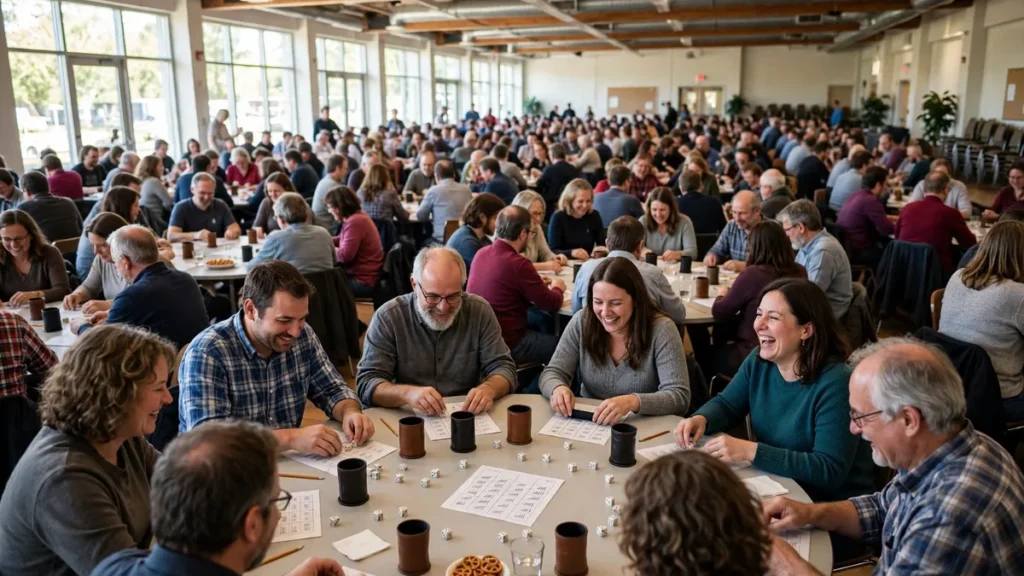
Finding the best trivia games for 307 players is a different challenge from planning a quiz for a dozen friends around a table. With more than three hundred people in the room, every decision matters more: the questions have to be readable from the back row, the scoring has to be simple enough to survive hundreds of answer sheets, and the pace has to keep every single team engaged from the first question to the final round. A format that works beautifully for twenty people can collapse under the weight of a crowd this size, so the games on this list were chosen specifically because they scale.
A group of 307 players usually means somewhere between thirty and fifty teams, depending on how you split them, and that scale changes the whole shape of the night. You need a host who can command a large room, a sound system that reaches every table, and rounds that reward teamwork rather than the fastest individual. The best formats for a crowd this big share a few traits: they use written answers instead of shouting, they give every team the same fair shot at each question, and they build in moments of drama that the whole room can enjoy together.
This guide covers ten formats that work for exactly this kind of event, from a classic pub quiz adapted for a hall full of teams to fast lightning rounds and a buzzer-style final that turns the last ten minutes into a show. Each game includes practical notes on team sizes, timing, and scoring, so you can mix and match rounds into a full evening that runs smoothly. Whether you are planning a company party, a school fundraiser, a community night, or a club social, these are the formats that keep 307 players laughing, thinking, and competing together.
Key takeaways
- Split 307 players into teams of six to ten for the best balance of discussion and speed.
- Use written answer sheets and a clear scoring system so hundreds of teams can be marked fairly.
- Mix question styles across rounds so every kind of knowledge gets a moment to shine.
- A host, a microphone, and a large screen are essential for a room this size.
- Finish with a buzzer or jackpot round so the whole hall shares one dramatic ending.

How to Run Trivia for 307 Players
Before choosing your games, get the structure right. Divide 307 players into teams of six to ten people, which gives you roughly thirty to fifty teams. Teams smaller than six feel thin in a huge room, while teams larger than ten let quieter players hide and slow down the discussion. Ask teams to pick a name and write it clearly at the top of every answer sheet, because you will be sorting dozens of sheets between rounds.
Appoint one host and at least two helpers. The host reads the questions and keeps the energy high, while the helpers collect answer sheets, mark them, and keep a running leaderboard. Marking is the bottleneck at this scale, so use simple scoring: one point per correct answer, with a bonus point for a perfect round. Avoid complicated partial credit, because it doubles the marking time and invites arguments. Display the questions on a large screen as well as reading them aloud, so nobody at the back misses a word.
Plan the evening in rounds of ten questions, with short breaks between rounds for marking and socialising. A full night of five or six rounds, plus a final, usually runs for about two hours. Keep the pace brisk: read each question twice, give teams thirty to sixty seconds to answer, and move on. Long pauses are the enemy of a big-room quiz, because attention drifts fast when three hundred people are waiting. If you have run a similar night for a slightly smaller crowd, the best trivia games for 304 players show how the same team-table layout works when the headcount is almost identical.
The 10 Best Trivia Games for 307 Players
These ten formats are proven crowd-pleasers for very large groups. Each one works with written answers and team play, so nobody needs to shout, nobody needs a buzzer at every table, and every team stays in the game until the end. Pick four or five for a full evening, or run all ten across a longer event.
| Game | Team size | Rounds | Best for |
|---|---|---|---|
| Classic Pub Quiz | 6 to 10 | 5 to 6 | A full evening event |
| Speed Round Lightning Trivia | 6 to 10 | 1 to 2 | Energy and pace |
| Picture Round | 6 to 10 | 1 | Visual thinkers |
| Music Round | 6 to 10 | 1 | Singing along together |
| True or False Stampede | 6 to 10 | 1 | Fast, fun warm-ups |
| Multiple Choice Showdown | 6 to 10 | 1 to 2 | Fair play for all |
| Themed Rounds | 6 to 10 | 1 to 2 | Passionate fans |
| Buzzer-Style Final | Top 3 teams | 1 | A dramatic finish |
| Trivia Bingo | 6 to 10 | 1 | Casual mixed crowds |
| Progressive Jackpot Round | 6 to 10 | 1 | High-stakes excitement |
1. Classic Pub Quiz, Team Style
The classic pub quiz is the backbone of any large trivia night, and it scales to 307 players better than almost any other format. Each team gets an answer sheet, the host reads ten questions per round, and teams write down their answers together. The questions should span general knowledge, geography, history, food, and sport, so that every team has a round where it feels strong. Keep the difficulty mixed inside each round rather than saving all the hard questions for the end, because a brutal final round can crush the mood.
For a crowd this size, run five or six rounds of ten questions with a short marking break after each one. Use a fresh answer sheet per round so that a lost sheet never wipes out a whole evening. Read the answers aloud after each round and let teams swap sheets with a neighbouring table for marking, which is faster than having two helpers mark fifty sheets alone. A clear, steady pub quiz gives the night its structure, and everything else you add is a variation on this dependable core.
2. Speed Round Lightning Trivia
Lightning trivia is the same idea at double speed: twenty quick questions, ten seconds each, no discussion time beyond a hurried whisper. It works brilliantly as a second or third round, when the room is warmed up and the energy needs a lift. Choose questions with short, definite answers, such as capitals, numbers, colours, and famous firsts, because long or ambiguous questions waste the ten-second window and frustrate teams.
3. Picture Round
A picture round gives the night a visual break and rewards a completely different kind of knowledge. Show ten images on the big screen, one at a time, and ask teams to identify each one. Famous landmarks, flags, movie stills, album covers, and close-up photos of everyday objects all work well. Print the images on the answer sheet as a backup, because the teams at the very back of a large hall will struggle to see fine detail on a screen.
4. Music Round
Few moments unite a room of three hundred people like a music round. Play ten short clips, each lasting about fifteen seconds, and ask teams to name the song, the artist, or both. Mix decades and genres so that younger and older players each get their moment, and include one or two famous intros that the whole room recognises within two notes. A good sound system matters more here than in any other round, so test the volume from the back tables before the night begins.
Music rounds create a wonderful atmosphere because people hum, sing along, and argue happily about the answer before writing it down. For a crowd nearly this size, the best trivia games for 305 players use the same team-table layout and the same style of music round, which shows how well the format transfers from one huge group to another. Award a point for the song and a bonus point for the artist if you want to stretch the scoring, but keep it simple enough to mark in under two minutes.
5. True or False Stampede
True or false rounds are the fastest format on this list and the easiest to mark, which makes them ideal for a crowd of 307. The host reads twenty statements, and each team simply writes T or F. Because the answers are one letter, marking fifty sheets takes minutes rather than a quarter of an hour. The simplicity is the point: it keeps the pace high and lets the host run the round as a warm-up or a breather between heavier rounds.
6. Multiple Choice Showdown
Multiple choice rounds are the fairest format for a mixed crowd, because every team can make an educated guess even when nobody knows the answer for certain. Offer four options per question, labelled A, B, C, and D, and display them clearly on the screen while the host reads the question aloud. Teams write a single letter per question, which makes marking almost instant and removes arguments about spelling or half-remembered answers.
7. Themed Rounds
Themed rounds let you tailor the night to the people in the room. A company party might enjoy a round on the industry, a school fundraiser might love a round on the local area, and a film club will adore a round on cinema. Pick one or two themes that suit your audience and build ten questions around each, mixing easy openers with a couple of genuinely hard ones for the experts. Themes give teams something to rally around and give the host a natural way to tell stories between questions.
8. Buzzer-Style Head-to-Head Final
After five or six written rounds, bring the top three teams to the front for a buzzer-style final that the whole room can watch. Give each team a buzzer or a raised hand, and ask questions one at a time, with the first team to buzz in getting the chance to answer. Award points for correct answers and take a point away for a wrong one, so teams must balance speed against certainty. The final usually lasts about fifteen minutes and turns the end of the night into a show.
This format only works for the final, because you cannot run buzzers for fifty teams at once, but that exclusivity is part of the excitement. The rest of the room becomes an audience, cheering for their favourite team and shouting answers that the finalists cannot hear. Choose questions that are dramatic and decisive, with clear single answers, and keep the host in control of the pace. A well-run buzzer final sends everyone home buzzing, even the teams that finished far down the table.
9. Trivia Bingo
Trivia bingo blends a quiz with a game of chance, and it is perfect for a casual crowd that includes people who do not think of themselves as quiz fans. Each team gets a bingo card filled with answers rather than numbers, and the host reads out questions whose answers appear on the cards. Teams mark off each answer they hold, and the first team to complete a line or a full house wins a prize. The format is gentle, social, and easy to explain in under a minute.
10. Progressive Jackpot Round
A progressive jackpot round adds high-stakes drama to the end of the written rounds. Each team starts with a set number of points, and each question lets them wager some of those points on their answer. A correct answer adds the wager, while a wrong answer loses it. Teams that are behind can gamble their way back into contention, while leaders must decide whether to play safe or risk their lead. The tension at every table is wonderful to watch.
Run the jackpot as a single round of ten questions, with the wager size capped so that no team can lose everything on one question. Announce the running totals after every few questions, because the leaderboard swings are the heart of the drama. This format rewards nerve as much as knowledge, and it gives every team a reason to stay engaged right to the final question. End the jackpot round with the overall winner announcement, and the night finishes on a genuine high.
Scoring, Prizes, and Keeping It Fair
Fair scoring is what separates a great trivia night from a frustrating one, especially with fifty teams in play. Publish the scoring rules before the first question, mark every round the same way, and show the leaderboard after each round so teams can see where they stand. If a question turns out to be ambiguous, accept every reasonable answer rather than arguing with the room, because a quick, generous ruling keeps the goodwill that a stubborn one destroys.
Prizes do not need to be expensive to be exciting. A trophy or a hamper for the winning team, a small prize for the best team name, and a booby prize for the team that finishes last will cover the night nicely. Many organisers also add a raffle or a spot prize for a random team, which gives the teams at the bottom of the table something to hope for. If your group enjoys tabletop games as well as quizzes, the best board games for 304 players make a natural companion event, since the same crowd size and team structure work for both. Announce the prizes early so teams know what they are playing for, and hand them out with a little ceremony at the end.
Trivia Night Checklist for 307 Players
Use this checklist in the week before your event so nothing is left to the last minute. Each item is small on its own, but together they are the difference between a smooth evening and a scramble.
- Book a hall with enough tables and chairs for fifty teams, plus space for the host and a stage.
- Test the microphone, speakers, and screen from the back row before the audience arrives.
- Print answer sheets, pens, and a leaderboard, with spares for every table.
- Prepare six rounds of ten questions, plus a buzzer final and a tie-breaker set.
- Recruit a host and two helpers for collecting and marking answer sheets.
- Buy prizes for the winners, the best team name, and one random spot prize.
Frequently Asked Questions
How many teams should 307 players form?
Teams of six to ten work best, which gives you roughly thirty to fifty teams. This size lets everyone contribute to the discussion without the team becoming so large that quieter players stop taking part. If your tables seat eight comfortably, aim for teams of eight and you will end up with about thirty-eight teams.
How long does trivia for 307 players take?
Plan for about two hours, including marking breaks. Five or six rounds of ten questions take roughly ninety minutes, and a buzzer final adds another fifteen. Add time at the start for seating and team names, and time at the end for prizes, and a two-and-a-half-hour evening is a comfortable total.
Do we need microphones and a screen?
Yes, both are essential for a room this size. A microphone lets the host be heard clearly at the back, and a screen lets teams read each question as well as hear it. Without them, the teams furthest from the stage will miss questions and lose interest quickly.
Can we play without an app?
Absolutely. Paper answer sheets are the most reliable option for a crowd of 307, because they need no Wi-Fi, no charging, and no troubleshooting. Apps can speed up marking, but they also introduce a single point of failure, so paper is the safer choice for a one-off event.
What prizes work for such a large group?
Keep prizes simple and shareable: a hamper, a trophy, or a gift voucher for the winning team, plus a small prize for the best team name and a fun booby prize for last place. A raffle ticket for every team also gives everyone something to look forward to, even if their quiz score is low.
How do we stop cheating?
Use a mix of question styles, keep the rounds moving quickly, and ask teams to put phones away during play. Most cheating at a large quiz is casual rather than organised, so a friendly announcement at the start and a fast pace are usually enough. For the final, bring the top teams to the front where everyone can see them.
The Bottom Line
The best trivia games for 307 players are the ones that respect the scale of the room: written answers, clear scoring, mixed rounds, and a dramatic finish that the whole hall can share. Start with a classic pub quiz as your backbone, add a lightning round and a music round for energy, and close with a buzzer final or a jackpot round that keeps every team in the running until the last question. Get the practical details right, from the sound system to the answer sheets, and a crowd of three hundred will feel like one big team enjoying the same night together.