
Finding the best puzzle games for 40 players is a very different challenge from picking a game for a family of four. With forty people in the room, a single jigsaw on one table leaves thirty-six people standing around with nothing to do, and a trivia round built for six teams falls apart when every answer is shouted at once. The games that work at this size are the ones built around teams, stations and shared goals, so that every player has a job from the first minute to the last.
A forty-player puzzle night is really a small event, and it works best when you treat it like one. Split the room into five to eight teams, give each team its own table and its own puzzle, and rotate the challenges so that nobody waits more than a few minutes between turns. The best formats mix quick brain teasers with longer builds, so fast thinkers and careful solvers both get moments to shine.
This guide covers the formats that genuinely scale to forty players, from giant jigsaw races and escape-room style challenges to word puzzles, logic hunts and picture rounds.
Key takeaways
- Split forty players into five to eight teams of five to eight people so everyone has a role and nobody waits around.
- Run puzzle stations instead of one big table, and rotate teams every fifteen to twenty minutes to keep energy high.
- Mix puzzle types: jigsaws, word puzzles, logic grids, picture rounds and code-breaking challenges suit different strengths.
- A forty-player night needs about two hours, one host, one scorekeeper and a clear set of printed rules at every table.
- Score teams on accuracy and teamwork, not just speed, so careful solvers stay in the race until the final round.
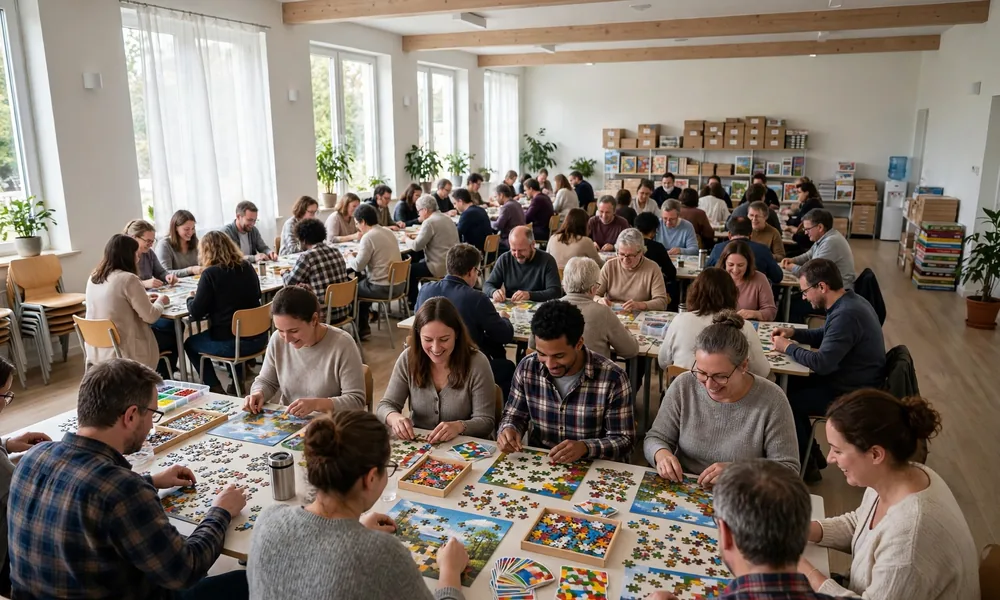
Why Puzzle Games Work So Well for 40 Players
Puzzle games suit large groups better than most party formats because they are naturally cooperative. A board game built for four players forces you to split forty people into ten separate games with ten separate winners, and the room fragments. A puzzle challenge, by contrast, gives every team the same task at the same time, so the whole room shares one story, one scoreboard and one finish line.
Puzzles also level the playing field in a way that trivia and speed games do not. A general knowledge quiz rewards the person who already knows the answers, and a physical relay rewards the fastest runner. A good puzzle, whether it is a jigsaw, a logic grid or a coded message, rewards patience, observation and teamwork. The quietest person at the table is often the one who spots the pattern everyone else missed.
There is a practical advantage too. Puzzle games need very little equipment: printed sheets, a few jigsaw boxes, some envelopes and a timer will carry an entire evening. If your group is one player short, the formats here still work, and our guide to the best puzzle games for 39 players covers nearly identical team sizes and setups.
How to Organise a Puzzle Night for 40 Players
A forty-player night fails when the host tries to run it like a small game night. The difference is structure. With forty people, you need teams, stations, a visible clock and a scoreboard that everyone can see. Get those four things right and the games almost run themselves.
Split Into Teams of Five to Eight
Five to eight teams is the sweet spot for forty players. Teams of five to eight are large enough to split tasks between members, but small enough that everyone can reach the puzzle and be heard. Smaller teams mean more teams to manage and more duplicate supplies to prepare. Larger teams mean some players drift to the edge of the table and stop contributing.
Mix the teams deliberately. Put a strong word person, a visual thinker and a methodical organiser on each team if you can. Avoid letting one team become the group of friends who always play together while another team is made up of strangers who have never met. A quick way to form teams is to hand out coloured wristbands or numbered cards as people arrive, which also doubles as an icebreaker.
Run Stations, Not One Big Table
Stations are the single best idea for a forty-player puzzle night. Set up five or six puzzle stations around the room, each with a different challenge, and rotate the teams every fifteen to twenty minutes. While one team works on a jigsaw, another decodes a message, a third solves a logic grid and a fourth tackles a picture round. Nobody waits, nobody watches, and the room stays noisy and busy.
Each station needs a printed instruction card, all the pieces or sheets the team will need, and a clear way to record the result, such as a score sheet or a sealed answer envelope. Keep the station rules short enough to read in thirty seconds. If a station needs explaining, it is too complicated for a rotation format.
Keep the Clock Visible
Time pressure is what turns a pleasant puzzle session into a game. Put a large timer on a screen or a whiteboard where every table can see it, and announce the halfway mark and the final two minutes at every station. Teams work faster and argue less when the deadline is public and the same for everyone.
Plan for about two hours in total. That allows a ten-minute welcome and team setup, four or five station rounds of fifteen minutes, a ten-minute break in the middle, and a fifteen-minute final challenge with the results and prizes. A night that runs much longer than two hours will lose people to tiredness, however good the puzzles are.
The Best Puzzle Games for 40 Players
The games below are ranked by how well they scale, how little setup they need and how much fun they create for a large room. Some are classics you can buy off the shelf, and others are formats you can build from printed sheets in an afternoon. All of them work with five to eight teams of five to eight players.
| Game | Players per team | Setup time | Best for |
|---|---|---|---|
| Giant jigsaw race | 5 to 8 | 10 minutes | Teamwork and patience |
| Escape room in a box | 5 to 8 | 15 minutes | Drama and problem solving |
| Code-breaking challenge | 5 to 8 | 20 minutes | Logic and pattern spotting |
| Word puzzle relay | 5 to 8 | 10 minutes | Fast, noisy energy |
| Picture puzzle round | 5 to 8 | 5 minutes | Visual thinkers |
| Logic grid tournament | 5 to 8 | 10 minutes | Careful, methodical teams |
| Scavenger puzzle hunt | 5 to 8 | 30 minutes | Big venues and movement |
| Trivia puzzle mashup | 5 to 8 | 15 minutes | Mixed-ability groups |
1. Giant Jigsaw Race
The giant jigsaw race is the simplest large-group puzzle and still one of the best. Give each team the same 500-piece or 1,000-piece jigsaw, start the timer, and the first team to finish wins. A 500-piece puzzle takes a team of six about forty-five minutes, which fits neatly into a single long round or two station rotations.
Choose puzzles with clear regions of colour and distinct areas, such as a landscape or a city scene, so teams can split the work by section. Avoid puzzles that are mostly one colour, like a plain sky or a dark forest, because they frustrate even strong teams.
2. Escape Room in a Box
Escape room board games and printable escape room kits are made for this format. Each team gets the same box or envelope set, the same starting clues and the same sixty-minute countdown. Teams must solve a chain of puzzles to unlock the next clue, and the first team to escape wins.
Commercial escape room games usually support four to six players, so a team of eight should split into two sub-groups working on different clue chains in parallel and comparing notes every ten minutes. Printable kits are often cheaper when you need five to eight identical sets, and many include a host guide with the answers and hints.
3. Code-Breaking Challenge
A code-breaking challenge gives each team a series of coded messages to decipher, from simple letter shifts to number grids and symbol substitutions. The first code is easy, the next is harder, and the final code reveals a phrase or a location that ends the round. Teams that solve the final code first take the points.
This format rewards teams that organise well. One member decodes, one checks the alphabet key, one writes down partial answers and one keeps an eye on the clock. It costs almost nothing to prepare, since the codes can be printed on ordinary paper, and it scales perfectly because every team works from identical sheets.
4. Word Puzzle Relay
In a word puzzle relay, each team sends one player at a time to the front of the room to solve a word puzzle, such as an anagram, a word ladder or a crossword clue, before tagging the next player. The relay format adds movement and noise, which is exactly what a large room needs after a quiet jigsaw round.
Prepare about forty puzzles per team, one for each player, and grade them so the early ones are quick and the later ones are harder. A relay round takes about twenty minutes and works well as the opening game, because it gets everyone on their feet and laughing before the longer challenges begin.
5. Picture Puzzle Round
Picture rounds ask teams to identify close-up images, spot the difference between two photos, or work out what a cropped picture shows. They are quick to run, need only a screen or printed sheets, and suit players who think visually rather than in words or numbers.
Use ten to twelve pictures per round and give teams two minutes per picture. Mix easy pictures with genuinely tricky ones, and include a few local or personal photos if the group knows each other, such as a close-up of a familiar building or a pet. Picture rounds also make a good tiebreaker, because a single image can separate two teams that are level on points.
6. Logic Grid Tournament
Logic grids, the puzzles where you work out who owns which house or who arrived in which order from a set of clues, are ideal for careful teams. Hand each team the same grid and the same clues, and award points for each correct row as well as for the finished grid. Partial credit keeps slower teams in the contest.
Choose grids rated medium rather than hard, and give teams about twenty minutes. A grid that is too easy ends in a tie, and a grid that is too hard ends with every team stuck halfway. Print the grids large enough to share across a table, and provide pencils rather than pens so teams can correct mistakes.
7. Scavenger Puzzle Hunt
A scavenger puzzle hunt sends teams around a venue solving a clue to find the next location, where the next puzzle waits. It works best in a large hall, a garden, a community centre or a school building, where there is room for teams to move without colliding. Each stop has a puzzle, and each solved puzzle gives a word or a number for the final code.
Plan six to eight stops and allow about forty minutes for the hunt. This is the most energetic format on the list, so schedule it after a break rather than at the start of the night.
8. Trivia Puzzle Mashup
A trivia puzzle mashup blends quiz questions with puzzle mechanics. Teams answer a question to earn a puzzle piece, solve the puzzle to unlock the next question, and race to complete the chain. It suits mixed-ability groups because a team can contribute through knowledge, wordplay or logic, and nobody is useless for the whole round.
Write the questions for your own group rather than copying a generic quiz. Questions about the players themselves, the workplace, the town or the occasion always get a bigger reaction than questions about distant history. If you want to extend the evening with more traditional formats, the best board games for 40 players pair well with a puzzle mashup as a second half.
Team Puzzle Challenges That Scale to Forty Players
Beyond the eight games above, a few challenge formats are worth knowing because they fill gaps in a long evening. A tower-building challenge, where teams build the tallest free-standing structure from spaghetti and tape, is not a puzzle in the strict sense, but it rewards the same planning and testing skills and gives restless players something physical to do.
A murder mystery puzzle, where each team receives the same set of witness statements, timetables and clues and must name the culprit, works beautifully for forty players because discussion is the whole game. The format favours teams that listen to each other rather than the loudest voice in the room.
A puzzle relay, where each team must complete five short puzzles in sequence and cannot start the next one until the previous answer is checked, adds tension and keeps the scoreboard moving. Short puzzles might include a sudoku, a word search, a maze, a riddle and a number sequence. The relay format is easy to score, since the host simply records the time each team finishes.
Checklist for Hosting a 40-Player Puzzle Night
Use this checklist in the week before your event so nothing is left to the last minute.
- Confirm the venue, the start time and the number of players, and prepare one extra team pack in case two more people turn up.
- Print every puzzle, answer sheet and instruction card in advance, and pack each station into its own labelled box or envelope.
- Set up the tables, the scoreboard and the timer before the first player arrives, and test the screen, the speakers and the lighting.
- Brief one host and one scorekeeper, and give each station a volunteer if you have enough helpers.
- Bring spare pencils, scissors, tape and blank paper, because every puzzle night loses at least one pen per table.
- Prepare the prizes and the final scores in advance, and keep a simple tiebreaker ready, such as a single picture puzzle or a quick riddle.
For a looser, higher-energy second half, it also helps to borrow ideas from party formats. The best party games for 39 players include several quick crowd games that work as warm-ups and closers for a puzzle night of this size.
Frequently Asked Questions
How long does a puzzle night for 40 players take?
Plan for about two hours. That covers a ten-minute welcome, four or five station rounds of fifteen minutes, a short break, and a final challenge with the results. You can stretch it to two and a half hours if you add a scavenger hunt, but avoid going much longer, because concentration fades and the last round suffers.
What is the best team size for 40 players?
Teams of five to eight work best, which means five to eight teams in total. Teams smaller than five struggle with big jigsaws and multi-part puzzles, while teams larger than eight leave some players with nothing to do.
Do puzzle games for 40 players cost a lot to organise?
No, they are among the cheapest large-group activities. Printed puzzles cost very little, and the only real expense is buying five to eight identical jigsaws or escape room kits. A full evening for forty players can be run for the price of a few board games, especially if you print your own code-breaking and logic grid rounds.
Can children and adults play together in a 40-player puzzle night?
Yes, if you choose the right mix. Jigsaws, picture rounds and scavenger hunts suit mixed ages well, because they do not depend on general knowledge. Avoid logic grids and code-breaking rounds for very young children, and consider mixed-age teams so that every team has both adult organisers and young spotters.
What prizes work best for a 40-player puzzle night?
Small team prizes work better than one big prize. A box of chocolates, a puzzle book or a small trophy for each member of the winning team is enough, and a fun prize for the best team name or the best comeback keeps the lower teams engaged.
How do you stop one team from dominating every round?
Mix the puzzle types and score on more than speed. Give points for accuracy, for completed sections and for teamwork, and include at least one visual round and one word round so different strengths matter. Rotating the stations also helps, because a team that is strong at jigsaws may be weak at code-breaking, and the scoreboard stays close.
The Bottom Line
The best puzzle games for 40 players are the ones that give every person a job, every team a fair chance and every round a clear finish. Split the room into teams of five to eight, run stations instead of one big table, mix jigsaws, codes, word puzzles and picture rounds, and keep the clock where everyone can see it. Do that, and forty players will leave asking when the next puzzle night is.


