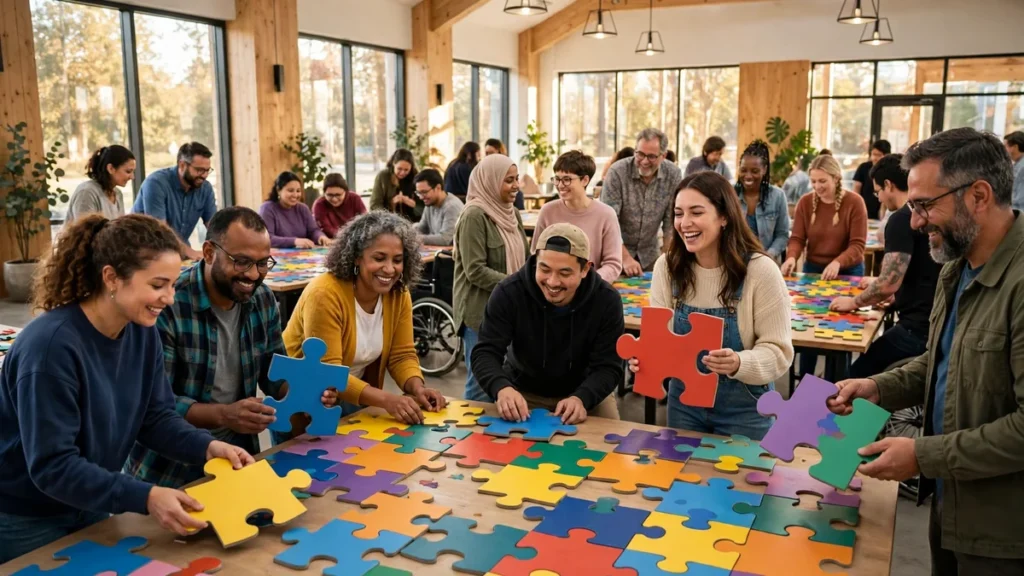
The Best Puzzle Games for 234 Players turn a simple pastime into a full-scale event. Few gatherings ever reach this size, and when they do, the usual approach of handing one puzzle to one table simply stops working. With 234 players in the room, every game needs structure, clear teams, and puzzles that keep hundreds of hands busy at the same time. Done well, the result is one of the most memorable group activities you can organise: loud, collaborative, and genuinely competitive.
A group of 234 players is large enough to fill a school hall, a conference centre, or a community festival ground. That scale changes the maths of puzzle night completely. A single 1,000-piece jigsaw that would entertain a family for an evening becomes a bottleneck when 234 people are waiting for a turn, so the best formats split the crowd into teams, run several puzzle stations at once, and give every player a real job to do from the first minute.
This guide covers the formats that actually work at this scale, how to set them up, what equipment you need, and how to keep the energy high from the opening clue to the final piece. Whether you are planning a school event, a corporate gathering, a church social, or a community fundraiser, these puzzle games will help 234 players work together without chaos.
Key takeaways
- Split 234 players into teams of 6 to 13 so every player has a clear role and no one is left standing around.
- Run several puzzle stations at the same time instead of one big puzzle, so all teams play simultaneously.
- Choose puzzles with 500 to 2,000 pieces per team, matched to the time you have and the age of your players.
- Mix physical puzzles with word, logic, and digital rounds to keep different strengths in play.
- Appoint one host and one scorekeeper per zone, and use a visible timer so every team knows where they stand.

What Makes a Puzzle Game Work for 234 Players
The first thing to understand about a 234-player puzzle event is that it is a logistics challenge as much as a game. At this size, the puzzle itself is only half the experience. The other half is movement, timing, and communication. Players need to know where to go, what their team is doing, and how their effort contributes to the final result. Games that work at this scale share three qualities: they are easy to explain in under two minutes, they give every player something to do at the same time, and they produce a clear winner or a clear finished result.
Speed matters too. A puzzle format that takes three hours to finish will lose a large crowd halfway through, no matter how clever it is. The best puzzle games for 234 players run in rounds of 20 to 45 minutes, with short breaks between rounds. Short rounds keep energy high, let organisers reset tables quickly, and give teams a fresh start if they fall behind early. If you want a longer event, plan three or four rounds rather than one marathon session.
Fairness is the third ingredient. When 234 people compete, small advantages add up fast. Every team should get the same puzzle, the same number of pieces, and the same time limit. If you run stations with different puzzles, rotate the teams so each group faces the same set of challenges by the end. Players accept losing to a faster team; they do not accept losing because another team had an easier puzzle.
How to Set Up Puzzle Games for 234 Players
Good preparation decides whether your event feels like a celebration or a crowd-control exercise. Start planning at least two weeks ahead, and confirm your venue, tables, and puzzle supplies before you send invitations. A hall that holds 234 people comfortably needs roughly one square metre per player plus space for puzzle tables, a host station, and walkways between zones.
Divide Players Into Teams That Actually Work
The cleanest split for 234 players is 18 teams of 13, or 26 teams of 9. Teams of 9 work best for table puzzles, since nine people can gather around a large table without crowding each other. Teams of 13 suit relay and station formats, where some players solve while others search, sort, or run pieces between tables. Avoid teams larger than 13, because the players at the edges stop contributing and start watching. Give each team a name, a colour, and a captain who collects scores and keeps the group organised.
Choose the Right Space and Tables
You need enough flat surface for every team to build at once. A standard banquet table seats eight to ten people, so plan for at least 26 tables if you run one team per table, plus a few spare tables for sorting and display. Leave wide aisles between tables so players can move without knocking pieces onto the floor. Place the host table and the timer where every team can see it, and keep the sound system loud enough to reach the back of the room without drowning out table conversation.
Pick Puzzles With the Right Piece Count
Piece count is the simplest way to control difficulty and timing. For a 30-minute team round, a 500-piece puzzle is a fair challenge for a team of nine adults. For a 60-minute round, step up to 1,000 pieces. For mixed-age groups with children, use 300-piece puzzles with large, clearly coloured pieces. Buy puzzles with distinct colour zones, such as landscapes with a blue sky, green fields, and a red building, because colour zones let teams split the work naturally. Avoid puzzles that are mostly one colour, like an all-white or all-black image, since those frustrate large teams and slow the whole event.
The Best Puzzle Games for 234 Players
The games below are ranked by how well they handle very large groups. Each one has been chosen because it scales cleanly to 234 players, needs only standard equipment, and keeps every team playing at the same time.
1. Giant Jigsaw Relay
In a giant jigsaw relay, each team receives the same 1,000-piece puzzle and races to complete it. The twist is that only four players may touch the puzzle at any time, and teams rotate builders every five minutes. This rule stops the fastest players from taking over and gives every member a turn at the table. The first team to place its final piece wins the round. Relay rules also make the game fair for mixed-ability groups, because sorting and searching count just as much as placing pieces.
2. Team Jigsaw Race
The team jigsaw race is the simplest format on this list and often the most popular. Every team gets an identical puzzle, a table, and a 45-minute timer. There are no rotations and no extra rules, so teams organise themselves however they like. Some teams sort by edge first, others by colour, and the different strategies become part of the fun. This format suits competitive groups and works well as the headline event of the evening, especially when the finished puzzles are displayed side by side for judging.
3. Puzzle Scavenger Hunt
A puzzle scavenger hunt turns the whole venue into the game board. Organisers hide puzzle pieces, clue cards, and small logic puzzles around the hall, and teams must find them, solve them, and assemble the pieces they collect. Each clue solved earns the next location, so teams stay moving and thinking at the same time. This format is ideal for 234 players because it spreads the crowd across the entire venue instead of crowding everyone around tables, and it suits outdoor spaces and festivals just as well as indoor halls.
4. Mystery Puzzle Challenge
In a mystery puzzle challenge, teams receive a sealed box containing a puzzle with no picture on the lid. Players must build the image without knowing what it shows, using only the shapes and colours of the pieces. This format rewards patience and teamwork more than speed, and it creates a wonderful moment when the picture finally becomes clear. Choose puzzles with strong colour blocks and recognisable shapes, such as animals or landmarks, so teams can make steady progress without the reference image.
5. Escape-Room Puzzle Stations
Escape-room stations divide the hall into six to eight themed zones, each holding a different puzzle challenge: a code lock, a word puzzle, a logic grid, a tangram set, a maze, and a pattern-matching task. Teams rotate through the stations in a fixed order, earning points at each one. This format is one of the best puzzle games for 234 players because it handles huge crowds smoothly, lets organisers reuse the same stations for every team, and gives every player a chance to shine at a different type of puzzle. You can build most stations from printed materials, padlocks, and inexpensive props.
6. Digital Puzzle Tournament
A digital tournament uses tablets or phones to run puzzle rounds that would be impossible with physical pieces at this scale. Teams compete in timed rounds of Sudoku, nonograms, picture logic, and jigsaw apps, with scores shown live on a big screen. Digital rounds are easy to score, need very little equipment, and work brilliantly as a change of pace between physical rounds. They also suit venues with limited table space. Make sure every team has at least two charged devices and a reliable Wi-Fi connection before the event starts.
7. Crossword and Word Puzzle Relay
Word puzzle relays suit groups that love language. Each team receives a large printed crossword, a word search, and a set of anagrams, and players take turns at the board while teammates call out answers from behind a line. Only the player at the board may write, and teams swap writers every two minutes. The format is fast, noisy, and very watchable, which makes it a strong choice for the final round of the evening. Prepare answer keys in advance so scoring is quick and undisputed.
8. Build-and-Solve Relay
The build-and-solve relay combines construction puzzles with brain teasers. At each station, a team must assemble a small three-dimensional puzzle, such as a wooden cube or a block model, and then solve a riddle or logic question to unlock the next station. Teams move through the course in order, and the fastest total time wins. This format works well for family events because children often excel at the building stages while adults handle the logic questions, so every age group contributes.
Best Puzzle Games for 234 Players at a Glance
Use this comparison to pick the right mix for your event. The best evenings combine one table format, one movement format, and one digital or word round, so different strengths all get a chance to matter.
| Game | Best For | Round Length | Equipment Needed | Energy Level |
|---|---|---|---|---|
| Giant Jigsaw Relay | Competitive adults | 45 minutes | Identical 1,000-piece puzzles | High |
| Team Jigsaw Race | Headline event | 45 minutes | Identical puzzles, tables, timers | High |
| Puzzle Scavenger Hunt | Outdoor and festival venues | 60 minutes | Hidden pieces, clue cards | Very high |
| Mystery Puzzle Challenge | Mixed-ability groups | 60 minutes | Sealed puzzles, no picture | Medium |
| Escape-Room Stations | Very large crowds | 40 minutes | Locks, printed puzzles, props | High |
| Digital Puzzle Tournament | Limited table space | 30 minutes | Tablets, Wi-Fi, big screen | Medium |
| Crossword and Word Relay | Word lovers, final round | 25 minutes | Printed grids, markers | High |
| Build-and-Solve Relay | Family events | 40 minutes | 3D puzzles, riddle cards | High |
Your 234-Player Puzzle Night Checklist
Run through this checklist in the week before your event, and again on the morning of the day itself. Most large-group puzzle nights that go wrong fail on a small detail, such as a missing timer or too few tables, rather than on the games themselves.
- Confirm the venue holds 234 players with tables, aisles, and a host station, and walk the floor plan once before the event.
- Count your puzzles and check every box is complete, with the same piece count for every team in each round.
- Prepare team lists, colour badges, and captain names in advance so registration takes minutes, not half an hour.
- Test the sound system, the visible timer, and the Wi-Fi from the back of the room, not just from the front.
- Brief your zone hosts and scorekeepers the day before, and give each one a printed copy of the rules.
- Pack spares: extra puzzles, sorting trays, timers, markers, tape, and a first-aid kit for the inevitable small accidents.
Mistakes to Avoid With Very Large Puzzle Groups
The most common mistake is choosing puzzles that are too hard for the time available. A team of nine can finish a 500-piece puzzle in about half an hour, but a 2,000-piece puzzle in the same time will leave every team frustrated and unfinished. Match the piece count to the clock, and test one puzzle with a small group before the event so you know the real completion time. It is better to finish early and add a bonus round than to run out of time with half-built puzzles on every table.
The second mistake is underestimating noise and movement. With 234 people talking, laughing, and moving between stations, a hall becomes loud very quickly. Choose a venue with good acoustics, keep announcements short, and use a whistle or a bell rather than shouting to get attention. Place quiet puzzle zones, such as the mystery challenge, away from the loudest relay stations so teams that need concentration can actually think.
The third mistake is letting a few confident players dominate every team. Large groups naturally develop leaders, and a puzzle night can quickly become a spectator event for quieter members. Rotation rules, timed turns at the table, and mixed stations all help, but the simplest fix is to tell captains at the start that every player must place at least one piece or solve at least one clue before the round ends. When everyone contributes, everyone enjoys the win. If you are planning a slightly smaller gathering, the format ideas in the best puzzle games for 233 players guide transfer almost directly, since the team sizes and station counts are nearly identical.
Frequently Asked Questions
How many teams should 234 players be split into?
The most practical split is 18 teams of 13 or 26 teams of 9. Teams of 9 suit table puzzles, because nine people can work around one large table comfortably. Teams of 13 suit relay and station formats, where players rotate between solving, sorting, and searching. Either split works well, so choose based on your tables and your game formats rather than on a fixed rule.
How long does a puzzle event for 234 players take?
Plan for two and a half to three hours in total. That allows time for registration, a short welcome, three rounds of 30 to 45 minutes, breaks between rounds, and a final results ceremony. Shorter events of 90 minutes work if you run only two rounds, but avoid squeezing three rounds into less than two hours, because setup and scoring always take longer than expected with a crowd this size.
What is the best puzzle size for a team of nine players?
A 500-piece puzzle is the best choice for a 30-minute round, and a 1,000-piece puzzle suits a 45 to 60-minute round. For mixed-age teams with children, drop to 300 pieces with large, brightly coloured pieces. Always test your chosen puzzle with a small group first, because piece size and image complexity change completion times more than the piece count alone.
Can puzzle games work outdoors for 234 players?
Yes, and outdoor venues suit scavenger hunts, relay races, and station formats very well. The main risks are wind, which scatters light puzzle pieces, and rain, which damages cardboard puzzles. Use weighted trays, clipboards, and laminated clue cards outdoors, and keep a covered area ready for the table rounds. Digital rounds are a good backup if the weather turns bad.
How do you score puzzle games fairly with so many teams?
Give every team the same puzzle, the same piece count, and the same time limit, and rotate teams through identical stations. Award points for completed puzzles, for the fastest finish, and for partial progress, such as the number of pieces placed when time runs out. Use a visible scoreboard and one scorekeeper per zone, and publish the scoring rules before the first round so no team can claim they were surprised.
What should I budget for a 234-player puzzle night?
For a basic event, budget for 26 identical puzzles, printed materials, timers, and simple prizes, which most organisers cover for a modest per-player cost. Reusable items such as sorting trays, padlocks, and station props can be used again at future events. The venue is usually the largest cost, so book early and ask whether tables and chairs are included. The guide to the best puzzle games for 232 players uses a similar budget breakdown, and the best puzzle games for 100 players guide shows how the same formats scale down when fewer players attend.
The Bottom Line
The best puzzle games for 234 players are the ones that give every person a job, every team a fair chance, and every round a clear finish. Split the crowd into teams of 9 or 13, run several stations at once, match the piece count to your clock, and mix table puzzles with movement, word, and digital rounds. Plan the logistics as carefully as the games themselves, test your puzzles in advance, and keep the rounds short enough that the energy never drops. Do that, and 234 players will leave talking about the night they solved something huge together.