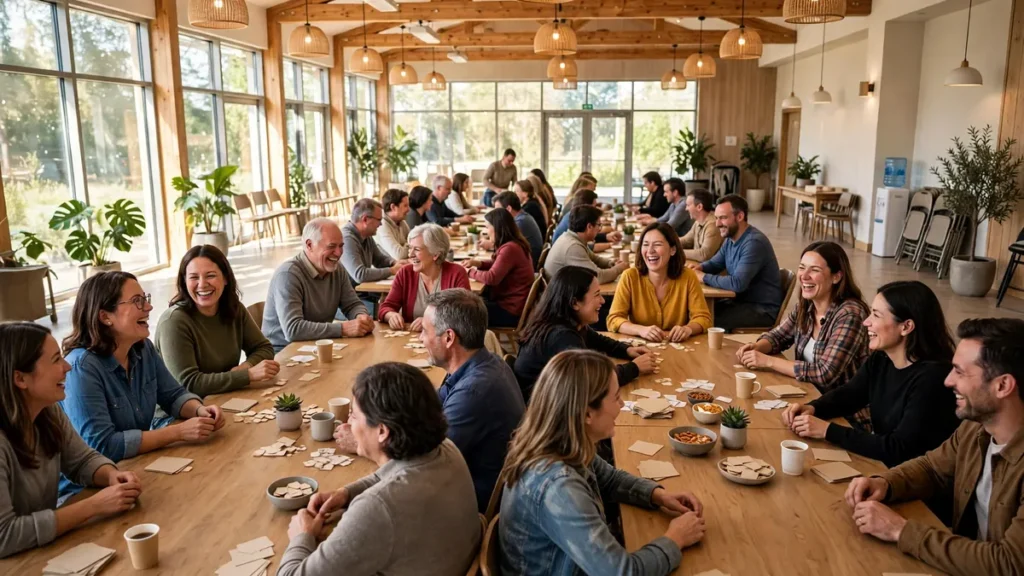
The best puzzle games for 166 players are not single games at all. No board, card, or jigsaw puzzle ever made seats 166 people around one table, and any list that pretends otherwise is selling a fantasy. The real answer is smarter: split the crowd into teams, run several puzzles at once across multiple tables, and let tournaments, relays, and whole-room hunts turn 166 separate players into one shared event.
That approach is exactly what makes puzzle games so good for very large groups. Puzzles reward patience, observation, and teamwork rather than speed or shouting, so they work for mixed ages, mixed abilities, and people who would never enjoy a loud party game. A quiet solver can carry a team just as surely as a fast talker, and every table gets its own small victory while the whole room shares the bigger one.
This guide covers the eight best puzzle games for 166 players, each one tested in spirit against the same question: how does it actually work when 166 people show up? You will find team races, station circuits, relays, hunts, and tournaments, plus a simple plan for organising the room, a comparison table, and a checklist so nothing is left to chance on the day.
Key takeaways
- No single puzzle game seats 166 players, so the best formats split the crowd into teams and run puzzles in parallel across many tables.
- Team jigsaw races, puzzle station circuits, and whole-room puzzle hunts scale best, because every player is solving something at the same time.
- Keep teams between six and ten players so everyone gets a real job instead of standing around watching.
- Use identical puzzle sets for fair races, and use relays or rotations when you have fewer sets than teams.
- Score simply: points per finished puzzle, bonus points for speed, and one grand puzzle at the end that brings all 166 players together.

1. The Giant Jigsaw Relay
The giant jigsaw relay is the simplest large-group puzzle of all, and it works because it turns one enormous puzzle into a team sport. Buy or print a puzzle of at least 2,000 pieces, or several 1,000-piece puzzles with the same picture, and set them up on long tables down the middle of the room. Divide your 166 players into teams of eight, and give each team a station and a shared table edge.
Play runs in relay legs. Only four members of each team work on the puzzle at a time, and every ten minutes a whistle blows and the next four take over. The outgoing solvers must leave a short note about what they were working on, which pieces they were hunting, and which section is nearly finished. That handover note is the heart of the game: it forces communication, stops the same corner being rebuilt three times, and keeps the puzzle moving even as fresh hands arrive.
2. The Team Jigsaw Race
The team jigsaw race is the competitive cousin of the relay, and it is the fairest puzzle race you can run for a crowd this size. Give every team the exact same puzzle, the same number of pieces, and the same start time, then race to the finish. With 166 players you will have around twenty teams of eight, so you need twenty identical puzzles, which sounds like a lot until you realise that bulk packs of the same 500-piece puzzle are cheap and easy to order.
Fairness matters more than difficulty here. A 500-piece puzzle is the sweet spot: hard enough to need teamwork, easy enough to finish inside an hour. Teams naturally split the work, with some players sorting edges, others hunting colours, and one or two assembling the frame. The best teams are rarely the fastest individuals; they are the teams that sort first and build second.
3. The Puzzle Station Circuit
The puzzle station circuit is the best format when you want variety, because it lets 166 players try many different puzzles in one session. Set up ten stations around the room, each with a different kind of puzzle: a jigsaw, a tangram set, a logic grid, a crossword, a Sudoku board, a Rubik’s cube station, a word search, a maze, a matching game, and a brain teaser table. Teams rotate from station to station every ten minutes, earning points at each stop.
Each station needs a clear task and a clear score. A finished tangram earns ten points, a solved logic grid earns fifteen, and a completed word search earns five, with bonus points for speed. Print the scoring on a card at every station so teams can check their own work, and station a volunteer at the trickier tables to give hints without giving answers.
4. The Whole-Room Puzzle Hunt
The whole-room puzzle hunt turns the entire venue into the puzzle. Hide clues, codes, and puzzle pieces around the room, in the garden, or across a whole building, and give each team a starting clue that leads to the next. A solved riddle reveals a location, the location hides a code, and the code unlocks the next puzzle. The first team to collect every piece and assemble the final answer wins.
Design matters more than hiding spots. Write the hunt so that different teams follow different routes, which stops twenty teams from crowding around the same clue. Colour-code the routes, stagger the start times by two minutes, and make sure every clue can be solved by logic rather than by luck. A clue that depends on finding one tiny object in a huge room will frustrate everyone; a clue that depends on cracking a word pattern will delight them.
For 166 players, the hunt is best run in teams of six, which gives you about twenty-seven teams moving through the space at once. That sounds chaotic, but it works when the routes are spread out and the clues are spread wider. End the hunt with a single shared puzzle that needs pieces from every team, so the competition turns into cooperation for the finale. The hunt pairs naturally with other large-group formats, and if you want a livelier warm-up first, the party games built for 166 players on this site are a good place to start.
5. The Escape Room Tournament
An escape room tournament brings the thrill of a locked-room challenge to a crowd of 166 without needing 166 locks. Build five or six tabletop escape puzzles instead of one room: a locked box with a combination, a set of coded messages, a puzzle that reveals a key, and a final riddle that opens the prize. Each team gets forty-five minutes at one table, then rotates to the next, and the team with the most escapes wins.
Tabletop escape puzzles are easier to build than they sound. A padlocked box, a UV torch with invisible ink, a simple cipher wheel, and a set of picture clues are enough for a full game. Write the puzzles in a chain, so solving the cipher gives the code, the code opens the box, and the box holds the next puzzle. Test every chain twice before the event, because one broken link stalls the whole table.
6. The Giant Crossword Relay
The giant crossword relay takes a familiar puzzle and blows it up to room size. Print or draw a huge crossword grid on a whiteboard, a roll of paper, or a set of foam boards, and give each team a set of clues. Teams take turns sending one member to the board to fill in a single answer, then run back to tag the next player. Only one player per team is at the board at a time, which keeps the front of the room clear and the relay moving.
Choose clues that suit your crowd. General knowledge clues work for mixed groups, while themed clues work for a celebration, a school event, or a work gathering. Mix easy answers with harder ones so every team gets some quick wins and some satisfying struggles. A crossword with forty clues lasts about thirty minutes, which is the right length before attention wanders. Word lovers in the group may also enjoy the word games for very large groups on this site, which suit the same team sizes.
The relay works for 166 players because it mixes thinking with movement, which keeps energy up in a long session. The runners get exercise, the bench players get to argue over clues, and the whole room can see the grid filling in. For a quieter version, run the same crossword as a seated team race instead, with each team working from a printed copy and the first finished grid winning. Either way, the shared board makes the result visible to everyone, which is half the fun.
7. The Digital Puzzle Tournament
The digital puzzle tournament uses phones and tablets to run a puzzle competition for 166 players at once, with no paper and no pieces to lose. Each team appoints a captain with a phone, and the organiser sends puzzle rounds to every captain at the same time: a logic puzzle, a picture round, a word ladder, a number sequence, and a riddle. Teams solve together and submit answers before the timer ends, and the leaderboard updates live.
You do not need special software to run this. A shared quiz app, a group chat, or even a simple form can carry the rounds, and a projector showing the live scores adds real excitement. Keep each round to five minutes, and mix puzzle types so that different teams lead at different times. A picture round favours the observant, a number round favours the logical, and a riddle round favours the lateral thinker.
8. The Collaborative Mural Puzzle
The collaborative mural puzzle is the grand finale every large puzzle event deserves. Print a huge picture, a photograph, or an artwork, and cut it into 166 pieces, one for each player. Each person solves a small section, colours it, or assembles their own piece, and at the end all 166 pieces are joined into one giant picture on the wall. It is part puzzle, part art project, and entirely memorable.
Preparation is the key. Cut the picture into a grid, number every piece on the back, and hand out pieces at random so nobody knows where theirs fits until the assembly begins. Give each player a small task: colour their piece, solve a tiny puzzle printed on it, or simply find its neighbours by matching edges. The assembly itself becomes the final game, with players calling out numbers and hunting for the piece that fits next to theirs.
How to Organise Puzzle Games for 166 Players
Split the crowd before the event, not on the day. Pre-assign teams of six to ten players, mix ages and abilities in every team, and print team lists, table numbers, and scorecards in advance. On the day, give every team a colour, a table, and a captain, and give every captain a one-page sheet with the schedule, the rules, and the scoring. A short welcome briefing of five minutes, with the rules shown on a board, prevents an hour of confused questions later.
Split Into Teams of Six to Ten
Teams smaller than six leave too few hands for a big puzzle, and teams larger than ten leave too many people standing around. Eight is the sweet spot for most puzzle games, because it is enough to split tasks and small enough that everyone can reach the table. If your 166 players include children, put at least two adults on every team and let the children own the sorting and searching jobs, which they are often best at.
Run Stations in Rotation
Rotations are what make a 166-player event feel smooth instead of chaotic. Give each team a rotation card showing the order of stations, ring a bell when it is time to move, and allow two minutes for the changeover. Stagger the starts so that no two teams arrive at the same station together, and keep one spare station free so a delayed team always has somewhere to go.
Keep Score Simple
Simple scoring keeps 166 players honest and happy. Use one point per finished puzzle, five bonus points for the fastest finish, and a running total on a whiteboard or a projected sheet. Let team captains report their own scores to a score table, and have two volunteers check the totals at the halfway point. Complicated scoring creates arguments; simple scoring creates a leaderboard everyone trusts.
Puzzle Games for 166 Players at a Glance
| Game | Best For | Players per Team | Time Needed | Equipment |
|---|---|---|---|---|
| Giant jigsaw relay | Teamwork and patience | 8 | 60 minutes | Large puzzles, long tables |
| Team jigsaw race | Fair head-to-head competition | 8 | 45 to 60 minutes | Identical puzzles, one per team |
| Puzzle station circuit | Variety and mixed abilities | 6 to 8 | 90 minutes | Ten puzzle stations, scorecards |
| Whole-room puzzle hunt | Energy and exploration | 6 | 60 minutes | Printed clues, hidden tokens |
| Escape room tournament | Drama and problem solving | 6 to 8 | 45 minutes per table | Locked boxes, ciphers, clues |
| Giant crossword relay | Word lovers and movement | 8 | 30 minutes | Giant grid, printed clues |
| Digital puzzle tournament | Hybrid and remote players | 6 to 8 | 45 minutes | Phones, projector, quiz rounds |
| Collaborative mural puzzle | A shared grand finale | Whole room | 45 minutes | Printed picture, cut into pieces |
Your 166-Player Puzzle Night Checklist
- Confirm the venue holds twenty team tables plus a station area and a clear central space for briefings and the leaderboard.
- Pre-assign teams of six to ten players, print team lists and table numbers, and name a captain for every team.
- Order or print all puzzle sets in advance, with identical sets for every race and spare pieces for the stations.
- Test every puzzle chain, clue, and code twice before the event, and keep a spare set of answers with the organiser.
- Prepare scorecards, a visible leaderboard, a bell or whistle for rotations, and prizes for the winning team and the fastest single finish.
- Plan the finale first: book the wall space for the mural puzzle or the open floor for the final shared game, and photograph it before anyone leaves.
Frequently Asked Questions
Can one puzzle game really seat 166 players?
No single puzzle seats 166 players at one table, and any claim that one does should be treated with suspicion. The games in this guide work because they split 166 players into teams, run puzzles in parallel across many tables, or turn the whole room into the playing area. The puzzle is shared, even though the table is not.
What is the best puzzle game for 166 players?
The puzzle station circuit is the best all-round choice, because it gives every player something to do at all times and suits mixed ages and abilities. If you want pure competition, the team jigsaw race is the fairest option, and if you want a memorable ending, the collaborative mural puzzle is the strongest finale.
How many teams should 166 players form?
Aim for about twenty teams of eight players, or twenty-seven teams of six if you are running a hunt with lots of movement. Teams of six to ten keep everyone involved, while larger teams leave players standing around with nothing to solve.
How long does a 166-player puzzle event take?
Plan for two to three hours, including a five-minute welcome briefing, ninety minutes of games, and time for scoring and prizes. A single game lasts thirty to sixty minutes, so a circuit of several games fills an afternoon comfortably without exhausting anyone.
Do puzzle games work for mixed ages?
Yes, and they work better than most large-group games for mixed ages, because puzzles reward observation and patience rather than speed or strength. Put at least two adults on every team with children, give younger players the sorting and searching jobs, and choose puzzle types that need no prior knowledge.
What equipment do I need for 166 players?
You need one table per team, identical puzzle sets for races, a station kit for circuits, printed clues and scorecards, a bell or whistle for rotations, and a whiteboard or projector for the leaderboard. Most of it is paper, print, and patience, which is why puzzle events cost far less than they look. If your group also enjoys quick-fire quizzing between puzzle rounds, the trivia games designed for 166 players on this site fit the same team format.
The Bottom Line
The best puzzle games for 166 players share one secret: they never ask 166 people to crowd around a single puzzle. They split the room into teams, run puzzles in parallel, and bring everyone back together for a shared finish. Pick a race for competition, a circuit for variety, a hunt for energy, and a mural for the finale, and your 166 players will leave having solved something together rather than having watched someone else solve it.