Finding the best puzzle games for 158 players sounds impossible at first, and in one sense it is: no single puzzle game seats 158 people around one table. A jigsaw puzzle built for a family of four does not magically stretch to fit a whole school year group, a company division, or a wedding guest list of 158. The good news is that puzzle games scale beautifully when you stop thinking about one table and start thinking about teams, tables, tournaments, and relays. With the right format, 158 players can all be solving at the same time, and the room feels electric rather than chaotic.
The best puzzle games for 158 players share three qualities. First, they split the crowd into small teams of four to eight people, so everyone actually touches the puzzle instead of watching from the back row. Second, they run in parallel across many tables or stations, so nobody waits around for a turn. Third, they build to a shared finish line, whether that is a completed puzzle, a solved code, or a leaderboard that keeps every team in the race until the last minute. When those three pieces are in place, a group of 158 stops being a logistics problem and becomes the whole point of the event.
This guide covers the formats that genuinely work at this scale, from jigsaw tournaments and puzzle hunts to escape-room relays and digital puzzle races. You will find honest advice on team sizes, table layouts, timing, and materials, plus a comparison table, a setup checklist, and answers to the questions organisers ask most. Every recommendation here has been chosen because it keeps all 158 players involved, not just the fastest few.
Key takeaways
- No single puzzle game seats 158 players, so the best formats split the crowd into teams of four to eight and run in parallel across many tables.
- Jigsaw tournaments, puzzle hunts, escape-room relays, and digital puzzle races are the four formats that scale best to 158 players.
- Plan for roughly one table per team, one puzzle set per team, and one host or referee for every six to eight teams.
- Keep rounds short, between 15 and 30 minutes, and use a visible leaderboard so every team stays in the race.
- Test every puzzle, code, and clue with a small group before the event, because one broken clue can stall all 158 players at once.
How Puzzle Games Work for 158 Players
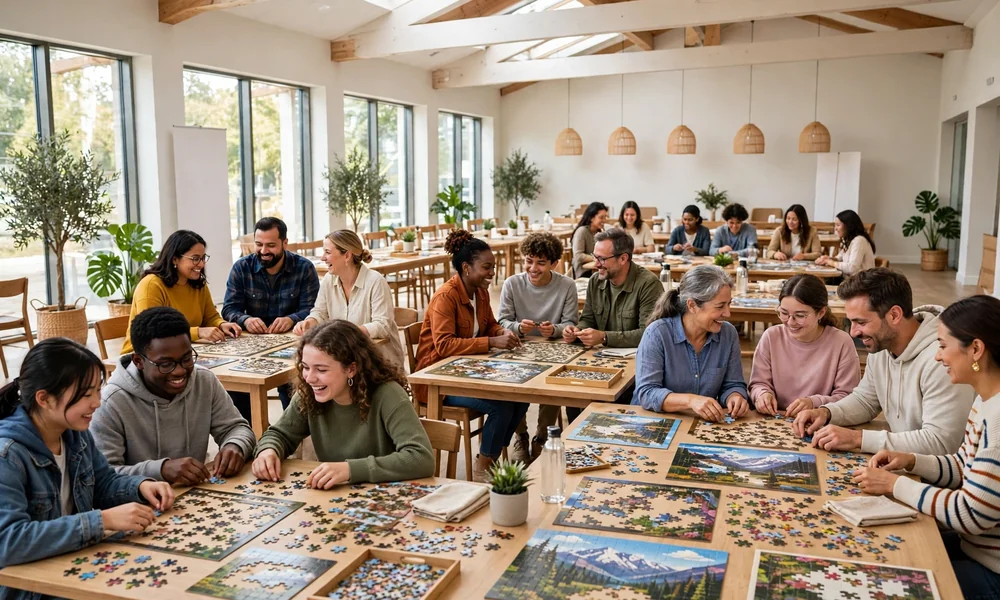
The first thing to accept about puzzle games for 158 players is that the number itself changes the game. A puzzle designed for six friends becomes a spectator sport at this size unless you rebuild it around teams. The simplest working model is twenty to thirty teams of five to eight players, each team at its own table with its own copy of the puzzle. Everyone solves the same challenge at the same time, and the competition comes from speed, accuracy, or both. This model works for jigsaws, crosswords, logic grids, and code-breaking sets alike.
Team size matters more than most organisers expect. Teams of four to six are ideal for hands-on puzzles such as jigsaws, because everyone can reach the pieces. Teams of six to eight work better for puzzle hunts and trivia-style rounds, where different members can tackle different clues at the same time. Anything above eight players per team leaves people standing around, and anything below four makes a 158-player event need more than thirty tables, which most venues cannot hold. Aim for twenty-six teams of six, or twenty teams of eight with two spare players folded into the smallest teams.
Best Jigsaw Puzzle Tournaments for 158 Players
Jigsaw tournaments are the most reliable large-group puzzle format, and they are the easiest to picture: rows of tables, identical puzzles, and a race to the finish. For 158 players, buy or borrow identical 500-piece puzzles, one per team, and give every team the same picture so the race is fair. Five-hundred pieces is the sweet spot for a 30-minute round, while 1,000-piece puzzles suit a 60-minute headline round. Avoid puzzles with large areas of plain sky or water, which slow everyone down equally and make the event feel like a chore.
Running a jigsaw tournament for this many players takes preparation. Sort the pieces into trays before the event, or buy puzzles that come pre-sorted by the maker, because 158 people opening boxes at once creates a mess. Place one puzzle board or large sheet of card at each table so teams can carry their work if tables need to move. Appoint one referee per six tables to check finishes, settle disputes about missing pieces, and keep the leaderboard honest. If your group has played smaller puzzle nights before, the jump to this scale will feel familiar, and reading about puzzle games that work for 156 players shows how the same tournament format adapts to a crowd just two players smaller.
Best Puzzle Hunts for 158 Players
A puzzle hunt sends teams racing around a venue, a campus, or a park to find clues and solve them in order. For 158 players, a hunt works because the crowd spreads out naturally instead of crowding one room. Design eight to twelve clue stations, each with a different puzzle type: a word ladder, a logic grid, a cipher, a picture puzzle, a riddle, and a physical task such as assembling a small object. Teams visit stations in any order, which prevents queues, and each solved station earns a stamp or a code word.
The clues are the heart of a puzzle hunt, and they need testing. Write every clue so that a team of average players can solve it in three to five minutes, and test the full route with two or three volunteers before the event. Place a volunteer at each station to hand out clues, check answers, and give a gentle hint after three minutes, because a stuck team blocks the station for everyone behind them. Keep the hunt to 45 minutes of solving time plus a 15-minute gathering and scoring session at the end.
Best Escape-Room Style Team Puzzles
Escape-room style puzzles bring the thrill of a locked-room game to a crowd of 158 without needing 158 escape rooms. The trick is to run the same escape challenge at many tables at once, or to build one large escape storyline with teams solving different chapters in parallel. Each team gets a box of puzzles: combination locks, hidden compartments, coded messages, and a final code that opens the last box. The first team to crack the final code wins the round.
You can buy ready-made escape-room board games and run one copy per team, which is the simplest option for a first event. Choose games that play in 60 minutes and seat up to six players, and buy enough copies for every team. Alternatively, build your own puzzle boxes with padlocks, envelopes, and printed clues, which costs less and lets you theme the story to your event, whether that is a school fundraiser, a company away day, or a birthday party. A homemade box takes about two hours to prepare per set, so start early and reuse the same design across all teams.
Best Word and Logic Puzzle Relays for 158 Players
Word and logic puzzle relays turn quiet brain games into a noisy team sport. In a relay, each team lines up and sends one player at a time to solve a small puzzle at the front, such as a crossword clue, an anagram, a sudoku row, or a logic question. The player solves it, runs back, tags the next teammate, and the next puzzle begins. The format keeps all 158 players active because everyone gets a turn, and the cheering from the sidelines makes even a simple anagram feel like a final.
Relays need a steady supply of short puzzles, so prepare at least ten puzzles per team, each solvable in under a minute. Mix the types so different strengths shine: word players take the anagrams, number players take the maths puzzles, and lateral thinkers take the riddles. A good relay round lasts 15 to 20 minutes, and you can run two or three rounds with different puzzle types. Keep the puzzles on large cards or a projected screen so the waiting players can follow along and shout encouragement.
This format suits school events and youth groups especially well, because it needs almost no equipment and no expensive materials. All you need is printed puzzle cards, a timer, and a clear space for the relay lanes. For mixed-age groups, use two difficulty levels and let teams choose their lane, so younger players are not put off by puzzles aimed at adults. Word and logic relays also pair well with a quiz round, and organisers planning a mixed puzzle-and-quiz night often look at trivia games built for 157 players for a question round that slots neatly between relay heats.
Best Digital Puzzle Games for 158 Players
Digital puzzle games solve the biggest headache of a 158-player event: materials. When every team plays on phones, tablets, or laptops, there is nothing to print, sort, or collect, and scoring happens automatically. Quiz and puzzle apps let you run live rounds where all 158 players answer on their own devices, with a leaderboard updating in real time on a big screen. Popular formats include live puzzle quizzes, picture rounds, code-breaking challenges, and multiplayer puzzle games where teams collaborate on a shared screen.
Running a digital round well takes a little technical preparation. Test the venue Wi-Fi with the full number of devices before the event, because 158 phones on one network can slow everything down. Ask players to charge their devices and bring a charger if possible, and keep a few spare tablets on hand for players without a suitable phone. Choose platforms that allow team play rather than individual play, so the event stays social instead of turning into 158 people staring at their own screens in silence.
Best Puzzle Games for 158 Players at Work Events
Work events with 158 colleagues need puzzle games that mix departments, break down silos, and give everyone a reason to talk to people they rarely work with. The best approach is to assign teams randomly rather than letting departments sit together, and to choose puzzles that reward different skills so no single department dominates. A mix of a jigsaw round, a puzzle hunt, and a digital quiz gives analytical, creative, and practical thinkers each a moment to shine.
Keep work-event puzzles professional and inclusive. Avoid puzzles that rely on inside jokes, company jargon, or knowledge only long-serving staff would have, because new starters will feel excluded. Use puzzles themed around general knowledge, logic, and teamwork rather than job-specific skills. A 90-minute puzzle session fits neatly into a half-day away day, leaving time for lunch, a short talk, and a prize ceremony. Schedule the puzzle games after lunch if you can, when energy dips and a lively team activity works better than another presentation.
For company events, the prize matters less than the recognition. Announce the winning team by name, share photos of the finished puzzles on the company intranet, and keep the trophy or certificate visible in the office afterwards. If your away day also includes board games in the evening, it helps to plan the whole day as one programme, and guides to board games that work for 157 players show how tabletop games can fill the social time after the main puzzle rounds end.
Best Puzzle Games for 158 Players at School Events
School events with 158 pupils need puzzle games that are safe, fair, and easy for teachers to supervise. The formats that work best are jigsaw tournaments, word relays, and puzzle hunts around the school grounds, because they need little equipment and keep pupils moving. Split pupils into mixed-age or mixed-ability teams so that every team has a fair chance, and keep the puzzles age-appropriate: 300-piece jigsaws for younger pupils, 500-piece for older ones, and clues written in clear, simple language.
Supervision is the main planning job for a school puzzle event. Place one teacher or parent volunteer at every four to six tables, and give each volunteer a simple answer sheet so they can check finishes quickly. Use a whistle or a bell to signal the start and end of each round, because 158 excited pupils will not hear a spoken announcement. Keep rounds to 15 minutes for younger pupils and 20 to 25 minutes for older ones, and always have a quiet puzzle table ready for pupils who need a break from the noise.
How to Set Up a 158-Player Puzzle Event
Setting up a puzzle event for 158 players is mostly a matter of counting: tables, chairs, puzzles, and volunteers. Start with the venue and work backwards. You need roughly one table per team, so twenty-six teams need twenty-six tables, plus a host table, a scoring table, and space for players to move between them. A school hall or community centre usually fits this layout, while a small restaurant room will not. Visit the venue in advance, sketch the table layout on paper, and check that there are enough power sockets if you plan a digital round.
Order materials at least two weeks ahead. For a jigsaw tournament you need one identical puzzle per team, plus two spare puzzles in case of missing pieces. For a puzzle hunt you need printed clue sheets, stamps, and answer cards. For an escape-room round you need one puzzle box or board game per team. Label everything by team number, pack each table’s materials into its own bag or box, and lay the bags out before players arrive so setup takes minutes rather than an hour.
Best Puzzle Games for 158 Players Compared
| Game format | Best for | Players per team | Round length | Why it works for 158 |
|---|---|---|---|---|
| Jigsaw tournament | Whole-room events | 4 to 6 | 30 minutes | Identical puzzles make the race fair |
| Puzzle hunt | Outdoor and campus venues | 6 to 8 | 45 minutes | Teams spread out across stations |
| Escape-room relay | Evening and party events | 4 to 6 | 60 minutes | Same challenge at every table |
| Word and logic relay | Schools and youth groups | 6 to 8 | 20 minutes | Almost no equipment needed |
| Digital puzzle race | Venues with strong Wi-Fi | 4 to 8 | 15 minutes | Automatic scoring and live leaderboard |
| Work event mix | Company away days | 5 to 7 | 90 minutes total | Mixes departments and skills |
| School puzzle day | Fundraisers and fairs | 5 to 6 | 15 to 25 minutes | Easy to supervise and low cost |
Checklist for a 158-Player Puzzle Event
- Confirm the venue holds at least one table per team, plus a host table and space to move between tables.
- Split 158 players into teams of four to eight, aiming for twenty to twenty-six teams, and assign team numbers in advance.
- Order one identical puzzle set per team, plus two spares, at least two weeks before the event.
- Test every puzzle, clue, code, and digital round with a small group before the day.
- Recruit one volunteer for every six to eight teams and brief them an hour before players arrive.
- Prepare a visible leaderboard, a timer, prizes for the winning team, and a backup indoor plan if the event is outdoors.
Frequently Asked Questions
Can one puzzle game really seat 158 players?
No single puzzle game seats 158 players at one table. The best puzzle games for 158 players split the crowd into teams of four to eight and run the same challenge in parallel across many tables, with a shared leaderboard to keep the competition fair and exciting.
How many teams should 158 players form?
Aim for twenty to twenty-six teams. Twenty-six teams of six is a good balance, while twenty teams of eight works if you have fewer tables. Teams smaller than four need too many tables, and teams larger than eight leave players with nothing to do.
How long should a 158-player puzzle event last?
Plan for 90 to 120 minutes of play across three or four rounds, plus time for welcome, scoring, and prizes. Individual rounds should last 15 to 30 minutes, with a five-minute reset between rounds for hosts to update the leaderboard and set up the next game.
What is the cheapest puzzle format for 158 players?
Word and logic puzzle relays are the cheapest, because they need only printed puzzle cards, a timer, and a clear space. Digital puzzle rounds are also low cost if players use their own phones, while jigsaw tournaments cost more because you need one identical puzzle per team.
Do I need a special venue for 158 players?
You need a venue with enough tables and floor space for twenty to twenty-six teams, such as a school hall, community centre, or conference room. Visit the venue in advance, sketch the layout, and check the Wi-Fi and power sockets if you plan a digital round.
What prizes work best for a puzzle event?
Small puzzle-themed prizes work best: puzzle books, board games, vouchers, or a travelling trophy for the winning team. Announce the winners by name, photograph the finished puzzles, and thank the volunteers, because recognition matters more than the value of the prize.
The Bottom Line
The best puzzle games for 158 players are not single games at all, but formats that turn a huge crowd into small, busy teams: jigsaw tournaments, puzzle hunts, escape-room relays, word and logic relays, and digital puzzle races. Pick two or three formats, split the room into teams of four to eight, keep the rounds short, and let a visible leaderboard do the work of keeping everyone in the race. Plan the tables, test every clue, brief your volunteers, and the number 158 stops being a problem and becomes the reason the night feels unforgettable.