Party games for 522 players work best when the whole crowd shares one simple idea, and a village fete gives you exactly that. Five hundred and twenty-two players sounds like a crowd that cannot play together, yet a fete turns that number into an advantage. Everyone arrives expecting stalls, contests, and a long afternoon on the green, so teams, heats, and a closing final feel natural. The green gives you space and the relaxed pace gives every team time to play properly.
If you want another huge-group format first, our guide to the best party games for 520 players shows how a crowd this size can play as one. The fete version below follows the same logic with a different flavour. Players form 87 teams of six, each wearing one colour, with nine games running at once in nine marked zones. Teams move from zone to zone on a timed rotation, play for eight minutes at each stop, and collect points as they go. No team waits more than a minute, and the whole course fits inside two hours.
This guide gives you the full plan: the nine games, the rotation that keeps 87 teams moving without jams, the points system that keeps every game honest, and the finals format that turns the best eight teams into one winner. Stage it at a village fete, a community festival, or a school summer fair, and it scales cleanly to a much larger space. Everything below uses ordinary fete equipment, ordinary helpers, and rules that a first-time player can learn in under a minute.
Key takeaways
- 522 players in 87 teams of six, so every player has a turn at every game.
- Nine fete games take about two hours, including changeovers and finals.
- Each game takes eight minutes and has one clear way to earn points.
- Points from all nine games decide the eight finalists, so one weak game never ends a team’s day.
- Two helpers per game keep the course moving, and one master list keeps the standings honest.

How the Village Fete Format Works
The format rests on teams of six. Six is small enough that every player gets a turn at every game, and large enough that a team can split jobs between its players. One player hurls while another measures, one player rolls while another adds up the points, and the games rotate the active role every time. With 87 teams spread across nine zones, the fete feels full without ever feeling crowded.
The team-of-six shape in our party games for 518 players works the same way, so the same rotation works here. Each zone runs the same eight-minute game all afternoon, and teams move to the next zone when the announcer gives the signal over the loudspeakers. A team that starts at the wellies finishes at the cordial pour. The order does not matter, because every team plays every game once, and the points list is the only thing that travels with them.
Points are simple on purpose. Each game awards up to 60 points, so a perfect day is 540 points, and most teams finish somewhere between 250 and 400. A game awards points for distance, for accuracy, for correct guesses, or for time, and the exact method is written on a small notice at each zone so players can check it without asking a helper. Ties at the top are settled by a single extra hurl at the wellies.
| Game | What a team does | Minutes |
|---|---|---|
| Village Fete Wellie Wanging | Hurl a wellie for distance | 8 |
| Village Fete Skittles Roll | Roll a ball at nine skittles | 8 |
| Village Fete Splat the Rat | Hit targets as they appear | 8 |
| Village Fete Bran Tub Grab | Draw sealed slips from bran | 8 |
| Village Fete Tombola Round | Draw numbered slips for prizes | 8 |
| Village Fete Longest Carrot Contest | Present and measure a carrot | 8 |
| Village Fete Preserve Tasting Round | Guess preserves by taste | 8 |
| Village Fete Burger Flip Race | Flip burgers without dropping one | 8 |
| Village Fete Cordial Pour Relay | Carry cordial without spilling it | 8 |
The 9 Village Fete Games
Each game below is written for teams of six and an eight-minute slot. The first paragraph gives the setup and the second gives the points, so a helper can run the zone from this page alone.
1. Village Fete Wellie Wanging
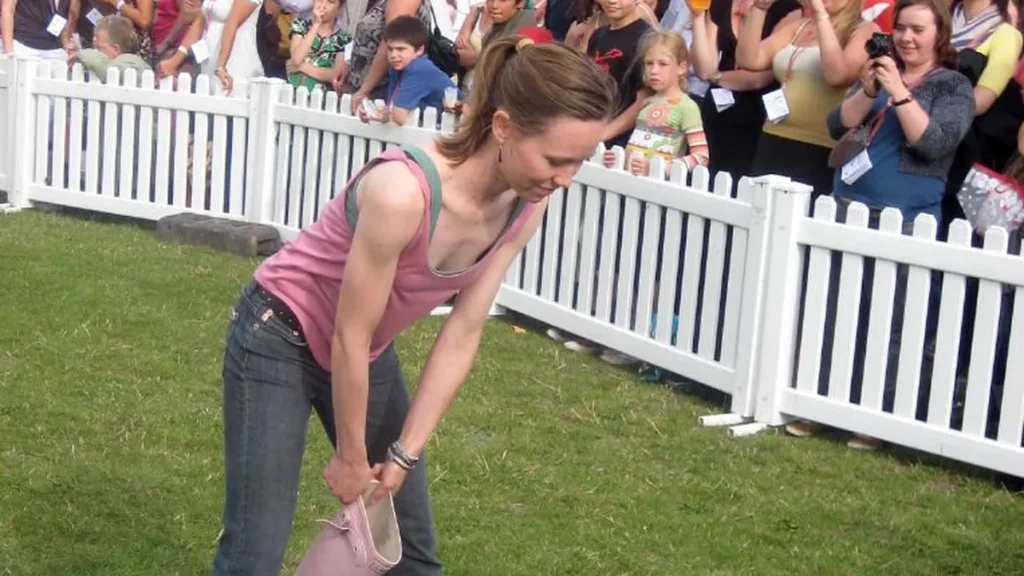
Wellie wanging is the classic fete opener, and it works for a huge crowd because it is fast, funny, and easy to judge. Each team lines up behind a marked line on the green, and each player gets one hurl of a pink wellie. The player swings the wellie by its top and lets go, and the helpers measure where it lands. A hurl outside the marked lane counts as zero.
Points come from distance. Add the six distances together for the team total. A team that lands every wellie between eight and twelve metres will beat a team with one huge hurl and five poor ones, which is exactly the lesson the game teaches.
2. Village Fete Skittles Roll
Skittles is the quiet game of the course, and teams love it because it rewards a steady hand rather than a loud voice. Nine wooden skittles sit in a diamond on a short lane, and each player rolls a wooden ball from behind a marked line. A ball that leaves the lane counts as zero. Each player gets three rolls, and the helpers reset the skittles after every roll.
Points come from the number of skittles toppled. Each skittle is worth two points, so a perfect roll is worth eighteen, and a perfect player can earn fifty-four across three rolls. Younger players roll from a closer line, and their points count the same.
3. Village Fete Splat the Rat
Splat the Rat is the noisiest game on the green, and it draws a crowd wherever you put it. A wooden frame with nine holes sits on a trestle, and a helper behind the frame pops a soft rat shape up through a hole for two seconds at a time. Each player holds three soft balls and hurls one at the rat shape each time it appears. Only a strike on the rat shape itself counts.
Points come from hits. Each hit is worth five points, so a team can earn ninety across six players. That sounds generous, and it is, because the rat shape appears in a different hole each time and two seconds is shorter than it feels. Keep the balls soft and light, with spares beside the frame.
4. Village Fete Bran Tub Grab
The bran tub is the gentlest game on the course, and it gives every team a small breather between the louder games. A deep tub filled with bran sits on a trestle, and sealed slips are buried through the bran. Each player reaches in, takes one slip, and opens it in front of a helper. Most slips carry points, a few carry a prize token, and one carries a golden slip worth twenty points. The bran hides everything, so the draw is pure luck.
Points come from the slips. Add the six slips together, add twenty for a golden slip, and add five per prize token handed in. Helpers stir the bran between teams so the next team faces a fresh tub, and count the slips before each team starts.
5. Village Fete Tombola Round
The tombola is the fete game everyone already knows, and it scales beautifully because the draw itself takes seconds. A rotating cage holds hundreds of numbered slips, and each player draws one slip, reads the number aloud, and checks it against the winning numbers on the notice beside the cage. A matching number wins a small prize, and every slip carries points even without a win.
Points come from the slips and the prizes. A plain slip is worth three points, a winning slip is worth ten points plus the prize, and a team that draws two winning slips earns a bonus of ten points. Stamp each slip as it is used so no slip can be drawn twice. The tombola zone is the easiest to run, so it sits in the middle of the course.

6. Village Fete Longest Carrot Contest
The longest carrot contest is the slowest game on the course, and it works because it turns a vegetable into a talking point. Each team brings one carrot from home, and the team presents it to the helpers at the measuring zone. Helpers measure it end to end in centimetres and write the length on the points list. The team also nominates its wonkiest carrot for a ten-point side award, judged on shape alone.
Points come from length. The longest carrot earns sixty points, and other teams earn points in proportion to length. The proportional method keeps the game fair when one team brings a huge specimen, because every centimetre still counts.
7. Village Fete Preserve Tasting Round
The preserve tasting is the tastiest game on the course, and it works because it asks players to trust their senses instead of their strength. Six small bowls hold six different preserves, and each player tastes one preserve on a small square of bread, writes down a guess at the flavour, and passes the bowl to the next player. The bowls carry numbers only, so nobody can read the answer from a label.
Points come from correct guesses. Each correct flavour is worth five points, so a team can earn one hundred and eighty across six players. That total looks large beside the other games, so the tasting points are halved before they go on the points list, which keeps the tasting in line with the rest of the course. The preserves on the day are usually marmalade, strawberry, blackcurrant, plum, apricot, and raspberry.
8. Village Fete Burger Flip Race
The burger flip is the messiest game on the course, and it works because the grill gives every team a shared job. Six burgers sit on the grill, and each player takes a turn with the spatula. The player must flip one burger, land it back on the grill without dropping it, and pass the spatula to the next player. A dropped burger costs five points and must be replaced before the next player starts.
Points come from successful flips and time. Each clean flip is worth five points, and finishing all six with time to spare earns a bonus of ten points. The game suits teams that talk to each other, because the player at the grill needs the next player ready with the spatula.
9. Village Fete Cordial Pour Relay
The cordial pour is the closing game for most teams, and it asks for a steady hand after eight games of running, hurling, and flipping. Each team lines up beside a long trestle with a jug of cordial at one end and six empty mugs at the other. The first player fills a mug, carries it to the far end, pours it into a measuring jug, and runs back with the empty mug. The team repeats the run until all six mugs have been carried, with helpers measuring what is left at the end.
Points come from what survives the journey. Each full mug is worth ten points, plus one point per ten millilitres left beyond the first hundred, up to sixty points. A team that spills nothing earns the full sixty, and a team that spills half earns far less, which is why the slowest teams often win this game.
Running the Day Without Queues
Queues are the enemy of a huge-group day, and the fete format beats them by giving every team somewhere to be at every minute. For another outdoor rotation that scales the same way, see our party games for 516 players. The rotation is the heart of the plan: nine zones, eight minutes each, and a signal that moves everyone at once. Helpers stay at their zones while teams move, so each zone is run by someone who knows the game. The announcer keeps the day on time, and the master points list keeps the standings honest.
Start the day with a short welcome on the green, then send the teams to their first zones in colour order so the green fills evenly. Run one practice heat at the first game so teams learn the rhythm of play, signal, and move, and then let the rotation run itself. The finals take the eight best teams to the wellies, and the prizes follow while the crowd is still together.
Six-Point Checklist
- Mark nine zones on the village green before anyone arrives, with a coloured flag and a notice at each one.
- Give every team a colour, a points list, and a starting zone, and check that all 87 teams are on the list.
- Put two helpers at every game, with one helper running the game and one keeping the points list.
- Keep a master points list at the announcer’s position, and update it as teams finish each game.
- Run a practice heat at the first game so teams learn the rhythm before the real points begin.
- End with the finals and hand out prizes while the crowd is still together on the green.
Frequently Asked Questions
The questions helpers hear most often on the day.
How do 522 players fit on a village green?
They fit because they are never in one place at the same time. Eighty-seven teams of six spread across nine zones, so each zone holds about ten teams at most. The green needs roughly the space of two football pitches, and a larger space works just as well because the rotation does not depend on the zones being close together.
How long does the whole day take?
The nine games take seventy-two minutes at eight minutes each, and changeovers add about fifteen minutes across the day. The welcome takes five minutes, the finals take ten minutes, and the prizes take ten minutes, so the whole day fits inside two hours.
What ages can play?
All ages can play, and mixed-age teams work best. Younger players roll from a closer line at the skittles, hurl a lighter wellie, and taste the same preserves as everyone else. Older players handle the measuring and the points lists, and every player counts equally toward the team total.
What if it starts to drizzle?
The day carries on, because most of the games work just as well under a canopy. Move the tombola, the bran tub, and the preserve tasting under cover first, since those three use slips and bowls that dislike the wet. The wellies, the skittles, and the burger flip carry on in the open, and the helpers keep the points lists dry under a clipboard cover.
Do teams need to bring anything?
Teams need to bring only one thing: a single carrot from home for the longest carrot contest. Everything else is provided at the zones, from the wellies and the skittles to the burgers and the cordial. Tell teams about the carrot a week before the day, so everyone has time to find a good one.
How are ties decided?
Ties at the top are decided by a single extra hurl at the wellies, with one player from each tied team hurling in turn. The longest hurl wins the tie, and if the hurls are still level, the teams hurl again until one lands further. The tie-break takes two minutes, and it always draws the biggest crowd of the day.
The Bottom Line
Party games for 522 players work when the format is simple, the teams are small, and the games are easy to learn. A village fete gives you all three at once: nine games that anyone can play, a rotation that keeps 87 teams moving, and a points system that rewards steady play over a single lucky moment. The wellies, the skittles, and the tombola do the entertaining, while the helpers and the points lists do the organising.
Pick your nine zones, gather your helpers, and tell every team to bring a carrot. The fete will do the rest.