Planning a party for 260 players is a completely different challenge from hosting a small gathering. When the guest list reaches the size of a school assembly or a company-wide celebration, the games that work for ten people simply fall apart. The Best Party Games for 260 Players are the ones built for scale: games that keep hundreds of people laughing, moving, and competing together without long waits, confusing rules, or a single person standing alone on the sidelines.
A crowd of 260 needs structure more than it needs novelty. The best large-group games divide the room into teams, use a host with a microphone, and give everyone something to do at the same time. When 260 people play together, the energy of the room becomes the entertainment itself, and even a simple game feels enormous. The trick is choosing games that match the space, the audience, and the time you have.
This guide covers the party games that genuinely work for 260 players, from auditorium-scale competitions and team relays to crowd games and icebreakers that warm up a hall in minutes. Every game here has been chosen because it scales cleanly, needs little equipment, and keeps a massive group engaged from the first minute to the last.
Key takeaways
- Split 260 players into 10 to 13 teams of 20 to 26 people so every game runs in parallel and nobody waits around.
- Use a host with a microphone and a visible scoreboard so the whole hall always knows what is happening.
- Choose games where everyone plays at once, such as trivia rounds, relay races, and crowd voting games.
- Keep each game short, around 10 to 15 minutes, and rotate through four or five games in a two-hour party.
- Prepare simple props, printed answer sheets, and a clear points system before the first guest arrives.
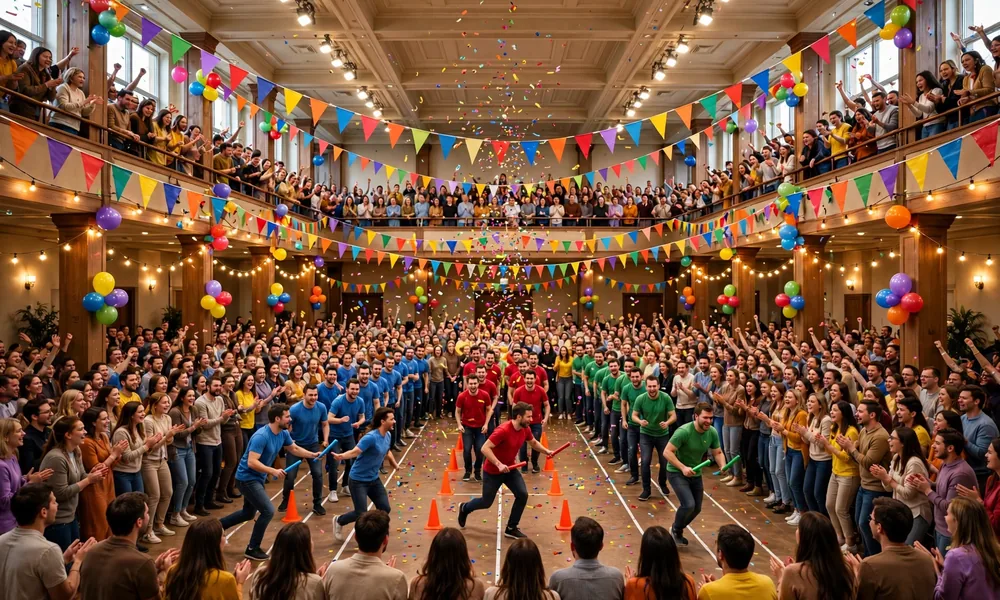
Why 260 Players Changes the Game
Most party games are designed for a living room, not a hall. With 260 players, the two biggest problems are waiting time and audibility. If only a few people play while the rest watch, the audience gets bored within minutes. If the rules are explained quietly to one corner of the room, half the hall never hears them. Successful large-group games solve both problems by making participation simultaneous and instructions simple enough to shout across a room.
Space is the second factor. A group of 260 needs a hall, an auditorium, a large garden, or a sports ground. Games that need a table for every player will not work, but games that use the floor, a stage, or the whole room will. Before choosing any game, measure the space and mark out team zones with tape, cones, or coloured signs so that 260 people can find their place in under two minutes.
Age range matters too. A crowd of 260 often mixes children, teenagers, and adults, especially at school events, family reunions, and community parties. The safest choices are games with no physical risk, no embarrassing dares, and rules a ten-year-old can understand in thirty seconds. When the whole room understands the game instantly, the party runs itself.
How to Organize 260 Players Without Chaos
Organization is what turns a crowd of 260 into a party instead of a stampede. Start by dividing the players into teams before the event begins. Ten teams of 26, or thirteen teams of 20, both work well. Give each team a colour, a name, and a captain, and hand out coloured wristbands or badges at the door so people can find their team without asking.
Appoint one confident host and two or three helpers. The host runs the games from a stage or a raised platform with a microphone, while the helpers manage the scoreboard, hand out props, and keep teams in their zones. A simple points system keeps the competition alive: ten points for a win, five for second place, and one point for every team that finishes. Announce the scores after every round so the energy stays high.
Plan the schedule in blocks. A two-hour party fits four or five games comfortably, with a short break in the middle for food and drinks. Start with a fast icebreaker, move to one or two high-energy physical games, then finish with a calmer quiz or voting game while everyone catches their breath. End with a final showdown round so the party finishes on a high note.
Best Auditorium-Scale Party Games for 260 Players
Auditorium games use the stage, the aisles, and the whole seated crowd at once. They are the easiest large-group games to run because everyone stays in their seat or in their team zone, and the host controls the pace from the front of the room.
Giant Team Trivia Battle
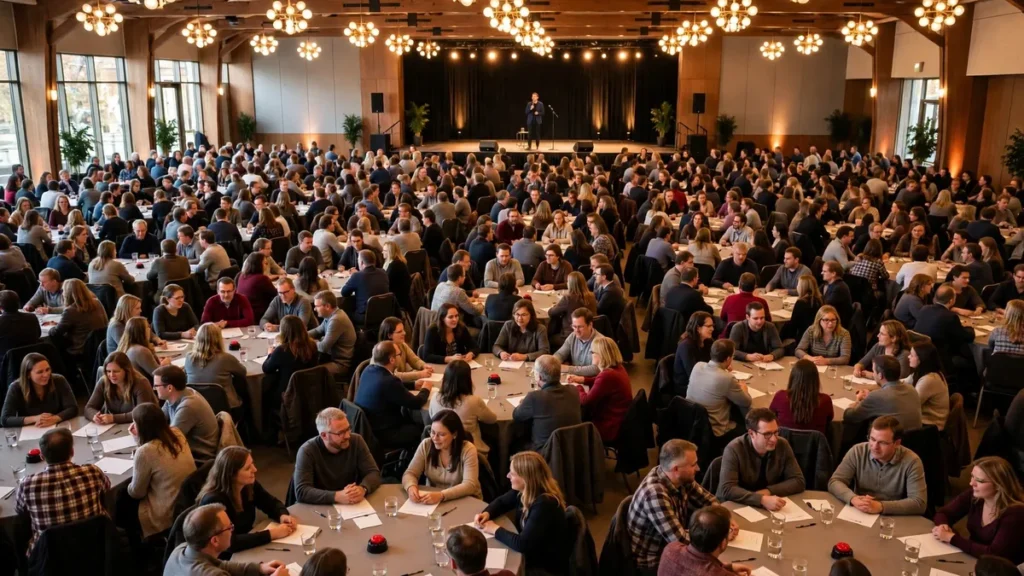
Trivia is the most reliable game for a crowd of 260 because every team plays every question at the same time. The host reads a question, each team writes its answer on a card or a whiteboard, and the cards are collected and scored. Ten rounds of ten questions fill forty minutes easily, and categories can cover music, movies, food, sports, and general knowledge so every team has a strength. Teams of 26 can discuss quietly before answering, which makes the game social as well as competitive. If you want more ideas in this style, the collection of trivia games for 258 players shows how the same format adapts to a nearly identical crowd size.
Crowd Bingo
Crowd bingo works beautifully at scale because 260 unique cards are easy to print and the game needs no turn-taking. Each player gets a card, the host calls numbers or themed clues from the stage, and the first players to complete a line shout for a check. Run three short rounds with small prizes, and the whole hall stays focused on every call. Themed bingo cards with party words, movie titles, or song names are more fun than plain numbers for a celebration.
Musical Statues With a Twist
Musical statues scales well when it is played in waves. Instead of eliminating one person at a time, play the music and ask everyone to dance in their team zone, then freeze when the music stops. Judges walk the floor and award points to the team with the best frozen poses, and the round repeats with a new dance style each time. Nobody is eliminated, so all 260 players stay in the game for every round, and the judges can pick fun categories such as funniest pose, tallest statue, or best team formation.
The Great Scavenger Hunt
A scavenger hunt for 260 players works when the hunt is confined to the venue and the list is built for teams rather than individuals. Each team receives the same list of twenty items to find or photograph within the hall, such as a red shoe, a birthday badge, a team selfie with the host, or a paper plane that flies ten metres. Teams race against the clock, and the first team to complete the list wins. Because the whole team searches together, nobody is left out, and the hunt fills a large space with movement and laughter.
Human Bingo Mixer
Human bingo is an icebreaker and a game in one. Every player receives a bingo grid filled with fun facts such as has travelled abroad, can juggle, owns a pet dog, or has baked a cake this month. Players walk around the hall finding people who match each square and collecting signatures. The first players to complete a row win a prize, and by the end of the round, strangers have talked to dozens of new people. For a crowd of 260, print the grids in team colours and award bonus points to the team with the most completed cards.
Stage Charades Championship
Stage charades turns a classic game into a spectator event. Each team sends one player to the stage to act out a movie, song, or phrase while their team shouts guesses from the audience. Give each team ninety seconds and one point per correct guess, then rotate to the next team. The audience loves watching the acting, the teams love shouting answers, and the host can keep the rounds moving quickly. Prepare the clue cards in advance and sort them by difficulty so every team gets a fair mix.
Team Relay Games That Work for 260 Players
Relay games are perfect for a crowd of 260 because they turn waiting into cheering. While one player from each team runs, the other twenty-five cheer from the sidelines, so the whole hall is involved in every race. Set up parallel lanes so ten or thirteen teams race at the same time, and keep each leg short so the action never slows down.
The balloon relay is a crowd favourite: players race to a marker carrying a balloon between their knees, drop it in a basket, and run back to tag the next teammate. The spoon race is another classic, with players carrying a ball on a spoon to a line and back without dropping it. For indoor parties, a dress-up relay works well, where each runner puts on an oversized hat, scarf, and jacket before racing to the line and passing the costume to the next player.
For a sillier option, try the paper plane relay. Each team folds paper planes, and players take turns flying them through a hoop or onto a target mat. Points go to the team with the most successful landings, and the game needs almost no equipment beyond paper and a marked target. Relay games work best outdoors or in a large hall with a clear runway, and a whistle or a starting horn adds to the excitement.
Crowd Games and Audience Participation
Some of the best games for 260 players ask the entire crowd to play at once, with no teams at all. These games are ideal for the opening or closing of a party because they unite the whole room and need almost no setup.
The wave game is a simple starter: the host divides the hall into sections and each section stands and cheers in turn, creating a wave around the room. Speed it up, reverse it, and add a clap, and the whole hall is laughing within a minute. The stand-up sit-down game is another easy crowd game. The host reads statements such as stand up if you love pizza, and players stand or sit according to their answer, which instantly shows the crowd what they have in common.
Vote-with-your-feet games work well too. The host asks a fun question, such as cats or dogs, and players move to one side of the hall or the other to vote. The host counts the sides, announces the winner, and asks the next question. These games need no props, no teams, and no scoring, yet they fill ten minutes with movement and conversation. Finish with a group dance or a giant conga line around the hall, and the party ends with everyone on their feet.
Large-Group Icebreakers for 260 People
Icebreakers matter most when many of the 260 players do not know each other. A good icebreaker for a huge group is fast, low-pressure, and gives everyone a chance to talk to at least five new people within ten minutes.
Two truths and a lie works in team circles: each team of 20 to 26 splits into smaller circles of six, and players take turns sharing two true facts and one lie while the circle guesses which is the lie. The team with the most correct guesses wins points. Speed introductions are another strong option: players pair up, introduce themselves in sixty seconds, then rotate to a new partner when the host blows a whistle. After five rotations, every player has met five new people.
The name game chain is simple and memorable. Each team stands in a circle, and players introduce themselves with an adjective that starts with the same letter as their name, such as Jumping Javed or Dancing Dana. The next player repeats all the previous names before adding their own, and the team cheers when the chain is completed. Keep the circles small so the chain stays manageable, and award points to the team that finishes first.
Comparison Table: Best Party Games for 260 Players at a Glance
| Game | Players at Once | Space Needed | Time | Best For |
|---|---|---|---|---|
| Giant Team Trivia Battle | All 260 | Auditorium | 40 minutes | Mixed ages |
| Crowd Bingo | All 260 | Seated hall | 20 minutes | Calm fun |
| Musical Statues | All 260 | Open floor | 15 minutes | High energy |
| Great Scavenger Hunt | All 260 | Whole venue | 30 minutes | Teamwork |
| Stage Charades | One team at a time | Stage and seats | 30 minutes | Spectators |
| Balloon Relay | 10 to 13 teams | Hall or field | 20 minutes | Physical fun |
| Vote With Your Feet | All 260 | Open hall | 10 minutes | Icebreaker |
| Human Bingo Mixer | All 260 | Open hall | 20 minutes | Meeting people |
Planning Checklist for a 260-Player Party
Use this checklist in the week before the party so nothing is left to the last minute.
- Book a hall or outdoor space large enough for 260 people plus team zones and game lanes.
- Divide the guest list into 10 to 13 teams, assign colours and captains, and prepare wristbands or badges.
- Choose four or five games from this guide and write a timed schedule with a break in the middle.
- Prepare all props, answer sheets, bingo cards, clue cards, and a visible scoreboard in advance.
- Test the microphone, speakers, and music playlist in the venue before the guests arrive.
- Brief the host and helpers on the rules, the points system, and the prizes for each game.
Frequently Asked Questions
What is the best party game for 260 players?
The best party game for 260 players is a giant team trivia battle, because all 260 players take part at the same time, it needs only a host, a microphone, and answer cards, and it works for mixed ages. Team relays and crowd bingo are close behind because they also keep the whole hall involved without long waits.
How do you split 260 players into teams?
Split 260 players into 10 teams of 26 or 13 teams of 20. Ten teams are easier to manage on a scoreboard, while thirteen smaller teams give each player more turns in relay games. Give every team a colour, a name, and a captain, and hand out coloured wristbands at the door so players can find their team quickly.
How long should a party for 260 players last?
A party for 260 players works best at two to three hours. Two hours fits four or five games with a short break for food and drinks. Three hours allows six games, a longer meal break, and a relaxed closing activity such as a group dance. Longer parties risk losing the crowd, so keep the pace brisk.
What equipment do you need for 260-player party games?
You need a microphone and speakers, a visible scoreboard, printed answer sheets or bingo cards, pens, coloured wristbands, and the props for your chosen games, such as balloons, spoons, balls, and clue cards. Most games on this list need very little equipment, and everything can be prepared a day in advance.
Can children and adults play together in a 260-player party?
Yes, children and adults can play together when the games are chosen well. Trivia with mixed categories, crowd bingo, musical statues, scavenger hunts, and vote-with-your-feet games all work for mixed ages. Avoid games with physical contact or embarrassing dares, and keep the rules simple enough for a ten-year-old to follow.
What if the venue is too small for physical games?
If the venue is too small for physical games, run seated games instead. Giant team trivia, crowd bingo, human bingo, stage charades, and word games all work in a seated hall with no running space. For a similar crowd size, the set of party games for 258 players offers more seated options, and word games for 257 players are a strong choice when the room has tables but no open floor.
The Bottom Line
The Best Party Games for 260 Players are the ones that let everyone play at once, split the crowd into clear teams, and keep the pace fast from start to finish. Giant trivia, crowd bingo, scavenger hunts, relays, and simple crowd games all scale cleanly to a hall of 260, and a confident host with a microphone ties the whole party together. Plan the teams, prepare the props, and keep each game short, and a crowd of 260 will feel like one big party rather than a crowd at all.