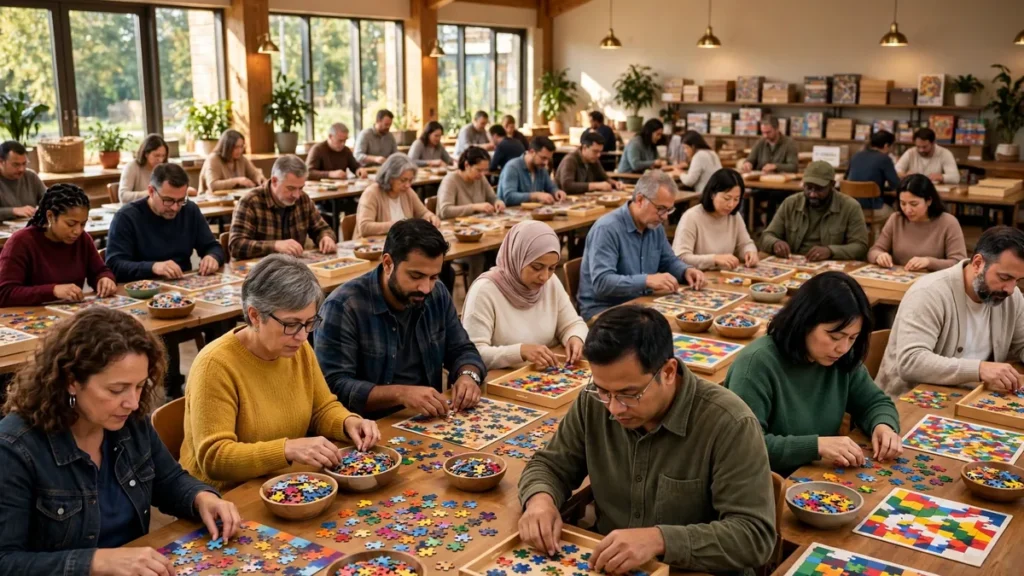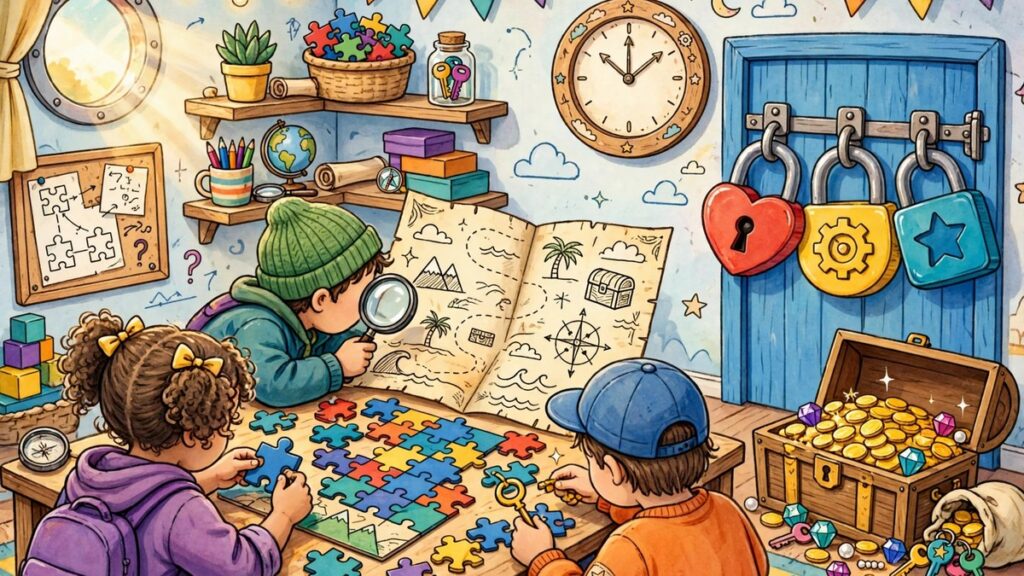
There is a special kind of magic in watching a child crack a code. Their eyes widen, they gasp, they shout for their teammates, and suddenly a locked box springs open to reveal the next clue. That is the joy of escape room games for kids, and in 2027 the options have never been better. From colourful board games that turn a living room into a pirate ship to clever card games that fit in a backpack, today’s escape room games are designed to be fun first and frustrating never, with puzzles that stretch young minds without ever making them feel stuck.
Parents and teachers love these games for a very practical reason: they teach real skills while children are far too busy having fun to notice. An escape room game asks kids to read carefully, spot patterns, work as a team, manage a ticking clock, and keep going when the first idea does not work. Those are the same skills that help in school, in sport, and in friendships, and they arrive wrapped in treasure hunts, space missions, haunted houses, and detective mysteries. The best games balance challenge and encouragement so that every child in the group gets a moment to shine.
This guide rounds up the best escape room games for kids in 2027, tested for age-appropriateness, replay value, setup time, and sheer excitement. Whether you are planning a birthday party, a rainy afternoon, a classroom activity, or a family game night, you will find a game here that fits your child’s age, your budget, and your tolerance for setup. We cover games for ages five and up, games that need no reading at all, games for one player, and games that can keep a whole party of ten busy for an hour.
Key takeaways
- Choose escape room games matched to your child’s age: ages 5–7 need picture clues and no reading, ages 8–10 love code-breaking and teamwork, and ages 11–12 are ready for multi-step logic and timed challenges.
- The best kids’ escape games take under ten minutes to set up, play in 30–60 minutes, and include hints so nobody gets stuck for long.
- Look for games with replay value, such as resettable locks, randomised clue cards, or multiple storylines, so one purchase lasts many play sessions.
- Escape games build reading, maths, pattern-spotting, communication, and resilience, all while children are simply playing together.
- For parties, pick a game that supports at least six players or buy two copies so every child stays involved from the first clue to the final reveal.

What Makes a Great Escape Room Game for Kids?
A great escape room game for kids is not simply a smaller version of an adult game. Adult escape rooms often rely on obscure trivia, tiny print, and puzzles that punish a single wrong guess. Children need the opposite: clear goals, clues they can actually find, and a steady stream of small wins that keep the energy high. The best kids’ games explain the story in one short paragraph, hand out the first clue within a minute, and let players feel clever every few minutes as each lock clicks open.
Age labelling matters more than anything else. A game marked ages 8 and up that secretly needs strong reading skills will frustrate a seven-year-old, while a game aimed at younger children will bore a confident eleven-year-old. Check the recommended age, but also read what the game actually asks players to do. Picture-based puzzles suit pre-readers, word puzzles suit confident readers, and number puzzles suit children who enjoy maths. Many of the games below list a wide age range because an adult can quietly adjust the difficulty by offering hints or removing the timer.
Setup time is the hidden factor that decides whether a game gets played once or twenty times. The best games in this guide need ten minutes or less to prepare, with most of that time spent hiding clue cards around the room. Games with a companion app or a built-in timer are especially handy for parents, because the app handles the countdown, the background music, and the hints, leaving the adult free to enjoy the game instead of running it. If you are buying for a party, look for games that state the player count clearly and pick one that covers your whole group.
Best Escape Room Games for Kids in 2027 at a Glance
| Game | Best Age | Players | Play Time | Best For |
|---|---|---|---|---|
| Escape Room: The Game – Family Edition | 8–12 | 3–5 | 60 minutes | Classic family game night |
| EXIT: The Game – Kids: Riddle of the Museum | 8–11 | 1–4 | 45 minutes | First escape game |
| Unlock! Kids – Detective Stories | 6–10 | 1–6 | 30 minutes | Younger players, no reading needed |
| Escape Room in a Box: The Werewolf Experiment | 10–12 | 2–8 | 60 minutes | Parties and bigger groups |
| ThinkFun Escape the Room: Stargazer’s Manor | 10–12 | 3–8 | 90 minutes | Deep thinkers and detectives |
| Cluebox: Captain Nemo’s Nautilus | 9–12 | 1–2 | 60 minutes | Solo puzzlers and gifts |
| Escape Quest: Kids – Pirate Treasure Hunt | 6–9 | 2–6 | 40 minutes | Birthdays and treasure hunts |
| Break In: Alcatraz Junior | 8–12 | 2–5 | 45 minutes | Card game fans, travel play |
| Escape Room: Mystery at the Stargazer’s Manor Junior | 7–10 | 2–4 | 45 minutes | Story lovers |
| Deckscape: The Mystery of Eldorado | 9–12 | 1–6 | 60 minutes | Portable card escape game |
| Escape the Crate: Space Mission | 7–11 | 2–6 | 50 minutes | Space fans, subscription fun |
| DIY Escape Room Kit: The Lost Toy Shop | 5–9 | 2–10 | 45 minutes | Parties, classrooms, big groups |
1. Escape Room: The Game – Family Edition
If you only buy one escape room game for your family, make it this one. The Family Edition takes the popular adult series and rebuilds it for children, with three complete adventures, a friendly electronic timer, and puzzles that use pictures, patterns, and simple codes rather than obscure knowledge. The timer, called Chrono Decoder, counts down, plays tense music, and accepts four-digit codes, which makes every solved puzzle feel like a real escape room moment.
What sets this game apart is how well it handles mixed ages. Younger children can hunt for hidden symbols and match shapes, while older children tackle the code-breaking and logic chains. The three adventures vary in theme, from a prison break to a nuclear countdown, but all are kept light and silly rather than scary. Setup takes about five minutes, the box holds everything you need, and the puzzles are resettable, so you can lend the game to friends or replay it with a different group. It is the most complete family escape room experience you can buy in 2027.
2. EXIT: The Game – Kids: Riddle of the Museum
The EXIT series is famous for clever, story-driven escape games, and the Kids edition is the perfect first step into the hobby. Players visit a museum after closing time and must solve a series of riddles to find a missing treasure before morning. The game uses a deck of cards, a decoder wheel, and a charming storybook, and every puzzle teaches a different skill, from spotting differences to decoding picture messages.
This is a one-time-play game, because some cards are folded, cut, or written on, but that is part of the charm: children love that their choices genuinely change the game. It plays in about 45 minutes, works beautifully with one or two players, and the difficulty is pitched just right for ages eight to eleven. Parents appreciate the gentle hint system, which offers clues in stages so children can ask for a nudge without being handed the answer. If your child has never played an escape game before, start here.
3. Unlock! Kids – Detective Stories
Unlock! Kids is the rare escape game that needs almost no reading, which makes it ideal for ages six to ten and for mixed-age groups where younger siblings want to join in. The game uses large, colourful cards and a free companion app that plays sounds, tracks time, and delivers hints. Players search scenes for hidden objects, match clues, and solve simple machines, all by pointing, tapping, and talking together.
The app does the heavy lifting, so parents do not need to run the game or read long rulebooks. Each of the three stories takes about thirty minutes, which is perfect for younger attention spans, and the game supports up to six players, so it works well at parties. The puzzles are visual and logical rather than wordy, which means children who struggle with reading can still be the hero of the team. It is cheerful, bright, and wonderfully low-stress, and it is one of the few escape games that genuinely works for a six-year-old.
4. Escape Room in a Box: The Werewolf Experiment
For a birthday party or a big family gathering, Escape Room in a Box is hard to beat. The Werewolf Experiment turns your living room into a mad scientist’s laboratory, complete with combination locks, UV lights, hidden compartments, and a story that has children howling with laughter. It supports up to eight players, so nobody is left watching from the sidelines, and the game comes with everything needed, including locks, keys, and props.
The puzzles are varied and physical: children search the room, decode messages with a black light, and open a series of locked boxes to reach the final cure. The game takes about an hour, and the host can adjust the difficulty by offering hints from the included guide. It is a little more expensive than a card game, but it is also resettable and reusable, which makes it good value for families who host parties. If you want a party game that feels like a real escape room, this is the one to choose.
5. ThinkFun Escape the Room: Stargazer’s Manor
ThinkFun has a long reputation for smart, well-tested puzzle games, and Stargazer’s Manor is its best escape room for older children. Players are trapped in a mysterious astronomer’s house and must solve a chain of puzzles involving star charts, secret compartments, and hidden messages. The game uses a clever envelope system, where each solved puzzle reveals the next part of the story, which keeps the momentum going for the full ninety minutes.
This is the longest and most challenging game on this list, so it suits confident readers aged ten to twelve and families who enjoy a slow, thoughtful puzzle session. The puzzles are genuinely clever, with several “aha” moments that children will remember and retell. It works best with three to five players who like to talk through ideas together, and the story is atmospheric without being frightening. If your child has already played a few escape games and wants a bigger challenge, Stargazer’s Manor is the natural next step.
6. Cluebox: Captain Nemo’s Nautilus
Cluebox is a different kind of escape game: a beautiful wooden puzzle box that must be opened by solving a sequence of sliding panels, hidden compartments, and clever mechanisms. Captain Nemo’s Nautilus is the most kid-friendly version, with a nautical adventure story and puzzles that are tactile and satisfying to solve. There are no cards, no app, and no timer, just a gorgeous box and a child’s curiosity.
It is best for one or two players and makes a wonderful gift, because the box itself is a keepsake that looks lovely on a shelf. The puzzles take about an hour, and the difficulty is moderate, with a QR code that links to hints if players get stuck. Children who love fidget toys, building sets, and hands-on puzzles will adore Cluebox, and because it is fully resettable, it can be passed on to a friend or sibling afterwards. It is quiet, screen-free, and deeply satisfying.
7. Escape Quest: Kids – Pirate Treasure Hunt
Few themes excite children as reliably as pirates, and this treasure hunt game leans into it with maps, gold coins, and a race against a rival crew. Players follow a trail of clues around the house, solving riddles, decoding messages in bottles, and unlocking a treasure chest at the end. The game is designed to be set up in under ten minutes, with printable-style clue cards and a clear host guide that tells the adult exactly where to hide each clue.
It is aimed at ages six to nine, which makes it one of the best choices for younger children and for birthday parties where the guests are still building their reading skills. The puzzles use pictures and simple words, and the game encourages teamwork by giving each child a role, such as map reader, code breaker, or treasure keeper. The final reveal, opening a chest full of small prizes, is a party moment children will talk about for weeks. For a pirate-themed birthday, this game does half the party planning for you.
8. Break In: Alcatraz Junior
Break In is a compact card-based escape game that fits in a small box, which makes it perfect for travel, restaurants, and rainy-day car journeys. Alcatraz Junior sends players on a light-hearted prison break, with a series of puzzle cards that must be solved in order. Each card presents a new challenge, from matching fingerprints to decoding a guard’s schedule, and the game includes a hint system that keeps things moving.
The game plays in about 45 minutes with two to five players, and because it is entirely card-based, there is almost no setup and nothing to lose or break. It is a great choice for families who want an escape game they can take on holiday, and it is also one of the most affordable games on this list. Older children will enjoy the logic puzzles, while younger players can help by spotting patterns and searching the cards for clues. It proves that you do not need a big box or fancy props to create a genuinely exciting escape adventure.
9. Escape Room: Mystery at the Stargazer’s Manor Junior
This junior mystery game is built around story, which makes it ideal for children who love books, drama, and make-believe. Players are junior detectives investigating a strange disappearance at a stargazer’s manor, and each clue reveals a little more of the story. The game uses a mix of cards, maps, and a simple decoder, and the puzzles are woven into the narrative so that solving a puzzle always feels like advancing the plot.
It suits ages seven to ten and plays in about 45 minutes with two to four players. The reading level is gentle, with short sentences and plenty of pictures, and the game includes a host guide that helps an adult keep the story moving. Children who enjoy role-playing will love taking on detective personas and announcing their discoveries to the group. It is a calmer, more story-driven escape game, which makes it a good choice for quieter children or for a cosy evening at home.
10. Deckscape: The Mystery of Eldorado
Deckscape is one of the cleverest ideas in escape gaming: an entire escape room in a deck of cards. The Mystery of Eldorado sends players searching for a lost city of gold, with each card presenting a puzzle, a choice, or a twist. Players must decide which cards to use and when, because some cards can only be played once, which adds a light layer of strategy to the puzzle-solving.
The game supports one to six players and takes about an hour, and it needs no table space beyond a small area for the deck. It is fully portable, affordable, and easy to learn, with a rulebook that fits on a single card. The puzzles are varied, from visual searches to logic chains, and the game includes a scoring system that encourages replaying to beat your previous time. For families who like card games and want an escape experience they can play anywhere, Deckscape is an excellent pick.
11. Escape the Crate: Space Mission
Escape the Crate takes the escape room idea and turns it into a monthly adventure, with each crate containing a complete mission, props, and puzzles. The Space Mission crate is a favourite with children aged seven to eleven, who must repair a spaceship, decode alien messages, and launch a rescue before time runs out. The crate includes hands-on materials, such as buildable models and secret envelopes, which make the game feel more like a real mission than a board game.
Each crate plays in about fifty minutes with two to six players, and the subscription model means a new adventure arrives regularly, which keeps children excited. Parents can also buy single crates without a subscription, which makes it a flexible gift. The puzzles are well-pitched for the age range, with a mix of science, maths, and logic, and the game includes a clear guide for the adult host. If your child loves space, this crate turns an ordinary afternoon into a mission to the stars.
12. DIY Escape Room Kit: The Lost Toy Shop
Sometimes the best escape room is the one you build yourself, and this DIY kit makes that easy. The Lost Toy Shop gives parents a complete set of printable clues, locks, and a step-by-step host guide for turning any room into an escape adventure. The story is simple and charming: the toys in a toy shop have gone missing, and players must find them before the shop opens. The kit is designed for ages five to nine and supports up to ten players, which makes it the best choice on this list for classrooms and large parties.
The kit takes about fifteen minutes to set up, and the difficulty can be adjusted by choosing which puzzles to include. Children love the physical searching, the silly toy characters, and the final reveal, and adults love that the kit is reusable and affordable. It is also a wonderful option for teachers, because the puzzles can be adapted to a lesson theme. If you want a game that can entertain a whole class or a big birthday party, this kit is the most flexible choice available in 2027.
How to Choose the Right Escape Room Game by Age
For ages five to seven, keep it simple, visual, and short. Look for games with picture clues, no reading, and a play time under forty minutes. The DIY kit and Unlock! Kids are the best starting points, because they let younger children succeed quickly and often. Avoid timers at this age unless the timer is gentle, and be ready to play alongside your child as a teammate rather than a host.
For ages eight to ten, children are ready for real code-breaking and teamwork. This is the sweet spot for most of the games on this list, including the Family Edition, EXIT Kids, and the Pirate Treasure Hunt. Children at this age enjoy a ticking clock, a clear goal, and puzzles that make them feel clever. They can also handle a little friendly competition, such as racing another team or trying to beat a previous time. When your child outgrows the easier games, the best escape room games for teens offer the next level of challenge with trickier puzzles and longer adventures.
For ages eleven to twelve, look for games with multi-step logic, longer play times, and stories that feel more grown-up. Stargazer’s Manor, Cluebox, and Deckscape are all excellent choices, and older children may also enjoy teaming up with friends to tackle a game designed for teens. At this age, children often want to run the game themselves, so pick a game with a clear host guide or an app that handles the timing. If your child loves the puzzle side of escape games, the best mind games for teens are a natural next step, and number lovers will enjoy the best Sudoku puzzles for kids as a quieter puzzle challenge between escape adventures.
Tips for Running a Kids’ Escape Room at Home
Set the scene before the game starts. Dim the lights a little, play some adventure music, and give each child a role, such as detective, code breaker, or map reader. A small amount of theatre goes a long way, and it helps children get into character. Hide the clues in advance, test each lock or code yourself, and keep a list of the answers nearby so you can offer hints without breaking the flow.
Use hints generously. The goal is for children to finish the game feeling proud, not to watch them struggle for twenty minutes on one puzzle. A good rule is to offer a hint after three minutes of no progress, and to make hints feel like part of the story, such as a message from a helpful character. If a younger child is struggling, give them a job they can succeed at, such as searching the room or holding the timer. Finally, plan a small reward for the ending, whether it is opening a treasure chest, earning a certificate, or simply enjoying a special snack together. The ending is what children remember.
Your Escape Room Checklist
- Match the game to the youngest player’s reading level, not the oldest player’s age.
- Check the player count and buy a second copy or a bigger game if your party is large.
- Set up the game in advance and test every lock, code, and clue before the children arrive.
- Prepare hints in advance so you can help quickly without breaking the story.
- Give every child a role so nobody is left watching while others solve puzzles.
- Plan a fun ending, such as a treasure chest, a certificate, or a special treat for the whole team.
Frequently Asked Questions
What age is best for escape room games for kids?
Most escape room games for kids are designed for ages six and up, with the best experience starting around age seven or eight. Younger children do best with picture-based games such as Unlock! Kids, while ages eight to ten enjoy code-breaking and teamwork, and ages eleven to twelve are ready for longer, more logical games. Always check the recommended age and reading level on the box before buying.
Are escape room games too scary for kids?
The games on this list are designed for children and are not scary. Themes such as pirates, space, museums, and toy shops are adventurous rather than frightening, and any spooky elements are kept light and silly. If your child is sensitive, avoid games with haunted house or monster themes and choose a cheerful adventure instead.
Can one child play an escape room game alone?
Yes, several games on this list work well solo, especially EXIT Kids, Cluebox, and Deckscape. Solo play is a great way for a child to build confidence and puzzle skills, although most children enjoy escape games even more with a friend or sibling. If your child is playing alone, choose a game marked for one player and be ready to offer hints.
How long does a kids’ escape room game take?
Most kids’ escape room games take between thirty and sixty minutes, with younger children’s games at the shorter end and older children’s games at the longer end. Add ten to fifteen minutes for setup and a few minutes at the end for the reveal and celebration. If you are playing at a party, allow a full hour so nobody feels rushed.
Are escape room games reusable?
It depends on the game. Board games with locks and resettable puzzles, such as the Family Edition and Escape Room in a Box, can be replayed many times. Card games that require folding or cutting, such as EXIT Kids, are one-time plays, although they can often be played once more with a different group if you are careful. Check the product description for replay information before buying.
Do escape room games need a phone or app?
Some do and some do not. Games such as Unlock! Kids use a free app for sounds, timers, and hints, while most board and card games work entirely without a screen. If you prefer a screen-free experience, choose a game that does not require an app, or use the app only for the timer and hints. Both styles can be equally fun.
The Bottom Line
The best escape room games for kids in 2027 turn an ordinary afternoon into an adventure, and they do it while building skills that last far beyond the game. Start with a game matched to your child’s age, set it up in advance, offer hints generously, and plan a fun ending. Whether you choose a big family board game, a portable card game, or a DIY treasure hunt, the real prize is the moment your child cracks the final code and the whole team cheers together.
Note: Prices and availability change often, so check the current details before you buy. Age recommendations are a guide, not a rule: you know your child best, and a game that is slightly easy but joyful is always better than a game that is technically perfect but frustrating. The best escape room game is the one your family actually plays, laughs through, and asks to play again.