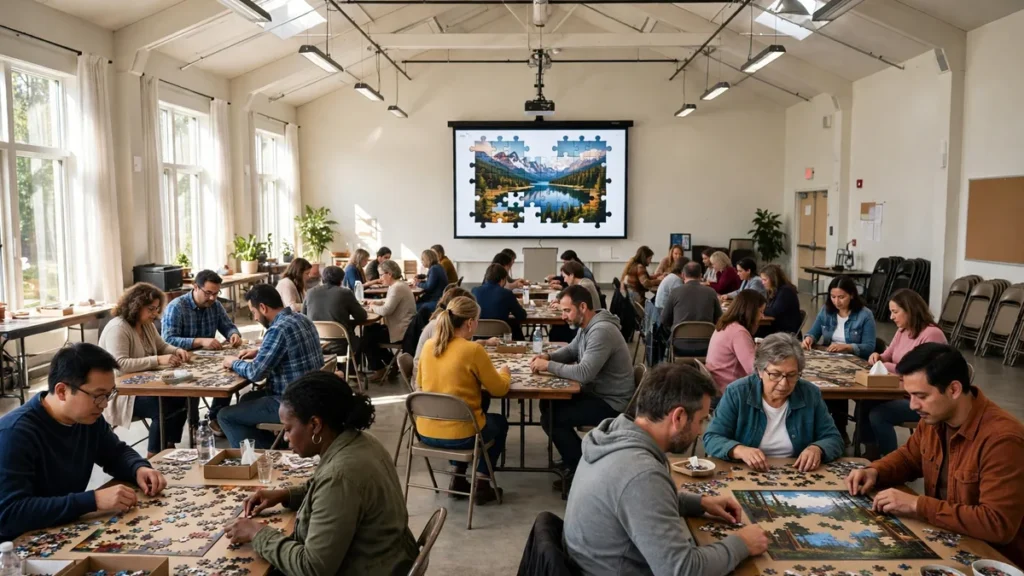
Finding the best trivia games for 132 players starts with an honest fact: no single trivia game seats 132 players around one table, and no board, card set, or buzzer kit is built for a crowd that large. A group of 132 people needs a different kind of plan, one built on teams, tables, and a shared host, rather than a single box that promises to fit everyone at once. The good news is that trivia is one of the easiest large-group activities to scale, because the questions do the work and the format can stretch to fill almost any room.
The strongest approach is to split 132 players into 22 teams of six, or 33 teams of four, and run every team through the same rounds at the same time. One host reads each question once, every team writes down one answer, and a simple score sheet keeps the whole room in the same competition. That structure turns a crowd that would overwhelm most games into a lively event where everyone plays every round, nobody waits for a turn, and the final score feels fair.
This guide covers the formats that work best at this scale, from a classic team quiz and a whole-room buzzer round to music rounds, picture rounds, relay trivia, and a tournament bracket for the top teams. Each option explains what equipment it needs, how long a round takes, and how to keep scoring simple when 132 answer sheets land on the scoring table at once. Use the comparison table to pick a format, then follow the setup checklist to run it without confusion.
Key takeaways
- No single trivia game seats 132 players; team play, multiple tables, and a shared host make the number work.
- Split 132 players into 22 teams of six or 33 teams of four so every player answers every question.
- One host, one set of questions, and one score sheet per team keep scoring fair and simple at this scale.
- Mix question rounds with music, picture, and buzzer rounds to keep energy high across a long evening.
- Use a tournament or relay finish for the top teams so the ending feels exciting instead of rushed.

How Trivia Works for 132 Players
Trivia scales well because it is a parallel game. In a board game, players take turns and a large group spends most of its time waiting. In trivia, all 132 players think at the same time, discuss the question inside their own team, and submit one answer together. The host controls the pace, and the room stays active from the first question to the last.
The maths of the room matters more than the choice of questions. With 22 teams of six, a host needs 22 answer sheets per round, 22 pens, and a clear way to collect sheets without mixing them up. Number each team, print the team number on every sheet, and assign one scorer per five or six teams. That organisation prevents the most common large-group problem: a lost or misread answer sheet.
Sound is the second practical limit. A host reading questions to 132 people needs a microphone and speakers, or at least a raised stage and a quiet room. Projecting each question on a screen helps even more, because teams at the back can read what they missed. If you have no projector, repeat each question twice, slowly, before moving on. The best trivia games for 131 players use the same team-and-host structure, so that guide is a useful companion when you are comparing team sizes and round lengths.
Best Trivia Games for 132 Players
The games below are not single boxes that seat 132 people. They are proven formats that work when they are run as a team event, with one host and many tables. Pick three or four formats for one evening, and keep each round to eight or ten questions so the night moves quickly.
1. Classic Team Pub Quiz
The classic team pub quiz is the most reliable format for 132 players. The host reads six rounds of ten questions, covering general knowledge, history, geography, food, sport, and science. Each team writes its answers on one sheet, swaps sheets with a neighbouring team for marking, and the host reads the answers aloud. Marking by swap keeps scoring honest and fast, and it gives teams a short break between rounds.
This format needs almost no equipment: printed answer sheets, pens, a microphone, and a prepared question set. It works in a hall, a school gym, or a large office space, and it suits mixed ages because each team can divide questions by strength. Keep the questions varied and avoid questions that only one specialist could answer, because a quiz that feels impossible in round one loses the room for the rest of the night.
Allow five minutes of discussion per round of ten questions, plus two minutes for marking. Six rounds take about 45 minutes of play, plus breaks, which fits a two-hour evening. For a shorter event, run four rounds instead of six and add a picture round as a visual change of pace.
2. Whole-Room Buzzer Trivia
Buzzer trivia adds speed and noise to a team quiz, and it works well as a single round inside a longer night rather than as the whole event. Give each table a buzzer, a bell, or a coloured card to raise. The host reads a question, the first team to buzz answers, and a correct answer earns a point while a wrong answer passes the question to the next fastest team. With 22 tables, a physical buzzer for every table is expensive, so a raised card or a phone-based buzzer app is a practical substitute.
The strength of buzzer trivia is energy: the room leans in and a close finish creates a genuine cheer. The weakness is fairness, because a team at the back may hear the question a fraction later and a fast team can dominate. Use buzzer trivia for only ten questions, let a passed question go to the next team, and keep its points smaller than the main written rounds, so speed helps without deciding the whole night.
3. Music Round Trivia
A music round asks teams to name a song, an artist, or a missing lyric after hearing a short clip. It is the easiest round to enjoy without deep general knowledge, and it breaks up a night of spoken questions with something everyone can hear together. Play ten clips of about ten seconds each, and ask for the song title and the artist for one point each, or one point for either answer if you want a gentler round.
Choose clips that span decades so younger and older players both recognise something. Test the sound before the event, because a clip that is too quiet at the back frustrates teams through no fault of their own. If you cannot play audio clearly, replace this round with a lyrics round, where the host reads a famous lyric and teams name the song.
4. Picture Round Trivia
A picture round gives each team a printed sheet of ten images and asks them to identify a person, a place, a landmark, a flag, a film still, or a famous object. Teams can work on it during a break, which makes it a useful filler while scores are being added up. It also suits players who think visually and may struggle with spoken questions, because they can study the images at their own pace.
Print the picture sheet large enough to read at a table, and number each image clearly. Famous landmarks, national flags, classic film scenes, and well-known animals make fair subjects. Avoid obscure images that only an expert would recognise, and avoid images that are too small or too dark to identify. A picture round usually takes ten minutes, including marking.
5. Relay Trivia
Relay trivia turns a written quiz into a moving game. Place a question station at the front of the room, or at several points around the hall. One player from each team walks to the station, reads a question, returns to the table, and the team discusses the answer before sending the next player. The relay continues until every team has answered the same number of questions, and the fastest correct answers earn bonus points.
This format suits a younger crowd, a school event, or a team-building day where movement is welcome. It is less suited to a formal dinner, because 132 people moving around a room can become noisy and crowded. Keep the walking route short, use one question per trip, and stop after eight or ten questions per team. If space is tight, run a table relay instead: pass a question card down each table, with each player answering one question before passing it on.
6. Tournament Trivia for the Top Teams
A tournament finish gives a long quiz a clear ending. After four or five written rounds, take the top four or six teams into a short head-to-head final in front of the whole room. Ask the finalists the same questions, give each team a whiteboard or a large answer card, and reveal answers together after each question. The rest of the room can play along silently, guess the answers, and cheer for a favourite team.
This format rewards the strongest teams without making the other players feel excluded. The final takes only fifteen minutes, the audience stays involved, and the winner is decided in front of everyone rather than by a quiet score sheet. Keep the final questions slightly harder than the earlier rounds, but still fair, and announce the finalists early enough that they can move to the front without confusion.
7. Themed Trivia Night
A themed trivia night builds every round around one subject, such as films, food, travel, animals, or a single decade. A film night might include a picture round, a music round, a quotes round, and a general film knowledge round. The theme makes the questions feel connected, and it helps the host choose questions that suit the audience.
Themed nights suit 132 players well because the theme gives teams a reason to talk before the event. The risk is a theme that is too narrow: a night built entirely around one television show or one sports league will exclude players who do not follow it. Choose a broad theme, or mix one themed round into a general quiz, so every team has a round where it can score well. For a large party setting, the best party games for 131 players show how a themed round can sit inside a wider evening of games.
8. Family and Mixed-Age Trivia
Family trivia for 132 players needs questions that children, parents, and grandparents can all answer. Mix simple questions with harder ones in every round, so a team with younger players can score on the easy questions while the adults chase the harder points. Include rounds on animals, food, cartoons, and school subjects, and avoid questions that depend on adult knowledge such as tax or work.
Seat families together where possible, and let younger players be the team captain for one round. Keep the language simple, read each question twice, and give teams a little extra time on rounds that include children. A night that moves too fast will leave younger players behind, while a steady pace keeps the whole room playing together.
Comparison Table
| Format | Best for | Teams | Equipment needed | Time per round |
|---|---|---|---|---|
| Classic team pub quiz | Any large group | 22 teams of six | Answer sheets, pens, microphone | 10 minutes |
| Whole-room buzzer trivia | Energy and excitement | 22 tables | Buzzers or cards, microphone | 10 minutes |
| Music round trivia | Mixed ages and tastes | 22 teams of six | Speakers, playlist | 10 minutes |
| Picture round trivia | Visual players, breaks | 22 teams of six | Printed picture sheets | 10 minutes |
| Relay trivia | Active, younger groups | 22 teams of six | Question stations, cards | 15 minutes |
| Tournament trivia | A clear, exciting finish | Top four to six teams | Whiteboards, answer cards | 15 minutes |
| Themed trivia night | Parties and celebrations | 22 teams of six | Theme sheets, decorations | 10 minutes |
| Family and mixed-age trivia | Families, all ages | 22 teams of six | Answer sheets, pens | 10 minutes |
How to Set Up Trivia for 132 Players
Arrange 22 tables of six, or 33 tables of four, with a clear view of the host and the screen. Leave wide aisles so scorers can collect sheets quickly. Place the host at the front, on a small stage if possible, with a microphone, a laptop, and a printed copy of every question and answer.
Write six rounds of ten questions, plus five tie-breaker questions in case two teams finish level. Check every answer twice, because a wrong answer in the host script will confuse 22 teams at once. Print one answer sheet per team per round, with the team and round numbers at the top, and prepare a master score sheet with one row per team and one column per round.
On the night, welcome the room, explain the rules in two minutes, and run a practice question so every team understands how to answer. Explain how marking works, how tie-breakers will be decided, and when breaks will happen. A short, clear start prevents most confusion later.
Scoring That Stays Fair
Keep scoring simple. One point per correct answer, with no half points and no complicated bonuses, is the easiest system to run with 22 teams. Add a single bonus point for a perfect round if you want a small reward for a strong team, but do not add bonus points for speed in written rounds, because speed favours teams near the front. In a buzzer round, speed is the point, so keep that round separate and smaller.
Collect answer sheets at the end of each round, mark them by swapping with a neighbouring team, and read the answers aloud while teams mark. Add the scores to the master sheet, and announce the top five teams after every two rounds so the room can follow the competition.
Choosing Questions for a Large Room
Good large-room questions are clear, short, and have one definite answer. Avoid questions with two possible answers, questions that depend on a trick of wording, and questions that take more than ten seconds to read aloud. If the answer could be argued, rewrite the question or replace it.
Mix easy, medium, and hard questions in every round: four easy, four medium, and two hard per round of ten. That balance lets every team score, gives stronger teams a challenge, and keeps the final scores close. Include one fun question per round to keep the mood light. The best word games for 131 players offer a useful contrast here, because word rounds reward quick thinking in a different way from general knowledge rounds.
Checklist for Trivia Games for 132 Players
- Split 132 players into 22 teams of six or 33 teams of four, and number every team clearly.
- Prepare six rounds of ten questions, plus five tie-breaker questions, and check every answer twice.
- Print one answer sheet per team per round, with the team and round numbers at the top.
- Test the microphone, speakers, and screen before the room fills, and keep a printed backup of the questions.
- Assign one scorer per five or six teams and use one master score sheet for the whole night.
- Announce the rules, the marking method, and the break times in the first two minutes.
Frequently Asked Questions
Can one trivia game really seat 132 players?
No. No single trivia game seats 132 players at one table. The number works only as a team event, with 22 teams of six or 33 teams of four, one host, and one set of questions played by every team at the same time.
How many teams should 132 players form?
Twenty-two teams of six is the simplest split, because six people can discuss a question without talking over each other. Thirty-three teams of four also works, and it suits a room with smaller tables, but it means more answer sheets to collect and mark.
How long does trivia for 132 players take?
A full evening takes about two hours: six rounds of ten questions, a halfway break, a picture or music round, and a short tournament final for the top teams. A shorter event can run four rounds in about 75 minutes, including a welcome and a final score announcement.
What equipment do I need for 132 players?
You need a microphone and speakers, printed answer sheets and pens, a master score sheet, and a projector or printed question sheets if you want teams at the back to follow easily. Buzzers, whiteboards, and a playlist are useful extras, but they are not essential for a written team quiz.
How do I keep scoring fair with so many teams?
Use one point per correct answer, mark by swapping sheets with a neighbouring team, and add scores to one master sheet after every round. Announce the top five teams after every two rounds so that the room can follow the competition.
What if two teams tie at the end?
Prepare five tie-breaker questions in advance. Ask the tied teams the same questions, one at a time, and the first team to answer correctly wins. If the tie is for a lower place, share the prize or decide it with a single closest-number question, such as guessing the height of a landmark.
Bottom Line
The best trivia games for 132 players are team formats run by one host, with 22 teams of six sharing the same questions, the same rounds, and the same score sheet. A classic team quiz, a music round, a picture round, and a short tournament final give the night variety without adding confusion, and simple scoring keeps the result fair. Plan the room, print the sheets, test the sound, and let the questions do the work.