
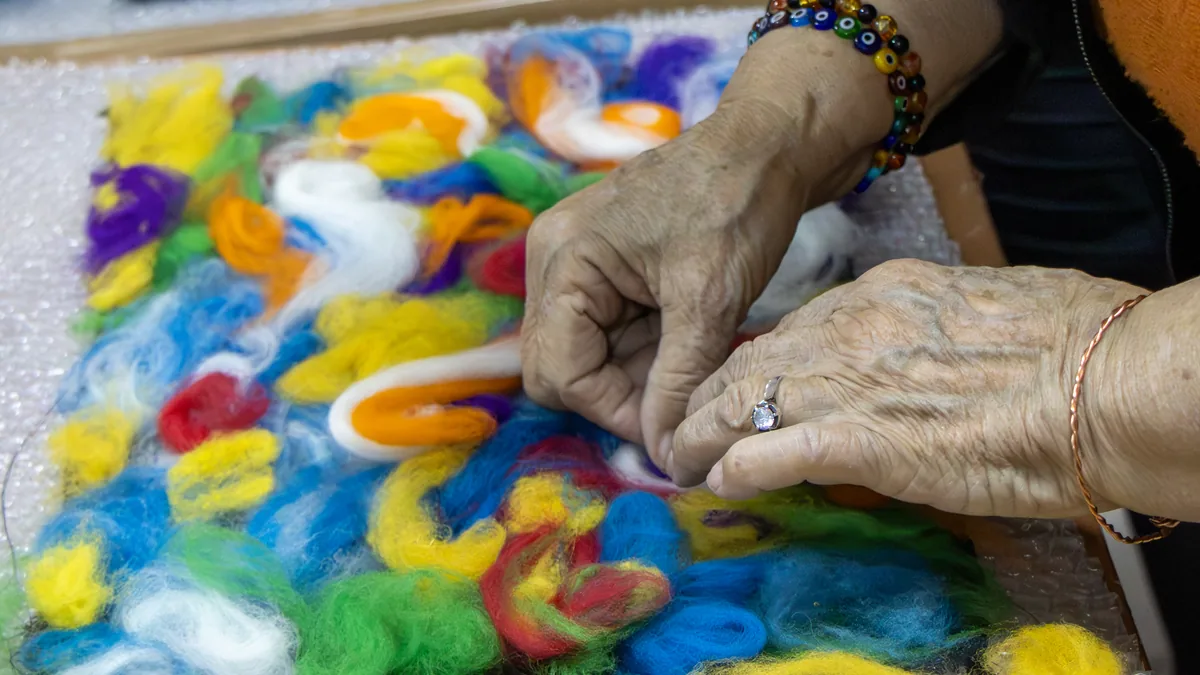
Five hundred and seventy-five players in one felt-maker’s workshop sounds like a crowd that cannot possibly play together, yet the old craft gives us the perfect setting for a huge day. Felt-making is slow, hands-on work done shoulder to shoulder: fibres are arranged in thin layers, dampened with warm water, and rolled again and again until they hold together as one even cloth.
That is exactly how these nine dice games work. Each one takes a small job from the felt-maker’s bench — arranging a layer, rolling a bundle, lifting a finished sheet, dipping fibres in colour — and turns it into a short dice round that a whole hall can play at once. The dice decide the score, the craft decides the job, and the announcer keeps every group moving on the same signal. A team never needs to know the craft to enjoy the game; the rules fit on a single tally slip.
This guide gives you the full day: nine games, a simple plan for 575 players, a checklist, and answers to the questions every organiser asks first. The felt-maker’s workshop does the rest.
Key takeaways
- Nine short dice games carry 575 players through one felt-maker’s workshop day, from arranging the first layer to lifting a finished yurt panel.
- Every game runs in about ten to fifteen minutes, so a hall of 575 players can finish all nine in a single afternoon with time to rest in between.
- Players work in small groups of five, each with its own dice and tally slips, while one announcer keeps every group on the same signal.
- No craft skill is needed: the dice decide the score, and each game explains its workshop job in two or three plain sentences.
- Warm water, wool fibres, and a flat surface are the only craft supplies, and every game reuses the same simple kit.
How 575 Players Fit Into One Day
Five hundred and seventy-five players divide neatly into 115 groups of five. Each group takes one flat surface in the hall, one shallow open box holding three dice, and a small pile of tally slips. The announcer explains one game at a time, every group plays it together, and the announcer calls time with a raised hand.
The day runs in three blocks of three games, with a short rest after each block. A block takes about forty-five minutes, which leaves room for water, a walk around the hall, and a look at the craft corners where helpers show how real felt is made. The apothecary’s workshop in our dice games for 571 players runs on the same idea: short rounds, plain tools, and a clear job for every group, so a huge crowd never stands idle.
Helpers matter more than fancy equipment. Ask one helper for every ten groups, and give each helper a copy of the rules for the current game. Helpers hand out dice, answer questions, and collect tally slips, which keeps the announcer free to run the hall.
The Nine Games at a Glance
| Game | Players in one round | Minutes | You need |
|---|---|---|---|
| Dice Felt Layer | 60 | 12 | Wool fibres, warm water, flat surface |
| Dice Felt Roll | 60 | 12 | Rolled bundles, warm water, flat surface |
| Dice Felt Sheet | 60 | 10 | Pale felt sheets, warm water, flat surface |
| Dice Felt Dye | 60 | 12 | Dyed fibres in red, blue, yellow, and green |
| Dice Felt Hood | 60 | 12 | Felt hoods, warm water, flat surface |
| Dice Felt Mitten | 60 | 10 | Felt mittens, warm water, flat surface |
| Dice Felt Yurt | 60 | 15 | Felt panels, warm water, flat surface |
| Dice Felt Mat | 60 | 10 | Felt mats, warm water, flat surface |
| Dice Felt Soap | 60 | 12 | Warm water, soap, felt offcuts |
The numbers in the table describe one round with sixty players at a time in the craft corners, while the other groups play the same game at their own surfaces with dice alone. Every group plays every game, and the table shows the busiest version of each round so organisers can plan helpers and supplies.
Nine Dice Games from the Felt-Maker’s Workshop
Each game below follows the same pattern: a short description of the workshop job, the dice rules in plain language, and a note on how the score is worked out. Read the job aloud first, so players picture the craft, then read the rules. The brush-maker’s workshop in our dice games for 570 players shows the same pattern at work: a craft bench, a handful of dice, and a job that any newcomer can learn in a minute.
1. Dice Felt Layer
Felt begins with layers. A maker arranges thin wisps of wool fibre across a flat surface, first in one direction and then across it, until the layer is even all over. A thin patch lets water through and leaves a weak place in the finished cloth, while a thick patch wastes good fibre. The whole craft depends on this patient, even arranging, and this game turns it into a dice challenge.
Each group rolls three dice and adds the total. A total of nine, ten, or eleven means the layer is even, and the group scores the total. A total below nine means a thin patch, and the group scores only half the total, rounded down. A total above eleven means a thick patch, and the group scores the total minus three. The announcer reads the three bands aloud before the first roll, so nobody has to remember them.
2. Dice Felt Roll
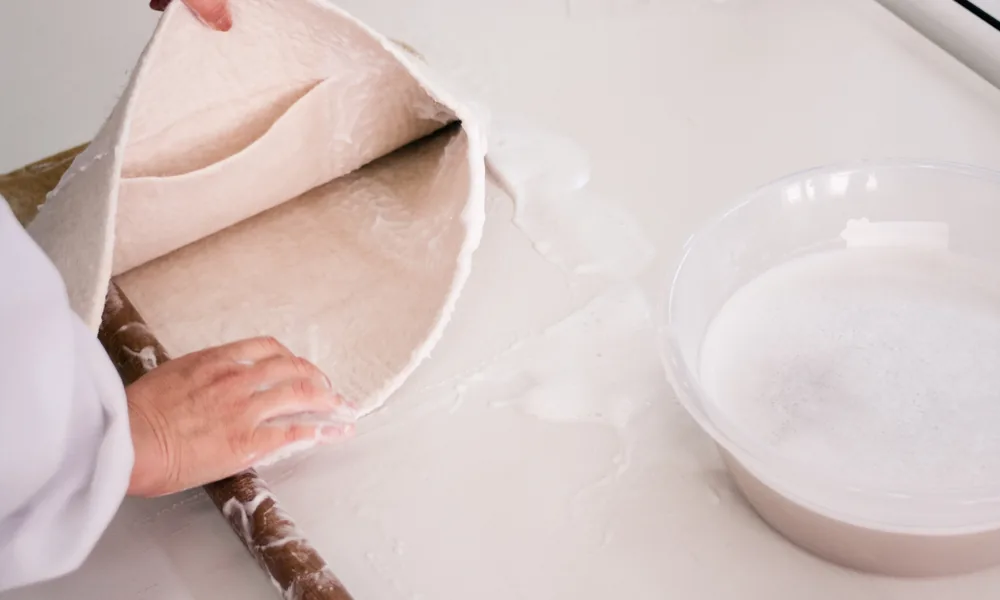
Once a layer is dampened with warm water, the maker rolls it into a firm bundle and rolls the bundle back and forth with both hands. The rolling is what locks the fibres together: too little rolling and the cloth falls apart, too much rolling and it shrinks into a hard, small piece. The movement of the work is steady and unhurried, and the dice in this game reward that same steady movement.
Each group rolls two dice, one after the other. If the two dice show the same number, the bundle is rolled just right, and the group scores ten plus the number shown. If the two dice are one apart, the bundle is nearly right, and the group scores the sum of the two dice. If the two dice are further apart, the bundle is uneven, and the group scores only the lower of the two dice. Three rounds are played, and the scores are added together.
3. Dice Felt Sheet
A finished sheet of felt is a satisfying thing to lift. It comes off the work surface in one piece, pale and even, light in the hand yet strong enough to hold its form. The maker lifts a corner first and peels the sheet away slowly, watching for any place where the fibres have stuck to the surface below. A clean lift means the sheet is ready for dyeing or shaping into something useful.
Each group rolls one die four times and writes down the four numbers in the order they appear. The group scores one for each number that is higher than the number before it, because a rising run is like a clean, steady lift. A group also scores five extra if all four numbers are different, since a sheet with no repeats in the lift is a rare and welcome sight. The highest possible score in a round is eight.
4. Dice Felt Dye
Undyed felt is a pale, creamy white, and the dye bath is where it gains its colour. The maker dips the fibres or the finished sheet into warm, coloured water and watches the shade deepen minute by minute. Red, blue, yellow, and green are the colours of this workshop, and each one needs a different length of time in the bath. Pull the felt out too soon and the colour looks washed out; leave it too long and the shade turns dark and heavy.
Each group rolls three dice and looks for colour groups in the result. Three dice showing the same number mean a deep, even dye, and the group scores fifteen. Two dice showing the same number mean a good, solid shade, and the group scores ten. Three different numbers mean a pale, patchy dye, and the group scores only the highest single die. Play three rounds and add the scores together.
5. Dice Felt Hood
A felt hood is a practical piece of clothing: warm when the temperature drops, light on the head, and shaped to keep out the cold. The maker forms the felt over a rounded wooden form, working the damp fibres down over the curve until the hood holds its form on its own. The work needs a gentle touch, because a firm squeeze leaves a dent that shows in the finished hood, while a touch too light leaves the top loose and floppy.
Each group rolls two dice and adds them together. A total of seven means the hood fits just right, and the group scores twelve. A total of six or eight means a good fit with a little room, and the group scores eight. Any other total means the hood needs more work, and the group scores the lower of the two dice. Play three rounds and add the scores together.
6. Dice Felt Mitten
Mittens are the felt-maker’s friendliest product. They need no fingers, no fiddly joins, and no exact sizing: a warm, roomy mitten fits almost any hand, and two can be made in an afternoon. Children love them because they are soft and forgiving, and adults love them because they keep hands warm on the coldest mornings. The workshop always has a pile of mittens in bright colours near the door.
Each group rolls one die five times and counts how many times the die shows an even number. Each even number is a warm mitten for the pile, and the group scores two for every even number shown. If all five rolls are even, the group scores five extra for a full pile of warm mittens. The highest possible score in a round is fifteen, and most groups land somewhere in the middle.
7. Dice Felt Yurt
The yurt is the felt-maker’s grandest product: a round home whose walls and roof are made from great panels of felt, warm in winter and cool in summer. A single yurt needs many panels, each one made by hand, and the panels must be even in thickness so the home keeps out the cold. Families who live in yurts know the maker’s name and pass the panels down from one generation to the next.
Each group rolls three dice and adds the total, then compares the total with the number twelve. A total of exactly twelve means a perfect panel, and the group scores fifteen. A total within two of twelve means a strong panel, and the group scores ten. A total further away means a thin panel, and the group scores only the smallest single die shown. Play three rounds and add the scores together.
8. Dice Felt Mat
A felt mat is the workshop’s everyday hero. It sits by the door or beside a bed, and it takes years of footsteps without wearing through. Mats are often the first thing a learner makes, because the job is simple: arrange the fibres, dampen them, roll them, and lift a flat, even piece. A good mat lies flat from the first day and never curls at the edges.
Each group rolls two dice and multiplies the two numbers together. A result of twelve means a mat that lies perfectly flat, and the group scores twelve. A result between six and twenty means a good, usable mat, and the group scores the result itself. A result below six or above twenty means a mat that curls at the edges, and the group scores only the smaller of the two dice. Play three rounds and add the scores together.
9. Dice Felt Soap
Soap and warm water are the felt-maker’s quiet helpers. A little soap in the water helps the fibres slide against each other and lock together, and the maker’s hands stay slippery and smooth through hours of rolling. Too much soap leaves a slippery layer on the felt that must be rinsed away, while too little soap makes the work slow and tiring. The right amount is learned by feel, not by counting spoonfuls.
Each group rolls one die six times and adds up the six numbers. A total between eighteen and twenty-four means the soap is just right, and the group scores the total. A total below eighteen means too little soap, and the group scores half the total, rounded down. A total above twenty-four means too much soap, and the group scores the total minus six. Play two rounds and add the scores together.
Checklist for the Day
- Dice and boxes: three dice in a shallow open box for every group of five, plus a few extra dice in case any roll under a surface and vanish.
- Tally slips: one slip per group per game, with the game name and the scoring bands written at the top so nobody has to remember them.
- Helpers: one helper for every ten groups, each holding a copy of the rules for the current game and a pile of extra tally slips.
- Craft corners: warm water, wool fibres, dyed bundles, felt sheets, hoods, mittens, mats, and a large felt panel, each at its own corner with a helper to explain it.
- A clear signal: the announcer uses a raised hand to start and finish each round, and every helper watches for that hand so the whole hall moves together.
- Time to rest: a short rest after each block of three games, with water available and room to walk around the hall before the next block begins.
Frequently Asked Questions
How long does the full day take?
Three blocks of three games take about two hours and fifteen minutes of play, with a short rest after each block and a longer rest in the middle of the day. Most halls finish in about three hours from the first announcement to the final tally, including the time players spend at the craft corners.
What if a team has never played a dice game before?
Nothing in these games needs earlier dice experience. The scoring bands are printed at the top of every tally slip, the helper at each group explains the current game in under a minute, and the first round of the day is played as a practice round with no score.
How do we keep 575 players moving without long waits?
Every group plays at the same time on the same signal, so nobody queues for a turn. The announcer explains one game, every group plays it, and the announcer ends the round with a raised hand. Helpers collect tally slips while the next game is being explained, and groups that finish early get a practice roll with no score.
What happens if two teams finish level?
Add up each team’s nine game scores for the day’s total. If two teams are level, compare their best single-game score: the team with the higher best game takes the higher place. If the teams are level on every game, they share the honour, and both names are read out together at the final tally.
Can children join in?
Yes, and they often enjoy the craft corners most of all. Mix ages inside each group of five so younger players have an older player beside them to help with the adding, and let the helper at the group read the scoring bands aloud. The dice games themselves use only adding and comparing, so a child who can add small numbers can play every game.
What do we need to bring?
Bring three dice per group in shallow open boxes, a pile of tally slips, and a loud, friendly announcer. For the craft corners, bring warm water, wool fibres in plain and dyed colours, a few felt sheets, hoods, mittens, and mats, plus one large felt panel and a cloth for damp hands.
The Bottom Line
A felt-maker’s workshop is a natural home for 575 players, because the craft itself is done side by side, in layers, with simple tools and visible results. These nine games follow the craft from the first layer to the finished yurt panel, and the dice keep every group honest, busy, and laughing together. The pottery workshop in our dice games for 567 players follows the same idea in clay, and it is a good next day out for any hall that enjoyed this one.
575 players will leave with damp hands, bright memories, and a new respect for the patient work that turns loose wool into felt.


