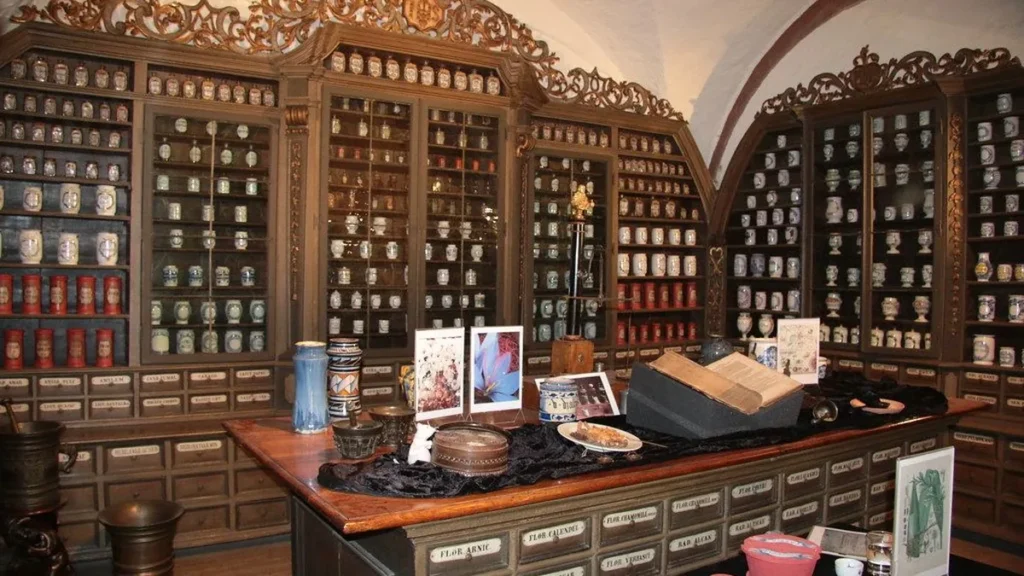
Five hundred and seventy-one players sounds like a crowd no single game could hold, yet the old apothecary’s workshop holds them all without a squeeze. Nine games run side by side in nine corners of the workshop, each one built around a different piece of the apothecary’s trade, and every player has dice in hand from the first minute. Nobody waits on the edge of the room. Nobody watches while others play.
The plan is simple. Players divide into nine groups, one for each game, and each group works its own corner while a single caller keeps the whole workshop moving. A round lasts about ten minutes, the caller gives the word, and every corner rolls at once, so the room fills with the rattle of dice and the murmur of tally keepers adding up points. When a round ends, groups stay where they are and a fresh round begins.
The beekeeper’s yard in our dice games for 531 players shows the same idea in a different setting, with nine groups sharing one open day, and the apothecary’s workshop follows that pattern. The games below need nothing fancy: a dozen dice per corner, a stack of tally sheets, and a few plain props from the worktop. What they give back is a full day of play in which 571 people all take part.
Key takeaways
- Nine short games carry 571 players: each game runs its own corner of the workshop.
- Eight corners hold 63 players and one corner holds 67, which adds up to 571 exactly.
- Every game uses ordinary dice and plain props, so nothing rare has to be found or bought.
- Rounds last about ten minutes, and a single caller keeps all nine corners in step.
- All nine games are pretend play: no real remedy changes hands at any point in the day.

How 571 Players Fit Into One Day
Divide 571 players into nine groups and the numbers fall into place at once. Eight groups hold 63 players each, which comes to 504, and the ninth group holds 67, which brings the total to 571 exactly. Each group takes one corner of the workshop and plays one game, so no corner feels crowded and no player stands idle. The caller walks the room, gives the word for each round, and every corner rolls together.
Each round lasts about ten minutes. The caller gives the word, every corner rolls its dice, and the tally keepers write down the points while the next round is arranged. A game needs four or five rounds to find its best player, which means each corner finishes in about an hour, and the whole day, with a gap in the middle, fits comfortably into an afternoon. Groups can also swap corners halfway through, so every player tries two games.
Supplies stay plain. Each corner needs about a dozen dice, a stack of tally sheets, and the small props named in its game, all of which come from ordinary household things. One person in each corner acts as tally keeper, writing down points and reading out the best total at the end of each round, while the caller keeps the nine corners in step.
The Nine Apothecary Games
The chandler’s workshop in our dice games for 546 players shows how a craft room gives each game its own flavour, and the apothecary’s workshop does the same. Each game below takes one piece of the apothecary’s trade, a small container, a curved vessel, a weight, a paste, and turns it into a short dice contest that a large group can play together.
Dice Apothecary Vial
The vial is the small container in which the apothecary keeps a single dose, and this game fills five of them before the round ends. Each player has five empty vials in a row, numbered two, three, four, five, and six, and rolls two dice on each go. When the two dice add up to one of the numbers on an empty vial, that vial is filled and put aside. A player who fills all five vials earns twenty points, and the round ends when the first player finishes or when every player has rolled six times.
Each player takes up to six rolls in a round, and the tally keeper adds five points for every vial filled, with a bonus of ten points for a player who fills all five. A roll that matches a vial already filled earns nothing, so players watch the numbers they still need and groan when the dice give them one they have already used. The game rewards patience more than luck, because a player who keeps a cool head and waits for the right numbers often beats a player who rushes.
Dice Apothecary Alembic
The alembic is the curved vessel in which vapour rises, cools, and falls again as liquid, and this game follows that slow journey along a winding path. Each player has a path of twelve steps drawn on a tally sheet, and rolls three dice on each go. Only the highest of the three dice counts, and the player moves forward by that many steps. The first player to reach the twelfth step earns twenty points, and every other player earns one point for each step travelled.
Each player rolls three times in a round, and the tally keeper adds the steps together to find how far each player travelled. A roll of three sixes is a rare delight, carrying a player nine steps in a single go, while a roll of three ones leaves a player standing still. The game suits players who enjoy a slow contest, because the lead changes hands often and nobody is ever far behind.
Dice Apothecary Retort
The retort is the round vessel that sits over gentle heat while its contents bubble and change, and this game asks players to keep their nerve while the heat rises. Each player rolls one die on each go, and adds the result to a running total. The aim is to reach a total of twenty without going over it, and a player who goes over the limit loses all the points from that round and starts again at zero. A player who lands exactly on twenty earns fifteen points at once.
Each player takes up to five rolls in a round, and may hold at any point and keep the points earned so far, which is where the judgement lies. A player sitting on seventeen must decide whether to risk one more roll for the exact twenty, knowing that a roll of four or more wipes the round away. The tally keeper writes down each total as it grows, and the room grows quiet as the totals near twenty and every roll matters.
Dice Apothecary Dram
The dram is the small weight the apothecary uses when an amount must be exact, and this game is a contest of exactness. Each player rolls four dice on each go and adds the four numbers together, aiming for a total of fourteen. A player who lands exactly on fourteen earns ten points, while a player who lands on thirteen or fifteen earns two points, and any other total earns nothing. The narrow target makes every roll feel close, because so many totals fall just one away.
Each player rolls four times in a round, and the tally keeper adds the points together to find the best total. A player who hits fourteen twice in one round earns a bonus of ten points on top of the twenty already earned, which often decides the round. The game suits players with a steady eye for numbers, because the winners are usually the ones who remember which totals are still possible.
Dice Apothecary Bolus
The bolus is the large pill the apothecary shapes by hand, rolling a soft mass between the palms until it holds its form, and this game shapes one bolus for every matching throw. Each player rolls five dice on each go, and every time two or more of the dice show the same number, that counts as one bolus shaped. A throw with two matching dice shapes one bolus, a throw with three matching dice shapes two, and a throw with all five matching shapes four, which is the finest result in the game.
Each player rolls five times in a round, and the tally keeper adds up the boluses shaped, giving three points for each one. A player who shapes twelve boluses across five throws earns a bonus of ten points, and the round usually comes down to the final throw, when one more matching throw can lift a player past the leader. The game is noisy and cheerful, because every matching throw draws gasps from the corner.

Dice Apothecary Tincture
The tincture is the liquid in which simples are left to steep until their goodness passes into it, and this game is a slow steep that must not go too far. Each player rolls two dice on each go and adds the result to a steeping total, aiming to reach thirty without going over it. A player who lands exactly on thirty earns twenty points, while a player who goes over the limit must pour the whole total away and start again at zero, which makes the final few rolls the tensest of the day.
Each player takes up to six rolls in a round, and may hold at any point and keep the points earned so far, with one point for every whole number in the steeping total when the player holds. A player who holds on twenty-eight earns twenty-eight points, which is often enough to win the round without ever reaching thirty, so the wise player knows when to hold and when to risk one more roll. The tally keeper writes down each total as it grows, and the corner falls silent as the totals climb into the late twenties.
Dice Apothecary Electuary
The electuary is the thick paste the apothecary mixes from simples and a sticky base, and this game gathers its six parts one roll at a time. Each player rolls three dice on each go, and every six that appears adds one part to the paste. A player needs six parts to finish one electuary, and each finished electuary earns fifteen points, while a player who finishes two in a single round earns a bonus of ten points on top.
Each player rolls six times in a round, and the tally keeper adds up the parts and the finished electuaries to find the best total. A throw of three sixes at once finishes half an electuary in a single go, which draws gasps from the whole corner, while a run of throws with no sixes leaves a player with a half-finished paste and nothing to show for it. The game rewards a calm temper, because the dice give sixes in bursts and the player who keeps rolling steadily usually ends the round ahead.
Dice Apothecary Salve
The salve is the soft ointment the apothecary spreads in a shallow dish, and this game fills one dish after another with careful portions. Each player rolls three dice on each go, and the middle value of the three decides how many portions go into the dish, so a throw of two, four, and six adds four portions. The first player to reach ten portions fills the dish and earns fifteen points, and then a fresh dish is started.
Each player rolls four times in a round, and the tally keeper adds the portions together, giving one point for each portion and a bonus of five points for every dish filled. A throw of three matching dice counts double, so a throw of three fours adds eight portions at once, which can fill a dish in a single go. The game suits players who like a quiet contest of addition, because the winner is usually the one who adds the middle values fastest.
Dice Apothecary Poultice
The poultice is the warm compress the apothecary lays over a sore place, and this game asks players to tell a ready poultice from one that needs more warmth. Each player rolls four dice on each go and adds the four numbers together. When the total is an even number, the poultice is ready and earns five points, and when the total is an odd number, the poultice needs another go and earns nothing. Three ready poultices in a row earn a bonus of ten points.
Each player rolls five times in a round, and the tally keeper adds up the points from the ready poultices to find the best total. The even and odd totals fall almost evenly across a round, so the lead changes hands often and the game stays open until the final throw. Players soon learn to say the total aloud before the tally keeper does, and the corner rings with even and odd as the dice settle.
The Nine Games at a Glance
The summary below gathers the nine games in one place, so a caller can see at a glance how many players each corner holds, how many dice each player needs, how many minutes a round runs, and what each game rewards.
| Game | Players in a corner | Dice | Minutes | What it rewards |
|---|---|---|---|---|
| Dice Apothecary Vial | 63 | 2 | 10 | Patience and exact totals |
| Dice Apothecary Alembic | 63 | 3 | 10 | Steady progress along a path |
| Dice Apothecary Retort | 63 | 1 | 8 | Nerve under rising heat |
| Dice Apothecary Dram | 63 | 4 | 10 | Exactness and a good eye |
| Dice Apothecary Bolus | 63 | 5 | 12 | Matching throws and quick hands |
| Dice Apothecary Tincture | 63 | 2 | 12 | Knowing when to hold |
| Dice Apothecary Electuary | 63 | 3 | 10 | A calm temper and steady rolling |
| Dice Apothecary Salve | 63 | 3 | 10 | Quick addition of middle values |
| Dice Apothecary Poultice | 67 | 4 | 10 | Even totals and a loud voice |
Your Checklist for the Day
The greenhouse in our dice games for 516 players runs on the same plain supplies, and the apothecary’s workshop asks for no more. Work through the points below before the players arrive, and the day will run itself.
- Bring enough dice. Nine corners need about a dozen dice each, so gather at least 108 dice and keep a few spare in the middle of the room.
- Arrange nine corners. Give each game its own corner with room for its players, and put the tally keeper where the whole corner can hear.
- Choose a tally keeper for each corner. One person per corner writes down the points and reads out the best total at the end of each round.
- Bring tally sheets for each corner. Plain sheets and a pen per corner are enough, with a fresh sheet for each game.
- Keep it pretend. No real remedy changes hands at any point in the day, and every prop is a plain household thing standing in for the apothecary’s wares.
- Plan a ten-minute gap halfway through. A short gap in the middle lets the tally keepers add up the first half and lets players swap corners for the second half.
Frequently Asked Questions
Can 571 people really play at once?
Yes, because the crowd divides into nine corners of about sixty-three players, and each corner plays its own game at the same time. Nobody waits, because every player rolls on every go, and the caller keeps all nine corners moving together.
How long does the whole day last?
About five hours from the first roll to the final tally, with a ten-minute gap in the middle. Each game needs four or five rounds of about ten minutes, and the corners run side by side.
What do we need to buy?
Almost nothing. Each corner needs about a dozen dice and a stack of tally sheets, and the props are plain household things. If the group already owns dice, the whole day costs no more than the tally sheets.
Do players need to know anything about apothecaries?
No. Each game explains its piece of the trade in a sentence or two before the first roll, and the rules use only dice and addition. Players who have never heard of an alembic or a bolus learn the games as fast as anyone else.
How do we keep the tally honest?
One tally keeper per corner writes down every point where the whole corner can see it, and the caller reads out the best totals at the end of each round. Any player may ask to see the sheet, and the open tally keeps every corner honest.
What happens on a tied total?
Tied players share the honours for that round and each keep their points, and if the tie is for the best total of the day, the tied players roll one die each until a single winner appears. The decider takes a minute at most and usually draws the most noise of the day.
The Bottom Line
Nine games, nine corners, and 571 players all rolling at once: the old apothecary’s workshop turns a crowd that sounds impossible into a day that runs itself. Bring the dice, arrange the corners, choose the tally keepers, and let the caller give the word. All that is left is the rattle of dice and the murmur of nine corners at play.


